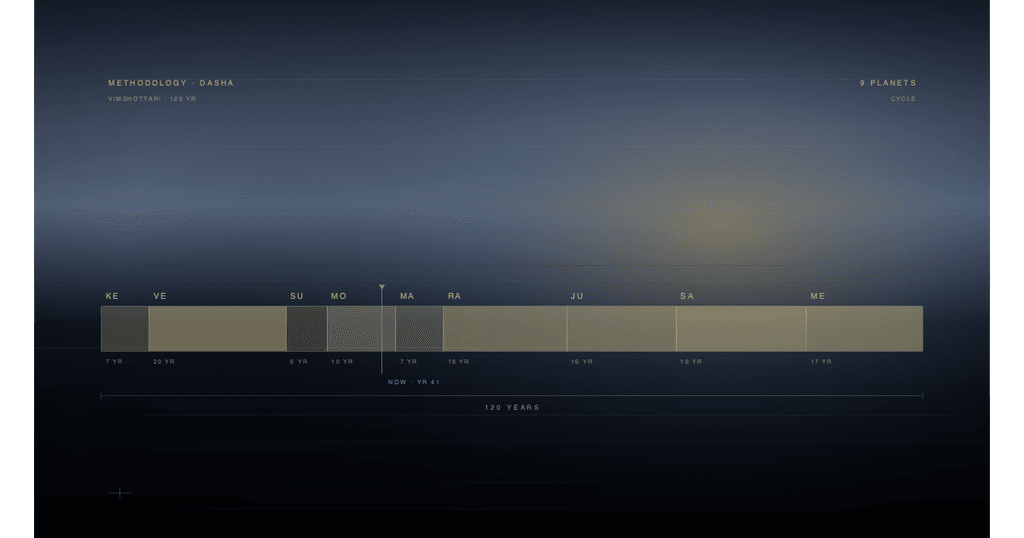
Jaimini Chara dasha explained.
Jaimini Chara dasha is a sign-based dasha system from the Jaimini tradition. It runs alongside Vimshottari as a parallel timing engine. This piece explains how it works, where it comes from, why the two systems are read together and what each one is best at.
Where Jaimini comes from
Jaimini astrology is named after the sage Jaimini, the reputed author of the Jaimini Sutras (also called the Upadesha Sutras), one of the foundational texts of Vedic astrology. The Jaimini system is older than Vimshottari in some scholarly readings and parallel to it in others; what is not in dispute is that the two systems are independent, read different layers of the chart and have been used together in classical practice for centuries.
The Jaimini tradition is sign-based throughout. Where Parashara astrology (the source of Vimshottari) uses the natal Moon nakshatra to fix the dasha and the planetary aspects (drishti) to read transits, Jaimini uses the natal lagna and sign-based aspects (rashi drishti) and a different set of significators called the Karakas. Jaimini Chara dasha is the most widely studied of several Jaimini dasha schemes (others include Sthira, Niryana Shoola, Trikona, Padakrama, Brahma and Drig dasha; Chara is the default).
The system is studied most heavily in southern India, particularly Andhra Pradesh and Karnataka, where the Jaimini tradition has a longer continuous lineage than in some northern schools. Modern English-language sources (including K N Rao's writings and the standard contemporary Jaimini Sutras commentaries) have brought the system to a wider readership over the last three decades.
The core difference: nakshatra vs sign
Vimshottari (the system explained in the mahadasha cluster) is anchored on the natal Moon nakshatra. The Moon's position in one of the 27 lunar mansions at birth determines which planetary mahadasha is running and exactly how much of it is left. The system runs through nine planets in a fixed sequence (Sun, Moon, Mars, Rahu, Jupiter, Saturn, Mercury, Ketu, Venus) for fixed durations (6, 10, 7, 18, 16, 19, 17, 7, 20 years respectively, summing to 120 years).
Chara dasha is anchored on the natal lagna sign. The active dasha runs through the twelve signs in order, starting from the lagna (in some variants from the strongest of lagna or seventh house, depending on whether the lagna is odd or even). Each sign holds the active dasha for a number of years determined by the position of that sign's lord. The full cycle covers all twelve signs and produces a total close to 144 years for most charts.
| Feature | Vimshottari | Jaimini Chara |
|---|---|---|
| Anchor | Natal Moon nakshatra | Natal lagna sign |
| Unit | Planet (9 planets) | Sign (12 signs) |
| Sequence | Fixed: Su-Mo-Ma-Ra-Ju-Sa-Me-Ke-Ve | Sign order from lagna (forward or reverse depending on lagna parity) |
| Period length | Fixed (6 to 20 years per planet) | Variable (1 to 12 years per sign) |
| Total cycle | 120 years | Approximately 144 years |
| Significators | Planet's natural significations | Karakas (degree-derived) and house significations |
| Best at predicting | Planet-driven events (authority, action, expansion) | Sign and house themes (marriage, foreign settlement, career change) |
How Chara dasha period length is computed
The period-length rule is the technical core of Chara dasha. For each sign, count from that sign to the position of its lord. If the sign is odd-numbered (Aries, Gemini, Leo, Libra, Sagittarius, Aquarius), count forward; if even-numbered, count reverse. Subtract 1 if the count includes the starting sign. The result is the period length in years.
Worked example. Suppose the lagna is Aries. Mars is in Capricorn at birth. Aries is odd, so the count is forward from Aries to Capricorn: Aries (1), Taurus (2), Gemini (3), Cancer (4), Leo (5), Virgo (6), Libra (7), Scorpio (8), Sagittarius (9), Capricorn (10). The count is 10. Subtract 1 for the starting sign. Aries holds the Chara dasha for 9 years.
The rule produces a unique total per chart depending on where each sign's lord sits. The conventional total is 144 years, but actual chart-specific totals vary by a few years above or below. Sub-periods (antardashas) within each sign are computed using the same rule but counting from each sub-sign.
The mechanical computation is what makes Chara dasha programmable. Most modern Vedic software (including the engines underlying Tempora's research stack) compute it directly from the natal chart with no manual table lookup, the way Vimshottari is computed from the Moon nakshatra.
The Karakas: significators by degree
The Karakas are the second pillar of the Jaimini system. They are the seven classical planets ranked by their longitudinal degree position in their respective signs at birth. The planet with the highest degrees (regardless of which sign it is in) becomes the Atmakaraka. The second-highest becomes the Amatyakaraka. The sequence runs through seven Karakas total (some readings include eight, with Rahu treated as a separate Karaka in reverse order).
| Karaka | Sanskrit meaning | What it signifies |
|---|---|---|
| Atmakaraka | Soul significator | The chart's central life-theme; the planet around which the soul's journey is organised |
| Amatyakaraka | Minister significator | Career, intellect, the manifestation of life-purpose into work |
| Bhratrikaraka | Sibling significator | Effort, action, siblings and resilience |
| Matrikaraka | Mother significator | Mother, emotional foundation, home base |
| Putrakaraka | Children significator | Children, creativity, intellectual offspring |
| Gnatikaraka | Relative significator | Extended family, ancestral karma, conflict |
| Darakaraka | Spouse significator | Partnership, marriage, the spouse's archetype |
The Karakas are dynamic. Each chart has its own seven Karakas based on its specific degree positions. The Atmakaraka in particular is read as the most personal planet in the chart; the navamsa sign of the Atmakaraka is read as the karakamsha (the soul-direction sign), one of the most-cited Jaimini reading layers.
How the two systems are read together
Modern practitioners almost always run both Vimshottari and Chara dasha on the same chart and look for agreement. The classical reading principle is that the more independent confirmations point to the same theme, the higher the confidence in the prediction. The Jaimini-Vimshottari method article walks through the cross-validation logic in detail.
The pattern that comes up most often is that Vimshottari fires on the planet-side and Chara dasha fires on the sign-side. A career-change event might run during a Sun mahadasha (Vimshottari, planet of authority) and a tenth-house Chara period (Jaimini, house of career). The cross-confirmation is what produces the high-confidence reading. A career-change event predicted by Vimshottari alone, with Chara dasha pointing elsewhere, is a weaker reading.
Tempora's research framework requires this cross-validation. The reproducible astrology piece documents the rule explicitly: a forward call must fire on at least Vimshottari plus one of Jaimini, Ashtakavarga or Shadbala before it goes into the dated published windows.
What Chara dasha reads best
The sign-based system is strongest for events that map naturally to house themes. The classical pattern is that the Chara sign active at the time of a life event corresponds to the house number of that event in the natal chart, counted from the lagna.
- Marriage events: 7th-house Chara sign or 7th-from-Atmakaraka activation
- Career change: 10th-house Chara sign or Amatyakaraka activation
- Foreign settlement: 12th-house Chara sign (the foreign-lands house) running
- Childbirth: 5th-house Chara sign or Putrakaraka activation
- Property and inheritance: 4th or 8th-house Chara sign
- Death and major transformation: 8th-house Chara sign or 64th navamsa from Moon
The Chara dasha for the matching house tends to fire as the structural backdrop. The Vimshottari mahadasha and antardasha then fire as the planetary trigger. Both running together is the classical signal for a high-confidence dated event.
What Vimshottari reads better than Chara
Vimshottari is stronger on planet-driven events where the dasha lord's natural significations dominate. A Mars antardasha during a Mars-dominant chart's career period is read more cleanly by Vimshottari than by Chara, because the planet's nature (Mars as action, conflict, fire) drives the event more than the sign theme.
The mahadasha cluster on Tempora documents the planet-driven readings in detail. The Ketu mahadasha article and the Venus mahadasha article both lean primarily on Vimshottari logic; Chara dasha is mentioned only as a cross-check, not as the primary engine.
The Atmakaraka and karakamsha layer
Within Jaimini, the Atmakaraka receives extended treatment as the chart's soul-direction indicator. The Atmakaraka's longitudinal position is taken into the navamsa (the D-9 divisional chart, explained in the Navamsa layer article) and the navamsa sign that the Atmakaraka occupies is called the karakamsha. The karakamsha is then read as a 12-house layout in its own right, with planets relative to it carrying specific significations.
Classical Jaimini texts identify combinations from the karakamsha that read as life-direction signatures. Mercury in the karakamsha indicates a lineage with intellectual and communicative orientation. Saturn in the karakamsha indicates discipline, structure, ascetic or service-oriented direction. Jupiter in the karakamsha indicates teaching, advisory and spiritual capacity. Venus in the karakamsha indicates art, refinement, aesthetic vocation. The karakamsha layer adds a soul-orientation reading that pure Vimshottari does not produce.
The Atmakaraka also receives treatment through transit. When transit Saturn or Jupiter aspects the Atmakaraka, classical Jaimini practice reads this as a soul-level transit window, often coinciding with major life-direction shifts. The reading is independent of Vimshottari mahadasha and adds a separate layer to timing analysis.
How Sthira and Niryana Shoola dasha differ
Chara is the default Jaimini dasha but not the only one. Sthira dasha (fixed dasha) is a sign-based dasha that follows a fixed sequence regardless of natal chart. Niryana Shoola dasha is a specialised dasha used for life-span and adverse-event timing. Trikona dasha runs through the trine signs (1, 5, 9 from lagna), Padakrama through the navamsa pada sequence and Drig dasha through aspect-based sign relationships.
Each Jaimini dasha scheme is suited to a different question. Chara is the broadest and is used for general life-event timing. Niryana Shoola is reserved for difficult-event timing. The choice of which Jaimini dasha to use is itself a practitioner judgement and modern practice typically uses Chara as the default with Niryana Shoola as a cross-check on harder windows.
Tempora's research framework uses Chara as the canonical Jaimini dasha layer. Niryana Shoola is computed for forward calls only when the call concerns mortality or major adverse events; otherwise the Chara reading is the standard cross-check on Vimshottari.
A worked Vimshottari plus Chara reading
Consider a chart with natal Moon in Pushya nakshatra. Vimshottari starts from Saturn at birth. Suppose the chart has Cancer lagna with Mars (Atmakaraka) in Capricorn. Chara dasha starts from Cancer at birth. The first Chara period runs Cancer for a number of years equal to the count from Cancer to Cancer's lord (the Moon); if Moon is in Cancer itself, the count is 1, so Cancer holds Chara dasha for 0 years and the dasha immediately moves to Leo.
Suppose Moon is in Cancer itself with Mars Atmakaraka in Capricorn. Vimshottari starts Saturn at birth (because Pushya is Saturn-ruled), running 19 years. Chara dasha starts Cancer 0 years, immediately moves to Leo for the count from Leo to Sun's position. If Sun is in Aries, the count from Leo (odd) forward to Aries is 9 (Leo, Virgo, Libra, Scorpio, Sagittarius, Capricorn, Aquarius, Pisces, Aries), so Leo holds Chara for 8 years.
During age 0 to 8, Vimshottari has Saturn-Saturn-Mercury-Ketu-Venus running through the Saturn mahadasha's antardashas. Chara has Leo (the 2nd house from Cancer) running. The 2nd house themes (family, accumulated wealth, speech) are active throughout the Leo Chara period; the Vimshottari activates specific months within those years for specific events. A career-related event during this period would read more strongly through Vimshottari (Saturn antardasha activating Saturn's natural career-discipline themes) than through Chara (which is foregrounding 2nd-house themes, not 10th).
Now consider the same chart at age 25. Vimshottari is now in Mercury mahadasha (Saturn ended at 19). Chara has moved from Leo to Virgo to Libra (the 4th house). The 4th-house themes (home, mother, foundation) are now structurally active. A home-related event at age 25 reads cleanly through both systems: Mercury Vimshottari for communication-based contracts, Libra Chara for the structural 4th-house theme. Cross-system agreement is what produces the dated forward signal.
Three honest limitations
Three limitations sit on the front of the Jaimini system as Tempora reads it.
First, the Jaimini Sutras are aphoristic. Translation and interpretation vary across commentaries. The basic Chara dasha rule is settled, but the variants (counting direction, sub-period derivation, exception cases for retrograde planets) differ across sources. Tempora uses the K N Rao reading convention for Chara dasha as the default; other practitioners may use the standard convention or a regional southern Indian variant. The differences are small but present.
Second, the Karaka system has both a 7-Karaka and an 8-Karaka variant. The 7-Karaka reading uses the seven planets from Sun to Saturn; the 8-Karaka reading adds Rahu as a Karaka with reverse degree treatment (highest reverse degree, since Rahu moves backward). Tempora uses the 7-Karaka system as the canonical default, consistent with the K N Rao convention.
Third, Chara dasha's 144-year cycle is not always relevant for human life prediction. Most charts will not run through a full cycle in a single lifetime. The system is therefore better suited to reading active periods and the immediate next two or three signs than to forecasting decades ahead in absolute terms.
Chapter and verse behind the count-to-lord rule
The Chara material on this page traces to two named places. The first is the chara dasha section of the dasha chapters of Brihat Parashara Hora Shastra, in the second volume of the Santhanam translation. The second is the Jaimini Sutras, Adhyaya 1 Pada 1 Sutra 28, in B. Suryanarain Rao's 1955 translation. Rao's note on that sutra flags the system's signature feature: most dasha schemes assign periods to planets, while Jaimini assigns them to the twelve signs themselves.
Both texts give the same length rule, the count from a sign to the sign its lord occupies. They diverge on how to finish the count. Rao's example counts Aries to Mars in Leo as five and gives Aries five years, an inclusive count, while the worked examples on this page subtract one. That gap is old. Rao's own note records it in a single line: a lord in the second sign gives one year, and some say he gives two. The count-minus-one and inclusive schools stand side by side in the translation, and the chapters read for this page do not adjudicate between them. The honest position is the one the limitations section above already takes: an implementation must pick a convention and say so, and a reader comparing calculators should expect one-year-per-sign differences between correct tools.
The BPHS verses also carry more directional structure than the odd-sign-forward, even-sign-reverse shorthand. The count to the lord runs by pada: the signs group in threes from Aries into four padas, with odd padas counting forward and even padas counting in reverse. The order of the twelve dashas is set separately, from the sign in the ninth from the lagna, forward when that sign falls in an odd pada and reverse when it falls in an even one. An exalted lord adds a year and a debilitated lord takes one away. Scorpio carries Mars with Ketu and Aquarius carries Saturn with Rahu; both lords in their own sign give twelve years, and lords in two signs send the count to the stronger, where occupancy beats emptiness, more planets beat fewer and an exalted occupant decides it. The chapter itself states no fixed cycle total; the familiar 144-year figure is a convention laid over chart-specific arithmetic.
The karaka ladder rests on the same texts. The BPHS chapter on planetary karakatwas and Jaimini Sutra 1.1.11 in Rao's rendering give the degree rule: the planet farthest along within its sign becomes the Atmakaraka, ties break by minutes and then seconds, and Rahu is measured from the end of his sign, thirty degrees less his within-sign longitude, in keeping with his reverse motion. Rao's rendering holds both rosters at once, the seven planets from Sun to Saturn or the eight with Rahu, and the seven-karaka and eight-karaka schools both stand in the sources. The BPHS likens the Atmakaraka to a king among the karakas. The karakamsha is defined at Adhyaya 1 Pada 2 Sutra 1: determine the Atmakaraka, then read results from his navamsa position, which the BPHS chapter on the effects of the karakamsa glosses the same way.
Sign periods and nakshatra periods answer differently on the same sky, and the corpus treats both as members of a wider family of timers, mapped in the guide to which dasha system fits which question. One dated anchor makes the contrast concrete. Jupiter sits exalted in Cancer from 27 May 2026 to 19 June 2027. A Vimshottari Jupiter period reads that window through the planet's significations, while a Chara period running Cancer reads it through the house Cancer occupies in that chart. Two frames, one transit, and neither is the sole method.
References
- Method article: Jaimini and Vimshottari: when systems disagree
- Cluster pillar: Mahadasha periods and Vimshottari
- publicly reconcilable framework: reproducible astrology
- Companion piece: Dasha sandhi junction periods
- Method cluster: Method articles and technique deep-dives
Frequently asked questions
What is Jaimini Chara dasha?
Jaimini Chara dasha is a sign-based dasha (planetary period) system from the Jaimini tradition of Vedic astrology, attributed to the sage Jaimini and codified in the Jaimini Sutras. Unlike Vimshottari, which is anchored on the natal Moon nakshatra and runs nine planetary periods totalling 120 years, Jaimini Chara dasha runs through the twelve signs in order, with each sign holding the active dasha for a number of years determined by the count from that sign to its lord. The full cycle covers approximately 144 years for most charts. Chara dasha is used as a sign-based cross-check on Vimshottari and as the primary timing engine in classical Jaimini-tradition readings.
How is Chara dasha different from Vimshottari?
The two systems differ in three primary ways. Vimshottari is nakshatra-based: the active mahadasha is fixed by the natal Moon nakshatra and runs through nine planetary periods (Sun, Moon, Mars, Rahu, Jupiter, Saturn, Mercury, Ketu, Venus) over 120 years. Chara dasha is sign-based: the active period runs through the twelve signs in order from the lagna (or from a sign-strength rule) and each sign's period length is determined by counting to that sign's lord. Vimshottari periods are fixed in length (Sun 6 years, Moon 10, Mars 7, etc); Chara dasha periods range from 1 to 12 years per sign depending on the count. Vimshottari emphasises planetary significations; Chara dasha emphasises sign and house significations.
Why use Jaimini when Vimshottari already works?
The two systems cross-validate. A life event predicted by Vimshottari that also fires on Chara dasha is a higher-confidence prediction than one that fires on only one system. Tempora's research framework requires cross-system agreement before issuing a dated forward call. Jaimini also reads through different significators: the Karakas (Atmakaraka, Amatyakaraka, Bhratrikaraka, Matrikaraka, Putrakaraka, Gnatikaraka, Darakaraka), each derived from the planet's degree position in the chart, give a sign-based reading layer that Vimshottari does not. The two systems answer different questions. Vimshottari answers when; Jaimini answers what kind of theme.
What are the Karakas in Jaimini astrology?
The Karakas (significators) in Jaimini astrology are the seven planets ranked by their degree position in their respective signs at birth. The planet with the highest degrees is the Atmakaraka (the soul significator); the second highest is the Amatyakaraka (career and intellect); the third Bhratrikaraka (siblings and effort); the fourth Matrikaraka (mother and emotion); the fifth Putrakaraka (children and creativity); the sixth Gnatikaraka (relatives and conflict); the seventh Darakaraka (spouse and partnership). The Atmakaraka in particular is read as the planet around which the soul's journey in this life is organised. The Karakas are dynamic: they change person to person based on the actual degree positions at birth.
How long is a Chara dasha period?
Chara dasha periods range from 1 year to 12 years per sign. The length is determined by counting from the sign in question to its lord (forward count if the sign is odd, reverse count if the sign is even). The count gives a number from 1 to 12 (subtracting 1 if the count includes the starting sign). For example, if Aries is the active sign and its lord Mars is in Capricorn, the count from Aries to Capricorn is 10 (forward), so Aries holds the dasha for 9 years (10 minus 1). The system produces a unique total that depends on lord placements; total cycle length is approximately 144 years for most charts. Sub-periods (antardashas) within each sign are derived using the same rule from each sub-sign.
When does Jaimini Chara dasha fire most reliably?
Chara dasha fires most reliably for events that map to sign and house significations: marriage (7th house), career change (10th house), foreign travel (12th house), childbirth (5th house), property and inheritance (4th and 8th houses). The active sign during a life event is read as carrying the event's theme and the count from the lagna to the active sign frequently corresponds to the house of the event. Vimshottari fires more reliably for planet-driven events, where the dasha lord's natural significations (Sun for authority, Mars for action, Venus for partnership) match the event. Cross-system agreement (Vimshottari and Jaimini both pointing to the same theme) is the strongest forward signal.
Where do the Chara dasha direction rules actually come from?
The direction rules sit in the chara dasha section of the BPHS dasha chapters. The count from a sign to its lord runs by pada: the twelve signs group in threes from Aries into four padas, and signs in odd padas count forward while signs in even padas count in reverse. The order of the twelve dashas is set separately, from the sign in the ninth from the lagna, forward when that sign falls in an odd pada and reverse when it falls in an even one. The common shorthand that odd signs count forward and even signs count reverse is a simplification of these pada rules, so implementations should state which form they follow. The Jaimini Sutras in Rao's translation carry the matching length rule at Adhyaya 1 Pada 1 Sutra 28.
Read next
This article is an explainer for Jaimini Chara dasha, the sign-based dasha system from the Jaimini Sutras tradition. Period-length rules and Karaka derivations are taken from the K N Rao reading convention with reference to the standard contemporary commentaries. The framework reads structural pressure on a chart through sign and house themes; it does not predict specific events, actors or outcomes. Tempora uses Jaimini cross-validation alongside Vimshottari, Ashtakavarga and Shadbala in calibrated forward calls. This research is published for informational and educational purposes only. No commercial, financial, medical, legal or professional decisions should be taken solely on the contents of this article. Internal audit log maintained.