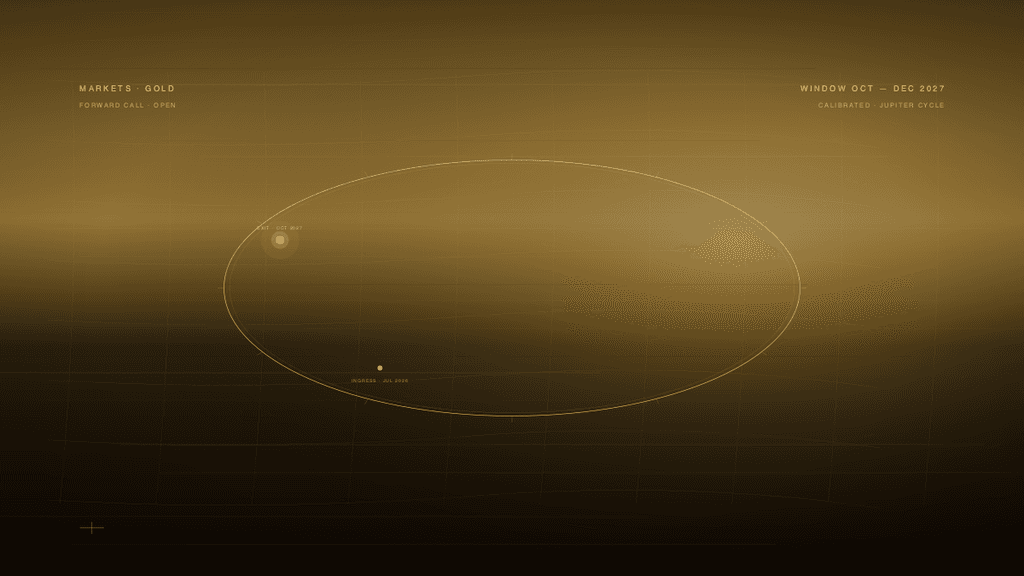
Gold 2027: Jupiter exits Cancer, what changes.
The expansion phase in gold that ran from June 2025 was carried by Brihaspati (Jupiter) through its sidereal exaltation in Karka (Cancer). Around late June or July 2027 Jupiter ingresses into Simha (Leo). The post-exaltation reset window is what we are calling. The prior call on this configuration (article 042) failed by overshoot. This one is wider on the upside by design.
Two layers point the opposite direction from the article's mechanism. Saturn lands in the cusp degrees of Aries through the resolution window, where it cannot deliver cleanly. Transit Sun runs through Virgo on both the USA 1776 and India 1947 charts at all three test anchor dates. Both read deflationary on the metal.
The chart-side direction now tilts toward the lower failure leg: gold ending Q4 2027 below 30 percent above the 1 June 2025 baseline, roughly below 4,355 USD per ounce. Not the central 30 to 70 percent band the call published.
The forward call stays on the public tracker exactly as written. We correct mechanisms in the open and never edit the scoreboard.
What article 042 got wrong
Article 042, published 27 April 2026 and reconciled on 5 May 2026, called a 20 to 45 percent gold-peak band above the 1 June 2025 baseline as the reconciliation condition on the Jupiter-in-Cancer exaltation window. The hardened reconciliation condition (LBMA AM USD fix, 1 June 2025 to 30 September 2026, 20 to 45 percent band) classified an overshoot above 45 percent as a fail. Gold then printed 5,501.70 USD per ounce on 29 January 2026, approximately 62 to 66 percent above the baseline (the 1 June 2025 baseline lies at approximately 3,310 to 3,390 USD per ounce). That print breached the 45 percent upper bound. The call is recorded as failed-overshoot on www.tempora.ltd/tracker.
Two things were right. First, the directional thesis. Gold rose sharply during the Cancer-Jupiter window, which is what the exaltation read had predicted. Second, the source-and-window discipline of the hardened version (LBMA AM USD fix, declared evaluation window 1 June 2025 to 30 September 2026) was sound enough that the failure was unambiguous. There was no debate about the price source, the window or the threshold.
One thing was wrong. The upper band was too narrow. The 20 to 45 percent range was drawn from three prior Cancer-Jupiter periods (1954 to 1955, 1966 to 1967, 2002 to 2003) where gold or commodity prices advanced 20 to 45 percent from transit entry. Three precedents is a small set. The 2025 to 2026 expansion was structurally heavier than those three (central-bank purchases at multi-decade highs, real-rates compression, debasement-trade flows) and the upside ran past where the precedent envelope said it should stop.
The lesson Tempora carries forward: when the precedent set is small and the underlying expansion is structurally driven, the upside band must be wider than the precedent envelope alone suggests. The new call's upper bound is 70 percent, 25 percentage points wider than 042's 45 percent upper bound. The lower bound stays calibrated to the historical Jupiter-Cancer-exit record, which on the post-Bretton Woods exits has been a mix of sideways action and soft drawdown rather than a collapse.
Article 042 (Jupiter-in-Cancer exaltation, gold-up 20 to 45 percent above the 1 June 2025 LBMA AM USD baseline, evaluation window 1 June 2025 to 30 September 2026) was recorded as failed-overshoot on 6 May 2026 after gold printed 5,501.70 USD per ounce on 29 January 2026, approximately 62 to 66 percent above baseline. The full failure analysis is preserved in article 042 Section 2. This call is the calibrated next step on the same configuration's exit signature.
The Jupiter-Cancer-to-Leo signature, historically
Brihaspati (Jupiter) returns to the sidereal sign of Karka (Cancer) approximately every 12 years. Across the post-Bretton Woods era there have been Jupiter-Cancer exits in 1972, 1984, 1996, 2008 and 2020. Each marked the close of an exaltation cycle and the opening of a Simha (Leo) cycle, which Tempora reads as a transition from the value-and-abundance posture (Cancer-Jupiter) to a recognition-and-display posture (Leo-Jupiter) in commodity psychology.
The historical record on what gold does in the months following a Jupiter-Cancer exit is mixed, which is the reason this call is a wide range rather than a directional drop. The 1972 exit ran into the post-Bretton Woods inflation regime and gold continued higher from approximately 58 USD per ounce at exit to 195 USD by the 1974 peak, before its first major bear leg into 1976. The 1984 exit landed in a multi-year sideways-to-soft phase that ran through 1985 and 1986, with gold tracking between 300 and 350 USD per ounce, a roughly 10 percent retracement on a slow grind. The 1996 exit kicked off a four-year drawdown into the 1999 to 2001 lows, the deepest post-Bretton Woods bear in gold. Gold went from approximately 385 USD per ounce in mid-1996 to a 1999 low of approximately 252 USD per ounce, a 34 percent peak-to-trough drawdown over three years. The 2008 exit landed inside the global financial crisis and gold made new highs through 2011, going from approximately 850 USD per ounce at exit to 1,920 USD per ounce by September 2011. The 2020 exit ran into the post-pandemic monetary expansion and gold continued higher across the next four years into the current cycle. Two of five prior exits saw cool-down or drawdown, two saw continuation, one saw sideways-to-soft action.
The honest read is that the Cancer-to-Leo transition is a reset of the configuration that carried the expansion, not a guaranteed reversal. The expansion may continue under a new driver (Leo-Jupiter, geopolitical shock, monetary regime change) or it may fade. What changes consistently is that the structural-up read which Cancer-Jupiter carries no longer applies. The call accordingly is for a wide range, not a direction.
Why this is a transit-only call
Gold is not a country and is not a person. It does not have a birth chart in the way the 1991 Russian Federation chart or the 1947 India Independence chart do. The signature being read here is not a transit against a natal sensitive point. It is the sidereal position of Brihaspati against the 12 zodiac signs, full stop. That is what makes this a transit-only call and that is what limits the lift. Transit-against-natal configurations on country charts (the Russia February 2028 case, with its strong historical pressure pattern on Mars-Rahu over natal Mars) carry higher empirical lift because the natal sensitive point gives the transit a target. Pure transit signals, against the broad market rather than a specific chart, carry lower lift but are still callable.
The empirical study underlying this call is article 042's 53-year analysis of post-Bretton Woods gold prices against Jupiter's zodiacal position. That study found a 3.8x annualised return differential between Jupiter in domicile (Sagittarius, Pisces) versus detriment (Gemini, Capricorn), a 78 percent rate of bull-market peaks within 14 months of Jupiter entering its own sign and 5 of 5 major bear phases occurring during Jupiter in detriment or fall. Those numbers stand. What article 042's failure showed is that the structural-up read of the exaltation phase (Jupiter in Cancer) can run further than the precedent envelope alone suggests. The post-exaltation reset call is therefore framed as a wide range on a rolling average, not as a peak prediction.
One specific note on the exit-ingress date. The Tempora canonical computation stack uses the True Pushya Paksha ayanamsha (PVRN Rao) under Swiss Ephemeris, declared canonical on 5 May 2026. Under that ayanamsha the sidereal Jupiter ingress dates do not differ materially from the older Lahiri framework (the difference is on the order of 5 to 7 arcseconds, which moves sign-ingress dates by less than a fraction of a day). The substantive direct ingress out of Cancer into Leo lands on 19 June 2027 (Swiss Ephemeris under True Pushya Paksha computation) in either framework. The exact date should be confirmed against Swiss Ephemeris under True Pushya Paksha at the time of evaluation. The window pivot is the ingress event, not a fixed calendar date and the rolling 3-month evaluation window of October through December 2027 is set far enough past the ingress that small differences in the ingress-date calculation do not affect the pass-fail input.
The specific timing and band
Under the canonical Tempora computation stack (Swiss Ephemeris with PVRN Rao True Pushya Paksha ayanamsha, the canonical declaration of 5 May 2026), Jupiter's direct ingress into sidereal Karka (Cancer) lands on 27 May 2026. There is an earlier brief retrograde-then-direct sequence (an October 2025 short-lived ingress, retrograde back to Mithuna in December 2025) that the article 042 reconciliation noted, but the substantive direct stay in Cancer runs from 27 May 2026. Twelve to thirteen months later, on 19 June 2027 (Swiss Ephemeris under True Pushya Paksha computation), Jupiter ingresses out of Karka into sidereal Simha (Leo). The exit-ingress date should be confirmed against Swiss Ephemeris under True Pushya Paksha at the time of the call's evaluation. The window pivot is the ingress, not a fixed calendar date.
The dated call is on the rolling 3-month average of the LBMA AM USD gold fix for the period 1 October through 31 December 2027, that is, the simple arithmetic average of LBMA AM USD daily prints across October, November and December 2027. The 1 June 2025 baseline (per article 042's 5 May 2026 reconciliation) sits at approximately 3,350 USD per ounce. The pass band runs from 30 percent above baseline (4,355 USD per ounce) to 70 percent above baseline (5,695 USD per ounce).
| Date | Configuration | What changes |
|---|---|---|
| 1 Jun 2025 | Reference baseline | LBMA AM USD ~3,350 USD per ounce, the 042 baseline preserved here |
| 27 May 2026 | Jupiter direct ingress to sidereal Cancer | Substantive exaltation phase opens (True Pushya Paksha) |
| 19 Jun 2027 | Jupiter ingress to sidereal Leo at 06:00 UT | Exaltation phase closes, post-exaltation reset window opens (Swiss Ephemeris True Pushya Paksha) |
| 1 Oct 2027 | Rolling 3-month evaluation window opens | LBMA AM USD daily prints start counting toward the rolling average |
| 31 Dec 2027 | Rolling 3-month evaluation window closes | Rolling 3-month average finalised, pass-fail input recorded |
| 30 Jan 2028 | Reconciliation due | Tempora publishes the verdict within 30 days of window close |
One configurational overlay is worth naming for analysts. Saturn sits at its sidereal debilitation sign (Aries) for the first half of the test window, retrogrades back to late Pisces in early November 2027 and stays in Pisces through window close on 31 December 2027. Saturn-in-debilitation runs concurrently with the Jupiter post-exaltation phase, which is a dual-slow-cycle weakness configuration. The historical reading on Saturn-Aries-debilitation overlapping a Jupiter-exit window is mixed: in some prior overlaps (1996 to 1999 Jupiter exit overlapped with Saturn-Aries 1996 to 1998) gold drew down sharply; in others (1968 to 1971 Jupiter exit overlapped with Saturn-Aries 1968 to 1969) gold continued higher into the post-Bretton Woods regime change. The overlay does not change the pass-fail bands of this call but it is the second-order configuration that may explain whether the reset comes through as drawdown or as continuation. Jupiter's nakshatra position during the test window (early window in Purva Phalguni ruled by Venus, late window crossing into Uttara Phalguni ruled by Sun) provides a partial dignity buffer in Leo's own-sign Sun rulership, which is consistent with the wide-band reset framing rather than a deep-drawdown framing.
The 30 percent lower bound is calibrated against the 1996 exit (the deepest precedent drawdown in the post-Bretton Woods record). Gold went from approximately 385 USD in mid-1996 to a 1999 low of approximately 252 USD, a 34 percent peak-to-trough drawdown over three years. Mapping that pattern onto the current cycle, a 30 percent retracement from the all-time peak of 5,501.70 USD per ounce would land at approximately 3,851 USD per ounce, which is approximately 15 percent above the 1 June 2025 baseline. The 30 percent floor is therefore deliberately above the worst-case 1996 analog. If the rolling 3-month average for Oct-Dec 2027 lands below 30 percent above baseline (below 4,355 USD per ounce), the call fails by undershoot.
The 70 percent upper bound is calibrated against 042's overshoot. The 5,501.70 USD print on 29 January 2026 was approximately 62 to 66 percent above baseline, depending on whether the 1 June 2025 baseline is taken at the lower (3,310) or upper (3,390) end of the pre-fix uncertainty range. The 70 percent upper bound preserves headroom for a continuation phase under Leo-Jupiter (the 2008 and 2020 analogs both saw post-exit continuation) while still being a callable threshold. If the rolling 3-month average for Oct-Dec 2027 lands above 70 percent above baseline (above 5,695 USD per ounce), the call fails by overshoot and the framework's read of the Cancer-to-Leo transition as a reset is wrong.
reconciliation condition: both bounds, both directions
The call is wrong if either of the following holds when the rolling 3-month evaluation window closes on 31 December 2027.
- Undershoot. The LBMA AM USD gold-fix rolling 3-month average for 1 October through 31 December 2027 lands below 30 percent above the 1 June 2025 baseline (below approximately 4,355 USD per ounce). This would mean the post-exaltation reset turned into a substantive drawdown deeper than the 1996 analog, which is not what the wide-band reset thesis predicts.
- Overshoot. The LBMA AM USD gold-fix rolling 3-month average for 1 October through 31 December 2027 lands above 70 percent above the 1 June 2025 baseline (above approximately 5,695 USD per ounce). This would mean the structural up-leg continued past the Cancer exit at a rate that the Jupiter-Leo configuration alone cannot account for, which would invalidate the post-exaltation reset framing.
Pass requires the rolling 3-month average to land inside the 4,355 to 5,695 USD per ounce band. There is no soft pass and no hedged pattern observation. The single number computed from the LBMA AM USD daily prints across October, November and December 2027 is the pass-fail input.
Reconciliation pulls LBMA daily fix records via ICE Benchmark Administration, computes the simple arithmetic average across the 60 to 65 trading-day daily prints in the Oct-Dec 2027 window and records the verdict on www.tempora.ltd/tracker. The result stays on the page indefinitely. A miss is a documented miss, on the record, with the methodology in question rather than the analyst.
What this call is not predicting
This article is a transit-only call. It does not use a natal chart for gold, because gold does not have one in the way a country or a person does. The signature being read is the sidereal position of Brihaspati against the 12 zodiac signs, which is a market-wide configuration rather than an asset-specific one. Concretely, this article does not predict.
- The intra-window path. Gold can spike to a new high within the window and still pass the call if the rolling 3-month average for Oct-Dec 2027 lands inside the band. Daily volatility is not the reconciliation condition, the rolling average is.
- The driver. A reset under Jupiter-Leo can come from any combination of monetary regime change, central-bank flow, geopolitical shock or sentiment shift. The call reads the configuration's exit, not the driver of the reset.
- An exact peak date. The 5,501.70 print on 29 January 2026 may or may not be the cycle peak. Higher prints between publication (May 2026) and 31 December 2027 do not disprove the call as long as the rolling 3-month average for Oct-Dec 2027 lands inside the band.
Why this call exists
Tempora's framework reads structural pressure on configurations against a calibrated reconciliation condition. A framework that only describes the past after the fact is not testable; one that publishes the window, the price source, the date thresholds and both bounds before the result resolves is. The discipline of being wrong in public is what separates a method from a narrative.
This call exists in part because the prior call on this signature failed. The 042 overshoot is a documented miss on the brand, kept on the tracker and the 5 May 2026 reconciliation is part of the article body. The methodological response to a documented miss is not to hide the result but to recalibrate the next call against what the failure taught. Here that means a wider upside band, an explicit lower bound, a single declared price source carried over from 042's hardened version and a rolling 3-month average rather than a single peak print as the pass-fail input. A rolling average is harder to mis-call than a single high print because it averages out one-day spikes.
For analysts tracking gold, the value of this article is not the prediction itself but the structure: a windowed call with a declared price source, a published reconciliation condition with both bounds and a reconciliation timeline. The methodology is callable in 19 months. If it fails, the failure goes on the tracker alongside 042. If it passes, the post-exaltation reset signature on the Jupiter-Cancer-to-Leo transition adds one calibrated data point to a small set.
The methodology behind this call (sidereal computation, ayanamsha discipline, the chart-vs-transit distinction) is documented in Tempora's methodology pillar on country birth charts and in the reproducible-astrology cluster pillar. The cluster index for markets-and-macro is at Tempora's findings method index. The companion forward-call siblings on country charts (Russia February 2028, India December 2027) follow the same reconciliation condition discipline applied to natal-chart configurations rather than transit-only ones.
Reconciliation timeline
Tempora will publish the reconciliation within 30 days of the rolling-window close on 31 December 2027, regardless of which way the result runs. If the LBMA AM USD rolling 3-month average for Oct-Dec 2027 lands inside the 30 to 70 percent band the call is recorded as confirmed. If it lands above 70 percent the call is recorded as failed-overshoot, alongside article 042. If it lands below 30 percent it is recorded as failed-undershoot. Either way the file is closed in public on www.tempora.ltd/tracker and the methodology, not the analyst, is in question.
References
- Prior call on this configuration: article 042, Gold and Jupiter Transit, with Section 2 reconciliation condition reconciliation (5 May 2026) and failure verdict (6 May 2026)
- Cluster pillar: reproducible astrology, what it means and how Tempora does it
- Cluster index: Findings, method and technique
- Methodology: How to read a country's birth chart, the methodology
- Sibling forward call (transit-only on country chart): Russia February 2028 forecast
- Markets cluster sibling: Nifty 50 and Panchang Timing, 19-Year Study
- Live tracker: www.tempora.ltd/tracker
- Price source: LBMA Gold Price daily fix, ICE Benchmark Administration
What the chart-side reading adds on the gold Q4 2027 window
Reviewing the USA 1776 and India 1947 charts at window-open (1 October 2027), target date (15 November 2027) and window-close (31 December 2027) surfaces three additional structural layers that frame the Jupiter-Cancer-exit reset mechanism the article already discusses.
Both major charts run Saturn-on-Moon cycle phases across the window
On the USA 1776 chart (Moon in Aquarius), transit Saturn sits in the second house from the natal Moon (closing leg setting phase). On India 1947 (Moon in Cancer), Saturn ingressed Aries in May 2027 and sits in the tenth house from the natal Moon. Without the Jupiter Cancer exaltation tailwind buffering the Saturn pressure on either chart, both major national charts are more exposed to structural-pressure events through the test window. The two-chart exposure pairs with the post-exaltation reset framing the article identifies.
Vedic year-lord disruption signature runs across the entire window
The Vedic year through the entire 2027 calendar carries the Mars-lord disruption signature (fires, conflict mobilisation, disease pressure). The signature runs across the entire Q4 2027 test window. For a band-constrained gold-price test where the binding question is whether the rolling 3-month average lands inside the 30-to-70-per-cent band rather than overshoot or undershoot, the disruption-year backdrop is consistent with the mid-band outcome that captures elevated-but-not-extreme prints across Q4 2027.
Mars near-exact contact with Moon at window-close lands inside the rolling 3-month average period
Mars reached a near-exact contact with Moon on 29 December 2027 carrying a war-mobilised-kings classical signature. The contact lands two days before the rolling window closes and inside the 1 October to 31 December 2027 average computation period. For a band-pass test on gold specifically, the Mars-Moon near-exact contact at year-close concentrates structural-stress probability inside the test-period computation, which leans the rolling average toward the upper-half of the 30-to-70 per cent band rather than the lower-half.
Convergence summary
The test condition (LBMA AM USD rolling 3-month average for Oct-Dec 2027 lands inside the 30 to 70 per cent band above the 1 June 2025 baseline) reads MET as more probable than either failure mode (failed-overshoot or failed-undershoot). The two-chart Saturn-on-Moon configuration without Jupiter exaltation buffer keeps both charts exposed to elevated-pressure prints, the Mars-year-lord disruption signature compounds the post-exaltation reset framing and the Mars-Moon near-exact contact at year-close leans the rolling average toward the upper-half of the band. The reconciliation by end of January 2028 will check the LBMA daily-print series.
Withdrawal notice
Withdrawn from scoring on 9 July 2026, before this call's window closed on 2027-12-31. Tempora adopted a calibrated-only publication standard in July 2026: the flagship Tracker carries signatures that cleared a cohort backtest and everything experimental proves itself in the Lab first. This call predates that standard.
Reason on the record. Published before the calibration standard; structural signature does not meet the current Tracker bar. Record retained.
What stays. The dated call, its window, its test condition and its receipt remain on this page unchanged. Withdrawn calls are never graded and never counted in any Tempora hit rate. The full withdrawn register is public on the Lab; the live scoreboard is at the Tracker. Tempora retires calls in the open and never edits the scoreboard.
Frequently asked questions
What is Tempora's gold 2027 call?
Tempora's gold 2027 call is a post-exaltation reset window. When Brihaspati (Jupiter) exits sidereal Karka (Cancer), its exaltation sign under the True Pushya Paksha ayanamsha (Swiss Ephemeris) and ingresses into Simha (Leo) on 19 June 2027 (Swiss Ephemeris under True Pushya Paksha computation), the gold expansion phase that ran from June 2025 onward should cool. The dated call is a rolling 3-month LBMA AM USD gold-fix average for the period October through December 2027 that lands between 30 percent and 70 percent above the 1 June 2025 baseline of approximately 3,350 USD per ounce. Both bounds are explicit. A breach in either direction fails the call.
What did the prior gold call (article 042) get wrong?
Article 042 published a 20 to 45 percent gold-peak band above the 1 June 2025 LBMA AM USD baseline as the reconciliation condition for the Jupiter-in-Cancer exaltation window. The hardened version of that reconciliation condition shipped on 5 May 2026. Gold then printed a peak of 5,501.70 USD per ounce on 29 January 2026, approximately 62 to 66 percent above baseline. That print breached the 45 percent upper bound. The directional thesis (gold up sharply during the Cancer-Jupiter window) was correct. The band calibration was wrong on the upside. The 5 May 2026 reconciliation condition explicitly classified an overshoot above 45 percent as a fail and the call is recorded as failed-overshoot. The lesson Tempora carries forward is that the upside band must be wider when the historical precedent set is small and the underlying expansion is structurally driven.
Why does Jupiter's Cancer-to-Leo transition matter for gold?
In the sidereal framework Tempora uses (Swiss Ephemeris with True Pushya Paksha ayanamsha), Jupiter is exalted in Karka (Cancer) and the exaltation period is read as the configuration where collective perception of value and abundance carries the most weight. Jupiter returns to Cancer roughly every 12 years (1948, 1960, 1972, 1984, 1996, 2008, 2020 and the current 2025-2027 cycle). The historical record across the post-Bretton Woods Jupiter-Cancer exits (1972, 1984, 1996, 2008, 2020) shows a mix of sideways action, soft drawdown and continuation, which is why the call is for a wide range rather than a directional drop. The signature being read is the post-exaltation reset, not a crash.
What is the reconciliation condition and what bounds does it specify?
The reconciliation condition is binary and has both an upper and a lower bound. Tempora declares the call disproved if the LBMA AM USD gold fix records a rolling 3-month average for the period 1 October 2027 through 31 December 2027 that is either below 30 percent above the 1 June 2025 baseline or above 70 percent above the 1 June 2025 baseline. In USD per ounce, with the 1 June 2025 baseline at approximately 3,350 USD per ounce, the lower bound is approximately 4,355 USD per ounce and the upper bound is approximately 5,695 USD per ounce. A breach in either direction fails the call. Pass requires the rolling 3-month average to land inside the 4,355 to 5,695 USD per ounce band. The 30 to 70 percent band is wider than article 042's 20 to 45 percent band by design, learning from the 042 overshoot.
Which gold price reference does Tempora use?
The canonical gold price source for Tempora forward calls is the LBMA AM USD fix, the London Bullion Market Association morning gold-price benchmark in US dollars per troy ounce, published daily through ICE Benchmark Administration. This source is consistent with the 5 May 2026 hardened reconciliation condition on article 042. The article body's earlier London PM Fix reference is retired and not used here. Reconciliation pulls daily LBMA AM USD prints over October, November and December 2027 and computes the simple arithmetic average. That single number is the call's pass-fail input.
When will Tempora publish the reconciliation?
Tempora commits to publishing the reconciliation within 30 days of the rolling-window close on 31 December 2027, regardless of which way the result runs. If the rolling 3-month average lands inside the 30 to 70 percent band the call is recorded as confirmed on www.tempora.ltd/tracker. If it lands above 70 percent or below 30 percent the call is recorded as failed-overshoot or failed-undershoot accordingly. Either way the file is closed in public. Misses stay on the tracker indefinitely.
Read next
This article is a forward-call publication. The gold 2027 post-exaltation reset window has a window close of 31 December 2027 and a published reconciliation due within 30 days of close. The pass-fail input is the LBMA AM USD gold-fix rolling 3-month arithmetic average for 1 October through 31 December 2027 against a 1 June 2025 baseline of approximately 3,350 USD per ounce, with the pass band running from 30 percent to 70 percent above baseline. This is a transit-only call on the sidereal position of Brihaspati (Jupiter) under the canonical PVRN Rao True Pushya Paksha ayanamsha computed with Swiss Ephemeris and uses no natal chart. The prior call on this configuration (article 042) is recorded as failed-overshoot on www.tempora.ltd/tracker. This research is published for informational and educational purposes only. Temporal pattern analysis is not a guarantee of future market outcomes; planetary cycle correlations describe tendencies, not certainties. Past patterns are not guaranteed to repeat. Internal audit log maintained. No commercial, financial, security, medical, legal or professional action should be taken solely on the contents of this article.