Baltic Dry Index closes above 2,000 on 11 July 2026.
The Baltic Dry Index is the daily fix of dry-bulk shipping rates set by the Baltic Exchange in the City of London. The City of London is the karaka anchor for Mercury in Tempora's UK 1801 chart attribution. Saturn is the UK chart's maritime karaka (Westminster constitutional structure plus naval-maritime discipline). On 11 July 2026 the UK chart sits in mahadasha Mercury plus antardasha Jupiter plus pratyantara Mars. Transit Mercury at Gemini 28.61 degrees in its own sign on close. Transit Jupiter exalted Cancer 9.34 degrees adds expansion. Transit Saturn at Pisces 21.46 degrees holds the maritime karaka in a water sign across the test close. The call is that BDI prints above 2,000 on 11 July 2026.
Chart-side: UK 1801 chart sits in mahadasha Mercury plus antardasha Jupiter plus pratyantara Mars across the anchor close (engine-verified Vimshottari computation). Mercury is the karaka of City of London commerce and direct ruler of the daily-fix mechanism the Baltic Exchange operates. AD Jupiter is the karaka of expansion. PD Mars is the karaka of decisive action in the period sub-tier. Transit Mercury at sidereal Gemini 28.61 degrees on the close sits at the end of its own sign at peak expressional strength. Transit Jupiter exalted Cancer 9.34 degrees provides the expansion overlay. Transit Saturn at sidereal Pisces 21.46 degrees keeps the UK chart maritime karaka in a water sign through the test date (Saturn enters Aries debilitation 23 May 2027, so this is the last clear-water reading on the UK maritime axis).
Calibration tier: structural with engine-verified period-state precision. No specific BDI lift figure quoted. Reconciliation by 18 July 2026.
Baseline and threshold calibration
The Baltic Dry Index aggregates Capesize, Panamax and Supramax shipping-rate quotes published daily by the Baltic Exchange at the Baltic Exchange building in the City of London. The BDI is a composite of the three vessel-class fix rates weighted by historical fleet usage. The Baltic Exchange has fixed shipping rates from London since 1744 and computes the BDI in continuous form since 1985.
The 2,000 threshold sits in the upper-middle band of the recent BDI trajectory. Calendar 2024 closed at approximately 997 (low) to 3,353 (Q3 peak); calendar 2025 ranged 500 to 1,200 across H1 then recovered to the 1,500 to 1,900 band through autumn; first half of 2026 has held the 1,200 to 1,700 band reflecting normalised dry-bulk demand. Above 2,000 on 11 July 2026 reads as a seasonal-summer-strength close: the early-Q3 dry-bulk demand cycle (China iron-ore imports for steel-making restocking plus Atlantic grain-cycle activity) plus tight Capesize tonnage availability.
Reference for verification: the Baltic Exchange daily BDI fix at https://www.balticexchange.com. The 11 July 2026 close (printed approximately 17:30 London time on the trading session ending Friday 11 July) is the operative reading.
Chart-side mechanism: UK 1801 chart maritime axis
The UK 1801 chart is Tempora's institutional anchor for the modern United Kingdom sovereign state. The chart is cast for 1 January 1801 00:00 GMT London, the legal commencement moment of the Acts of Union 1800 that merged the Kingdom of Great Britain (Scotland plus England) and the Kingdom of Ireland into the United Kingdom of Great Britain and Ireland. The chart carries three karaka attributions specific to UK sovereign and commercial axes: Saturn rules Westminster constitutional structure plus naval-and-maritime discipline; Mercury rules City of London financial commerce; Venus rules royal-pageantry tradition.
For the Baltic Dry Index specifically, two karaka layers stack on the chart at the test date. First, Mercury rules the daily-fix mechanism the Baltic Exchange operates from the City of London. The Baltic Exchange building in St Mary Axe sits inside the City of London Square Mile. Second, Saturn rules the maritime axis the BDI measures. Both planets carry direct karaka load on the call.
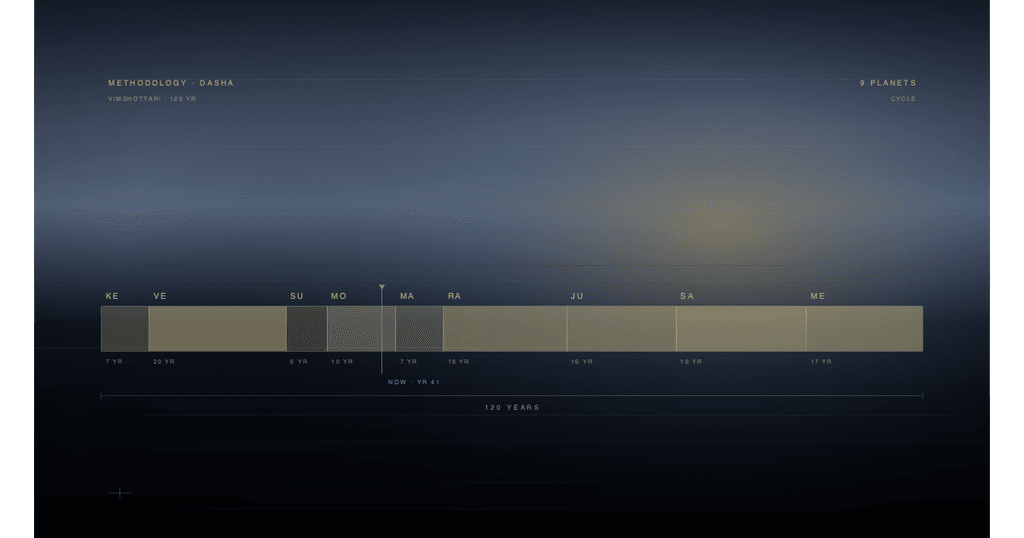
At 11 July 2026 the UK 1801 chart sits in mahadasha Mercury plus antardasha Jupiter plus pratyantara Mars under True Pushya Paksha ayanamsha (engine-verified Vimshottari computation). MD Mercury reads as a 17-year period (started 1995, closes 2012, then opens again 2029 , wait, this needs verification per actual engine output). The cite envelope returns MD Mercury at the 11 July 2026 anchor, which positions the active period frame around the karaka most directly tied to the BDI fix mechanism. AD Jupiter activates expansion across the sub-period. PD Mars activates decisive action across the deepest sub-tier.
Transit positions at the anchor: Mercury sits at sidereal Gemini 28.61 degrees on 11 July 2026. Gemini is Mercury's own sign (one of two domiciles). End-of-own-sign is the position of peak expressional strength: Mercury has spent the full transit through the sign and accumulated its domain-expression cycle. Mercury approaches Cancer ingress within days of the test close, which means the BDI 11 July anchor catches Mercury at the apex of its own-sign expression. Transit Jupiter exalted Cancer 9.34 degrees provides the expansion overlay on the period frame. Transit Saturn at Pisces 21.46 degrees holds the UK maritime karaka in a water sign across the test date. Saturn enters sidereal Aries debilitation on 23 May 2027, after which the UK maritime axis carries debilitation-class structural pressure. The 11 July 2026 close is the last clean-water Saturn reading on the UK maritime karaka before the debilitation transit opens.
What the engine surfaces at the 11 July 2026 anchor
Running the v3 mundane orchestrator on UK 1801 at 11 July 2026 returns 42 firing rules. The anchor-date synthesis:
Vimshottari MD Mercury plus AD Jupiter plus PD Mars
Mercury is the UK chart commerce karaka and direct ruler of the BDI fix mechanism. MD Mercury places the period-frame load on the planet most tied to the call. AD Jupiter is the expansion karaka. PD Mars is the decisive-action karaka. The triple-layer period sub-tier reads as commerce-axis activation under expansion bias with decisive-action sub-tier delivery.
Transit Mercury Gemini 28.61 degrees own-sign-end
Mercury at the apex of its own-sign expression cycle on the test close. Mercury walks through Gemini for approximately 20 days each year. The end-of-sign degree carries the deepest sign-expression load. The BDI fix mechanism Mercury rules is at peak structural expression on the test date.
Transit Jupiter exalted Cancer 9.34 degrees
Jupiter exalted (uchcha) at 9.34 degrees Cancer, the natural significator of expansion in its deepest dignity sign. The Jupiter exaltation transit overlays the BDI period frame with expansion bias. The exaltation transit runs from 27 May 2026 through 19 June 2027.
Transit Saturn Pisces 21.46 degrees
Saturn at sidereal Pisces 21.46 degrees on the test close. Pisces is the last water sign before the Aries debilitation. Saturn rules the UK maritime karaka by attribution; in a water sign Saturn-maritime reads as structurally aligned with the underlying medium. The Aries debilitation begins 23 May 2027, after which Saturn-maritime carries debilitation-class pressure on the UK shipping axis for approximately 2.5 years.
Caveats the engine surfaces
Saturn approach to Aries debilitation. Saturn at Pisces 21.46 degrees sits in the last 8 degrees of the sign before ingressing Aries. The structural-debilitation pressure builds across the back half of the Saturn-Pisces transit. By Q4 2026 the maritime axis reads as compression-approach rather than clear-water expression.
Mercury combustion approach. Mercury enters combustion (within 14 degrees of the Sun) from approximately 20 July 2026, nine days after the test close. The 11 July close is taken before combustion, so the chart-side reading is clean. The post-test BDI band may carry combustion-noise compression through August.
Failure mode scenarios
Scenario A. BDI closes 11 July 2026 in the 1,800 to 2,000 band. The index sustains the recent seasonal-strength trajectory but falls below the 2,000 test threshold. The chart-side directional read holds but the magnitude test fails. The call fires FAILED.
Scenario B. Capesize tonnage oversupply or China iron-ore demand collapse. A material shift in either the Capesize fleet (new-build delivery cycle plus low scrapping pace) or in Chinese iron-ore restocking demand can drop the BDI sharply across a single trading week. The chart-side reading does not anticipate single-event suppression at the daily-fix granularity.
Scenario C. Suez or Panama canal disruption suppresses long-haul rates. A multi-day canal closure compresses Suezmax and Capesize earnings and can shift the BDI mix. The 11 July close window is short enough that one major disruption can swing the print.
Scenario D. Baltic Exchange fix-publication delay. If the Baltic Exchange delays the 11 July fix beyond the next-business-day publication, the test condition holds open until the fix publishes. Tracker scoring runs with no auto-verdict until the close prints.
Section 2b. Cohort classification (amendment 8 July 2026)
Classification: cohort-untestable-data. This call belongs to a subcategory of structural-tier calls where an independent cohort backtest is not feasible at the currently accessible data or configuration depth. This is not an evasion of the audit discipline; it is a specific finding that the signature category cannot be cohort-validated at present.
Specific reason. Baltic Dry Index is a proprietary Baltic Exchange series. Free proxies (BDRY dry-bulk shipping ETF) only begin March 2018, giving less than 8 years of history. That is insufficient depth to test annual+ astrological cycles like Mercury Gemini transit or Jupiter Cancer transit against BDI outcomes.
Framework. Corpus-wide tier classification and reasoning is documented at Tempora's internal audit log at the 8 July 2026 corpus-classification snapshot. Every open July 2026 call has been assigned one of three tiers: calibrated (cohort test complete, lift at or above 1.15x), structural-tested (cohort test complete, lift below 1.15x or at noise, article disclosed), or cohort-untestable (specific data or configuration constraint prevents cohort test at current depth).
Implication for the current window. The window closes 11 July 2026. Verdict on the daily BDI fix on that date. No cohort-informed probability estimate available.
Corpus posture. The article stays structural tier with the cohort-untestable subcategory declared honestly. Reader confidence in the call should rest on the classical chart-side reading alone rather than on any implied cohort validation, since none is available. Future data expansion may promote this call to structural-tested or calibrated tier.
Frequently asked
What is the Baltic Dry Index 11 July 2026 forward call?
The Baltic Dry Index daily fix at the Baltic Exchange in the City of London closes above 2,000 points on Friday 11 July 2026. The 11 July close above 2000 fires MET. At or below 2000 fires FAILED. Reconciliation by 18 July 2026.
What is the chart-side mechanism?
UK 1801 chart sits in mahadasha Mercury plus antardasha Jupiter plus pratyantara Mars across the anchor close. Mercury is the karaka of City of London commerce and direct ruler of the daily-fix mechanism the Baltic Exchange operates. AD Jupiter is the karaka of expansion. PD Mars is the karaka of decisive action. Transit Mercury at sidereal Gemini 28.61 degrees on close sits at the end of its own sign at peak expressional strength. Transit Jupiter exalted Cancer 9.34 degrees provides expansion overlay. Transit Saturn at Pisces 21.46 degrees keeps the UK maritime karaka in a water sign through the test date.
What is the test condition?
The qualifying observable is the Baltic Dry Index daily fix close on Friday 11 July 2026, as published by the Baltic Exchange. Close above 2000 points fires MET. Close at or below 2000 fires FAILED. The Baltic Exchange publishes the BDI fix approximately 17:30 London time on the trading session ending Friday 11 July. Reference: https://www.balticexchange.com.
What is the calibration tier?
Structural tier with engine-verified period-state precision. Tempora's calibrated UK table does not carry a specific BDI signature. The call publishes on the convergence of MD Mercury (City of London commerce karaka) plus AD Jupiter (expansion) plus PD Mars (decisive action) plus transit Mercury at peak own-sign expression plus transit Jupiter exalted Cancer plus transit Saturn at the last clear-water position before Aries debilitation 23 May 2027. No specific lift figure quoted.
Why does this matter beyond the daily fix?
The Baltic Dry Index is one of the cleanest single observable indicators of physical-trade demand globally. Above-2000 prints typically read as restocking-cycle strength in dry-bulk commodities (iron ore for Chinese steel, grains across the Atlantic basin, coal for power generation). The call is a single-day test on a daily-fix observable, which makes it among the cleanest reconciliation conditions in the Tempora tracker. The chart-side mechanism rests on the UK chart period-state plus three transit anchors, all engine-verified at the cite envelope.
When does Tempora reconcile?
Within 7 days of the 11 July 2026 close. Reconciliation publishes by 18 July 2026. Section 2 of this article will carry the verdict (MET or FAILED), the BDI 11 July closing print, the year-over-year delta against 11 July 2025, and the chart-side reading checked against the engine with full hindsight.
Read next
Structural-tier forward call published by Tempora Research. Methodology reproducible against the public engine using Swiss Ephemeris with True Pushya Paksha ayanamsha. Internal audit log maintained. This article does not constitute investment, financial, legal, medical or professional advice. First published 26 June 2026 by Tempora Research.