Rahu Mahadasha Saturn Antardasha: the 2-year 10-month structural contraction
The Saturn sub-period inside the 18-year Rahu Mahadasha. Duration, the amplification-meets-contraction dynamic, how Saturn's natal dignity shapes the reading, transit confirmation protocol and what the framework does not predict.
The Saturn antardasha is where the Rahu mahadasha slows to walking pace. It follows the 2.4-year Jupiter sub-period, and the handover is a change of register: whatever expanded under the dharma karaka now files past the auditor, because Saturn's brief is structure, delay and the bill arriving. In the classical friendship matrix Rahu counts Saturn as a friend, and the two share a taste for the margins, the foreign and the unglamorous long game, so the pairing works with the grain even when it feels heavy. The texture the tradition assigns to these 2 years and roughly 10 months is compression in service of the mahadasha's ambition: fewer fronts, harder ground, durable results. Only the 3-year Venus antardasha gives a lord more time in this cycle, which gives the compression room to finish its work.
Where the sub-period falls in the Vimshottari sequence
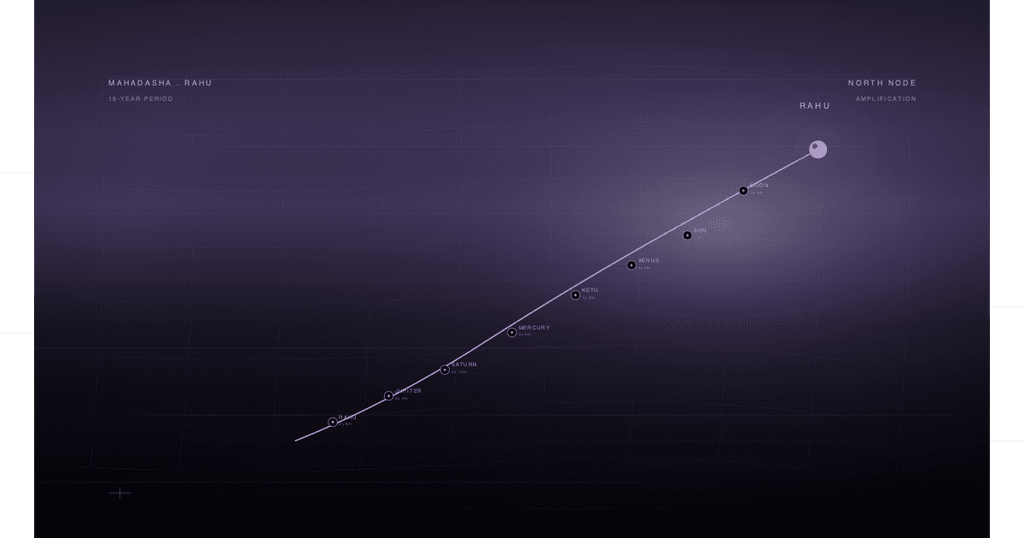
The 18-year Rahu mahadasha divides into nine antardasha sub-periods in fixed Vimshottari order starting with Rahu itself. The Saturn sub-period sits at position 3 of 9. Exact start and end dates for any chart can be computed from the natal Moon nakshatra-pada and the date of Rahu mahadasha onset. The Tempora dasha engine produces this to the day.
Friendship status and pairing reading
In the classical Parashari friendship matrix, Rahu views Saturn as friend. The friend-pair classification means the 2 years 10 months 6 days sub-period classically delivers outcomes where Rahu's register (worldly desire, foreign-axis, amplification, taboo and the boundary-crossing register) and Saturn's register (discipline, longevity, institutional structure and sustained-effort outcomes) integrate constructively. Events typically surface from both karaka domains in alignment rather than friction.
The Saturn karaka overlay
Saturn is the karaka of discipline, longevity, institutional structure and sustained-effort outcomes. Across the 2 years 10 months 6 days sub-period, this karaka set overlays on top of Rahu's 18-year worldly desire, foreign-axis, amplification, taboo and the boundary-crossing register register. The combined reading is the central output of the sub-period.
How Saturn's natal dignity shapes the reading
Saturn's natal sign and house set the floor for the 2 years 10 months 6 days sub-period. Saturn at exaltation gives the strongest reading. Own-sign and mooltrikona placement gives clean expression. Debilitation introduces friction that the sub-period must work through. Combust and retrograde state, conjunctions with malefics or benefics and the dispositor's strength all further modulate the reading. See the Saturn mahadasha overview for the per-dignity breakdown.
Event classes typical to Rahu-Saturn sub-period
The 2 years 10 months 6 days Rahu mahadasha Saturn antardasha typically surfaces events across these specific domains:
- Constructive integration of Rahu-register with Saturn-register: friend-pair sub-periods classically deliver outcomes where both planets' karakas align rather than friction.
- Events in Saturn's natural karaka domain: discipline, longevity, institutional structure and sustained-effort outcomes.
- Events specific to the natal house Saturn occupies in the chart.
- Events where the Rahu-mahalord and Saturn-antarlord houses (both natal and ruled) interact (aspect, mutual reception or natal conjunction).
Transit confirmation protocol
The sub-period reading sets a structural-pressure floor of 2 years 10 months. Specific event timing inside that window requires the pratyantara (sub-sub-period) overlay and a transit cross-check.
Two transit overlays do most of the work. The first: transit Saturn aspecting natal Rahu or transit Rahu within tight orb of natal Saturn. These transits intensify the amplification-meets-contraction dynamic within the broader sub-period and concentrate event timing on those windows. The second: transit Mars through houses 1, 6, 8 or 12 from the natal chart during the sub-period, which adds combative-pressure triggers to specific months inside the broader 2-year 10-month band.
The pratyantara (sub-sub-period) inside the antardasha gives finer timing. The opening Rahu-Saturn-Rahu pratyantara (about 5 months 12 days) carries the strongest amplification-meets-contraction collision. The middle Saturn-Mercury and Saturn-Ketu pratyantaras read more as the slow-grind structural-building phase. The closing Saturn-Mars pratyantara (about 1 month 29 days) carries the most concentrated friction signal and often produces the inflection event that closes the sub-period.
What the framework does not predict
The Rahu-Saturn sub-period reading is structural, not deterministic. The framework identifies a 2-year 10-month window where the conditional probability of three named event classes is elevated. It does not predict that a specific native will experience a specific event in that window.
The framework does not predict outcome direction. A blocked-ambition event during the sub-period can read as the constraint that builds durable foundation or as the structural failure that ends a project. The chart's broader signals determine which.
The framework does not predict timing finer than the antardasha band without the transit and pratyantara overlay. The Tempora dasha engine produces this data to the day for any chart.
The framework also does not predict the social or institutional content of the constraint. A career stall in the sub-period might come from external regulatory pressure, internal organisational politics or the native's own decision to consolidate. Saturn's natal dignity, the dispositor placement and the 10th-house transit overlay each contribute to the form.
How this connects to the broader Rahu Mahadasha
Rahu-Saturn is the second of two structurally significant friction windows inside the 18-year Rahu Mahadasha. The first is Rahu-Jupiter (about 2 years 5 months), which carries the Guru-Chandala expansion-with-caution reading covered in the Rahu Mahadasha Jupiter Antardasha piece. Together the two sub-periods occupy 5 years 3 months of the Mahadasha.
Between the friction windows, Rahu-Mercury (about 2 years 6 months) runs as the conventional commerce and communication amplification and Rahu-Venus at 3 years is the longest single antardasha across the entire Vimshottari system, carrying the wealth-and-desire amplification reading.
The Tempora Rahu Mahadasha method article covers the dispositor analysis, natal-house framework and the broader 18-year texture this sub-period sits inside. Reading the sub-period in isolation captures the 2 years 10 months; reading it inside the Mahadasha gives the longer arc that places the contraction reading in context.
The arithmetic of this period
Saturn holds 19 of the 120 Vimshottari years, the largest single share, and Rahu holds 18. The sub-period is 18 multiplied by 19 divided by 120: 2.85 years, about 2 years and 10 months. It stands at position 3 of 9; the 2.7-year Rahu-Rahu and 2.4-year Rahu-Jupiter sub-periods sum to 5.1 years, so Saturn runs from roughly year 5.1 to year 7.95 of the mahadasha. Against its neighbours it reads as the middle term of a three-act opening: Rahu states the appetite, Jupiter feeds it and Saturn tests what was built. The Mercury antardasha that follows at year 7.95 then trades on whatever survives the test.
A sub-period in years 5 to 8 of eighteen catches a native mid-construction rather than at the start or the summing-up, which is why the classical reading of Rahu-Saturn leans practical: the directions chosen in the opening years are now old enough to have consequences and young enough to correct. The 18-year frame is set out in the Rahu mahadasha overview; Saturn's character when it holds the major period itself is covered in the Saturn mahadasha article.
What Parashara and Mantreswara record
The Saturn entry in the BPHS antardasha chapters, Rahu mahadasha section, is one of the strangest in the chapter because even its favourable clause is mixed. Saturn in a kendra or trikona, exalted, in own sign or mulatrikona, or in the third or eleventh is assigned royal pleasure through service, marriage celebrations at home, construction of gardens and reservoirs and wealth arriving from prosperous Sudras, yet the same clause carries loss of wealth through the king on a westward journey, income thinned by lethargy and a return to the homeland. The afflicted branch answers in kind: a debilitated or enemy-sign Saturn, or one in the eighth or twelfth, brings danger from menials, king and enemies, family distress and disputes with co-heirs, and still slips in a sudden gain of ornaments. In the sixth, eighth or twelfth from the dasha lord the text lists heart disease, defamation, quarrels and coarse food, and where Saturn carries maraka lordship it attaches health cautions with charity of a black cow or buffalo prescribed. Phaladeepika, in its chapter on the sub-divisions of dashas, assigns wind and bile disease, wounds and family discord, which agrees with the afflicted Parashari branch. The engine reads this deliberately tangled record as a set of conditioned inputs, scored against natal Saturn's dignity and house position.
This period against the 2026 to 2028 sky
Saturn's calendar between 2026 and 2028 is unusually legible. It has sat in Pisces since 20 March 2025, enters Aries on 23 May 2027, retreats back into Pisces on 4 November 2027 and re-enters Aries to stay on 11 February 2028, holding the sign until 2030. Aries is the sign of Saturn's classical debilitation, so a native running Rahu-Saturn across 2027 and 2028 has the antardasha lord transiting its weakest sign, entering, withdrawing and entering again; the tradition reads that stutter as structure tested twice. The limitation holds as always: the transit is planet-wide and says nothing about any single chart's timing, and a natal Saturn exalted in Libra or strong in its own Capricorn or Aquarius meets a debilitated transit from a very different footing than a natal Saturn already afflicted. The mahadasha lord has its own date in the window, Rahu crossing from Aquarius into Capricorn on 27 December 2026, which moves the node into a Saturn-ruled sign while Saturn's own sub-period runs. Where any of this lands by house depends on the natal ascendant, which is chart work rather than calendar work.
Frequently asked questions
How long is the Rahu Mahadasha Saturn Antardasha and where does it fall in the Vimshottari sequence?
The Rahu Mahadasha Saturn Antardasha runs approximately 2 years and 10 months (2 years 10 months 6 days at exact computation). It is the third antardasha inside the 18-year Rahu Mahadasha in the Vimshottari sub-period system, the longest single antardasha inside Rahu Mahadasha after Rahu-Venus at 3 years. The order runs Rahu-Rahu first (2 years 8 months), then Rahu-Jupiter (2 years 5 months), then Rahu-Saturn and continues through Mercury, Ketu, Venus, Sun, Moon, Mars in sequence. The native is approximately 5 years 1 month into the Rahu Mahadasha when Rahu-Saturn opens and the sub-period closes about 7 years 11 months into the broader Mahadasha.
Why is Rahu-Saturn conventionally the most demanding sub-period inside Rahu Mahadasha?
Rahu amplifies and reaches. Saturn contracts and restrains. The two functions operate in direct opposition during the 2-year 10-month sub-period: the Mahadasha context wants the native to expand reach and pursue unconventional opportunity, while the antardasha overlay wants the native to consolidate, defend and discipline structure. The friction is structural rather than thematic. Conventional manifestations are blocked ambition, structural delays on large-scale projects, foreign-residence complications, slow grind against institutional resistance and the inversion of momentum the native felt during earlier Rahu sub-periods. The reading is not deterministic: well-placed natal Saturn substantially modulates the friction.
How does Saturn's natal dignity shape the Rahu-Saturn sub-period reading?
Saturn's natal house, sign and aspectual state set the floor for the 2-year 10-month sub-period. Saturn exalted in Libra, in own signs Capricorn or Aquarius or in angular houses (1st, 4th, 7th, 10th) substantially modulates the friction reading and shifts the sub-period toward structural-discipline payoffs (career consolidation, institutional position, durable building). Saturn debilitated in Aries or combust in close-orb conjunction with the Sun amplifies the friction reading. Saturn aspected by Jupiter softens the contraction; Saturn aspected by Mars adds combative-pressure overlay. The natal-dignity layer determines whether the sub-period reads as forced consolidation that builds durable structure or as the friction that grinds prior Rahu Mahadasha momentum to a halt.
What kinds of events historically correlate with Rahu-Saturn sub-periods?
The conventional Parashari reading associates Rahu-Saturn with three event classes: blocked-ambition events where prior Rahu Mahadasha momentum hits structural resistance (career stalls, foreign-residence visa issues, regulatory delays on large projects), slow-grind structural building events where the native consolidates an institutional position without dramatic external reward and isolation or seclusion events where the Saturnine pull toward consolidation expresses as withdrawal from social or professional networks. The Tempora framework reads the sub-period as a structural-pressure window for these classes of event rather than a deterministic predictor. The conditional probability is elevated relative to chance, not certain.
How does this sub-period connect to the broader Rahu Mahadasha?
Rahu-Saturn is the second of two structurally significant friction windows inside the 18-year Rahu Mahadasha. The first is Rahu-Jupiter (about 2 years 5 months), which carries the Guru-Chandala expansion-with-caution reading. Rahu-Saturn carries the contraction reading. Together the two sub-periods occupy 5 years 3 months of the Mahadasha. Between them, Rahu-Mercury (about 2 years 6 months) runs as the conventional commerce and communication amplification and Rahu-Venus at 3 years is the longest single antardasha across the entire Vimshottari system. The sub-period reading is best held in tandem with the broader Rahu Mahadasha reading from the Tempora Rahu Mahadasha method article, which covers the dispositor analysis and natal-house framework that sets the texture of the whole 18 years.
What does the Tempora framework not predict about this sub-period?
The framework identifies a structural-pressure window of approximately 2 years 10 months. It does not predict whether a specific native will experience a specific event in that window. It does not predict outcome direction (whether an event is read as positive consolidation or as blocked ambition). It does not predict timing finer than the sub-period band without overlaying the pratyantara (the sub-sub-period) and the transit overlay for the date in question. The classical readings carry historical and conventional weight, but the framework treats them as structural-pressure flags to be cross-checked against transit data, not as deterministic forecasts.
Which years of the Rahu mahadasha does the Saturn antardasha cover?
Roughly years 5.1 to 7.95. The duration is 18 multiplied by 19 divided by 120, which is 2.85 years, about 2 years and 10 months. It is position 3 of 9: the Rahu-Rahu sub-period covers years 0 to 2.7, Rahu-Jupiter covers 2.7 to 5.1 and Saturn's turn follows, handing over to the Mercury antardasha at roughly year 7.95. For a native who entered the mahadasha at age 30 this places Rahu-Saturn between about 35.1 and 38.
What does Saturn's 2027 Aries entry mean for a running Rahu-Saturn antardasha?
Saturn enters Aries, its classical debilitation sign, on 23 May 2027, retreats into Pisces on 4 November 2027 and returns to Aries for its long stay on 11 February 2028. A native in Rahu-Saturn across those months has the antardasha lord transiting at low dignity, which the tradition reads as added weight on the period's structural themes. The transit applies to every chart at once, so it colours the window without timing any personal event, and natal Saturn's condition matters more: a well-placed Saturn at birth carries a weak transit far better than an afflicted one. House placement from the natal ascendant decides which life areas take the weight.
What do the classical texts say about Rahu-Saturn?
The record is mixed even at its best. In the BPHS antardasha chapters, Rahu mahadasha section, a well-placed Saturn earns royal pleasure through service, home celebrations and wealth from prosperous Sudras, yet the same favourable clause carries losses on a westward journey and income thinned by lethargy, while the afflicted case brings danger from menials, king and enemies alongside a sudden gain of ornaments, with health cautions and black-cow charity where maraka lordship applies. Phaladeepika, in its chapter on the sub-divisions of dashas, lists wind and bile disease, wounds and family discord, siding with the afflicted branch. The engine parses this tangled entry as conditional inputs measured against the natal Saturn.
Read next
- Rahu Mahadasha Jupiter Antardasha: the Guru-Chandala sub-period · the prior sub-period in the series
- Rahu Mahadasha: how to read the 18-year period · the broader framework
- Saturn return at 29 · the other major Saturn-pressure window in early-to-mid adulthood
- reproducible astrology · the methodological standard
- Mars mahadasha career: 7 years that test your structure
- Rahu Mahadasha Ketu Antardasha: 1.05 years and the dissolution sub-period
- Rahu Mahadasha Moon Antardasha: 1.5 years and the emotional-axis amplification
- Rahu Mahadasha Rahu Antardasha: 2.7 years and the identity-reset opening
- Rahu Mahadasha Sun Antardasha: 0.9 years and the authority-axis pressure
- Yogini dasha explained: the 36-year alternative to Vimshottari
- Ketu Mahadasha: how to read the 7-year period
- Venus Mahadasha: how to read the 20-year period
- Jupiter Mahadasha: how to read the 16-year period
- Sun Mahadasha: how to read the 6-year period
- Moon Mahadasha: how to read the 10-year period
- Mars Mahadasha: how to read the 7-year period
- Saturn Mahadasha: how to read the 19-year period
- How Tempora Reads India's National Chart for Economic Cycles
- Rahu Mahadasha: how to read the 18-year period
This article represents conventional Vedic teaching and Tempora Research method documentation. It does not constitute financial, legal or professional advice. Internal audit log maintained.