Rahu Mahadasha Jupiter Antardasha: the Guru-Chandala sub-period explained
The 2-year 5-month Jupiter sub-period inside the 18-year Rahu Mahadasha. Duration, the Guru-Chandala overlay, how Jupiter's natal dignity shapes the reading, transit confirmation protocol and what the framework does not predict.
Jupiter's antardasha is the moment the 18-year Rahu cycle first admits another voice. After 2.7 years of Rahu running on itself, the arrival of the dharma karaka introduces the one register the node lacks entirely: precedent, lineage and the sense that expansion should answer to something. In the Parashari friendship matrix Rahu holds Jupiter as neutral, so the pairing carries no built-in ease and no built-in war; the classical texture is instead the specific Guru-Chandala tension, the teacher and the outcaste working the same 2 years and roughly 5 months. Tradition reads the combination as ambition seeking legitimacy, the boundary-crossing appetite of the mahadasha lord now routed through counsel, teachers, faith and law. Whether that routing dignifies the ambition or corrodes the counsel is the question the whole sub-period turns on.
Where the sub-period falls in the Vimshottari sequence
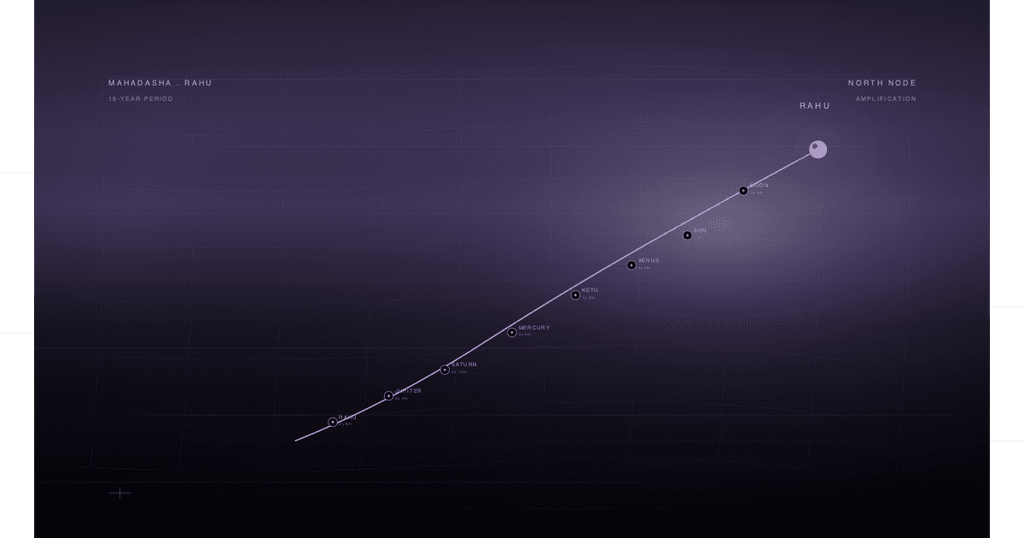
The 18-year Rahu mahadasha divides into nine antardasha sub-periods in fixed Vimshottari order starting with Rahu itself. The Jupiter sub-period sits at position 2 of 9. Exact start and end dates for any chart can be computed from the natal Moon nakshatra-pada and the date of Rahu mahadasha onset. The Tempora dasha engine produces this to the day.
Classical Guru-Chandala-Yoga pairing
Jupiter-Rahu pairing produces the Guru-Chandala Yoga. The Jupiter antardasha inside Rahu mahadasha is one of the most expansion-supportive Rahu sub-periods, bringing dharmic-amplification arcs: foreign-teaching, large-scale philosophical work or significant cross-cultural dharmic transmission.
Friendship status and pairing reading
In the classical Parashari friendship matrix, Rahu views Jupiter as neutral. The neutral-pair classification means the 2 years 4 months 24 days sub-period takes the colouring of the natal placement of both planets. Rahu's register (worldly desire, foreign-axis, amplification, taboo and the boundary-crossing register) and Jupiter's register (wisdom, dharma, children, expansion, teaching and the dignified-blessing register) can integrate constructively or friction-prone depending on the broader chart configuration.
The Jupiter karaka overlay
Jupiter is the karaka of wisdom, dharma, children, expansion, teaching and the dignified-blessing register. Across the 2 years 4 months 24 days sub-period, this karaka set overlays on top of Rahu's 18-year worldly desire, foreign-axis, amplification, taboo and the boundary-crossing register register. The combined reading is the central output of the sub-period.
How Jupiter's natal dignity shapes the reading
Jupiter's natal sign and house set the floor for the 2 years 4 months 24 days sub-period. Jupiter at exaltation gives the strongest reading. Own-sign and mooltrikona placement gives clean expression. Debilitation introduces friction that the sub-period must work through. Combust and retrograde state, conjunctions with malefics or benefics and the dispositor's strength all further modulate the reading. See the Jupiter mahadasha overview for the per-dignity breakdown.
Event classes typical to Rahu-Jupiter sub-period
The 2 years 4 months 24 days Rahu mahadasha Jupiter antardasha typically surfaces events across these specific domains:
- Configuration-dependent Rahu-Jupiter integration: neutral-pair sub-periods take the colouring of the natal placement of both planets.
- Activation of Guru-Chandala-Yoga (where the natal configuration supports it).
- Events in Jupiter's natural karaka domain: wisdom, dharma, children, expansion, teaching and the dignified-blessing register.
- Events specific to the natal house Jupiter occupies in the chart.
- Events where the Rahu-mahalord and Jupiter-antarlord houses (both natal and ruled) interact (aspect, mutual reception or natal conjunction).
Transit confirmation protocol
The sub-period reading sets a structural pressure floor of 2 years 5 months. Specific event timing inside that window requires the pratyantara (sub-sub-period) overlay and a transit cross-check.
Two transit overlays do most of the work. The first: transit Jupiter aspecting natal Rahu or transit Rahu in close-orb conjunction with natal Jupiter. These transits intensify the Guru-Chandala dynamic within the broader sub-period and concentrate event timing on those windows. The second: transit Saturn through houses 1, 6, 8 or 12 from the natal chart, which converts the sub-period from a flagged-but-managed window into one where structural pressure is acting concurrently. Both transit overlays can be computed forward to the day using the Tempora dasha engine and the Swiss Ephemeris.
The pratyantara (sub-sub-period) inside the antardasha gives finer timing. The opening Rahu-Jupiter-Rahu pratyantara (about 4 months 14 days) and the closing Rahu-Jupiter-Mars pratyantara (about 1 month 22 days) carry the most concentrated friction signal. The middle Jupiter-Saturn and Jupiter-Mercury pratyantaras read more softly.
What the framework does not predict
The Rahu-Jupiter sub-period reading is structural, not deterministic. The framework identifies a 2-year 5-month window where the conditional probability of three named event classes is elevated. It does not predict that a specific native will experience a specific event in that window.
The framework does not predict outcome direction. An ambition event during the sub-period can read as the turn that unlocks a career or as the overreach that produces a public failure; the chart's broader signals determine which. The framework times the pressure, not the result.
The framework does not predict timing finer than the antardasha band without the transit and pratyantara overlay. A native asking "when in this 2-year 5-month window does the event fire" is asking a question that requires the transit data, the pratyantara and often a synastric or muhurta cross-check. The Tempora dasha engine produces this data to the day for any chart.
The framework also does not predict moral or spiritual content. The Guru-Chandala friction is a structural pattern, not a moral judgement. Whether a native experiences the sub-period as dharmic growth or as ethical compromise depends on natal dignity, transit overlay and the native's own decision architecture.
How this connects to the broader Rahu Mahadasha
The Rahu-Jupiter sub-period is one of two structurally significant friction windows inside the 18-year Rahu Mahadasha. The other is Rahu-Saturn (about 2 years 10 months), which carries the contraction reading rather than this sub-period's expansion-with-caution reading. Between the two, Rahu-Mercury (about 2 years 6 months) runs as the conventional commerce and communication amplification. Rahu-Venus (3 years) is the longest antardasha inside the Rahu mahadasha and carries the wealth-and-desire amplification reading.
The Tempora Rahu Mahadasha method article covers the dispositor analysis, natal-house framework and the broader 18-year texture that this sub-period sits inside. Reading the sub-period in isolation captures the 2 years 5 months; reading it inside the Mahadasha gives the longer arc that places the friction reading in context.
The conditional probability framework holds across the full series. Each antardasha is a flagged window for specific event classes whose probability is elevated relative to chance; none is a deterministic forecast for any individual chart.
The arithmetic of this period
Jupiter carries 16 of the 120 cycle years and Rahu carries 18, so the sub-period runs 18 multiplied by 16 divided by 120: 2.4 years, about 2 years and 5 months. It is position 2 of 9. The opening Rahu-Rahu antardasha occupies years 0 to 2.7, which places Rahu-Jupiter across roughly years 2.7 to 5.1 of the mahadasha. Its neighbours define it by contrast: the sub-period before it is pure amplification with no second lord, and the 2.85-year Saturn antardasha after it is the contraction that audits whatever Jupiter expanded. Read in sequence, Jupiter is the first brake and the first blessing the mahadasha receives.
Landing in years 3 to 5 of an 18-year cycle matters. An antardasha this early works on directions that are still forming, so its expansion tends to compound through the remaining thirteen years; the same Jupiter sub-period arriving late in a mahadasha would be dignifying an arc already built. The wider frame sits in the Rahu mahadasha overview, and Jupiter's conduct as a period lord in its own right is treated in the Jupiter mahadasha article.
What the classical texts assign here
The BPHS antardasha chapters, Rahu mahadasha section, open this pairing on a condition: when Jupiter stands exalted, in own sign or in a kendra or trikona from the lagna, the text assigns gain of position, patience, destruction of foes and wealth that fills out steadily the way the waxing Moon does. The same passage adds conveyances and cows, successful journeys, return to the homeland, pilgrimage and family happiness reaching down to grandchildren. Reverse the condition and the assignment reverses with it: Jupiter debilitated, combust, in an enemy sign or in the sixth, eighth or twelfth is given loss of wealth, obstacles, defamation, distress to wife and children and heart trouble, though the same clause also carries an entrustment of governmental authority. Placement counted from the dasha lord runs as a separate test, with a strong Jupiter well placed from Rahu promising land, good food, cattle and a charitable religious turn. Where Jupiter holds lordship of the second or seventh house the text attaches health cautions and prescribes remedial worship. Phaladeepika, in its chapter on the sub-divisions of dashas, gives this bhukti the advent of happiness, worship of God and freedom from disease, which sits close beside the favourable Parashari branch, and between them the two texts make Rahu-Jupiter one of the friendlier sub-periods Rahu runs. The engine takes these classical positions as inputs and weights each branch by what the natal chart shows for Jupiter.
This period against the 2026 to 2028 sky
Both lords of this combination have dated business in the 2026 to 2028 calendar. Jupiter takes its full Cancer stay, the sign of its exaltation, from 27 May 2026, then tastes Leo from 23 October 2026 to 3 February 2027 before settling there from 19 June 2027. A native running Rahu-Jupiter through mid 2026 therefore has the antardasha lord transiting at its highest classical dignity, which the tradition reads as the counsel side of the Guru-Chandala pairing at full strength. The limitation: an exalted transit Jupiter is shared by every chart on the planet for that year, so it raises the tone of the window without dating anything personal, and a natal Jupiter that sits debilitated in Capricorn or combust does not become strong because its transit position improved. On 27 December 2026 the mahadasha lord moves too, Rahu leaving Aquarius for Capricorn with Ketu crossing into Cancer until 15 July 2028, which re-points the desire axis mid sub-period. Which houses Cancer, Leo and Capricorn count from the natal ascendant decides where these windows land, and that requires the birth chart rather than the calendar alone.
Frequently asked questions
How long is the Rahu Mahadasha Jupiter Antardasha and where does it fall in the Vimshottari sequence?
The Rahu Mahadasha Jupiter Antardasha runs approximately 2 years and 5 months (2 years 4 months 24 days at exact computation). It is the second antardasha inside the 18-year Rahu Mahadasha in the Vimshottari sub-period system. The order runs Rahu-Rahu first (2 years 8 months), then Rahu-Jupiter, then Rahu-Saturn (2 years 10 months) and continues through Mercury, Ketu, Venus, Sun, Moon, Mars in sequence. Exact start and end dates for any chart can be computed from the natal Moon nakshatra-pada and the date of Rahu Mahadasha onset.
What is Guru-Chandala yoga and why is it associated with this sub-period?
Guru-Chandala (literally teacher-outcaste) names the structural tension when Rahu's boundary-crossing nodal character meets Jupiter's dharma-protecting karaka role. The yoga activates structurally during the Rahu-Jupiter sub-period because both planets are operating concurrently in the dasha hierarchy and natally when Rahu and Jupiter sit in conjunction in the birth chart. Conventional readings flag the sub-period for ethical complications around teaching or guidance figures, philosophical reorientation that breaks with inherited tradition and ambition outrunning structural support. The reading is not deterministic: well-placed natal Jupiter softens the friction substantially.
How does Jupiter's natal dignity shape the Rahu-Jupiter sub-period reading?
Jupiter's natal house, sign and aspectual state set the floor for the 2-year 5-month sub-period. Jupiter exalted in Cancer, in own signs Sagittarius or Pisces or in angular houses (1st, 4th, 7th, 10th) substantially reduces the Guru-Chandala friction and shifts the sub-period toward expansion under unconventional channels. Jupiter debilitated in Capricorn or in close-orb combustion with the Sun amplifies the friction reading. Jupiter aspected by Saturn brings structural-discipline pressure into the sub-period; Jupiter aspected by Mars brings competitive-action pressure. The natal-dignity layer determines whether the sub-period reads as dharmic expansion or as the Guru-Chandala caution materialising.
What kinds of events historically correlate with Rahu-Jupiter sub-periods?
The conventional Parashari reading associates Rahu-Jupiter with three event classes: ambition events where unconventional opportunity expands the reach the chart is pursuing, philosophical or spiritual reorientation events where the native breaks with inherited tradition or family religious lineage and ethical-complication events around mentor, teacher or institutional-authority figures. The Tempora framework reads the sub-period as a structural-pressure window for these classes of event rather than a deterministic predictor. The conditional probability is elevated relative to chance, not certain.
How does this sub-period connect to the broader Rahu Mahadasha?
The Rahu-Jupiter sub-period is one of two structurally significant friction windows inside the 18-year Rahu Mahadasha. The other is Rahu-Saturn (about 2 years 10 months), which carries the contraction reading versus Rahu-Jupiter's expansion-with-caution reading. Between the two, Rahu-Mercury (about 2 years 6 months) runs as the conventional commerce and communication amplification. The sub-period reading is best held in tandem with the broader Rahu Mahadasha reading from the Tempora Rahu Mahadasha method article, which covers the dispositor analysis and natal-house framework that sets the texture of the whole 18 years.
What does the Tempora framework not predict about this sub-period?
The framework identifies a structural-pressure window of approximately 2 years 5 months. It does not predict whether a specific native will experience a specific event in that window. It does not predict outcome direction (whether an event is read as positive or negative). It does not predict timing finer than the sub-period band without overlaying the pratyantara (the sub-sub-period) and the transit overlay for the date in question. The classical readings carry historical and conventional weight, but the framework treats them as structural-pressure flags to be cross-checked against transit data, not as deterministic forecasts.
Which years of the Rahu mahadasha does the Jupiter antardasha cover?
Roughly years 2.7 to 5.1. The duration is 18 multiplied by 16 divided by 120, which is 2.4 years, about 2 years and 5 months. The opening Rahu-Rahu sub-period runs exactly 2.7 years, so Jupiter's turn begins once it closes and hands over to the 2.85-year Saturn antardasha at roughly year 5.1. A native who entered Rahu mahadasha at age 30 runs Rahu-Jupiter from about 32.7 to 35.1.
Does Jupiter's exaltation in Cancer from 27 May 2026 help a running Rahu-Jupiter antardasha?
It strengthens the transit layer, with two limits. From 27 May 2026 transit Jupiter sits in Cancer at its highest classical dignity, and the tradition reads that as support for the Jupiter side of this pairing while it lasts. The transit is planet-wide, so it cannot single out one chart or date a personal event, and it does nothing to change natal Jupiter's condition: a chart with Jupiter debilitated or combust at birth still reads through that weakness. The antardasha dates themselves come only from the Vimshottari computation on the birth chart.
What do the classical texts say about Rahu-Jupiter?
The BPHS antardasha chapters, Rahu mahadasha section, condition everything on Jupiter's state: exalted, own-sign or kendra-trikona placement yields position, steadily growing wealth, successful journeys and family happiness, while a debilitated, combust or badly housed Jupiter yields losses, defamation and heart trouble, with health cautions and remedial worship attached where Jupiter carries maraka lordship. Phaladeepika, in its chapter on the sub-divisions of dashas, assigns this bhukti the advent of happiness, worship of God and freedom from disease. The two sources agree unusually closely on this pairing, and the engine reads both as classical inputs whose applicable branch is decided by the natal chart.
Read next
- Rahu Mahadasha: how to read the 18-year period · the broader framework this sub-period sits inside
- Saturn return at 29: the structural floor · the other major structural-pressure window in early-to-mid adulthood
- reproducible astrology: how Tempora ships testable claims · the methodological standard the framework is held to
- Calibrated lift: the discipline that turns Vedic astrology into research · how Tempora computes elevated-probability claims
- Mars mahadasha career: 7 years that test your structure
- Rahu Mahadasha Rahu Antardasha: 2.7 years and the identity-reset opening
- Rahu Mahadasha Sun Antardasha: 0.9 years and the authority-axis pressure
- Ketu Mahadasha: how to read the 7-year period
- Venus Mahadasha: how to read the 20-year period
- Jupiter Mahadasha: how to read the 16-year period
- Sun Mahadasha: how to read the 6-year period
- Moon Mahadasha: how to read the 10-year period
- Mars Mahadasha: how to read the 7-year period
- Saturn Mahadasha: how to read the 19-year period
- How Tempora Reads India's National Chart for Economic Cycles
- Rahu Mahadasha: how to read the 18-year period
This article represents conventional Vedic teaching and Tempora Research method documentation. It does not constitute financial, legal or professional advice. Internal audit log maintained.