Rahu Mahadasha: how to read the 18-year period
The Rahu mahadasha is the 18-year window of amplification, foreign expansion and unconventional rise. Rahu as a shadow karaka, how natal house and sign shape the reading, the 9 antardasha sub-periods and what the framework does not predict.
Where it falls in the Vimshottari sequence
The Vimshottari system runs nine mahadashas in a fixed sequence totalling 120 years: Ketu 7, Venus 20, Sun 6, Moon 10, Mars 7, Rahu 18, Jupiter 16, Saturn 19 and Mercury 17. Rahu occupies the sixth position in the cycle and runs 18 years. Which mahadasha a native is born into depends on the natal Moon's nakshatra and how far through that nakshatra the Moon had travelled at the moment of birth.
Rahu follows Mars (7 years of decisive-action register). After the Rahu period closes the Jupiter mahadasha opens for 16 years, often producing a marked shift from amplification-orientation to dharmic-expansion orientation.
Rahu's karaka nature
Rahu is the karaka for worldly desire, amplification and the boundary-crossing register. Rahu is a shadow planet (chhaya graha) without a physical body, the North Node of the Moon. Careers in foreign trade, technology, aviation, unconventional fields, taboo-domain work, large-scale promotion, foreign-residency arcs and disruption-axis ventures often peak during the Rahu Mahadasha for natives with Rahu well placed natally.
The Sanskrit name Rahu derives from the demon Svarbhanu in the classical mythology of the churning of the ocean of milk. Rahu drinks the amrita (nectar of immortality) by deception, gets beheaded by Vishnu but the immortality has already entered him, leaving the head (Rahu) and body (Ketu) as separate immortal-axis planets. This mythology of deception-and-immortality frames Rahu's classical reading: amplification through unconventional or boundary-crossing means.
Dignity: exaltation, own signs, debilitation
Rahu exalted in Taurus or Gemini (classical sources differ). Maximum natal strength. The 18-year period operates with maximum rahu-register support. Natives with Rahu exalted in Taurus or Gemini (classical sources differ) typically experience the mahadasha as flowing with unusual ease in the karaka domain.
Rahu in own sign no own sign. The own-sign placement carries the rahu qualities with the stability of familiar territory, close to exaltation-strength without the elevation but with reliability across the 18-year period.
Mooltrikona: no mooltrikona. The mooltrikona band within the own sign is the strongest functional placement after exaltation. The classical readings give mooltrikona-Rahu the rahu signification in its most direct and operative form.
Rahu debilitated in Scorpio or Sagittarius (classical sources differ). The classical tradition reads debilitated Rahu as reducing the ease of the rahu-register. The debilitation does not cancel the mahadasha's fundamental signature but introduces friction into it. Neecha Bhanga (debilitation cancellation) is possible under specific configurations and is read separately.
Combustion. Rahu as a shadow body (without physical luminosity) is not classically subject to combustion in the same way as the seven physical planets. The classical readings of Rahu in proximity to the Sun emphasise the eclipse-axis activation rather than a combustion-friction effect.
Classical friend-enemy scheme. Rahu's friends are Mercury, Venus and Saturn. Enemies are Sun, Moon and Mars. Neutral planets are Jupiter. This friendship matrix shapes the antardasha sub-period readings: friend-sub-periods read constructively, enemy-sub-periods read with more friction.
Additional dignity factors. Rahu is classically read through the dispositor (sign-ruler) and the conjoining planets rather than through its own sign dignity. Rahu in a kendra (1st, 4th, 7th, 10th) with a benefic dispositor produces Raja Yoga-equivalent results. Rahu in a dusthana (6th, 8th, 12th) classically intensifies hidden-or-foreign themes.
How natal house shapes the reading
Rahu's natal house tells the reader which life domain carries the rahu-reading most strongly during the 18-year period. The house gives the surface domain. The dispositor gives the underlying mechanism. Both are read together.
Rahu in the 1st house. The self as boundary-crossing. The 18-year mahadasha reads as a period of unconventional-self-formation, foreign-residency arcs and significant amplification events. Rahu in the 1st often produces unconventional-presented natives whose life-arc takes unexpected directions.
Rahu in the 2nd house. Wealth from unconventional sources and family-of-origin amplification. The 18-year window often produces foreign-business wealth, unconventional-inheritance or significant family-line foreign-axis events. Speech can carry unusual register (foreign-language, code-switching).
Rahu in the 3rd house. Initiative through unconventional channels. Rahu in the 3rd is one of the strongest classical placements (upachaya + Rahu's natural amplification register). The 18-year window typically produces defining unconventional-publishing, foreign-sibling collaboration or significant boundary-crossing communication work.
Rahu in the 4rd house. Home, mother and the foreign-residency register. Rahu in the 4th classically reads as foreign-home arcs, unconventional-mother-relationship or significant real-estate-amplification events. Often produces multiple-residence periods or foreign-residency arcs.
Rahu in the 5rd house. Children, unconventional creative-arcs and speculation amplification. Rahu in the 5th reads as unconventional-children events (adoption, technology-mediated conception), speculative-amplification or significant authority-in-unconventional-education arcs. The 18-year window can produce defining speculative-trading or unconventional-creative-output cycles.
Rahu in the 6rd house. Service, conflict and the amplified-enemy register. Rahu in the 6th is one of the strongest classical placements (upachaya + dusthana intensification). The 18-year window typically produces defining victory in unconventional-conflict, foreign-litigation success or significant health-amplification events.
Rahu in the 7rd house. Partnership and the foreign-marriage register. Rahu in the 7th classically reads as foreign-spouse, unconventional-partnership or amplified-public-relationship events. The 18-year window often produces marriage with significant boundary-crossing register.
Rahu in the 8rd house. Transformative amplification, occult-research and hidden-foreign register. Rahu in the 8th is classically intense (dusthana + Rahu's hidden-amplification natural register). The 18-year window often produces defining occult-research arcs, large inheritance events or significant transformation-axis foreign work.
Rahu in the 9rd house. Dharma, father and foreign-higher-purpose. Rahu in the 9th reads as unconventional-dharma, foreign-residency for study or significant father-line foreign events. The 18-year window often produces defining cross-cultural philosophical work or unconventional teaching credentials.
Rahu in the 10th house. Career-summit through unconventional channels. Rahu in the 10th supports careers in technology, foreign-trade, aviation, unconventional-leadership or large-scale promotion-domain work. The 18-year window typically produces the defining unconventional-career event of the native's life.
Rahu in the 11th house. Large gains from foreign-networks and elder-sibling amplification. Rahu in the 11th is one of the strongest classical placements (upachaya + gains-house). The 18-year window often produces large-network-driven income amplification through foreign or unconventional channels.
Rahu in the 12th house. Foreign residency, hospital-administration and the hidden-amplification register. Rahu in the 12th reads as significant foreign-residency arcs, hospital-or-prison administration with unconventional register or significant moksha-axis-amplification events (cult-leadership, large-scale spiritual movements).
Dispositor analysis
Rahu's reading depends heavily on the dispositor (the planet ruling Rahu's sign). Rahu has no own sign, so dispositor analysis is the central mechanism for the 18-year period.
Rahu in Taurus: dispositor is Venus. Rahu in Taurus (often read as exaltation) draws Venus into amplified-aesthetic arcs. The 18-year period reads as foreign-aesthetic work, unconventional-luxury arcs or large-scale-relationship amplification.
Rahu in Scorpio: dispositor is Mars. Rahu in Scorpio (often read as debilitation) with Mars dispositor. The 18-year period often produces intense transformative-amplification, occult-research arcs or significant taboo-domain decisive moves. Most volatile dispositor configuration.
Rahu in Sagittarius: dispositor is Jupiter. Rahu in Sagittarius (neutral Jupiter dispositor) brings amplification into the dharmic register. The 18-year period often produces foreign-teaching, unconventional-philosophical work or significant cross-cultural dharmic arcs.
Rahu in Aquarius: dispositor is Saturn. Rahu in Aquarius (friend-sign Saturn dispositor) supports unconventional-institutional work, technology-amplification or significant network-building through unconventional channels.
Rahu in Gemini: dispositor is Mercury. Rahu in Gemini (friend-sign Mercury dispositor) supports unconventional-communication work, foreign-publishing or significant commerce-amplification arcs.
The 9 antardasha sub-periods
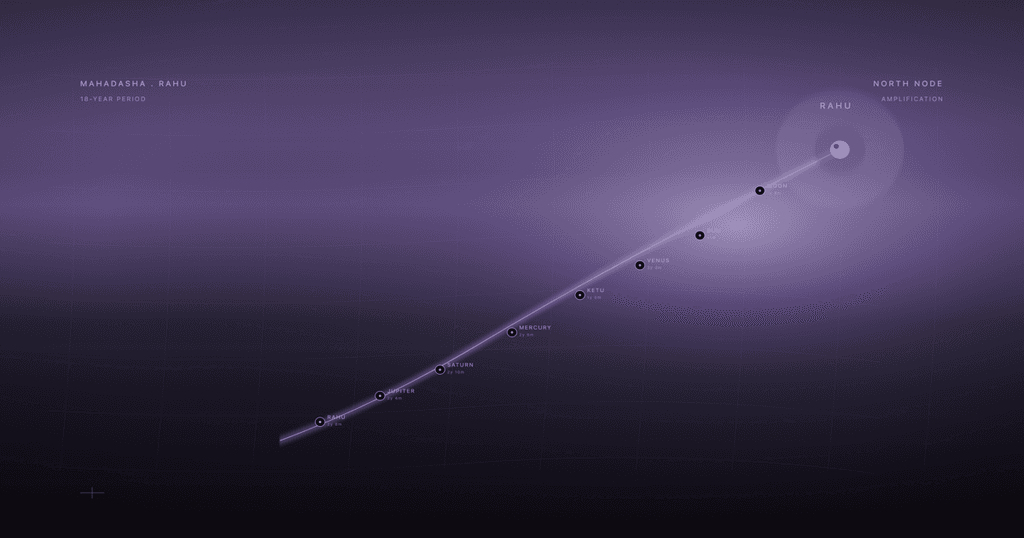
The Vimshottari sub-periods inside the 18-year Rahu Mahadasha run through all nine planets in proportion to their mahadasha lengths. Each sub-period activates a different pairing with the Rahu mahalord. Friend-pair sub-periods read constructively, enemy-pair sub-periods read with more friction. The full reading for each pairing is at the dedicated antardasha article linked in the table.
| Antardasha | Duration | Reading |
|---|---|---|
| Rahu | 648 days | Pure Rahu signature, opens and closes the 18-year window. Defining unconventional-amplification events at one of the two endpoints. |
| Jupiter | 864 days | Rahu-Jupiter brings amplification into the dharmic register (about 2 years 5 months, neutral pair). Foreign-dharmic events, unconventional-teaching, eclipse-axis dharmic activations. Often the most outwardly-expansion-supportive sub-period. |
| Saturn | 1026 days | Rahu-Saturn brings amplification and structure together (about 2 years 10 months, friend-pair). Foreign-institutional work, unconventional-structural arcs. Long sub-period producing sustained outcomes. |
| Mercury | 918 days | Rahu-Mercury brings amplification into communication. Foreign-commerce, unconventional-publishing, eclipse-axis publication events. About 2 years 6 months. |
| Ketu | 252 days | Rahu-Ketu brings amplification and dissolution together (node-pair sub-period). Classically the most karmically-decisive sub-period: eclipse-axis activation at maximum, foreign-detachment, significant past-life-axis events. |
| Venus | 1080 days | Rahu-Venus is the longest sub-period (about 3 years, friend-pair). Foreign-pleasure events, unconventional-luxury arcs, large-scale aesthetic-amplification. Often the most pleasure-supportive Rahu sub-period. |
| Sun | 324 days | Rahu-Sun brings amplification and authority together (enemy-pair). Authority-amplification events, foreign-government recognition, eclipse-axis authority activations. |
| Moon | 540 days | Rahu-Moon brings amplification and emotional life together (enemy-pair). Emotional-amplification events, foreign-residency with emotional weight, eclipse-axis mind-events. Classically warning for mental volatility. |
| Mars | 378 days | Rahu-Mars brings amplification and action together (enemy-pair, Angarak Yoga activation). Defining unconventional-action arcs, foreign-conflict or significant decisive-amplification moves. The Mars-Rahu signature carries strong historical pressure pattern on Russia (under recalibration per 2026-05-09 audit). |
By natal ascendant
Rahu's functional reading shifts with the ascendant. The houses Rahu rules and the dignity Rahu carries for each lagna determine whether Rahu reads as functional benefic, functional malefic or yogakaraka for that ascendant. The per-ascendant readings are at the dedicated articles linked below.
- Rahu mahadasha for Aries ascendant
- Rahu mahadasha for Taurus ascendant
- Rahu mahadasha for Gemini ascendant
- Rahu mahadasha for Cancer ascendant
- Rahu mahadasha for Leo ascendant
- Rahu mahadasha for Virgo ascendant
- Rahu mahadasha for Libra ascendant
- Rahu mahadasha for Scorpio ascendant
- Rahu mahadasha for Sagittarius ascendant
- Rahu mahadasha for Capricorn ascendant
- Rahu mahadasha for Aquarius ascendant
- Rahu mahadasha for Pisces ascendant
Transit confirmation protocol
The Rahu mahadasha reading anchors against natal Rahu's house position and the Rahu-Ketu axis (always exactly 180 degrees apart). Watch Rahu's 18-year orbital cycle (Rahu returns to natal position once every approximately 18.6 years), Rahu transit conjunctions to natal planets, eclipse cycles (solar and lunar eclipses occur on the Rahu-Ketu axis) and the rahu_over_stellium signature on national charts. See eclipse-axis on national charts.
Forward-call grounding
Rahu signatures feed several Tempora forward calls: AI bubble (rahu_over_stellium 3.0x on US chart calibrated weight), India 2029 election (overlapping with India Rahu mahadasha), Korean peninsula Rahu stellium 2027-2028, mag-7 NVDA peak 2026-2027 and the india-monsoon-2026 (Rahu-Jupiter context). The Mars-Rahu Russia 5.46x figure is under recalibration. See the tracker.
What the framework does not predict
The mahadasha reading is structural. The 18-year Rahu period names a register and a karaka domain; it does not generate forward calls by itself. Calibration is by chart and signature class, not by mahadasha membership. The personal reading depends on natal Rahu's house, sign dignity, dispositor strength, conjoining planets, aspecting planets, the running antardasha and the simultaneous transit picture. The framework is explicit about this scope limit.
Classical sources
Brihat Parashara Hora Shastra (BPHS) Chapter 38 covers Rahu mahadasha effects. Phaladeepika treats Rahu in detail across multiple chapters given Rahu's shadow nature. The 18-year duration is fixed by the classical Vimshottari assignment.
Rahu mahadasha by ascendant
Rahu owns no sign, so the 18-year period takes its content from natal Rahu's house and dispositor rather than from any lordship of its own. What the ascendant fixes is the whole-sign grid the node borrows from: which lords receive the amplification and what each sub-period carries. The condensed readings below summarise the twelve dedicated ascendant pages linked above.
Aries ascendant
Mars rules the 1st and 8th houses from Aries lagna, so identity and rupture share one landlord and Rahu amplifies a chart already built for speed. The characteristic failure mode of the eighteen years is overreach, starting a third venture before the first has stabilised; the characteristic gift is metabolising disruption that would flatten a more cautious chart. The Saturn sub-period of 2 years 10 months 6 days carries the 10th and 11th houses, the heaviest career stretch of the cycle, and the 3-year Venus sub-period carries the 2nd and 7th, money and marriage. Natal Rahu's own house and dispositor set the actual theatre of events.
Taurus ascendant
Saturn rules the 9th and 10th houses from Taurus lagna, an angle and a trine from one planet, the most constructive lord this chart holds, so the Rahu-Saturn sub-period of 2 years 10 months 6 days is the axis of the mahadasha rather than its ordeal. Jupiter carries the 8th and 11th, mixing windfall with volatility in one stretch, and Venus, the ascendant lord, also owns the 6th, keeping work and health load inside even the pleasant 3-year Venus sub-period. The fixed temperament concentrates the node's force into a few large moves rather than continuous churn. Natal Rahu in Capricorn or Aquarius hands the amplifier to the friendliest dispositor.
Gemini ascendant
Mercury rules the 1st and 4th houses from Gemini lagna, tying identity and home base to one fast planet, and several classical sign-strength lists count Gemini among Rahu's strongest signs. The eighteen years typically read as serial intensity: genuine reach across networks, languages and platforms, with scatter as the cost, reaching the private base through the 4th-house lordship. Rahu-Jupiter carries the 7th and 10th, both angles, marriage and profession in one stretch; Rahu-Saturn spends 2 years 10 months on the 8th and 9th, the slowest interior part; the closing Rahu-Mars year tilts toward competition that pays through the 6th and 11th. Natal house and dispositor still decide the story.
Cancer ascendant
The Moon rules the Cancer lagna alone, so Rahu's appetite plays out against a security-first temperament and many natives experience the period as appetite and security taking turns at the wheel. Mars, ruling the 5th and 10th, is the classical yogakaraka here, so natal Rahu in a Mars sign takes on career-and-creative-ambition colouring, while Venus signs pull the home-and-gains axis forward and Saturn signs drag the 7th-8th portfolio centre-stage. Rahu-Saturn at 2 years 10 months 6 days is the structural test of the period; the 3-year Rahu-Venus stretch is usually its most materially generous. Vimshottari is one timing system among several and natal placement outranks any sign-level summary.
Leo ascendant
The Sun owns the Leo lagna alone, and Rahu is the eclipse point that opposes solar authority, so the recurring question of the eighteen years is authorship: whether visibility is earned in the chart's own name or borrowed at scale. Venus, ruling the 3rd and 10th, and Mars, the classical yogakaraka ruling the 4th and 9th, convert the node's push into career and standing. Rahu-Sun lasts just 10 months 24 days yet concentrates the identity question of the whole period into one short window. Natal Rahu in Taurus, Aries or Gemini tends to cooperate; Rahu in Leo itself or in the 12th tends to grind.
Virgo ascendant
Mercury rules the 1st and 10th houses from Virgo lagna, making identity and career a single audited circuit: Rahu inflates and Mercury itemises, and inflation that survives the audit becomes genuine scale. Rahu-Mercury at 2 years 6 months 18 days is the signature sub-period, while the 3-year Rahu-Venus stretch runs wealth and fortune through the 2nd and 9th. Saturn rules the 5th and 6th here, so the long Rahu-Saturn slice reads as workload more than wreckage. Natal Rahu in the 10th, 11th or 6th tends to produce output; in the 8th or 12th the amplification runs on losses instead. The failure mode is claims compounding faster than the ledger supports.
Libra ascendant
Saturn rules the 4th and 5th houses from Libra lagna, an angle and a trine together, the classical yogakaraka, and the node hands its longest sub-period to precisely that planet: Rahu-Saturn at 2 years 10 months 6 days is the constructive axis of the mahadasha provided natal Saturn holds up. Venus, the ascendant lord, also owns the 8th, so lagna-lord sub-periods carry the chart's own transformation load, and Mars ruling the 2nd and 7th folds partnership friction into the money house. The usual shape is prolonged consultation resolving into a single decisive step. Natal Rahu in Capricorn or Aquarius hands the amplifier straight to the yogakaraka.
Scorpio ascendant
Several classical lists treat Scorpio as Rahu's sign of debilitation, so the node's eighteen years carry an extra structural weight for this ascendant, heaviest when natal Rahu sits in Scorpio and the fall lands in the lagna itself. Mars, the ascendant lord, also owns the 6th, so lagna-lord sub-periods bring a service and health load. Jupiter rules the 2nd and 5th, wealth and creativity together, making Rahu-Jupiter at 2 years 4 months 24 days the constructive axis, while Rahu-Saturn at 2 years 10 months 6 days grinds through effort and home via the 3rd and 4th. Jupiter-ruled natal placements are the friendliest; Mars-ruled ones stack the fall with the 6th-house drag.
Sagittarius ascendant
Jupiter rules the 1st and 4th houses from Sagittarius lagna, so the Rahu-Jupiter sub-period of 2 years 4 months 24 days runs the ascendant lord itself, amplifying identity and home base simultaneously; where natal Jupiter is dignified this is the highlight of the eighteen years, where compromised the same houses take the strain. Mercury owns the 7th and 10th, so Rahu-Mercury at 2 years 6 months 18 days doubles career with partnership, and Rahu-Saturn, the longest stretch, grinds money and effort together through the 2nd and 3rd. The usual shape is a doctrine that opens outward, geographically or intellectually. Jupiter-ruled natal placements host the node best; Mars-ruled ones activate the 5th-and-12th mix.
Capricorn ascendant
Capricorn rising is already wired for rank earned in sequence, and Rahu mostly removes the patience: the dasha changes how fast the chart reaches for what it wants and what the reaching costs. Venus is the classical yogakaraka here, ruling the 5th and 10th, so the 3-year Rahu-Venus antardasha carries the heaviest career stakes of the period, while Rahu-Saturn at 2 years 10 months 6 days, the longest sub-period, audits whatever the earlier stretches inflated. Two Capricorn risings can live entirely different Rahu periods; the dispositor of natal Rahu and its occupied house choose which square of the grid catches fire. Transit Rahu crosses Capricorn itself from 27 Dec 2026 to 15 Jul 2028.
Aquarius ascendant
Aquarius is the one rising sign where Rahu arrives on home ground: the chart is Saturn-ruled air, already unconventional and network-first, and several lineages outside the Parashari mainstream name Rahu a co-lord of the sign, an assignment Vimshottari timing ignores. The fluency cuts both ways, since excess arrives as slow drift rather than announcement, which makes audit points matter more here than for any other lagna. Jupiter rules the 2nd and 11th together, so Rahu-Jupiter at 2 years 4 months 24 days is the period's wealth window; Venus, the yogakaraka ruling the 4th and 9th, gives the 3-year Rahu-Venus stretch its weight; Saturn ruling the 1st and 12th binds self-definition to withdrawal through Rahu-Saturn.
Pisces ascendant
Jupiter rules the 1st and 10th houses from Pisces lagna, so self and career answer to one lord and the eighteen years stage an argument between two methods: the node grips, Jupiter releases. Classical readings fall into two outcomes, Rahu recruiting Jupiter into worldly expansion with a spiritual vocabulary attached, or Jupiter absorbing Rahu until the appetite itself becomes a teacher, and most natives alternate between the two. Rahu-Jupiter at 2 years 4 months 24 days activates the 1st and 10th together and is the structural centre of the period, while Saturn holding the 11th and 12th makes Rahu-Saturn alternate between earning and withdrawing. Transit Rahu occupies Capricorn, the 11th house here, from 27 Dec 2026 to 15 Jul 2028.
Frequently asked questions
How long is the Rahu Mahadasha and where does it fall in the Vimshottari sequence?
The Rahu Mahadasha runs 18 years. It is the sixth mahadasha in the 120-year Vimshottari sequence, falling between Mars and Jupiter. Which mahadasha a native is born into depends on the natal Moon's nakshatra and how far through the dasha the nakshatra-pada places the birth point.
What does Rahu signify as a karaka?
Rahu is the primary karaka for foreign and unconventional pursuits. Its full karaka portfolio includes amplification, foreign lands, sudden rise, scandal, obsession, technology, mass-audience phenomena, unconventional careers, drugs and shadow-significations and the principle of magnification in life. The Rahu mahadasha brings these significations into the foreground for 18 years, with the natal house and dispositor of Rahu setting the texture of the period.
How does Rahu's natal dignity shape the reading?
Rahu's natal sign and house set the floor for the 18-year period. Rahu exalted in Taurus (per most modern schools) or Gemini (per some classical sources) (20°) gives the strongest reading. Rahu in own sign no traditional own-sign assignment for the lunar nodes gives clean uncomplicated expression. Rahu debilitated in Scorpio (per most modern schools) or Sagittarius (per some classical sources) (20°) introduces friction that the mahadasha must work through. Angular house placement (1st, 4th, 7th, 10th) softens the reading regardless of sign.
What are the 9 antardasha sub-periods inside the Rahu Mahadasha?
The Vimshottari sub-period sequence inside the Rahu Mahadasha runs: Rahu-Rahu (2 years 8 months 12 days), Rahu-Jupiter (2 years 4 months 24 days), Rahu-Saturn (2 years 10 months 6 days), Rahu-Mercury (2 years 6 months 18 days), Rahu-Ketu (1 year 18 days), Rahu-Venus (3 years), Rahu-Sun (10 months 24 days), Rahu-Moon (1 year 6 months), Rahu-Mars (1 year 18 days). Each sub-period activates a different karaka combination and is the unit where event timing concentrates.
What does the Tempora framework not predict about the Rahu Mahadasha?
The framework identifies a 18-year structural-pressure window where the Rahu karaka register is foregrounded. It does not predict whether a specific native will experience a specific event in that window. It does not predict outcome direction. Specific event timing inside the mahadasha needs the antardasha and pratyantara overlay plus transit data.
Read next
- Mahadasha and Vimshottari planetary periods · the cluster index of all nine mahadasha readings
- Mars Mahadasha · the mahadasha that precedes Rahu in the Vimshottari sequence
- Jupiter Mahadasha · the mahadasha that follows Rahu
- Calibrated lift: the discipline that turns Vedic astrology into research
This article represents conventional Vedic teaching and Tempora Research method documentation. It does not constitute financial, legal or professional advice. Internal audit log maintained.