Rahu Mahadasha Moon Antardasha: 1.5 years and the emotional-axis amplification
Moon antardasha inside Rahu runs 1.5 years and is the eighth sub-period of the 18-year Mahadasha. Moon rules the emotional foundation, the mother, public-mood patterns and the inner-life domains; Rahu amplifies these into boundary-crossing or unconventional emotional patterns. What the structural-amplification window actually does and how natal Moon dignity modulates it.
The Moon's sub-period brings the Rahu mahadasha home to the mind. Arriving after the brief, glaring Sun antardasha, it turns the cycle's sixteenth and seventeenth years toward the interior register the Moon rules: mood, memory, mother, the public's reception and the tide of feeling. The classical matrix marks Rahu and the Moon as enemies, and the enmity is asymmetric in a specific way, since the Moon is the planet most easily shadowed and Rahu the shadow most drawn to it; the tradition's grahan imagery belongs to this pair. The assigned texture is turbulence of the inner weather, amplified longing and imagination running past its banks, alongside the possibility of an unusually vivid interior life where the natal Moon is strong. It is the mahadasha's emotional reckoning, scheduled late, when there is finally something to reckon with.
Where the sub-period falls in the Vimshottari sequence
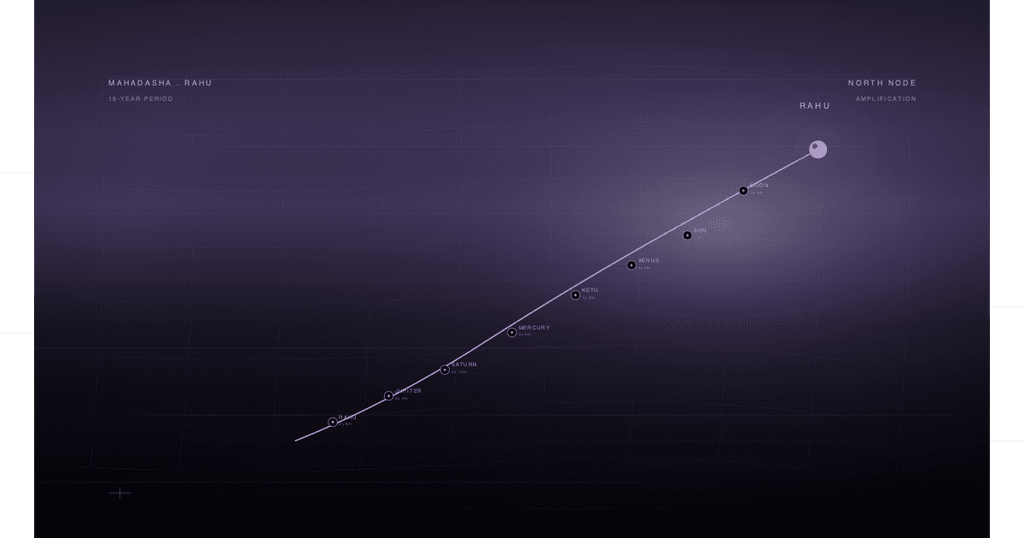
The 18-year Rahu mahadasha divides into nine antardasha sub-periods in fixed Vimshottari order starting with Rahu itself. The Moon sub-period sits at position 8 of 9. Exact start and end dates for any chart can be computed from the natal Moon nakshatra-pada and the date of Rahu mahadasha onset. The Tempora dasha engine produces this to the day.
Friendship status and pairing reading
In the classical Parashari friendship matrix, Rahu views Moon as enemy. The enemy-pair classification means the 1 year 6 months sub-period classically delivers outcomes through friction between Rahu's register (worldly desire, foreign-axis, amplification, taboo and the boundary-crossing register) and Moon's register (mind, mother, emotional foundation, public reception and the cyclic register). Classical guidance suggests sustained-effort and patience over decisive-action during enemy-pair sub-periods. Events surface through the friction rather than around it.
The Moon karaka overlay
Moon is the karaka of mind, mother, emotional foundation, public reception and the cyclic register. Across the 1 year 6 months sub-period, this karaka set overlays on top of Rahu's 18-year worldly desire, foreign-axis, amplification, taboo and the boundary-crossing register register. The combined reading is the central output of the sub-period.
How Moon's natal dignity shapes the reading
Moon's natal sign and house set the floor for the 1 year 6 months sub-period. Moon at exaltation gives the strongest reading. Own-sign and mooltrikona placement gives clean expression. Debilitation introduces friction that the sub-period must work through. Combust and retrograde state, conjunctions with malefics or benefics and the dispositor's strength all further modulate the reading. See the Moon mahadasha overview for the per-dignity breakdown.
Event classes typical to Rahu-Moon sub-period
The 1 year 6 months Rahu mahadasha Moon antardasha typically surfaces events across these specific domains:
- Friction between Rahu-register and Moon-register: enemy-pair sub-periods classically require careful navigation. Events surface through the friction rather than around it.
- Events in Moon's natural karaka domain: mind, mother, emotional foundation, public reception and the cyclic register.
- Events specific to the natal house Moon occupies in the chart.
- Events where the Rahu-mahalord and Moon-antarlord houses (both natal and ruled) interact (aspect, mutual reception or natal conjunction).
What the framework does not predict
The framework reads structural pressure on the emotional axis. It does not predict that a specific native will experience a specific emotional inflection, mother-axis event or public-facing transition on a specific date inside the 1.5-year band.
It does not predict outcome direction. Whether an emotional inflection resolves through stabilisation or destabilisation, whether a mother-axis event reads as growth or loss, whether a public-facing transition produces favourable or unfavourable reception, is not specified by the structural-pressure reading. The chart times the pressure; the actor decides the form and the broader environment decides the outcome.
It does not predict timing finer than the sub-period band without the pratyantara overlay and the transit cross-check. The mahadasha-antardasha reading gives a 1.5-year window; finer date-identification requires additional layers.
How Rahu-Moon connects to the broader Rahu Mahadasha
Rahu-Moon is the eighth sub-period of the 18-year Rahu Mahadasha and opens the closing band. The native has been through the foundational Rahu-Rahu phase, the friction phases (Rahu-Jupiter and Rahu-Saturn), the commerce-amplification of Rahu-Mercury, the dissolution of Rahu-Ketu, the wealth-and-partnership amplification of Rahu-Venus and the authority-axis pressure of Rahu-Sun. The Rahu-Moon emotional-axis processing prepares the native for the action-axis closure events of the closing Rahu-Mars sub-period.
The classical pattern reads the penultimate sub-period of any Mahadasha as a processing window that integrates the patterns of the broader Mahadasha. For Rahu Mahadasha specifically, this often expresses as the emotional-axis processing that integrates the boundary-crossing and amplification patterns the Mahadasha established. The closing Rahu-Mars sub-period then carries the action-axis events that close out the integrated themes.
The arithmetic of this period
The Moon carries 10 of the 120 Vimshottari years, so its sub-period under Rahu runs 18 multiplied by 10 divided by 120: exactly 1.5 years, 1 year and 6 months. It is position 8 of 9. The seven sub-periods before it sum to 15.45 years, placing Rahu-Moon across roughly years 15.45 to 16.95 of the mahadasha, the penultimate chapter. Its neighbours frame a closing sequence: the 0.9-year Sun antardasha before it raises the authority question, the Moon processes what that exposure stirred and the final 1.05-year Mars antardasha then acts on the findings and closes the cycle.
An antardasha this deep in the mahadasha meets a settled life stage, which changes its character: the same Moon sub-period early in a cycle would colour formation, while here it reviews sixteen years of Rahu-era choices at the level of feeling. The complete map is in the Rahu mahadasha overview; the Moon's own 10-year major period is treated in the Moon mahadasha article.
Where the two classical texts part ways
This is a pairing on which the two classical sources pull in opposite directions. The BPHS antardasha chapters, Rahu mahadasha section, read a strong Moon generously: exalted or in own sign, in a kendra, trikona or the eleventh, or in a friendly sign under benefic aspect, the Moon is assigned kingdom-gain, royal respect, wealth, sound health, garments and ornaments, happiness from children and growth of house and landed property. Counted from the dasha lord, a Moon in a kendra or in the fifth, ninth or eleventh is given the grace of Lakshmi, all-round success, rising wealth and grain and the worship of deities. The adverse branch keeps its condition attached, since a weak Moon in the sixth, eighth or twelfth from the dasha lord brings disturbances at home and in agriculture, theft danger on journeys and stomach disorders, and where the Moon holds second-house lordship the passage adds health cautions with charity of a white cow prescribed. Phaladeepika, in its chapter on the sub-divisions of dashas, hard-sets the period as loss of the wife, quarrels and destruction of wealth and cattle, an assignment carrying no favourable branch at all. The gap between Parashara's conditional generosity and Mantreswara's fixed severity here is among the widest in the two texts' antardasha treatments. The engine resolves the split by treating both records as inputs and letting the natal Moon's dignity decide which reading a chart inherits.
This period against the 2026 to 2028 sky
For a lunar sub-period the marked sky event of this span is the 12 August 2026 solar eclipse on the Cancer-Leo cusp, an event the tradition hands to the nodes and the luminaries jointly, with Cancer being the Moon's own sign. A native whose Rahu-Moon runs across mid 2026 would classically read the eclipse as bearing directly on the pairing's themes, the shadowing of the light this sub-period is named for, located by the houses Cancer and Leo hold from the natal ascendant. The limitation is structural, since an eclipse is a matter of hours shared across a hemisphere and can only tint a season of an eighteen-month window, never date its events. The nodal ingress of 27 December 2026 then moves Ketu into Cancer, the Moon's sign, with Rahu opposite in Capricorn until 15 July 2028, a second nodal contact with lunar terrain inside the same span. Against all of this stands the Moon's own speed, completing the 27-nakshatra circuit every 27.3 days, which is why classical timing inside a Moon sub-period leans on the natal Moon's condition rather than on any single transit date. A Moon exalted in Taurus or at home in Cancer steadies the enemy pairing; a Moon debilitated in Scorpio or conjunct a node at birth gives it turbulence to amplify.
Frequently asked questions
How long is the Rahu Mahadasha Moon Antardasha and where does it fall in the Vimshottari sequence?
The Rahu Mahadasha Moon Antardasha runs exactly 1.5 years (1 year 6 months). It is the eighth sub-period inside the 18-year Rahu Mahadasha. The Vimshottari sub-period order is Rahu, Jupiter, Saturn, Mercury, Ketu, Venus, Sun, Moon, Mars. The native is approximately 15 years 5 months into the Rahu Mahadasha when Rahu-Moon opens and the sub-period closes at approximately 16 years 11 months into the Mahadasha. Exact start and end dates depend on natal Moon nakshatra-pada and the date the Rahu Mahadasha opened.
Why is Rahu-Moon called the emotional-axis amplification window?
Moon is the karaka of the emotional foundation, the mother, public-mood patterns, the inner-life domain, fluctuation and sensitivity. Rahu amplifies whatever planet runs concurrent dasha alignment with it. The Rahu-Moon combination over 1.5 years produces structural amplification of Moon-axis domains: emotional-pattern intensification, mother-axis events, public-facing inflections, mood-cycle pressure and the kinds of inner-life processing events that the Moon classically rules but with the boundary-crossing or amplified character that Rahu adds. Classical readings flag the sub-period for both genuine emotional-maturation events and for the anxiety or destabilisation patterns that follow Rahu's amplification when natal Moon is weakly placed.
How does Moon's natal dignity shape the Rahu-Moon sub-period reading?
Moon's natal house, sign and aspectual state set the floor for the 1.5-year sub-period. Moon exalted in Taurus, in own sign Cancer or in angular houses (1st, 4th, 7th, 10th) substantially modulates the reading toward genuine emotional-maturation events, stable mother-axis transitions and public-facing inflections that compound favourably. Moon debilitated in Scorpio, combust within close orb of the Sun or under malefic aspect amplifies the destabilisation reading and produces more complicated emotional-axis events: anxiety patterns, mother-axis crisis, public-mood inflections that go poorly. Moon aspected by Jupiter softens the reading and brings emotional discernment into the Moon-axis events. Moon aspected by Saturn produces slow-developing emotional patterns with structural-discipline overlay; the reading is often grief or loss processing that matures the emotional foundation.
What kinds of events historically correlate with Rahu-Moon sub-periods?
The classical Parashari reading associates Rahu-Moon with several event classes: emotional-pattern inflection events (relationships ending or stabilising, grief work, mental-health-axis transitions) often with boundary-crossing context (long-distance or international relational events), mother-axis events (mother's health changes, family-foundation transitions, generational-axis shifts in the family-of-origin), public-facing career inflections where Moon-axis significations apply (media-axis transitions, public-mood-dependent work, the broader public reception of the native's output) and inner-life processing events that compress significant emotional change into the 1.5-year window. The Tempora framework reads the sub-period as a structural-pressure window for these classes of event rather than a deterministic predictor.
How does this sub-period connect to the broader Rahu Mahadasha?
Rahu-Moon is the eighth and penultimate sub-period of the 18-year Rahu Mahadasha. It opens after Rahu-Sun (authority-axis pressure) and closes into Rahu-Mars (action-and-completion). By the time Rahu-Moon opens, the native has been through the foundational and middle phases of the Mahadasha and is in the closing band. The sub-period typically reads as the emotional-processing window that prepares the native for the action-axis closure events of Rahu-Mars and the broader Mahadasha transition to Jupiter. The Tempora Rahu Mahadasha method article covers the dispositor analysis and natal-house framework that sets the texture of the full 18 years.
What does the Tempora framework not predict about this sub-period?
The framework identifies a 1.5-year structural-pressure window with elevated conditional probability for Moon-axis event classes. It does not predict whether a specific native will experience a specific emotional-pattern inflection, mother-axis event or public-facing transition in that window. It does not predict outcome direction (whether an emotional inflection resolves through stabilisation or destabilisation, whether a mother-axis event reads as growth or loss). It does not predict timing finer than the sub-period band without the pratyantara overlay and the transit cross-check. The classical readings carry historical and conventional weight, but the framework treats them as structural-pressure flags to be cross-checked against transit data and chart-specific natal Moon dignity, not as deterministic forecasts.
Which years of the Rahu mahadasha does the Moon antardasha cover?
Roughly years 15.45 to 16.95. The duration is 18 multiplied by 10 divided by 120, which is exactly 1.5 years, 1 year and 6 months. It is position 8 of 9, following the Sun sub-period and preceding the closing Mars antardasha at roughly year 16.95. A native who entered the mahadasha at 30 runs Rahu-Moon between about 45.45 and 46.95.
Which 2026 to 2028 sky events touch a running Rahu-Moon antardasha?
Two dated events involve this pairing's actors. The 12 August 2026 solar eclipse falls on the Cancer-Leo cusp, touching the Moon's own sign, and the 27 December 2026 nodal ingress places Ketu in Cancer with Rahu in Capricorn until 15 July 2028. Both are sky-wide events shared by every chart, so neither can time a personal outcome; they colour the window for natives whose computed dasha calendar actually places Rahu-Moon across those dates, and the natal Moon's sign, phase and house carry more interpretive weight than either transit.
What do the classical texts say about Rahu-Moon?
They disagree sharply. The BPHS antardasha chapters, Rahu mahadasha section, read a strong Moon as kingdom-gain, royal respect, wealth, health and property growth, reserving the adverse list for a weak Moon badly placed from the dasha lord, with health cautions attached where second-house lordship applies. Phaladeepika, in its chapter on the sub-divisions of dashas, fixes the period as loss of the wife, quarrels and destruction of wealth and cattle, one list for every chart. The engine carries both records as inputs and lets natal Moon dignity decide which one a chart inherits.
Read next
- Rahu Mahadasha Mars Antardasha · the closing sub-period that follows Moon
- Rahu Mahadasha Venus Antardasha · the partnership and luxury sub-period earlier in the Mahadasha
- Rahu Mahadasha Mercury Antardasha · the commerce-amplification sub-period
- Calibrated lift astrology · the methodology behind the conditional-probability claim
- Sun Mahadasha: how to read the 6-year period
This article represents conventional Vedic teaching and Tempora Research method documentation. It does not constitute financial, legal or professional advice. Internal audit log maintained.