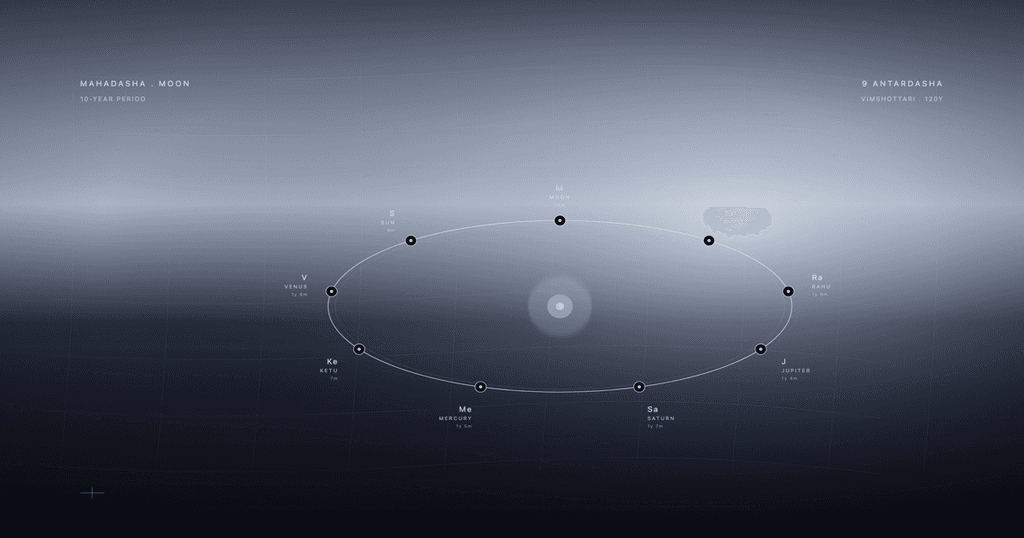
Moon Mahadasha: how to read the 10-year period
The Moon mahadasha is the period when mind, mother and the emotional life dominate the texture of a decade. Moon as karaka of the mind and the public, how natal house and dispositor shape the reading, the 9 antardasha sub-periods and what the framework does not predict.
Where it falls in the Vimshottari sequence
The Vimshottari system runs nine mahadashas in a fixed sequence totalling 120 years: Ketu 7, Venus 20, Sun 6, Moon 10, Mars 7, Rahu 18, Jupiter 16, Saturn 19 and Mercury 17. Moon occupies the fourth position in the cycle and runs 10 years. Which mahadasha a native is born into depends on the natal Moon's nakshatra and how far through that nakshatra the Moon had travelled at the moment of birth.
Moon follows Sun (6 years of authority and identity-formation). After the Moon period closes the Mars mahadasha opens for 7 years.
Moon's karaka nature
Moon is the karaka for the mind, mother and emotional foundation. In the natural zodiac Moon rules the 4th house (Cancer) which doubles its signification for home, real estate, comfort and inner emotional life. Careers in food, hospitality, real estate, fluids, women's domains, public-facing service and lunar-cycle businesses often peak during the Moon Mahadasha for natives with Moon well placed natally.
The Sanskrit name Chandra translates as 'the bright' or 'the cool one'. Classical mythology frames Moon as the queen of the planetary cabinet, the consort to Sun's king-register. The Moon's 27 wives (the nakshatras) frame the timing system: Moon's location among the nakshatras at birth sets the entry point of the Vimshottari sequence.
Dignity: exaltation, own signs, debilitation
Moon exalted in Taurus. Maximum natal strength. The 10-year period operates with maximum moon-register support. Natives with Moon exalted in Taurus typically experience the mahadasha as flowing with unusual ease in the karaka domain.
Moon in own sign Cancer. The own-sign placement carries the moon qualities with the stability of familiar territory, close to exaltation-strength without the elevation but with reliability across the 10-year period.
Mooltrikona: Taurus (3-30 degrees). The mooltrikona band within the own sign is the strongest functional placement after exaltation. The classical readings give mooltrikona-Moon the moon signification in its most direct and operative form.
Moon debilitated in Scorpio. The classical tradition reads debilitated Moon as reducing the ease of the moon-register. The debilitation does not cancel the mahadasha's fundamental signature but introduces friction into it. Neecha Bhanga (debilitation cancellation) is possible under specific configurations and is read separately.
Combustion. Moon combust (within 12 degrees of the Sun) is classically read as reducing the Moon's expressive capacity. Combust-Moon natives in the Moon Mahadasha often experience the emotional and public-reception register filtered through identity-and-authority themes from the Sun.
Classical friend-enemy scheme. Moon's friends are Sun and Mercury. Enemies are none classically. Neutral planets are Mars, Jupiter, Venus and Saturn. This friendship matrix shapes the antardasha sub-period readings: friend-sub-periods read constructively, enemy-sub-periods read with more friction.
Additional dignity factors. Moon waxing (paksha bala) adds strength: Moon between the 8th tithi of shukla paksha and the 8th tithi of krishna paksha is considered strong. Moon in the 4th house carries digbala. Both factors are weighed alongside sign dignity in the natal reading.
How natal house shapes the reading
Moon's natal house tells the reader which life domain carries the moon-reading most strongly during the 10-year period. The house gives the surface domain. The dispositor gives the underlying mechanism. Both are read together.
Moon in the 1st house. The self as feeling. The mahadasha reads as a period of emotional-life surfacing, self-image consolidation and lunar-quality embodiment (sensitivity, public visibility, mood-rhythm). Moon in the 1st reads as strong emotional self-presentation.
Moon in the 2nd house. Wealth from emotional sources and family-of-origin events. The 10-year window often produces family-business consolidation, inheritance from the maternal line and significant speech-related work (singing, public-speaking). The 2nd house also rules food, which a Moon-dominant period often activates.
Moon in the 3rd house. Communication, courage and younger-sibling dynamics. Moon in the 3rd reads as emotional-creative output: writing, publishing, music or significant younger-sibling life events. The 10-year window often produces a defining creative-publishing arc.
Moon in the 4rd house. Home, mother and emotional foundation at maximum intensity. Moon in the 4th has digbala (directional strength), the strongest classical placement for emotional-domestic life. The mahadasha typically produces the defining home-and-mother events of the native's life: home purchase, mother-significator events, real-estate cycles.
Moon in the 5rd house. Children, creative emotional expression and devotional intelligence. Moon in the 5th brings emotional-creative-children themes together. The mahadasha often produces birth events, defining creative-emotional output or significant devotional practice.
Moon in the 6rd house. Service, conflict and the emotional-health register. Moon in the 6th is classically uncomfortable (emotional planet in conflict house) but can produce healing-profession work, emotional-service careers or significant health-management episodes. The 10-year window often produces defining episodes around digestive or emotional-health themes.
Moon in the 7rd house. Marriage, partnership and public-facing emotional life. Moon in the 7th is the classical marriage-significator placement. The mahadasha typically produces marriage events, business-partnership consolidation and significant public-relationship arcs.
Moon in the 8rd house. Transformative and hidden emotional registers. Moon in the 8th classically reads as emotional-volatility but can produce occult-emotional work, inheritance from the maternal line or significant transformative events. The 10-year window often produces defining mortality-confrontation experiences.
Moon in the 9rd house. Foreign travel, higher learning and emotional dharma. Moon in the 9th reads as devotional-emotional life: pilgrimage, foreign emotional connection, philosophical-emotional integration. The mahadasha often produces significant foreign-residency or higher-education credentials.
Moon in the 10th house. Career-summit in emotional-domain fields. Moon in the 10th supports careers in public-facing service, food, hospitality, real estate, women's domains or care professions. The mahadasha often produces the defining public-career event of the native's life.
Moon in the 11th house. Large gains from emotional networks and public reach. Moon in the 11th supports income from large-audience or public-facing work. The mahadasha often produces income-step-changes through emotional-domain channels and significant friendship-network events.
Moon in the 12th house. Foreign emotional life, contemplation and retreat. Moon in the 12th reads as emotional-life-abroad or contemplative-emotional practice. The mahadasha often produces significant foreign-residency, monastic-or-contemplative time or hospital-related emotional work.
Dispositor analysis
When Moon occupies a sign it does not rule (any sign except Cancer), the dispositor (the ruler of Moon's sign) shapes the underlying mechanism of the 10-year period.
Moon in Taurus: dispositor is Venus. Moon in Taurus is exalted; the Venus dispositor adds material-pleasure-and-stability colouring. Venus in the 4th or 10th doubles the comfort-and-public-life register.
Moon in Aries: dispositor is Mars. Moon in Aries draws the Mars dispositor into the emotional reading. Mars in a friend-house supports decisive-emotional action; Mars in the 6th or 8th adds emotional-volatility.
Moon in Leo: dispositor is Sun. Moon in Leo reads through the Sun dispositor. The mother-significator carries authority-quality. Sun in the 9th or 10th supports public-recognition of emotional work.
Moon in Scorpio: dispositor is Mars. Moon in Scorpio is debilitated, the most challenging dispositor configuration. The Mars dispositor's house and dignity determine whether the emotional-volatility resolves into productive intensity (Mars in 10th, well placed) or into ongoing friction (Mars debilitated in Cancer).
Moon in Pisces: dispositor is Jupiter. Moon in Pisces draws the Jupiter dispositor into the emotional reading. The 10-year period takes on dharmic-emotional depth, often producing significant teaching, philosophical or devotional events.
The 9 antardasha sub-periods
The Vimshottari sub-periods inside the 10-year Moon Mahadasha run through all nine planets in proportion to their mahadasha lengths. Each sub-period activates a different pairing with the Moon mahalord. Friend-pair sub-periods read constructively, enemy-pair sub-periods read with more friction. The full reading for each pairing is at the dedicated antardasha article linked in the table.
| Antardasha | Duration | Reading |
|---|---|---|
| Moon | 300 days | Pure Moon signature, opens and closes the 10-year window. Mother-significator events, emotional consolidation, public-life arcs. |
| Mars | 210 days | Moon-Mars brings emotional energy and action together. Often produces property events, sibling activations or defining emotional-decisive moments. |
| Rahu | 540 days | Moon-Rahu is classically challenging: mind-instability, foreign-emotional events or amplified public-reception. Eclipse-axis activations often visible. |
| Jupiter | 480 days | Moon-Jupiter is the most benefic sub-period. Dharmic-emotional events: marriage, children, devotional-teaching arcs or significant maternal-line dharmic transmission. |
| Saturn | 570 days | Moon-Saturn is heavy: emotional restriction, public-burden or significant mother-significator stress. Real-estate consolidation often visible. |
| Mercury | 510 days | Moon-Mercury brings emotional life into communication, commerce or writing. Publications, contract-cycles or significant sibling-emotional events. |
| Ketu | 210 days | Moon-Ketu contracts the emotional register. Spiritual retreat, mother-significator detachment or significant inner-emotional transformation. |
| Venus | 600 days | Moon-Venus brings emotional life into the pleasure-and-partnership register. Marriage, luxury, aesthetic-emotional events. Classically the most pleasure-supportive sub-period of the 10-year window. |
| Sun | 180 days | Moon-Sun brings emotional-and-authority registers together. Public-recognition with emotional weight, father-line events or authority-emotional consolidation. |
By natal ascendant
Moon's functional reading shifts with the ascendant. The houses Moon rules and the dignity Moon carries for each lagna determine whether Moon reads as functional benefic, functional malefic or yogakaraka for that ascendant. The per-ascendant readings are at the dedicated articles linked below.
- Moon mahadasha for Aries ascendant
- Moon mahadasha for Taurus ascendant
- Moon mahadasha for Gemini ascendant
- Moon mahadasha for Cancer ascendant
- Moon mahadasha for Leo ascendant
- Moon mahadasha for Virgo ascendant
- Moon mahadasha for Libra ascendant
- Moon mahadasha for Scorpio ascendant
- Moon mahadasha for Sagittarius ascendant
- Moon mahadasha for Capricorn ascendant
- Moon mahadasha for Aquarius ascendant
- Moon mahadasha for Pisces ascendant
Transit confirmation protocol
The Moon mahadasha reading anchors against natal Moon's nakshatra. Watch Sade Sati (Saturn transit through 12th/1st/2nd from natal Moon, the 7.5-year stress band; calibrated as the saturn_moon_opposition signature at 3.6x India / 4.21x UK calibrated lift), Jupiter transit to natal Moon (gajakesari yoga activation) and eclipse-axis activations across natal Moon. See the Sade Sati overview for the per-rashi reading.
Forward-call grounding
The Saturn-Moon-opposition signature feeds Tempora's India December 2027 forward call (strong historical pressure pattern on the India 1947 chart, under recalibration per the 2026-05-09 audit). See the calibrated-lift methodology for the audit details.
What the framework does not predict
The mahadasha reading is structural. The 10-year Moon period names a register and a karaka domain; it does not generate forward calls by itself. Calibration is by chart and signature class, not by mahadasha membership. The personal reading depends on natal Moon's house, sign dignity, dispositor strength, conjoining planets, aspecting planets, the running antardasha and the simultaneous transit picture. The framework is explicit about this scope limit.
Classical sources
Brihat Parashara Hora Shastra (BPHS) Chapter 31 covers Moon mahadasha effects. Phaladeepika treats Moon dignity with particular care for paksha bala (waxing/waning strength). The 10-year duration is fixed by the classical Vimshottari assignment.
Moon mahadasha by ascendant
The 10-year period reads differently for each rising sign because the ascendant fixes which house the Moon rules and how the ascendant lord relates to the Moon. The Moon owns a single sign (Cancer), so every lagna gets exactly one house from it, and the exaltation-in-Taurus and debilitation-in-Scorpio axis adds a second modifier. The twelve condensed readings below state the structural prior for each lagna.
Aries ascendant
The Moon rules the 4th house from Aries lagna, clean kendra ownership with no dusthana pairing, and Mars the ascendant lord treats the Moon as a classical friend. The ten years run home, property, emotional base and mother themes at their natural strongest, often bringing a home acquisition, a substantial property move or a foundational shift in the family base, the classical settle-after-battle expression for the warrior sign. Natal Moon in Cancer in the 4th or exalted in Taurus in the 2nd gives the strongest home-and-money signatures; Moon debilitated in Scorpio in the 8th is the most demanding placement unless Neechabhanga fires. Natal Moon's dignity, house and aspects remain the majority of the reading.
Taurus ascendant
The Moon rules the 3rd house from Taurus lagna, an upachaya, with Venus the ascendant lord neutral toward the Moon. Taurus is also the Moon's exaltation sign, so natal Moon in the lagna itself is exalted, a rare structural blessing for this rising sign. The upachaya register means the ten years grow stronger over time: initiative, siblings, courage and short-form communication compound, with sustained sibling and communication themes throughout. Exalted Moon in the 1st or own-sign Moon in Cancer in the 3rd are the strongest placements; Moon debilitated in Scorpio in the 7th strains marriage themes unless Neechabhanga fires. Natal Moon's dignity, house and aspects remain the majority of the reading.
Gemini ascendant
The Moon rules the 2nd house from Gemini lagna and Mercury the ascendant lord treats the Moon as a classical enemy. The 2nd is technically a maraka, though money and family themes dominate the reading unless the Moon is heavily afflicted. The ten years concentrate on family finances, food-and-speech matters and accumulated resources, often through channels the communicator temperament finds uncomfortable, such as family obligations that constrain a communication career or work requiring emotional depth over intellectual dexterity. Own-sign Moon in Cancer in the 2nd supports the period directly; Moon debilitated in Scorpio in the 6th is the most demanding placement unless Neechabhanga fires. Natal Moon's dignity, house and aspects remain the majority of the reading.
Cancer ascendant
For Cancer lagna the Moon is the ascendant lord itself, ruling only the 1st house with no doubling and no dusthana. This is the pure ascendant-lord mahadasha: ten years where identity, body, temperament and vitality take the period, the stretch the tradition treats as the native living most fully as themselves. Natal Moon in Cancer in the lagna is the strongest expression, with exalted Taurus in the 11th compounding network income and Aries in the 10th carrying yogakaraka Mars's support for career; Moon debilitated in Scorpio in the 5th strains speculation and children themes unless Neechabhanga fires. Natal Moon's dignity, house and aspects remain the majority of the reading.
Leo ascendant
The Moon rules the 12th house from Leo lagna, single-house dusthana ownership, softened by the Sun-Moon luminary friendship. The tradition reads 12L mahadashas as producing genuine expatriate life, monastic themes, spiritual retreat or hospital and hidden-institution work, and for the sovereign sign the classical signature is renunciation of the throne: prominence that requires voluntary retreat from public position. Own-sign Moon in Cancer in the 12th runs foreign and monastic themes directly, while exalted Taurus in the 10th gives an unusually strong career recovery; Moon debilitated in Scorpio in the 4th strains home themes unless Neechabhanga fires. Natal Moon's dignity, house and aspects remain the majority of the reading.
Virgo ascendant
The Moon rules the 11th house from Virgo lagna, clean upachaya ownership, with Mercury the ascendant lord treating the Moon as a classical enemy. The ten years concentrate on gains, elder-sibling matters and network income, flowing through emotionally-charged channels rather than the analytical ones the analyst sign prefers: healthcare, hospitality, food service, nursing and therapy work are the productive expressions. Own-sign Moon in Cancer in the 11th compounds network income directly and exalted Taurus in the 9th gives an unusually strong fortune signature; Moon debilitated in Scorpio in the 3rd strains initiative unless Neechabhanga fires. Natal Moon's dignity, house and aspects remain the majority of the reading.
Libra ascendant
The Moon rules the 10th house from Libra lagna, clean kendra ownership with no dusthana pairing and a neutral Venus-Moon relationship, structurally one of the cleaner Moon configurations for career. The ten years often bring career expansion through Moon-domain channels: hospitality, healthcare, food service, therapy, work with women and work with the general public. Whether the signature produces authority or exposure depends on natal Moon's dignity. Own-sign Moon in Cancer in the 10th compounds career directly and exalted Taurus in the 8th forms Vipareeta Raja Yoga with exaltation; Moon debilitated in Scorpio in the 2nd strains family finances unless Neechabhanga fires. Natal Moon's dignity, house and aspects remain the majority of the reading.
Scorpio ascendant
The Moon rules the 9th house from Scorpio lagna in clean trikona ownership, and Mars the ascendant lord treats the Moon as a classical friend. The ten years carry a genuine fortune signature: doctrine, teachers, long journeys and paternal-lineage themes, often flowing through spiritual, therapeutic or transformation channels rather than conventional dharma paths. The standing caveat is that Scorpio is the Moon's debilitation sign, so natal Moon in the lagna itself is debilitated and the most demanding placement unless Neechabhanga fires. Own-sign Moon in Cancer in the 9th or exalted in Taurus in the 7th are the strongest configurations. Natal Moon's dignity, house and aspects remain the majority of the reading.
Sagittarius ascendant
The Moon rules the 8th house from Sagittarius lagna, single-house dusthana ownership softened by Jupiter-Moon friendship. Transformation, in-laws' finances, hidden knowledge and joint-resource themes activate for the ten years, and the philosopher temperament steers them toward the classical spiritual-transformation signature: therapy, research, occult study and forensic work. Own-sign Moon in Cancer in the 8th forms the Vipareeta Raja Yoga configuration where hidden-matter themes produce sudden fortune, and exalted Taurus in the 6th forms Vipareeta with exaltation; Moon debilitated in Scorpio in the 12th is the most demanding placement unless Neechabhanga fires. Natal Moon's dignity, house and aspects remain the majority of the reading.
Capricorn ascendant
The Moon rules the 7th house from Capricorn lagna, a kendra that is also a maraka, and Saturn the ascendant lord treats the Moon as a classical enemy. The ten years concentrate on marriage and business partnership through emotionally-charged channels rather than the disciplined-work channels the ambition sign prefers. The productive form is a partnership that catalyses fundamental life-restructuring; the difficult form is partnership friction that constrains ambition trajectories. Own-sign Moon in Cancer in the 7th compounds marriage directly and exalted Taurus in the 5th carries yogakaraka Venus's support; Moon debilitated in Scorpio in the 11th strains income themes unless Neechabhanga fires. Natal Moon's dignity, house and aspects remain the majority of the reading.
Aquarius ascendant
The Moon rules the 6th house from Aquarius lagna, single-house dusthana ownership, with Saturn the ascendant lord treating the Moon as a classical enemy. Service, workload, competition and health carry the ten years, and public-service careers, medical practice, nursing, therapy and adversarial work are the active expressions. Own-sign Moon in Cancer in the 6th forms the Vipareeta Raja Yoga configuration where workplace competition reverses in the native's favour, and exalted Taurus in the 4th compounds home under yogakaraka Venus; Moon debilitated in Scorpio in the 10th strains career unless Neechabhanga fires. Natal Moon's dignity, house and aspects remain the majority of the reading.
Pisces ascendant
The Moon rules the 5th house from Pisces lagna in clean trikona ownership, and Jupiter the ascendant lord treats the Moon as a classical friend, structurally one of the strongest Moon configurations in the zodiac. The ten years often bring artistic work, children matters, teaching and speculation, with the mystic temperament producing the classical devotional-creativity signature: creative work with spiritual or emotional depth. Own-sign Moon in Cancer in the 5th is the strongest expression of creativity and children themes, and exalted Taurus in the 3rd compounds initiative and communication; Moon debilitated in Scorpio in the 9th strains doctrine themes unless Neechabhanga fires. Natal Moon's dignity, house and aspects remain the majority of the reading.
Frequently asked questions
How long is the Moon Mahadasha and where does it fall in the Vimshottari sequence?
The Moon Mahadasha runs 10 years. It is the fourth mahadasha in the 120-year Vimshottari sequence, falling between Sun and Mars. Which mahadasha a native is born into depends on the natal Moon's nakshatra and how far through the dasha the nakshatra-pada places the birth point.
What does Moon signify as a karaka?
Moon is the primary karaka for the mother and the emotional life. Its full karaka portfolio includes the mind, emotion, the mother, the public and mass-audience, intuition, fluctuation, water, white, silver, milk, beverages and the comfort-and-care register of life. The Moon mahadasha brings these significations into the foreground for 10 years, with the natal house and dispositor of Moon setting the texture of the period.
How does Moon's natal dignity shape the reading?
Moon's natal sign and house set the floor for the 10-year period. Moon exalted in Taurus (3°) gives the strongest reading. Moon in own sign Cancer gives clean uncomplicated expression. Moon debilitated in Scorpio (3°) introduces friction that the mahadasha must work through. Angular house placement (1st, 4th, 7th, 10th) softens the reading regardless of sign.
What are the 9 antardasha sub-periods inside the Moon Mahadasha?
The Vimshottari sub-period sequence inside the Moon Mahadasha runs: Moon-Moon (10 months), Moon-Mars (7 months), Moon-Rahu (1 year 6 months), Moon-Jupiter (1 year 4 months), Moon-Saturn (1 year 7 months), Moon-Mercury (1 year 5 months), Moon-Ketu (7 months), Moon-Venus (1 year 8 months), Moon-Sun (6 months). Each sub-period activates a different karaka combination and is the unit where event timing concentrates.
What does the Tempora framework not predict about the Moon Mahadasha?
The framework identifies a 10-year structural-pressure window where the Moon karaka register is foregrounded. It does not predict whether a specific native will experience a specific event in that window. It does not predict outcome direction. Specific event timing inside the mahadasha needs the antardasha and pratyantara overlay plus transit data.
Read next
- Mahadasha and Vimshottari planetary periods · the cluster index of all nine mahadasha readings
- Sun Mahadasha · the mahadasha that precedes Moon in the Vimshottari sequence
- Mars Mahadasha · the mahadasha that follows Moon
- Calibrated lift: the discipline that turns Vedic astrology into research
This article represents conventional Vedic teaching and Tempora Research method documentation. It does not constitute financial, legal or professional advice. Internal audit log maintained.