Sun Mahadasha: how to read the 6-year period
See which Mahadasha and Antardasha you are in now, with dates, in the free Mahadasha calculator, no sign-up.
Dates here use the True Pushya Paksha ayanamsa. Most almanacs and apps use Lahiri, which gives Rahu into Capricorn and Ketu into Cancer on 5 December 2026 (27 December here), Rahu into Sagittarius and Ketu into Gemini on 24 June 2028 (15 July here) and Jupiter back into Cancer on 25 January 2027 (3 February here). Why the two differ.
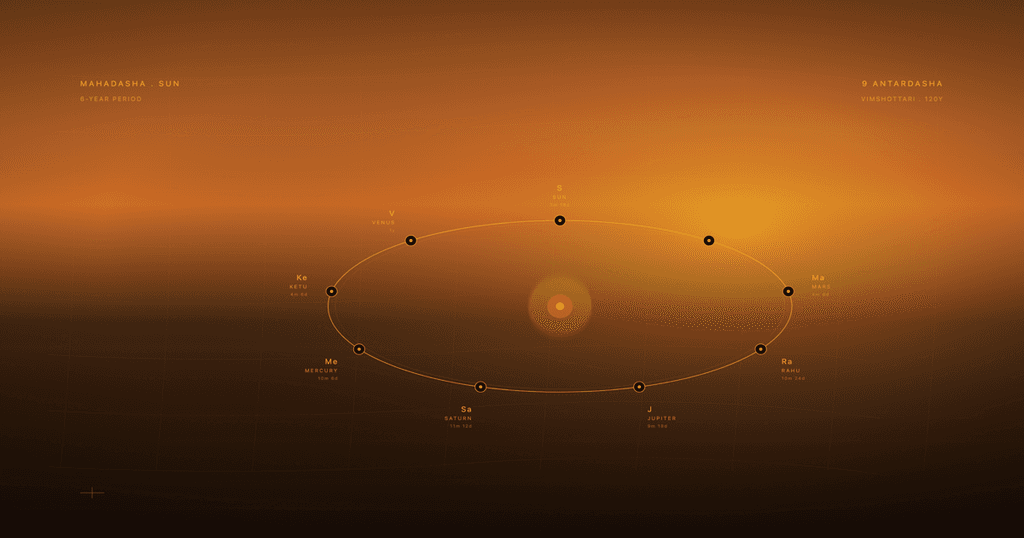
The Sun mahadasha is the shortest period in the Vimshottari cycle. Sun as karaka of authority, identity and the father-figure, how natal house and dispositor shape the reading, the 9 antardasha sub-periods and what the framework does not predict.
Where it falls in the Vimshottari sequence
The Vimshottari system runs nine mahadashas in a fixed sequence totalling 120 years: Ketu 7, Venus 20, Sun 6, Moon 10, Mars 7, Rahu 18, Jupiter 16, Saturn 19 and Mercury 17. Sun occupies the third position in the cycle and runs 6 years. Which mahadasha a native is born into depends on the natal Moon's nakshatra and how far through that nakshatra the Moon had travelled at the moment of birth.
Sun follows Ketu (7 years of dissolution and inward turn) and Venus (20 years of pleasure and partnership). After the Sun period closes the Moon mahadasha opens for 10 years.
Sun's karaka nature
Sun is the karaka for the soul, dignity and the visible self. In the natural zodiac Sun rules the 5th house (Leo) which adds creative expression, intelligence and the king-register to its base signification. Careers in government, law, leadership, the medical profession, gold and entertainment with public visibility often peak during the Sun Mahadasha for natives with Sun well placed natally.
The Sanskrit name Surya translates as 'the one who illumines' or 'the radiant'. The classical mythology frames Sun as the king of the planetary cabinet, the source of dharmic-authority who grants recognition. Sun in mythology is also the witness to all action, the impartial seer who tracks each soul's karmic ledger.
Dignity: exaltation, own signs, debilitation
Sun exalted in Aries. Maximum natal strength. The 6-year period operates with maximum sun-register support. Natives with Sun exalted in Aries typically experience the mahadasha as flowing with unusual ease in the karaka domain.
Sun in own sign Leo. The own-sign placement carries the sun qualities with the stability of familiar territory, close to exaltation-strength without the elevation but with reliability across the 6-year period.
Mooltrikona: Leo (0-20 degrees). The mooltrikona band within the own sign is the strongest functional placement after exaltation. The classical readings give mooltrikona-Sun the sun signification in its most direct and operative form.
Sun debilitated in Libra. The classical tradition reads debilitated Sun as reducing the ease of the sun-register. The debilitation does not cancel the mahadasha's fundamental signature but introduces friction into it. Neecha Bhanga (debilitation cancellation) is possible under specific configurations and is read separately.
Combustion. Sun is itself the source of combustion for other planets. The Sun mahadasha reading does not require a combustion check on the Sun itself.
Classical friend-enemy scheme. Sun's friends are Moon, Mars and Jupiter. Enemies are Venus and Saturn. Neutral planets are Mercury. This friendship matrix shapes the antardasha sub-period readings: friend-sub-periods read constructively, enemy-sub-periods read with more friction.
Additional dignity factors. Sun in the 10th house carries digbala (directional strength) regardless of sign dignity. This is one of the four-house strength points that classical practice weighs heavily in the natal reading.
How natal house shapes the reading
Sun's natal house tells the reader which life domain carries the sun-reading most strongly during the 6-year period. The house gives the surface domain. The dispositor gives the underlying mechanism. Both are read together.
Sun in the 1st house. The self as authority. The mahadasha reads as a period of identity-formation, leadership emergence and visible-self consolidation. Sun in the 1st gives digbala-equivalent strength to the lagna register, often producing physical heat-sign markers (early greying, prominent eyes, strong cardiac signal).
Sun in the 2nd house. Family-of-origin authority and wealth from authority figures. The 6-year window often produces inheritance, family-business succession or a defining episode with the father-line. The 2nd house also rules the right eye and speech, both Sun karakas, intensifying the reading.
Sun in the 3rd house. Initiative and younger-sibling dynamics. Sun in the 3rd is an upachaya placement, growing in strength with time. The mahadasha favours bold initiatives, publishing, public speaking and competitive ventures. Younger siblings or the native's role-as-elder often takes a defining turn.
Sun in the 4rd house. Property, mother and home as the authority register. The reading is challenging classically because Sun in the 4th can scorch the mother-significator. The period often produces real-estate decisions, government quarters or a shift in the native's relationship to the family home.
Sun in the 5rd house. Children, creative authority and dharmic intelligence. The Sun in the natural 5th house is at home in the creative-king register. The mahadasha favours children-related events, creative ventures with public visibility and authority in education or speculation.
Sun in the 6rd house. Service, conflict and the enemies-house. Sun in the 6th is classically an upachaya placement giving the native upper hand in litigation, competitive examination and conflict with adversaries. The mahadasha often produces visible victory in disputes, government-service appointments or military-line outcomes.
Sun in the 7rd house. Partnership and the public marriage register. Sun in the 7th classically reads as some friction in marriage (ego in the partnership house) but supports high-profile partnerships. The mahadasha often produces visible-public-relationship events or business-partner dynamics with authority figures.
Sun in the 8rd house. Inheritance, longevity and hidden-authority. Sun in the 8th is challenging classically for the father-significator but can produce inheritance, occult-research authority or a defining transformation in the native's relationship to mortality.
Sun in the 9rd house. Father, dharma and higher purpose. The 9th house is the natural friend-house for Sun (trikona). The mahadasha often produces defining father-line events, dharmic-philosophical recognition, higher-education credentials or pilgrimage.
Sun in the 10th house. Career-summit and the public dharmic-role. Sun in the 10th has digbala, the strongest classical placement for visible authority. The mahadasha typically produces the career-summit event of the native's life: appointment to high office, public recognition, founder-CEO arc or the publication that defines reputation.
Sun in the 11th house. Gains from authority and elder-siblings. Sun in the 11th house favours large-scale gains through authority networks, eldest-sibling support and large-organisation income streams. The mahadasha often produces income-step-changes and a defining episode with elder-line community.
Sun in the 12th house. Foreign authority, expense and the hidden self. Sun in the 12th classically reads as authority-loss or expense-of-self but can also produce foreign-government appointments, hospital-administration or contemplative-authority work. The mahadasha often produces significant time abroad or in contemplative service to authority structures.
Dispositor analysis
When Sun occupies a sign it does not rule (any sign except Leo), the dispositor (the ruler of Sun's sign) shapes the underlying mechanism of the 6-year period.
Sun in Aries: dispositor is Mars. Sun in Aries is exalted, but the Mars dispositor still adds energy-and-conflict colouring. Mars in the 10th doubles the authority register; Mars in the 6th adds litigation-intensity.
Sun in Taurus: dispositor is Venus. Sun in Taurus draws the Venus dispositor into the authority reading. Venus in Libra (own-sign) softens and aestheticises Sun's expression; Venus in Virgo (debilitation) introduces friction with relational-aesthetic themes.
Sun in Cancer: dispositor is Moon. Sun in Cancer reads through the Moon dispositor. The mother and emotional-public dimensions of the period strengthen. Moon in the 4th doubles the home/mother focus; Moon in the 8th adds emotional-transformation depth.
Sun in Libra: dispositor is Venus. Sun in Libra is debilitated, the most challenging dispositor configuration. The Venus dispositor's house and dignity determine whether the 6-year period reads as friction-pleasure or full-friction. Venus in own-sign Taurus or Libra rescues the configuration significantly.
Sun in Scorpio: dispositor is Mars. Sun in Scorpio carries intensity and hidden-authority register. The Mars dispositor in a friend-sign (Aries/Leo) supports a research, investigation or covert-leadership arc; Mars debilitated in Cancer complicates it.
Sun in Capricorn: dispositor is Saturn. Sun in Capricorn meets enemy-Saturn as dispositor. The 6-year period often reads as authority-through-discipline or authority-through-burden. Saturn's house position determines whether the burden-register or the authority-register predominates.
The 9 antardasha sub-periods
The Vimshottari sub-periods inside the 6-year Sun Mahadasha run through all nine planets in proportion to their mahadasha lengths. Each sub-period activates a different pairing with the Sun mahalord. Friend-pair sub-periods read constructively, enemy-pair sub-periods read with more friction. The full reading for each pairing is at the dedicated antardasha article linked in the table.
| Antardasha | Duration | Reading |
|---|---|---|
| Sun | 108 days | Pure Sun signature, opens and closes the 6-year window. Often produces the most visible authority-event of the mahadasha at one of the two endpoints. |
| Moon | 180 days | Sun-Moon brings emotional-and-public register together. Often produces public-recognition with emotional weight (marriage, child-birth, mother-event). |
| Mars | 126 days | Authority-and-action register. Often produces military, competitive, surgical or property events. Disputes resolve in this window. |
| Rahu | 324 days | Sun-Rahu is classically challenging: authority meets the unconventional or shadow register. Foreign or boundary-crossing authority events; eclipse-axis activations often visible. |
| Jupiter | 288 days | Sun-Jupiter is the most benefic sub-period. Dharmic-authority recognition, teaching, publishing, child-events or significant elder-line dharmic transmission. |
| Saturn | 342 days | Sun-Saturn is the heaviest sub-period: enemy-pair across both planets. Authority-restriction, career-burden or institutional-friction. Use caution on litigation initiation. |
| Mercury | 306 days | Sun-Mercury brings authority into communication, commerce or writing. Publications, commercial-authority events or contract-cycle activations. |
| Ketu | 126 days | Sun-Ketu contracts the visible-self register. Spiritual retreat, authority-renunciation or significant family-line-detachment events. Father-significator stress possible. |
| Venus | 360 days | Sun-Venus brings authority into the pleasure-and-partnership register. Marriage events, luxury acquisitions or aesthetic-authority recognition. Functional friction (enemy-pair) softened by Venus's natural benefic register. |
The Sun Mahadasha sub-periods in full
The sections below give the full reading for each sub-period of the Sun Mahadasha that does not have a page of its own: the character of the period, what the classical texts assign to it and how it sits against the 2026 to 2028 sky. Durations are in the table above.
Sun Mahadasha, Moon Antardasha
The Moon's sub-period is the first handover of the Sun mahadasha, taking over once the Sun's own opening antardasha of 3 months 18 days has announced the register. The friendship here is mutual and unqualified in the Parashari matrix, the only pairing of the two luminaries anywhere in the cycle, day and night ruling in turn. Classical writers read the change as authority acquiring a public: the visible self of the Sun is now reflected in reception, mood, mother and household rather than asserted outright. Where the opening weeks declare an identity, these six months test whether anyone is holding it. The texture assigned to Sun-Moon is mild and tidal, moving in monthly rhythm with the Moon's own circuit.
The Moon's natal condition decides how much of that mildness survives contact. A bright Moon, waxing, exalted in Taurus or at home in Cancer, is classically read as giving the pairing warmth, public goodwill and an easy alliance between authority and feeling. A dark or debilitated Moon in Scorpio, waning thin or besieged by malefics, turns the same six months brittle, reputation touchy and the mother-line a source of concern rather than support. The tradition grades the texture, never the events themselves.
The classical assignments for this sub-period
The BPHS antardasha chapters, Sun mahadasha section, condition this period on the Moon's state: in a kendra or trikona she is assigned marriage, wealth and property, house, land, cattle and conveyances, and exalted or in own sign the list grows to children, royal favours and ambitions fulfilled. A waning or malefic-joined Moon reverses the account toward distress to wife and children, failed ventures, disputes and royal antagonism, and in the 6th, 8th or 12th the text adds danger from water, imprisonment, hard journeys and urinary trouble. Benefics in the 1st, the 9th or a kendra from the dasha lord restore luxuries and a dawn of fortune, so the reckoning from the dasha lord stands beside the reckoning from the lagna throughout. Where the Moon holds maraka lordship the chapter appends a health caution and prescribes the charity of a white cow and a female buffalo. Phaladeepika's bhukti chapter is concordant here, listing destruction of enemies, wealth, agriculture and house-building. These positions enter the engine as classical priors that the individual chart then conditions.
Against the 2026 to 2028 sky
Both lords of this combination are luminaries, which makes the solar eclipse of 12 August 2026 on the Cancer-Leo cusp the calendar event that belongs to this page. An eclipse is the Moon standing before the Sun, the two lords of this very period meeting in the sky, and classical practice treats eclipse windows inside luminary dashas as time for restraint in launches and public claims. The caution needs its counterweight: the eclipse lasts an afternoon, the antardasha lasts six months and most natives running Sun-Moon through August 2026 will cross the date without a datable event. The nodal shift of 27 December 2026 then carries Ketu into Cancer, the Moon's own sign, a background colouring for any Sun-Moon period running into 2027 rather than a trigger. Whether either signal touches a given chart depends on where Cancer and Leo fall by house from the natal ascendant, the ground the Moon mahadasha overview works through for this page's antardasha lord.
Sun Mahadasha, Mars Antardasha
When Mars takes over from the Moon inside the Sun mahadasha, the register shifts from reception to execution. Classical friendship runs both ways here, the Sun as king and Mars as the commander of his forces, so the tradition reads the pairing as delegated fire: authority that now moves, builds and contests rather than presides. The handover is a genuine change of temperature, six reflective months of Sun-Moon giving way to the mahadasha's first push outward. Classical texture for Sun-Mars is brief and pitta-hot, a short campaign rather than a long administration, with brothers, land, engineering and contested ground as its traditional subject matter.
Mars's natal state tells the tradition which version of the campaign to expect. Well placed, exalted in Capricorn or at home in Aries or Scorpio, Mars is read as giving the period disciplined force, decisions that land and physical energy to spend. Debilitated in Cancer or afflicted, the same months lean toward haste, friction with authority figures and injuries of the self-inflicted kind, which is why classical counsel for a weak Mars period is to slow the tempo the period itself wants to raise.
BPHS and Phaladeepika on this period
In the BPHS antardasha chapters, Sun mahadasha section, the Mars sub-period divides cleanly along dignity: exalted or in own sign, in a kendra or trikona, Mars is assigned land, house, wealth and grain, and joined with the lagna lord the grant extends to army command, destruction of enemies, peace of mind and an increase of siblings. Afflicted, undignified or in the 8th or 12th from the dasha lord, the same lord delivers brutality, mental ailment, imprisonment, disputes with brothers and failed ventures, and a debilitated Mars is said to see wealth destroyed through royal displeasure. Where Mars carries lordship of the 2nd or the 7th the chapter notes diseases of mind and body and prescribes Veda recitation, japa and Vrishotsarga as remedial measures. Phaladeepika's chapter on bhukti effects gives diseases, wounds, loss of position and enemy trouble, a fixed list that matches the BPHS adverse branch. Both records enter the Tempora engine as inputs whose weight the natal chart decides.
Against the 2026 to 2028 sky
Mars itself carries no dated event in the engine-verified 2026 to 2028 calendar, so the sky reading routes through the mahadasha lord. The solar eclipse of 12 August 2026 falls on the Cancer-Leo cusp, Leo being the Sun's own sign, and a native running the fiery Sun-Mars months across that date meets the classical counsel to hold rather than force decisions inside an eclipse window. The counsel stays proportionate: the antardasha lasts 4 months 6 days, the eclipse a single afternoon, and for most charts the window passes without a datable mark. The nodal shift of 27 December 2026 moves Ketu, the graha the tradition treats as Mars-like in action, from Leo into Cancer, background colouring rather than a trigger for this pairing. Where any of it lands by house is decided by the natal ascendant alone, which is why the reading starts from the birth chart and the Mars mahadasha overview rather than from the calendar.
Sun Mahadasha, Rahu Antardasha
Rahu's arrival is the Sun mahadasha's first hostile handover. The Parashari scheme holds Sun and Rahu as enemies, the node being the very agent that eclipses the Sun, and the classical image for the pairing is the grahan shadow: authority met by an appetite that does not acknowledge it. After the brisk 4 months 6 days of Sun-Mars, where force still served the king, the tempo stretches to nearly eleven months and the loyalty inverts, ambition pulling toward unconventional, foreign or boundary-crossing ground. The texture the tradition assigns is smoky and amplifying, gains that arrive larger than expected and carry a question mark, and its standing counsel for the period is patience over assertion.
Because Rahu owns no sign, its condition is read through dispositor, house and company rather than exaltation tables. A well-disposed Rahu, seated in a friendly sign with a strong dispositor and a constructive house, is classically read as turning the period's appetite into genuine unconventional rise, position gained by routes the orthodox would not have taken. A poorly disposed Rahu turns the same appetite toward overreach and eclipse of reputation, which is why the classical literature keeps this pairing under closer watch than its length alone would warrant.
How the old texts grade Sun-Rahu
The BPHS antardasha chapters, Sun mahadasha section, give this period an unusual internal clock: with Rahu in a kendra or trikona from the lagna the first two months bring loss of wealth, danger from theft and snakes, wounds and family distress, after which the trouble lifts and comfort, health and royal favour follow for a benefic-supported node. Rahu in an upachaya house, joined to a yogakaraka or well placed from the dasha lord is assigned royal recognition, fortune, name and fame and the birth of a son, though the text keeps some distress to wife and children even inside that grant. Weak, or in the 8th or 12th from the dasha lord, the node brings imprisonment, loss of position and disease, and where Rahu occupies or is tied to the lords of the 2nd or the 7th the chapter attaches a health caution with Durga worship and the charity of a black cow among the remedies. Phaladeepika's bhukti chapter weighs the period darker, new enemies, wealth loss, poison danger and headaches, an unbroken adverse list where BPHS splits the verdict across time and condition. The reference record treats this as a disagreement of emphasis between the two texts. The engine carries both gradings as inputs and lets the natal chart set their weight.
Against the 2026 to 2028 sky
Both dated nodal events in the verified 2026 to 2028 calendar belong to this antardasha's lord. Rahu occupies Aquarius until 27 December 2026 and then shifts into Capricorn, holding it until 15 July 2028, so a Sun-Rahu period running across that date watches its own antardasha lord change signs midstream, which the tradition reads as a redirection of the appetite rather than its end. The solar eclipse of 12 August 2026 on the Cancer-Leo cusp is the literal enactment of this pairing, node occluding Sun, and classical practice treats such a window inside a Sun-Rahu period as one for deliberate restraint. Both signals carry the same limitation: they date the sky, never the native, and their force in a particular chart depends on which houses Aquarius, Capricorn and the Cancer-Leo axis occupy from the natal ascendant. The node's own eighteen-year period, a different scale of the same appetite, is treated in the Rahu mahadasha overview.
Sun Mahadasha, Jupiter Antardasha
Jupiter's sub-period arrives inside the Sun mahadasha carrying the friendliest handover the sequence allows, the king seated before the guru. Parashari tradition counts Sun and Jupiter as mutual friends, so classical writers read the pairing as counsel reaching authority rather than obstruction testing it. The arrival matters because of what precedes it: the Sun-Rahu antardasha, 10 months 24 days of smoky, boundary-crossing pressure and the first hostile stretch of the mahadasha. When Jupiter takes over, the tradition sees appetite yielding to principle, with recognition now arriving through teaching, counsel, children and matters of dharma. The texture assigned to this exact pairing is sattvic and steady, an authority measured against what it serves.
How fully that texture delivers is read from Jupiter's natal condition. A Jupiter well placed for the chart, exalted in Cancer, in its own Sagittarius or Pisces or standing angular, is held to give the pairing its full voice, honours and guidance arriving without being chased. A weak Jupiter, debilitated in Capricorn, combust or hemmed by malefics, is read as promising the same subjects while delivering them thinner, advice that goes unheard and recognition that stays informal. Either way the classical claim concerns texture, never guarantee.
What the classical texts assign here
The BPHS antardasha chapters, Sun mahadasha section, grade this sub-period on Jupiter's condition: exalted, in own sign or standing in a kendra or trikona from the lagna, Jupiter is assigned marriage, royal favours, wealth and grain, the birth of a son, gains of clothes and ambitions fulfilled. Where Jupiter rules the 9th or the 10th the text adds position and a palanquin-class conveyance, a line the English translation glosses as the motor car of the present day. The grant reverses when Jupiter falls in the 6th or 8th from the dasha lord or arrives afflicted: distress to wife and children, body pains, royal displeasure, goals unachieved and wealth lost through wrongdoing, with the passage closing on remedial charity of gold and a tawny cow. Mantreswara's Phaladeepika, in its chapter on the sub-divisions of dashas, hands the same bhukti a short fixed list of destruction of enemies, money and ear disease, a mixed verdict that sits broadly beside the BPHS reading. The Tempora engine takes these classical positions as inputs and conditions them on the natal chart before flagging any window.
Against the 2026 to 2028 sky
A native running Sun-Jupiter through this window meets a rare overlay: transit Jupiter is exalted in Cancer from 27 May 2026, after a first taste from 6 October to 18 December 2025, then takes a first taste of Leo from 23 October 2026 to 3 February 2027 before settling there from 19 June 2027. An exalted antardasha lord in transit is classically the strongest external support this sub-period can receive, though exaltation describes the planet's condition in the sky, never an outcome for a particular chart. The Leo windows add a second signal, transit Jupiter moving through the Sun's own sign while the Sun runs the mahadasha, which the tradition reads as the guru entering the king's court. The solar eclipse of 12 August 2026 on the Cancer-Leo cusp touches the mahadasha lord directly, and eclipse windows during Sun periods are classically held for caution rather than launch. Which houses any of this activates is a whole-sign question the birth chart alone answers, as the Jupiter mahadasha overview details for the lord this page shares. The overlay narrows attention; it does not decide events.
Sun Mahadasha, Saturn Antardasha
Of the nine sub-periods inside the Sun mahadasha, the classical texts weigh this one most carefully. Sun and Saturn are mutual enemies in the Parashari matrix, and the image behind the enmity is domestic: Saturn is the Sun's own son, estranged, slow and exacting where the father is radiant and immediate. The handover sharpens the point, because Saturn takes over directly from the benefic Sun-Jupiter months, the guru's blessing giving way to the auditor's ledger. Tradition assigns the pairing a dry, structural texture, duties, institutions, delays and the long consequences of how authority has been used, and reads its outcomes as earned against resistance rather than conferred.
Saturn's natal condition sets which face of the auditor appears. Strong, exalted in Libra or in its own Capricorn or Aquarius, Saturn is classically read as making the period constructive, formalisation, tenure and structures that outlast the mahadasha. Weak, debilitated in Aries or heavily afflicted, the same months lean toward obstruction, fatigue and friction with superiors and the father-line, and the classical counsel in that case is endurance over confrontation, since the pairing rewards outlasting far more reliably than outshining.
Classical positions on the Sun-Saturn stretch
In the BPHS antardasha chapters, Sun mahadasha section, Saturn's sub-period earns real grants when the lord is dignified: a kendra or trikona placement is assigned destruction of foes, full enjoyment, grain-gain and marriage-type functions at home, and an exalted or own-sign Saturn with a friendly graha adds property, royal recognition and national renown. The chapter also fixes a phase order, loss of friends at the start, good results through the middle and distress at the end, with a debilitated Saturn adding separation from parents and wandering. Afflicted, or in the 8th or 12th from the dasha lord, the period turns to rheumatism, fevers, imprisonment and quarrels with co-heirs, and maraka lordship of the 2nd or the 7th draws a health caution with Mrityunjaya japa and the charity of a black cow among the prescriptions. Phaladeepika's bhukti chapter states wealth loss, separation from children and phlegmatic troubles without qualification, which the record logs as a disagreement of emphasis with the conditional BPHS grant. The pattern is general across the two works: Mantreswara fixes one effect-list per bhukti while Parashara makes every effect contingent on dignity, on the house from the lagna and on the house from the dasha lord. The engine follows the Parashari grammar, taking each textual position as an input conditioned on the chart in hand.
Against the 2026 to 2028 sky
Saturn is the one lord on this page with dated transits of its own in the verified calendar. It sits in Pisces from 20 March 2025, enters Aries on 23 May 2027, retreats into Pisces on 4 November 2027 and re-enters Aries to stay on 11 February 2028, holding the sign until 2030. Aries is Saturn's debilitation sign, so a native running Sun-Saturn across mid-2027 watches the antardasha lord enter its weakest placement, withdraw and then commit, a stutter the tradition reads as institutional matters opening, stalling and resuming rather than resolving in one motion. The 12 August 2026 solar eclipse on the Cancer-Leo cusp separately touches the mahadasha lord for anyone running this period earlier in the window. Every signal here ends at the same boundary: transit condition describes the planet and never the person, and which life departments are even in play depends on the houses these signs hold from the natal ascendant. Saturn's own nineteen-year period is covered in the Saturn mahadasha overview.
Sun Mahadasha, Mercury Antardasha
Mercury reaches the Sun mahadasha with the one asymmetric relationship in this sequence: the Sun holds Mercury as neutral while Mercury counts the Sun a friend, the courtier more attached than the king. The pairing carries the Buddha-Aditya signature, intelligence standing close enough to authority to speak for it, and the tradition reads the sub-period through that voice: writing, accounts, negotiation and articulate command. Timing gives the arrival its meaning, since Mercury takes over from the 11 months 12 days of Sun-Saturn, the harshest stretch of the mahadasha, and classical writers treat the handover as speech returning after discipline, the point where whatever survived the audit gets named, documented and traded. The texture is quick, mixed and commercial, lighter than what precedes it without pretending the audit never happened.
Mercury's natal condition decides how clean the voice runs. Strong, exalted in Virgo or at home in Gemini, it is classically read as giving the period articulate command, contracts drafted well and intelligence that authority actually uses. Weak, debilitated in Pisces or combust, the same months lean toward miscommunication, nervy decisions and paperwork that returns for correction, and since Mercury travels close to the Sun in every chart, combustion is the condition classical writers check first for this pairing.
Where the source texts land on Sun-Mercury
The BPHS antardasha chapters, Sun mahadasha section, give this pairing a favourable baseline once Mercury holds strength: in a kendra or trikona the text assigns kingdom-gain, vivacity, happiness from wife and children, conveyances by royal favour and pilgrimage, and Mercury with the 9th lord is called very beneficial. Well placed from the dasha lord the list extends to marriage, oblations, charity and fame, including the distinctive detail of becoming famous under an assumed name. In the 6th, 8th or 12th from the dasha lord the chapter turns to bodily distress and a phased decline, difficulty at the start, some relief in the middle and royal displeasure toward the end, and where Mercury carries lordship of the 2nd or the 7th it records body pains and fevers with Vishnu Sahasranama and grain charity as the prescribed remedies. Phaladeepika's bhukti chapter reads the same period very differently, assigning skin eruptions, jaundice, belly pain and leprosy-type disease with no favourable branch at all. That is a genuine disagreement between the two texts, among the sharpest anywhere in the Sun mahadasha, and worth knowing before either verdict is repeated as settled doctrine. The engine resolves the tension by conditioning both positions on the natal chart before any reading is issued.
Against the 2026 to 2028 sky
Mercury carries no dated transit of its own in the engine-verified 2026 to 2028 calendar, so the sky question for this period runs through the mahadasha lord. The solar eclipse of 12 August 2026 falls on the Cancer-Leo cusp, Leo being the Sun's own sign, and a Sun-Mercury native crossing that date inherits the classical caution about signing or launching inside an eclipse window during a Sun period, pointed advice for a pairing whose subject matter is precisely signatures and agreements. The caution keeps its proportion: one afternoon inside a 10 months 6 days period, unmarked for most charts. In practice this antardasha is located rather than watched for, since its boundaries fall out of the natal Moon's nakshatra-pada and the Sun mahadasha onset date, derived to the day by the free computed reading. What the calendar cannot supply, the houses Mercury and the Sun occupy and rule from the natal ascendant, is the ground the Mercury mahadasha overview covers for this page's antardasha lord.
Sun Mahadasha, Venus Antardasha
Venus closes the Sun mahadasha, and the closure is charged, because the Parashari matrix holds Sun and Venus as mutual enemies, the ascetic king facing the preceptor of his rivals. The sub-period follows Ketu's stripping 4 months 6 days, so the tradition reads the sequence as detachment giving way to appetite: comfort, partnership and the arts pressing their claims on an authority that spent five years being singular. Classical writers also treat a mahadasha's final antardasha as its junction, the dasha-chidra, where the outgoing lord's themes loosen and the incoming period is already audible, and here the incoming period is the Moon's, so the year carries relational and domestic weight from both directions. The texture assigned to Sun-Venus is rich, frictional and outward, luxury and alliance negotiated rather than granted.
Venus's natal dignity tells the tradition how the negotiation goes. Exalted in Pisces or at home in Taurus or Libra, Venus is read as closing the mahadasha graciously, partnerships formalised, comfort earned and ceremonial recognition arriving on time. Debilitated in Virgo or combust, the same year reads as indulgence taxing authority and relationships straining against position, and the classical counsel there is moderation, since an enemy-pair closing period amplifies whatever excess it is given.
What Parashara and Mantreswara record here
The BPHS antardasha chapters, Sun mahadasha section, hand Venus one of the richest favourable lists in that chapter when she is dignified: in a kendra or trikona, exalted, in own sign or varga, the text assigns marriage, desired happiness from the wife, property, travels, pearls and jewels, cattle, conveyances, sweet food and reputation. In the 6th, 8th or 12th from the dasha lord the verdict inverts to royal displeasure, mental agony and family distress, and the chapter times the decline, a moderate start, a good middle and disrepute with loss of position at the end. Venus as lord of the 7th or the 2nd draws the maraka note, body pains and disease, graver if she is joined with the lords of the 6th or the 8th, and the prescribed remedies run from Rudra japa to the charity of a tawny cow or buffalo. Phaladeepika's bhukti chapter assigns the same period head pain, agricultural loss and family sickness with nothing favourable recorded. The two texts genuinely part company on Sun-Venus, a clear disagreement the source record flags instead of smoothing over. The engine admits both verdicts as inputs and conditions them on the natal chart before any window is scored.
Against the 2026 to 2028 sky
Venus has no dated event of its own in the engine-verified 2026 to 2028 calendar, so the sky reading rests on the mahadasha lord. The solar eclipse of 12 August 2026 arrives on the Cancer-Leo cusp, Leo being the Sun's own sign, and a native whose closing Sun-Venus year contains that date meets the old counsel to keep ceremonies and major commitments away from the eclipse window itself, advice with obvious bearing on a pairing whose classical subjects include marriage and alliance. The proportion matters: a full year dwarfs one eclipse afternoon, and most Sun-Venus natives will cross August 2026 without a datable mark. Locating the year precisely is the more practical task, since its boundaries follow from the natal Moon's nakshatra-pada and the Sun mahadasha onset date, both derived to the day in the free computed reading. The houses Venus and the Sun rule and occupy from the natal ascendant then carry the interpretation, ground the Venus mahadasha overview works through for the lord this page shares.
By natal ascendant
Sun's functional reading shifts with the ascendant. The houses Sun rules and the dignity Sun carries for each lagna determine whether Sun reads as functional benefic, functional malefic or yogakaraka for that ascendant. The per-ascendant readings follow on this page, one entry for each rising sign.
- Sun mahadasha for Aries ascendant
- Sun mahadasha for Taurus ascendant
- Sun mahadasha for Gemini ascendant
- Sun mahadasha for Cancer ascendant
- Sun mahadasha for Leo ascendant
- Sun mahadasha for Virgo ascendant
- Sun mahadasha for Libra ascendant
- Sun mahadasha for Scorpio ascendant
- Sun mahadasha for Sagittarius ascendant
- Sun mahadasha for Capricorn ascendant
- Sun mahadasha for Aquarius ascendant
- Sun mahadasha for Pisces ascendant
Transit confirmation protocol
The Sun mahadasha reading anchors against natal Sun in the chart. Watch Saturn transits over natal Sun (the Saturn-natal-Sun signature carries strong historical pressure pattern on the US chart, 4.26x on UK). Watch Sun-Rahu conjunction triggers, eclipse-axis activations across the natal Sun-Moon and the Sun's annual ingress into its own sign (Leo) for sub-period openings.
Forward-call grounding
No active Tempora forward call is keyed to the Sun mahadasha specifically; the underlying Saturn-natal-Sun signature is used in the US late 2029 window. See the tracker for live forward-call status.
What the framework does not predict
The mahadasha reading is structural. The 6-year Sun period names a register and a karaka domain; it does not generate forward calls by itself. Calibration is by chart and signature class, not by mahadasha membership. The personal reading depends on natal Sun's house, sign dignity, dispositor strength, conjoining planets, aspecting planets, the running antardasha and the simultaneous transit picture. The framework is explicit about this scope limit.
Classical sources
Brihat Parashara Hora Shastra (BPHS) Chapter 32 covers Sun mahadasha effects. Phaladeepika and Sarvartha Chintamani contribute additional dasha-pattern observations. The 6-year duration is fixed by the classical Vimshottari assignment.
Sun mahadasha by ascendant
The 6-year period reads differently for each rising sign because the ascendant fixes which house Sun rules and how the ascendant lord relates to Sun. Sun owns a single sign (Leo), so every lagna gets exactly one house from it, anywhere from a trine to a dusthana. The twelve condensed readings below state the structural prior for each lagna; the dedicated articles linked above carry the full treatment.
Aries ascendant
Sun rules only the 5th house from Aries lagna, a clean trikona ownership with no dusthana attached, and Mars the ascendant lord counts Sun as a classical friend. That places this among the most benefic Sun lordships of the twelve ascendants: six years leaning toward creativity, children and speculation, with intelligence and creative work as the standing subjects. Natal Sun in Leo in the 5th, Sagittarius in the 9th or Capricorn in the 10th supports the period, while the 6th, 8th and 12th turn it toward health friction, rupture or expenditure. Sun-Venus closes the mahadasha at a full year and Sun-Saturn at 11 months 12 days is usually the most demanding stretch. Natal Sun's dignity, house and aspects remain the majority of the reading.
Aries rising and Sun's 5th-house line
Lay out the whole-sign lordships first. From an Aries lagna: Mars rules the 1st and 8th, Venus the 2nd and 7th, Mercury the 3rd and 6th, the Moon the 4th, the Sun the 5th, Jupiter the 9th and 12th, Saturn the 10th and 11th. The Sun's line is the interesting one: it rules only the 5th, a clean single-house trikona ownership with no dusthana attached. This is the shortest Sun lordship in the zodiac and among the most benefic for this ascendant.
Sun as a pure 5th lord for Aries risings, without doubling into any dusthana, is a rare structural fact worth naming. Most single-house Sun rulerships across the twelve ascendants carry a mixed reading; here it does not. The six years therefore lean toward the trikona themes at their strongest expression, moderated only by natal Sun's actual dignity.
Placements that help and placements that fight, Aries rising
Reasoning from lordships, the friendliest homes for natal Sun in a Aries-rising chart:
- 5th house (Leo, own sign). Sun in its own sign of Leo occupying the trikona it rules. The mahadasha runs the strongest classical creative expression this ascendant can carry.
- 9th house (Sagittarius). The Sun in the fortune trine, disposited by Jupiter, ascendant lord's friend. Doctrine, teachers and long journeys become the operative theme.
- 10th house (Capricorn). The Sun in an angle disposited by Saturn. Career visibility gets the six years.
The placements that demand the most:
- 6th house (Virgo). Sun in an enemy sign (Mercury) in a dusthana. Health, workplace conflict and litigation are the standing subjects.
- 12th house (Pisces). Sun in Jupiter's sign but in a dusthana. Foreign residence and expenditure themes dominate.
- 8th house (Scorpio). Sun disposited by lagna lord Mars but in a dusthana. Transformation and hidden matters run the six years.
Taurus ascendant
Sun rules the 4th house from Taurus lagna, single-house kendra ownership with no dusthana pairing, but Venus the ascendant lord treats Sun as a classical enemy. Home, property, emotional base and the mother carry the six years, often through work-and-authority channels rather than the pleasure-and-relationship channels the merchant sign prefers. Natal Sun in Leo in the 4th gives property and family their strongest classical expression, and the 10th or 11th lifts career and income alongside; the 6th, 8th and 12th shift the period toward workplace conflict, joint-resource strain or relocation-and-expenditure themes. Natal Sun's dignity, house and aspects remain the majority of the reading.
Taurus rising and Sun's 4th-house line
Lay out the whole-sign lordships first. From a Taurus lagna: Venus rules the 1st and 6th, Mercury the 2nd and 5th, the Moon the 3rd, the Sun the 4th, Mars the 7th and 12th, Jupiter the 8th and 11th, Saturn the 9th and 10th. Sun's line is unusual: single-house angle ownership without any dusthana pairing, which is structurally clean. The complication is not lordship but planetary friendship, since Venus and the Sun are classical enemies.
Sun's kendra ownership for Taurus risings gives the mahadasha a home-and-property signature at its natural strongest expression. What complicates the reading is the enemy-friendship between the ascendant lord and the mahadasha lord. In practice this reads as home themes running through a mode Venus would not have chosen, often meaning property acquisition through work-and-authority channels rather than through pleasure-and-relationship channels the merchant sign would have preferred.
Placements that help and placements that fight, Taurus rising
Reasoning from lordships, the friendliest homes for natal Sun in a Taurus-rising chart:
- 4th house (Leo, own sign). Sun in its own sign occupying the angle it rules. Property, family and emotional base receive their strongest classical expression.
- 10th house (Aquarius). Sun in the career kendra disposited by Saturn. Career and home rise together through the six years.
- 11th house (Pisces). Sun in the gains house disposited by Jupiter. Income compounds under the mahadasha.
The placements that demand the most:
- 6th house (Libra). Sun in Venus's sign but in a dusthana. Workplace conflict and health themes compound.
- 12th house (Aries). Sun in Mars's fire sign in the loss house. Foreign relocation is the productive form; expenditure the difficult one.
- 8th house (Sagittarius). Sun disposited by Jupiter but in a dusthana. Transformation and joint resources activate.
Gemini ascendant
Sun rules the 3rd house from Gemini lagna, an upachaya with no dusthana attached, and Mercury the ascendant lord holds a neutral relationship with Sun. Upachaya houses grow stronger over time, so the six years read as incremental gains through sustained effort: initiative, siblings and short-form communication are the active themes, with courage that pays over years rather than months. Natal Sun in Leo in the 3rd compounds initiative strongly and the 10th or 11th adds career and gains-through-effort; Sun in Scorpio in the 6th, Taurus in the 12th or Capricorn in the 8th turns the period toward competition, expenditure or grinding transformation. Natal Sun's dignity, house and aspects remain the majority of the reading.
Gemini rising and Sun's 3rd-house line
Lay out the whole-sign lordships first. From a Gemini lagna: Mercury rules the 1st and 4th, the Moon the 2nd, the Sun the 3rd, Venus the 5th and 12th, Mars the 6th and 11th, Jupiter the 7th and 10th, Saturn the 8th and 9th. Sun's line reads as clean single-house upachaya ownership without dusthana pairing, which the tradition treats as one of the growing-through-effort combinations.
Sun as 3rd lord for Gemini risings sits in the upachaya category, the houses classical texts describe as growing stronger over time. The six years of Sun mahadasha therefore have a specific texture: incremental gains through sustained effort, siblings and communication as active themes, courage that pays over years rather than months. Natal Sun's placement decides direction; the mahadasha's underlying shape is patience-and-effort.
Placements that help and placements that fight, Gemini rising
Reasoning from lordships, the friendliest homes for natal Sun in a Gemini-rising chart:
- 3rd house (Leo, own sign). Sun in its own sign in the upachaya it rules. Initiative and communication compound strongly.
- 10th house (Pisces). Sun in the career angle disposited by Jupiter (7th and 10th lord). Career runs alongside partnership through the six years.
- 11th house (Aries). Sun in the gains house disposited by Mars (6th and 11th lord). Gains-through-effort compounds.
The placements that demand the most:
- 6th house (Scorpio). Sun disposited by Mars in a dusthana. Enemies, competition and health matters dominate.
- 12th house (Taurus). Sun in Venus's sign in the loss house. Expenditure and foreign residence themes activate.
- 8th house (Capricorn). Sun disposited by Saturn (8th and 9th lord) in a dusthana. Transformation grinds through the mahadasha.
Cancer ascendant
Sun rules the 2nd house from Cancer lagna and the Moon as ascendant lord is a natural friend of Sun, a friendly luminary pair. The 2nd is technically a maraka, though that quality stays muted unless natal Sun sits in specific afflictive configurations. The dominant reading is six years of family finances, speech and accumulated resources, with food-and-throat matters in the health column. Natal Sun in Leo in the 2nd runs wealth accumulation at full classical strength, and the 5th under yogakaraka Mars or the 9th under Jupiter adds speculation and fortune; the 6th, 8th and 12th push the period toward health strain, hidden matters and expenditure. Natal Sun's dignity, house and aspects remain the majority of the reading.
Cancer rising and Sun's 2nd-house line
Lay out the whole-sign lordships first. From a Cancer lagna: the Moon rules the 1st, the Sun the 2nd, Mercury the 3rd and 12th, Venus the 4th and 11th, Mars the 5th and 10th, Jupiter the 6th and 9th, Saturn the 7th and 8th. Sun's line is clean single-house ownership of a maraka (2nd is a killer house in the classical scheme), but without dusthana pairing. The Moon-Sun luminary pair as lagna lord and 2H lord is a specific structural fact for this ascendant.
The 2nd house is technically a maraka (a house classical astrologers marked as capable of ending life, alongside the 7th), but in mahadasha readings this quality is muted unless natal Sun sits in specific afflictive configurations. The dominant reading for Cancer risings is that six years of Sun mahadasha run family finances, speech, food-and-throat matters and accumulated resources under a friendly luminary pair.
Placements that help and placements that fight, Cancer rising
Reasoning from lordships, the friendliest homes for natal Sun in a Cancer-rising chart:
- 2nd house (Leo, own sign). Sun in its own sign in the money-and-family house. Wealth accumulation runs at its strongest classical expression.
- 5th house (Scorpio). Sun in the trikona disposited by Mars (5th and 10th lord, yogakaraka for Cancer). Speculation, children and creative work compound under the yogakaraka.
- 9th house (Pisces). Sun in the fortune trine disposited by Jupiter (6th and 9th lord). Doctrine and long journeys become operative.
The placements that demand the most:
- 6th house (Sagittarius). Sun disposited by Jupiter but in a dusthana. Health and workplace conflict compound with the maraka lord.
- 12th house (Gemini). Sun disposited by Mercury in the loss house. Expenditure runs through communication and short-form channels.
- 8th house (Aquarius). Sun in Saturn's sign in a dusthana. Transformation and hidden matters run the mahadasha.
Leo ascendant
For Leo lagna Sun is the ascendant lord itself, ruling only the 1st house with no doubling and no dusthana. This is the pure ascendant-lord mahadasha: six years where identity, body and vitality take the period, the stretch the tradition treats as the native living most fully as themselves. Natal Sun in Leo in the lagna is the strongest expression this configuration can carry, with the 9th under yogakaraka Mars and the 10th under Venus close behind; Sun in Capricorn in the 6th, Cancer in the 12th or Pisces in the 8th turns the six years toward workplace conflict, retreat or transformation. Natal Sun's dignity, house and aspects remain the majority of the reading.
Leo rising and Sun's 1st-house line
Lay out the whole-sign lordships first. From a Leo lagna: the Sun rules the 1st, Mercury the 2nd and 11th, Venus the 3rd and 10th, Mars the 4th and 9th, Jupiter the 5th and 8th, Saturn the 6th and 7th, the Moon the 12th. Sun's line is the shortest in the zodiac and structurally unique: single-house ownership of the ascendant itself. This is the pure ascendant-lord mahadasha with no dusthana or doubling attached.
Sun as ascendant lord for Leo risings makes the mahadasha unusually direct: for six years the native's own identity, body and vitality get the mahadasha period. The tradition treats ascendant-lord mahadashas as the periods where the native lives most fully as themselves. For Leo specifically, the sub-periods walk through every other planet without the Sun's own reign, so the mahadasha is a sequence of chapters in a book the Sun writes.
Placements that help and placements that fight, Leo rising
Reasoning from lordships, the friendliest homes for natal Sun in a Leo-rising chart:
- 1st house (Leo, own sign). Sun in its own sign in the lagna itself. The strongest possible expression of the ascendant-lord mahadasha, running the chart at its most classical strength.
- 9th house (Aries). Sun in the fortune trine disposited by Mars (4th and 9th lord, yogakaraka for Leo). Doctrine and long journeys compound with the yogakaraka.
- 10th house (Taurus). Sun in the career kendra disposited by Venus. Career visibility runs through the six years.
The placements that demand the most:
- 6th house (Capricorn). Sun disposited by Saturn (6th and 7th lord) in a dusthana. Workplace conflict and enemies dominate.
- 12th house (Cancer). Sun disposited by the Moon (12L for Leo) in the loss house. Foreign residence and expenditure themes activate.
- 8th house (Pisces). Sun disposited by Jupiter (5L and 8L for Leo) in a dusthana. Transformation and hidden matters carry the six years.
Virgo ascendant
Sun rules the 12th house from Virgo lagna, single-house dusthana ownership, with Mercury the ascendant lord neutral-friendly toward Sun. This is one of the harder Sun placements structurally: authority signification runs through the loss-and-foreign register, so the six years favour foreign residence, expenditure and moksha themes over public authority. Emigration is the productive form and drift the difficult one. Natal Sun in Leo in the 12th runs retreat or foreign residence at its most direct, while the 9th or 10th recovers doctrine and career; Sun in Aquarius in the 6th or Aries in the 8th compounds health conflict and rupture. Natal Sun's dignity, house and aspects remain the majority of the reading.
Virgo rising and Sun's 12th-house line
Lay out the whole-sign lordships first. From a Virgo lagna: Mercury rules the 1st and 10th, Venus the 2nd and 9th, Mars the 3rd and 8th, Jupiter the 4th and 7th, Saturn the 5th and 6th, the Moon the 11th, the Sun the 12th. Sun's line reads as clean single-house dusthana ownership. The 12th governs loss but also foreign lands, spiritual liberation (moksha) and bed pleasures.
Sun as 12th lord for Virgo risings is one of the harder Sun placements structurally, since dusthana ownership pairs with the Sun's natural authority signification and produces internal friction. The six years therefore typically run through foreign, monastic or expenditure themes rather than through public authority, unless natal Sun is well-placed enough to override the dusthana signature. Emigration is the productive form; drift is the difficult one.
Placements that help and placements that fight, Virgo rising
Reasoning from lordships, the friendliest homes for natal Sun in a Virgo-rising chart:
- 12th house (Leo, own sign). Sun in its own sign occupying the dusthana it rules. The mahadasha runs foreign residence, spiritual retreat or monastic themes at their most direct expression.
- 9th house (Taurus). Sun in the fortune trine disposited by Venus (2L and 9L). Doctrine and long journeys compound.
- 10th house (Gemini). Sun in the career kendra disposited by Mercury (ascendant lord). Career runs alongside the mahadasha.
The placements that demand the most:
- 6th house (Aquarius). Sun in Saturn's sign in a dusthana. Health, workplace conflict and enemies compound heavily.
- 8th house (Aries). Sun in Mars's fire sign in the transformation dusthana. Rupture and joint-resource loss carry the mahadasha.
- 2nd house (Libra). Sun disposited by Venus (2L and 9L) but the maraka house is under a natural malefic in enemy sign. Family finances take strain.
Libra ascendant
Sun rules the 11th house from Libra lagna, clean upachaya ownership with no dusthana attached, but Venus the ascendant lord treats Sun as a classical enemy. The six years lean toward gains, elder siblings and network income at their natural strongest, with the enemy friendship steering income through authority-based channels rather than the partnership-based channels the diplomat sign prefers. Natal Sun in Leo in the 11th compounds gains most strongly, the 10th raises career and income together and the 5th carries yogakaraka Saturn's support; the 6th, 8th and 12th redirect the period toward workplace conflict, joint-resource matters and foreign expenditure. Natal Sun's dignity, house and aspects remain the majority of the reading.
Libra rising and Sun's 11th-house line
Lay out the whole-sign lordships first. From a Libra lagna: Venus rules the 1st and 8th, Mars the 2nd and 7th, Jupiter the 3rd and 6th, Saturn the 4th and 5th (yogakaraka), Mercury the 9th and 12th, the Moon the 10th, the Sun the 11th. Sun's line is clean single-house upachaya ownership without dusthana pairing, which is structurally clean. The complication is not lordship but Venus-Sun enemy friendship.
Sun as 11th lord for Libra risings owns the upachaya gains house without dusthana attached. The six years therefore lean toward income and social-network expansion at their natural strongest expression. What complicates the reading is the enemy relationship between Venus (ascendant lord) and the Sun (mahadasha lord), which the tradition reads as gains flowing through channels the diplomat sign would not have chosen, often meaning authority-based income rather than partnership-based.
Placements that help and placements that fight, Libra rising
Reasoning from lordships, the friendliest homes for natal Sun in a Libra-rising chart:
- 11th house (Leo, own sign). Sun in its own sign in the upachaya it rules. Gains and network income compound at their strongest classical expression.
- 10th house (Cancer). Sun in the career kendra disposited by the Moon (10L). Career visibility and gains rise together.
- 5th house (Aquarius). Sun in the trikona disposited by Saturn (yogakaraka for Libra). Creativity and speculation carry the yogakaraka's blessing.
The placements that demand the most:
- 6th house (Pisces). Sun disposited by Jupiter (3L and 6L) in a dusthana. Workplace conflict and health themes compound.
- 12th house (Virgo). Sun disposited by Mercury (9L and 12L) in the loss house. Foreign expenditure runs through the mahadasha.
- 8th house (Taurus). Sun in Venus's sign but in a dusthana. Transformation and joint-resource matters carry the six years.
Scorpio ascendant
Sun rules the 10th house from Scorpio lagna in clean single-house kendra ownership, and Mars the ascendant lord is Sun's classical friend, structurally one of the cleaner Sun mahadasha configurations in the zodiac. The six years concentrate on career, public position and reputation-building. Whether the career signature produces authority or exposure depends on natal Sun's dignity and the strength of the 9th and 11th houses. Sun in Leo in the 10th is the strongest career signature this ascendant can carry, with the 9th and 5th adding fortune and creative work; the 6th, 8th and 12th run career through conflict, rupture or hidden institutions instead. Natal Sun's dignity, house and aspects remain the majority of the reading.
Scorpio rising and Sun's 10th-house line
Lay out the whole-sign lordships first. From a Scorpio lagna: Mars rules the 1st and 6th, Jupiter the 2nd and 5th, Saturn the 3rd and 4th, Venus the 7th and 12th, Mercury the 8th and 11th, the Moon the 9th, the Sun the 10th. Sun's line reads as clean single-house kendra ownership without dusthana pairing, and Mars (ascendant lord) is the Sun's classical friend. Structurally one of the cleaner Sun mahadasha configurations in the zodiac.
Sun as 10th lord for Scorpio risings, with Mars-Sun friendship intact, gives the mahadasha a genuine career signature. The six years therefore concentrate on public position, career visibility and reputation-building at their natural strongest expression. Whether the career signature produces authority or exposure depends on natal Sun's dignity and the strength of the 9th and 11th houses.
Placements that help and placements that fight, Scorpio rising
Reasoning from lordships, the friendliest homes for natal Sun in a Scorpio-rising chart:
- 10th house (Leo, own sign). Sun in its own sign occupying the career kendra it rules. The strongest possible career signature for this ascendant.
- 9th house (Cancer). Sun in the fortune trine disposited by the Moon (9L for Scorpio). Career runs alongside fortune.
- 5th house (Pisces). Sun in the trikona disposited by Jupiter (2L and 5L). Speculation, children and creative work compound.
The placements that demand the most:
- 6th house (Aries). Sun in Mars's sign but in a dusthana. Career runs through workplace conflict and adversarial competition.
- 12th house (Libra). Sun disposited by Venus (7L and 12L) in the loss house. Foreign career or hidden-institution work carries the mahadasha.
- 8th house (Gemini). Sun in Mercury's sign in the transformation dusthana. Career transforms through rupture rather than continuity.
Sagittarius ascendant
Sun rules the 9th house from Sagittarius lagna, pure trikona ownership with no dusthana attachment, and Jupiter the ascendant lord counts Sun as a classical friend. This is one of the strongest Sun mahadasha signatures in the zodiac, though Sun stops short of yogakaraka status since it rules a single house. Fortune, doctrine, teachers, long journeys and paternal-lineage themes activate for the six years. Natal Sun in Leo in the 9th compounds dharma and fortune at full strength, with the 10th and the lagna itself close behind; the 6th, 8th and 12th turn the period toward health conflict, joint-resource rupture and foreign expenditure. Natal Sun's dignity, house and aspects remain the majority of the reading.
Sagittarius rising and Sun's 9th-house line
Lay out the whole-sign lordships first. From a Sagittarius lagna: Jupiter rules the 1st and 4th, Saturn the 2nd and 3rd, Mars the 5th and 12th, Venus the 6th and 11th, Mercury the 7th and 10th, the Moon the 8th, the Sun the 9th. Sun's line is clean single-house trikona ownership without dusthana pairing. The 9L position, combined with Jupiter-Sun friendship, gives Sun mahadasha for this ascendant an unusually favourable structural prior.
Sun as 9L for Sagittarius risings, with Jupiter-Sun friendship intact, is one of the strongest Sun mahadasha signatures in the zodiac. Sun does not qualify as full yogakaraka for this ascendant (yogakaraka requires kendra + trikona rulership from one planet, and Sun rules only one house here), but the pure trikona ownership without any dusthana attachment gives the mahadasha the classical dharma-and-fortune reading. Doctrine, teachers, long journeys and paternal-lineage themes activate for the six years.
Placements that help and placements that fight, Sagittarius rising
Reasoning from lordships, the friendliest homes for natal Sun in a Sagittarius-rising chart:
- 9th house (Leo, own sign). Sun in its own sign occupying the fortune trine it rules. Doctrine and long journeys compound at their strongest classical expression.
- 10th house (Virgo). Sun in the career kendra disposited by Mercury (7L and 10L for Sagittarius). Career visibility rises alongside fortune.
- 1st house (Sagittarius). Sun in the lagna itself, disposited by Jupiter (ascendant lord). Identity and vitality compound with the fortune signature.
The placements that demand the most:
- 6th house (Taurus). Sun in Venus's sign in a dusthana. Health and workplace conflict dominate.
- 12th house (Scorpio). Sun in Mars's water sign in the loss house. Foreign residence and expenditure themes carry the mahadasha.
- 8th house (Cancer). Sun disposited by the Moon in the transformation dusthana. Joint-resource matters and rupture activate.
Capricorn ascendant
Sun rules the 8th house from Capricorn lagna in single-house dusthana ownership, and Saturn the ascendant lord treats Sun as a classical enemy, which makes this among the more demanding Sun mahadashas in the zodiac. Transformation, hidden matters, joint resources and in-laws' income carry the six years. Emigration, sustained transformation practice or dedicated occult study are the productive forms; drift and rupture are the difficult ones. Natal Sun in Virgo in the 9th or Libra in the 10th under yogakaraka Venus recovers the period's constructive potential, while the 6th, 12th and 2nd compound health conflict, foreign expenditure and family-finance strain. Natal Sun's dignity, house and aspects remain the majority of the reading.
Capricorn rising and Sun's 8th-house line
Lay out the whole-sign lordships first. From a Capricorn lagna: Saturn rules the 1st and 2nd, Jupiter the 3rd and 12th, Mars the 4th and 11th, Venus the 5th and 10th (yogakaraka), Mercury the 6th and 9th, the Moon the 7th, the Sun the 8th. Sun's line is clean single-house dusthana ownership. Combined with Saturn-Sun enemy friendship, the mahadasha carries a specific structural friction absent in the friendlier Sun mahadasha configurations.
Sun as 8L for Capricorn risings, under Saturn-Sun enemy friendship, is structurally among the more demanding Sun mahadashas in the zodiac. The 8th house governs transformation but also hidden matters, joint resources, in-laws' income and rupture. The six years therefore concentrate on these themes with the ascendant lord opposing the mahadasha lord internally. Emigration, sustained transformation practice or dedicated occult study are the productive forms; drift and rupture are the difficult ones.
Placements that help and placements that fight, Capricorn rising
Reasoning from lordships, the friendliest homes for natal Sun in a Capricorn-rising chart:
- 8th house (Leo, own sign). Sun in its own sign in the dusthana it rules. Transformation themes run at their most direct expression, though under the dusthana attribution.
- 9th house (Virgo). Sun in the fortune trine disposited by Mercury (6L and 9L). Doctrine and long journeys carry the mahadasha's constructive potential.
- 10th house (Libra). Sun in the career kendra disposited by Venus (yogakaraka for Capricorn). Career runs under the yogakaraka's protection.
The placements that demand the most:
- 6th house (Gemini). Sun disposited by Mercury (6L and 9L) in a dusthana. Health and workplace conflict compound heavily.
- 12th house (Sagittarius). Sun disposited by Jupiter (3L and 12L) in the loss house. Foreign expenditure carries the mahadasha.
- 2nd house (Aquarius). Sun in Saturn's air sign in the money maraka house. Family finances take strain.
Aquarius ascendant
Sun rules the 7th house from Aquarius lagna, a kendra that is also a maraka, and Saturn the ascendant lord treats Sun as a classical enemy, one of the more friction-prone Sun configurations. Partnership, marriage and open enemies take the six years, often through channels the collective sign finds uncomfortable: marriage to an authority figure, business partnership with a strong-willed partner or partnership through work rather than network. Natal Sun in Leo in the 7th runs marriage and business partnership at full classical strength, with the 9th under yogakaraka Venus and the 11th adding fortune and income; the 6th, 8th and 12th compound conflict, rupture and loss. Natal Sun's dignity, house and aspects remain the majority of the reading.
Aquarius rising and Sun's 7th-house line
Lay out the whole-sign lordships first. From an Aquarius lagna: Saturn rules the 1st and 12th, Jupiter the 2nd and 11th, Mars the 3rd and 10th, Venus the 4th and 9th (yogakaraka), Mercury the 5th and 8th, the Moon the 6th, the Sun the 7th. Sun's line is clean single-house angle ownership, but the 7th is also a maraka in the classical scheme. Combined with Saturn-Sun enemy friendship, the mahadasha carries specific structural friction.
Sun as 7L for Aquarius risings, under Saturn-Sun enemy friendship, gives the mahadasha a partnership signature that runs against the ascendant lord's natural mode. Aquarius is the collective and networked sign; the Sun's method is individual authority. The six years therefore concentrate on partnership themes but through channels the ascendant lord finds uncomfortable, often meaning marriage-to-authority-figure, business partnership with a strong-willed partner or partnership-through-work rather than partnership-through-network.
Placements that help and placements that fight, Aquarius rising
Reasoning from lordships, the friendliest homes for natal Sun in a Aquarius-rising chart:
- 7th house (Leo, own sign). Sun in its own sign in the partnership kendra it rules. Marriage and business partnership themes run at their strongest classical expression.
- 9th house (Libra). Sun in the fortune trine disposited by Venus (yogakaraka for Aquarius). Doctrine and long journeys compound with the yogakaraka.
- 11th house (Sagittarius). Sun in the gains house disposited by Jupiter (2L and 11L). Income streams and elder-network compound.
The placements that demand the most:
- 6th house (Cancer). Sun disposited by the Moon (6L for Aquarius) in a dusthana. Workplace conflict and health matters compound heavily.
- 12th house (Capricorn). Sun disposited by Saturn (ascendant lord) but in the loss house. Foreign residence themes activate under a hostile lord.
- 8th house (Virgo). Sun disposited by Mercury (5L and 8L) in a dusthana. Transformation and rupture carry the mahadasha.
Pisces ascendant
Sun rules the 6th house from Pisces lagna, a dusthana softened by Jupiter the ascendant lord's classical friendship with Sun. The 6th is the strongest of the three dusthanas, treated as upachaya-like and growing over time, so the six years concentrate on service, sustained workload, competition and health with less internal friction than the Capricorn configuration carries. Public-service careers, medical practice and adversarial work activate. Natal Sun in Leo in the 6th is the classical Vipareeta Raja Yoga configuration that can produce sudden gain through adversity, and the 10th or 9th adds career and fortune; the 12th, 8th and 2nd bring expenditure, rupture and maraka pressure on family finances. Natal Sun's dignity, house and aspects remain the majority of the reading.
Pisces rising and Sun's 6th-house line
Lay out the whole-sign lordships first. From a Pisces lagna: Jupiter rules the 1st and 10th, Mars the 2nd and 9th (yogakaraka), Venus the 3rd and 8th, Mercury the 4th and 7th, Saturn the 11th and 12th, the Moon the 5th, the Sun the 6th. Sun's line reads as clean single-house dusthana ownership. The Jupiter-Sun friendship softens the dusthana signature, and Mars (yogakaraka for Pisces) is also the Sun's friend, further supporting the mahadasha structurally.
Sun as 6L for Pisces risings, with Jupiter-Sun friendship intact, is a mixed structural signature: the 6th house is a dusthana, but the 6th is also the strongest of the three dusthanas (the tradition treats it as upachaya-like, growing stronger over time). The six years therefore concentrate on service, sustained workload, competition and health matters, but with less internal friction than the Capricorn Sun mahadasha carries. Public-service careers, medical practice and adversarial-work themes activate.
Placements that help and placements that fight, Pisces rising
Reasoning from lordships, the friendliest homes for natal Sun in a Pisces-rising chart:
- 6th house (Leo, own sign). Sun in its own sign in the dusthana it rules. Service and workload run at their most direct expression, and 6L in 6L is the classical Vipareeta Raja Yoga configuration that can produce sudden gain through adversity.
- 10th house (Sagittarius). Sun in the career kendra disposited by Jupiter (ascendant lord). Career visibility carries the mahadasha's positive signature.
- 9th house (Scorpio). Sun in the fortune trine disposited by Mars (yogakaraka for Pisces). Doctrine and long journeys compound with the yogakaraka.
The placements that demand the most:
- 12th house (Aquarius). Sun disposited by Saturn (11L and 12L for Pisces) in the loss house. Foreign expenditure runs through the mahadasha.
- 8th house (Libra). Sun disposited by Venus (3L and 8L) in the transformation dusthana. Rupture and hidden-matter themes activate.
- 2nd house (Aries). Sun disposited by Mars (yogakaraka but 2L is a maraka) in the money house. Family finances face maraka pressure.
Frequently asked questions
How long is the Sun Mahadasha and where does it fall in the Vimshottari sequence?
The Sun Mahadasha runs 6 years. It is the third mahadasha in the 120-year Vimshottari sequence, falling between Venus and Moon. Which mahadasha a native is born into depends on the natal Moon's nakshatra and how far through the dasha the nakshatra-pada places the birth point.
What does Sun signify as a karaka?
Sun is the primary karaka for the father and the relationship to authority. Its full karaka portfolio includes authority, identity, ego, soul, vitality, the father, government, leadership, dignity, prestige, recognition, public position, the heart, eyesight and gold or precious metals. The Sun mahadasha brings these significations into the foreground for 6 years, with the natal house and dispositor of Sun setting the texture of the period.
How does Sun's natal dignity shape the reading?
Sun's natal sign and house set the floor for the 6-year period. Sun exalted in Aries (10°) gives the strongest reading. Sun in own sign Leo gives clean uncomplicated expression. Sun debilitated in Libra (10°) introduces friction that the mahadasha must work through. Angular house placement (1st, 4th, 7th, 10th) softens the reading regardless of sign.
What are the 9 antardasha sub-periods inside the Sun Mahadasha?
The Vimshottari sub-period sequence inside the Sun Mahadasha runs: Sun-Sun (3 months 18 days), Sun-Moon (6 months), Sun-Mars (4 months 6 days), Sun-Rahu (10 months 24 days), Sun-Jupiter (9 months 18 days), Sun-Saturn (11 months 12 days), Sun-Mercury (10 months 6 days), Sun-Ketu (4 months 6 days), Sun-Venus (12 months). Each sub-period activates a different karaka combination and is the unit where event timing concentrates.
What does the Tempora framework not predict about the Sun Mahadasha?
The framework identifies a 6-year structural-pressure window where the Sun karaka register is foregrounded. It does not predict whether a specific native will experience a specific event in that window. It does not predict outcome direction. Specific event timing inside the mahadasha needs the antardasha and pratyantara overlay plus transit data.
Read next
- Mahadasha and Vimshottari planetary periods · the cluster index of all nine mahadasha readings
- Venus Mahadasha · the mahadasha that precedes Sun in the Vimshottari sequence
- Moon Mahadasha · the mahadasha that follows Sun
- Calibrated lift: the discipline that turns Vedic astrology into research
This article represents conventional Vedic teaching and Tempora Research method documentation. It does not constitute financial, legal or professional advice. Internal audit log maintained.