Saturn Mahadasha: how to read the 19-year period
See which Mahadasha and Antardasha you are in now, with dates, in the free Mahadasha calculator, no sign-up.
Dates here use the True Pushya Paksha ayanamsa. Most almanacs and apps use Lahiri, which gives Rahu into Capricorn and Ketu into Cancer on 5 December 2026 (27 December here), Rahu into Sagittarius and Ketu into Gemini on 24 June 2028 (15 July here) and Saturn into Aries on 3 June 2027 (23 May here). Why the two differ.
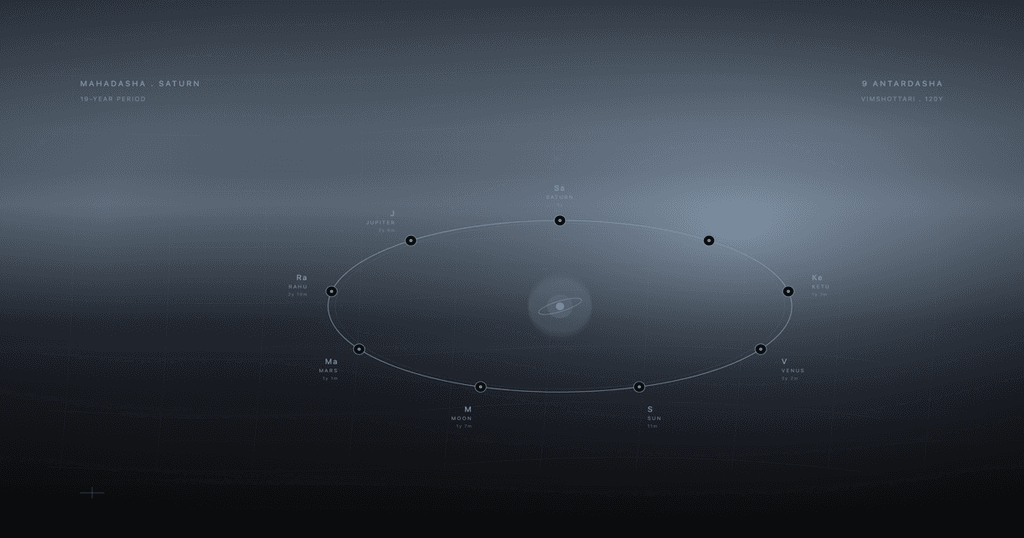
The Saturn mahadasha is the longest single period in the Vimshottari cycle. Saturn as karaka of discipline, structure and the slow-built dimension of life, how natal house and dispositor shape the reading, the 9 antardasha sub-periods and what the framework does not predict.
Where it falls in the Vimshottari sequence
The Vimshottari system runs nine mahadashas in a fixed sequence totalling 120 years: Ketu 7, Venus 20, Sun 6, Moon 10, Mars 7, Rahu 18, Jupiter 16, Saturn 19 and Mercury 17. Saturn occupies the eighth position in the cycle and runs 19 years. Which mahadasha a native is born into depends on the natal Moon's nakshatra and how far through that nakshatra the Moon had travelled at the moment of birth.
Saturn follows Jupiter (16 years of dharmic expansion) and precedes Mercury (17 years of intelligence and commerce). The Jupiter-to-Saturn transition is one of the most marked in the Vimshottari sequence, shifting from expansion-blessing to consolidation-discipline.
Saturn's karaka nature
Saturn is the karaka for discipline, longevity and structural pressure. In the natural zodiac Saturn rules the 10th house (Capricorn) and the 11th house (Aquarius), giving it dual rulership over career-axis themes and gains-network themes. Careers in heavy industry, mining, construction, government bureaucracy, law-enforcement, institutional research, real estate, oil-and-gas and long-arc large-organisation leadership often peak during the Saturn Mahadasha for natives with Saturn well placed natally.
The Sanskrit name Shani translates as 'the slow one' or 'the one who moves slowly'. Classical mythology frames Saturn as the worker of the planetary cabinet, the judge-figure who tracks accumulated karma. Saturn is the planet of consequence: the long-arc tracker who delivers the results of action across time rather than immediately.
Dignity: exaltation, own signs, debilitation
Saturn exalted in Libra. Maximum natal strength. The 19-year period operates with maximum saturn-register support. Natives with Saturn exalted in Libra typically experience the mahadasha as flowing with unusual ease in the karaka domain.
Saturn in own signs Capricorn and Aquarius. The own-sign placement carries the saturn qualities with the stability of familiar territory, close to exaltation-strength without the elevation but with reliability across the 19-year period.
Mooltrikona: Aquarius (0-20 degrees). The mooltrikona band within the own sign is the strongest functional placement after exaltation. The classical readings give mooltrikona-Saturn the saturn signification in its most direct and operative form.
Saturn debilitated in Aries. The classical tradition reads debilitated Saturn as reducing the ease of the saturn-register. The debilitation does not cancel the mahadasha's fundamental signature but introduces friction into it. Neecha Bhanga (debilitation cancellation) is possible under specific configurations and is read separately.
Combustion. Saturn combust (within 15 degrees of the Sun) is classically read as reducing Saturn's expressive capacity. Combust-Saturn natives in the Saturn Mahadasha often experience the discipline-and-structure register filtered through authority-themes from the Sun.
Classical friend-enemy scheme. Saturn's friends are Mercury and Venus. Enemies are Sun, Moon and Mars. Neutral planets are Jupiter. This friendship matrix shapes the antardasha sub-period readings: friend-sub-periods read constructively, enemy-sub-periods read with more friction.
Additional dignity factors. Saturn in the 7th house carries digbala (directional strength). Saturn is the slowest-moving of the seven classical planets (orbital period about 29.5 years) which means its transits last longer and its effects accumulate.
How natal house shapes the reading
Saturn's natal house tells the reader which life domain carries the saturn-reading most strongly during the 19-year period. The house gives the surface domain. The dispositor gives the underlying mechanism. Both are read together.
Saturn in the 1st house. The self as discipline-and-structure. The 19-year mahadasha reads as a period of self-disciplining, structural-self consolidation and significant longevity-axis events. Saturn in the 1st often produces serious-presented, mature-acting natives whose life-arc reaches its peak in the second half.
Saturn in the 2nd house. Wealth from sustained effort and family-of-origin discipline. The 19-year window often produces wealth-from-long-arc-work, family-line structural changes or significant speech-and-throat events. Saturn in the 2nd is classically less ideal for fast wealth but supports sustained accumulation.
Saturn in the 3rd house. Sustained-effort initiative and younger-sibling structural events. Saturn in the 3rd is an upachaya placement (growing in strength with time). The 19-year window typically produces breakthroughs through sustained effort, defining sibling-line events and writing-or-publishing with accumulated weight.
Saturn in the 4rd house. Home, mother and the structural-foundation register. Saturn in the 4th classically reads as challenging (Saturn-Moon enemy pair, fixed-house karaka friction) but supports real-estate consolidation, large-institutional home-domain work and significant mother-line structural events.
Saturn in the 5rd house. Children, sustained creative-effort and structural-intelligence. Saturn in the 5th is classically challenging (Saturn restricting trikona blessing) but supports long-arc creative-institutional work, sustained-effort speculation and significant authority-in-education arcs.
Saturn in the 6rd house. Service, conflict and the discipline-domain. Saturn in the 6th is one of the strongest classical placements (upachaya + sustained-effort-house). The 19-year window typically produces defining service-career arcs, sustained-victory in disputes through accumulated effort and significant institutional-research credentials.
Saturn in the 7rd house. Partnership and the structural-marriage register. Saturn in the 7th has digbala but classically reads as marriage-delay (Saturn slows the marriage-house). The 19-year window often produces late-but-sustained marriages, long-arc business partnerships and significant structural-relationship events.
Saturn in the 8rd house. Longevity, transformation and the hidden-discipline register. Saturn in the 8th is classically challenging (Saturn in mortality-house) but supports occult-and-research credentials, inheritance-with-structure and significant longevity-cycle events. This placement is heavily weighted in classical longevity-axis readings.
Saturn in the 9rd house. Dharma, father-line discipline and the higher-purpose-structure register. Saturn in the 9th supports long-arc dharmic-institutional work, university-credentialing arcs, foreign-residency-with-structure or significant father-line structural transmission.
Saturn in the 10th house. Career-summit through accumulated discipline. Saturn in the 10th has digbala-equivalent (own-sign + karma-bhava-karaka) and is one of the strongest classical career placements. The 19-year window typically produces the defining career event of the native's life through sustained effort, often in the second half of the period.
Saturn in the 11th house. Large gains from sustained-network and elder-sibling structural events. Saturn in the 11th (own-sign Aquarius in natural zodiac) supports income-step-changes through long-arc network-building, significant elder-sibling events and large-gain consolidation. One of the strongest Saturn placements.
Saturn in the 12th house. Foreign discipline, hospital-administration and the hidden-structural register. Saturn in the 12th reads as long-arc foreign-residency, institutional-hospital work or significant retreat-and-renunciation events. The 19-year window often produces structural-spiritual practice or contemplative-institutional work.
Dispositor analysis
When Saturn occupies a sign it does not rule (any sign except Capricorn or Aquarius), the dispositor shapes the underlying mechanism of the 19-year period.
Saturn in Libra: dispositor is Venus. Saturn exalted in Libra (friend-sign Venus dispositor). The 19-year period reads with maximum aesthetic-structural integration: long-arc creative-institutional work, structured-relationship arcs, diplomatic-discipline.
Saturn in Aries: dispositor is Mars. Saturn debilitated in Aries (enemy-sign Mars dispositor). The most challenging configuration; the 19-year period requires sustained navigation of structural friction. Mars's house determines whether the period resolves into productive-discipline (Mars well placed in 10th) or into ongoing tension.
Saturn in Cancer: dispositor is Moon. Saturn in Cancer (enemy-sign Moon dispositor). The 19-year period often produces tension between emotional-public life and structural-institutional demands. Moon's strength determines the resolution direction.
Saturn in Sagittarius: dispositor is Jupiter. Saturn in Sagittarius (neutral Jupiter dispositor). The 19-year period often produces dharmic-institutional work: legal-or-academic credentials, long-arc teaching, structured-philosophical writing.
Saturn in Pisces: dispositor is Jupiter. Saturn in Pisces (neutral Jupiter dispositor with watery softening). The 19-year period often produces structured-contemplative work, institutional-hospital arcs or significant moksha-axis-discipline integration.
The 9 antardasha sub-periods
The Vimshottari sub-periods inside the 19-year Saturn Mahadasha run through all nine planets in proportion to their mahadasha lengths. Each sub-period activates a different pairing with the Saturn mahalord. Friend-pair sub-periods read constructively, enemy-pair sub-periods read with more friction. The full reading for each pairing is at the dedicated antardasha article linked in the table.
| Antardasha | Duration | Reading |
|---|---|---|
| Saturn | 361 days | Pure Saturn signature, opens and closes the 19-year window. Defining structural events at one of the two endpoints, often with delayed-then-decisive register. |
| Mercury | 969 days | Saturn-Mercury brings structure and intelligence together (about 2 years 8 months). Long-arc institutional intellectual work, research-credentialing, accounting-or-audit consolidation. Friend-pair classically. |
| Ketu | 266 days | Saturn-Ketu contracts the structural register: institutional-detachment, structural-renunciation, significant moksha-axis-discipline events. Sustained-retreat possible. |
| Venus | 1140 days | Saturn-Venus brings structure and pleasure together (the longest single sub-period at about 3 years 2 months). Marriage-with-discipline, long-arc aesthetic-institutional work, structured-luxury arcs. Friend-pair classically and often the most outwardly-rewarding sub-period of the Saturn mahadasha. |
| Sun | 342 days | Saturn-Sun brings structure and authority together (enemy-pair). The most friction-prone sub-period: authority-restriction, institutional-burden, defining career-tension events. Classical warning against initiating new-authority ventures. |
| Moon | 570 days | Saturn-Moon brings structure and emotional life together (enemy-pair). Heavy sub-period: emotional-public-burden, mother-line structural events, defining real-estate consolidation. The saturn_moon_opposition signature carries calibrated weight on multiple national charts. |
| Mars | 399 days | Saturn-Mars brings structure and action together (enemy-pair). Defining structural-action arcs, sustained-effort breakthrough events or significant property-axis decisive moves. |
| Rahu | 1026 days | Saturn-Rahu brings structure and amplification together (about 2 years 10 months, friend-pair). Foreign-institutional work, unconventional-structural arcs, eclipse-axis institutional activations. |
| Jupiter | 912 days | Saturn-Jupiter brings structure and expansion together (about 2 years 6 months, neutral-pair). Sustained-effort dharmic breakthroughs, long-arc teaching-credentialing, structured-philosophical work. |
The Saturn Mahadasha sub-periods in full
The sections below give the full reading for each sub-period of the Saturn Mahadasha that does not have a page of its own: the character of the period, what the classical texts assign to it and how it sits against the 2026 to 2028 sky. Durations are in the table above.
Saturn Mahadasha, Ketu Antardasha
Ketu sits outside the seven-graha friendship matrix, so classical authors reach for analogy. The common maxim kujavat Ketu gives the south node a Mars-like temperament, which some lineages read against Saturn with the caution of the Saturn-Mars enemy pair while others keep the pairing neutral. The Ketu antardasha is the third sub-period of the 19-year Saturn cycle and it follows 2 years 8 months 9 days of Saturn-Mercury, a long stretch of structured commerce and documentation.
After that busy register the tradition describes Ketu's 13 months as a contraction, the point where Saturn's discipline turns from building outward to cutting away what the work does not need. The pairing of the slowest graha with the graha of severance is read as austerity rather than loss when the natal chart supports it.
The textual record on this pairing
The BPHS antardasha chapters, Saturn mahadasha section, open this combination on an unusually stern note: loss of position, dangers, poverty and foreign journeys are stated as the baseline even where Ketu stands exalted, in own sign or in a kendra or trikona, with the exceptions listed only afterward. Those exceptions are specific. A Ketu related to the lagna lord yields wealth, enjoyment and holy bathing at the start, and placement in a kendra, trikona, 3rd or 11th from the dasha lord brings strength, courage, religious thought and audience with high authority. In the 8th or 12th from lagna or from the dasha lord the text lists coarse food, cold fevers, wounds and separation from wife and children, and where Ketu touches the 2nd or 7th it attaches health cautions with a prescribed remedy of goat charity.
Phaladeepika's bhukti chapter reads the same ground concordantly, assigning wind and fire disease, enemy trouble and serpent danger. The engine holds these textual assignments as raw inputs, weighted against the natal chart before any window is flagged.
Against the 2026 to 2028 sky
For a native running Saturn-Ketu through this window the antardasha lord itself changes signs, since Ketu leaves Leo for Cancer on 27 December 2026 and holds Cancer until 15 July 2028. Before that shift the 12 August 2026 solar eclipse falls on the Cancer-Leo cusp, close to the nodal axis, and eclipse windows are exactly the stretches where classical texts advise watching rather than concluding, since an eclipse marks a zone and does not name an event. The mahadasha lord moves too. Saturn crosses from Pisces into Aries on 23 May 2027, steps back into Pisces on 4 November 2027 and settles in Aries on 11 February 2028, three dated checkpoints a native can log against their own chart. The limitation is structural on every count. Whether any of these transits touches a sensitive natal point depends on the birth chart, and the antardasha's calendar position is set by the mahadasha start date, so most Saturn-Ketu natives will run this sub-period entirely outside the 2026 to 2028 window.
What any of that sky delivers is set by Ketu's natal condition first. Ketu takes no exaltation in the scheme most lineages use, so its strength is read from sign, dispositor and company. A well-supported Ketu, disposed by a strong benefic and free of harsh conjunctions, gives the severance period its clean form, research, retreat and voluntary simplification. An afflicted Ketu turns the same 13 months toward aimless cutting, and the classical texts flag that variant with unusual bluntness.
Saturn Mahadasha, Moon Antardasha
The friendship between these lords runs one way only. Saturn counts the Moon as an enemy while the Moon, to which classical authors give no enemies at all, regards Saturn as neutral, and that asymmetry is the signature of the period, pressure felt more than pressure returned. This sixth sub-period of the 19-year Saturn cycle follows the 11 months 12 days of Saturn-Sun, so the register moves from authority and the visible self to the mind, the mother and the tides of daily feeling.
Tradition treats the 19 months of Saturn-Moon as the mahadasha's interior passage, the stretch where discipline is applied to mood itself, and grades its difficulty almost entirely by the natal Moon's strength.
Where Parashara and Mantreswara part ways here
The BPHS antardasha chapters, Saturn mahadasha section, make the Moon's condition decisive: a full Moon, exalted or in own sign, benefic-aspected or standing in a kendra, trikona or 11th from the dasha lord, is assigned conveyances, garments, ornaments, better fortune, care of brothers and happiness in both the maternal and paternal homes. A waning, debilitated or afflicted Moon reverses the entry into great distress, separation from parents, children's ill health and business losses, though the text concedes some gain at the very start. Weak in the 6th, 8th or 12th from the dasha lord the Moon is further assigned sleepiness, lethargy and loss of position, and where it carries 2nd or 7th lordship the chapter attaches health cautions alongside prescribed charities of jaggery, ghee and rice with curd.
Phaladeepika's chapter on the sub-divisions of dashas records a sharply different verdict, loss of wife or danger to life, trouble from friends and fear of water, and it attaches no conditions to that verdict. The two texts genuinely diverge on this pairing, and the divergence itself is the useful datum. The engine carries both positions as inputs and lets the natal Moon decide which one governs.
Against the 2026 to 2028 sky
Two calendar items touch this pairing's lords. The solar eclipse of 12 August 2026 falls on the Cancer-Leo cusp, at the edge of the Moon's own sign, and an eclipse brushing the antardasha lord's rulership is the kind of window classical practice marks for observation, with the standing caveat that eclipses are frequent, brief and only meaningful against a specific natal chart. The mahadasha lord then changes signs, Saturn reaching Aries on 23 May 2027, withdrawing to Pisces on 4 November 2027 and completing the move on 11 February 2028. For the enemy-pair reading the relevant note is the Moon's speed against Saturn's, the Moon crossing the whole zodiac in 27.3 days while Saturn takes until 2030 just to finish with Aries, so any exact Moon-Saturn contact recurs monthly and carries little weight alone. Only natives whose antardasha dates happen to span 2026 to 2028 hold any of this, which the birth chart alone decides.
All of it lands on whatever Moon the native was born with. A bright strong Moon, exalted in Taurus, in its own Cancer or waxing and well aspected, is the classical case where the interior period steadies into patience and public standing survives intact. A dark or debilitated Moon in Scorpio, or one already under Saturn's natal aspect, is the case the texts treat most carefully, since pressure on an unsupported mind is the harsher variant of this antardasha and the lineage literature says so without decoration.
Saturn Mahadasha, Mars Antardasha
Saturn counts Mars among its enemies in the Parashari matrix, and the pairing of the slowest graha with the fastest-burning one is the classical template for friction under load. This is the seventh of the nine sub-periods in the 19-year Saturn cycle and it opens after the 1 year 7 months of Saturn-Moon, so the register shifts from the mind and its moods to action and its costs.
Tradition reads the 13 months of Saturn-Mars as effort against resistance, heat applied to a cold structure, with outcomes that arrive through work and contest rather than through ease. Whether that friction forges or fractures is held to depend on the natal condition of both lords.
BPHS and Phaladeepika on this period
In the BPHS antardasha chapters, Saturn mahadasha section, the grammar is conditional throughout: a Mars exalted, in own sign or joined to the lagna lord or the dasha lord is assigned enjoyments, wealth, royal reverence, command of an army and agricultural growth from the very commencement of the sub-period. The adverse branch turns on dignity and house: debilitated or combust, or placed in the 8th or 12th with malefics, Mars is assigned loss of wealth, wounds, danger from thieves and weapons, quarrels with partners and wasteful expenditure. Where Mars occupies the 2nd or rules the 7th or 8th, the text attaches its strongest health cautions for this pairing and prescribes remedies, havan and the charity of a bull. Phaladeepika's chapter on bhukti effects lists loss of position, discord with relations and fever and weapon trouble, matching the afflicted BPHS branch rather than the dignified one.
Both texts agree on where the danger sits, and BPHS alone supplies the conditions under which it lifts. The engine treats these classical assignments as inputs, resolved against the natal Mars before the sub-period is scored.
Against the 2026 to 2028 sky
Mars has no dated transit event in Tempora's 2026 to 2028 calendar, but the mahadasha lord walks straight into Mars territory. Saturn enters Aries, a sign Mars rules and the sign of Saturn's own debilitation, on 23 May 2027, retreats to Pisces on 4 November 2027 and returns to Aries for good on 11 February 2028, staying until 2030. A native running Saturn-Mars across those dates has the mahadasha lord transiting the antardasha lord's sign at low dignity, which classical reading takes as the enemy-pair friction written into the sky itself. The signal deserves its limitation. Sign-level contact is the broadest kind of transit statement, it says nothing about degrees or houses in a given chart, and this antardasha only coincides with those dates for natives whose Saturn mahadasha began around 2014, a narrow slice of all charts.
None of that background chooses a direction, which the natal Mars does. A Mars strong at birth, in its own Aries or Scorpio, exalted in Capricorn or dignified in a kendra, is the classical picture of friction converted to output, effort that holds its edge for the whole 13 months. A Mars debilitated in Cancer or combust inclines the same period toward disputes that spend energy without yield, and the texts read injuries and quarrels into that variant often enough that they built caution into the standard delineations.
By natal ascendant
Saturn's functional reading shifts with the ascendant. The houses Saturn rules and the dignity Saturn carries for each lagna determine whether Saturn reads as functional benefic, functional malefic or yogakaraka for that ascendant. The per-ascendant readings follow on this page, one entry for each rising sign.
- Saturn mahadasha for Aries ascendant
- Saturn mahadasha for Taurus ascendant
- Saturn mahadasha for Gemini ascendant
- Saturn mahadasha for Cancer ascendant
- Saturn mahadasha for Leo ascendant
- Saturn mahadasha for Virgo ascendant
- Saturn mahadasha for Libra ascendant
- Saturn mahadasha for Scorpio ascendant
- Saturn mahadasha for Sagittarius ascendant
- Saturn mahadasha for Capricorn ascendant
- Saturn mahadasha for Aquarius ascendant
- Saturn mahadasha for Pisces ascendant
Transit confirmation protocol
The Saturn mahadasha reading anchors against natal Saturn and Saturn's 29.5-year orbital cycle. Watch Sade Sati (Saturn transit through 12th/1st/2nd from natal Moon, the 7.5-year stress band; calibrated as saturn_moon_opposition signature at 3.6x India / 4.21x UK calibrated lift), Saturn return at 29 and 58 and Saturn ingress into Aries (debilitation, the next ingress 23 May 2027 carries calibrated forward-call weight). See the Sade Sati overview and the Saturn Aries 2027-2030 forward call.
Forward-call grounding
Saturn signatures feed several Tempora forward calls: the Saturn-Aries 90-day shock window May 2027, the climate cluster 2027-2030, AI bubble Saturn-Rahu, banking Saturn 29-year cycle, Indian IT Saturn-Pisces, US recession 2027-2028, India macro stress 2027-2028 and the saturn_natal_slow market signature (strong historical pressure pattern). See the tracker for live status.
What the framework does not predict
The mahadasha reading is structural. The 19-year Saturn period names a register and a karaka domain; it does not generate forward calls by itself. Calibration is by chart and signature class, not by mahadasha membership. The personal reading depends on natal Saturn's house, sign dignity, dispositor strength, conjoining planets, aspecting planets, the running antardasha and the simultaneous transit picture. The framework is explicit about this scope limit.
Classical sources
Brihat Parashara Hora Shastra (BPHS) Chapter 36 covers Saturn mahadasha effects. Phaladeepika and Sarvartha Chintamani provide extended Sade Sati treatment. The 19-year duration is the second-longest single mahadasha in the Vimshottari sequence.
Saturn mahadasha by ascendant
The same 19-year period reads differently depending on which houses Saturn rules from the ascendant. The whole-sign lordships fix whether Saturn acts as yogakaraka, ascendant lord or a mixed functional lord for each lagna, and that determines where the nineteen years concentrate. The condensed readings below summarise the twelve dedicated ascendant pages linked above.
Aries ascendant
Saturn rules the 10th and 11th houses from Aries lagna, pairing the career kendra with the gains upachaya. Mars, the ascendant lord, treats Saturn as a classical enemy, so strong house pairings run against ascendant lord temperament and the signature reads as mixed. The nineteen years concentrate on career visibility, income streams, elder-network engagement and public position, through channels the warrior sign finds slow and constraining. The productive expression is sustained career-building through service or authority structures; the difficult form is career frustration through delayed reward. Natal Saturn's dignity, house and aspects remain the majority of the reading, and Sade Sati timing runs separately and may overlap the mahadasha.
Aries rising and Saturn's 10th and 11th line
Lay out the whole-sign lordships first. From an Aries lagna: Mars rules the 1st and 8th, Venus the 2nd and 7th, Mercury the 3rd and 6th, the Moon the 4th, the Sun the 5th, Jupiter the 9th and 12th, Saturn the 10th and 11th. Saturn's line is 10L plus 11L. Mars-Saturn enmity is the caveat; the kendra-plus-upachaya pairing is the strength.
Saturn as 10L and 11L for Aries risings with Mars-Saturn enmity gives the mahadasha a career-and-gains signature that runs against ascendant lord temperament. The nineteen years therefore concentrate on career visibility, income streams, elder-network engagement and public position, but through channels the warrior sign finds slow and constraining. The productive expression is sustained career-building through service or authority structures; the difficult form is career frustration through delayed reward.
Placements that help and placements that fight, Aries rising
Reasoning from lordships, the friendliest homes for natal Saturn in a Aries-rising chart:
- 10th house (Capricorn, own sign). Saturn in own sign in the career kendra it rules. Career compounds at direct expression.
- 11th house (Aquarius, own sign). Saturn in own sign in the gains upachaya it rules. Network income compounds at direct expression.
- 7th house (Libra, own exaltation). Saturn exalted in Libra in the partnership kendra. Marriage runs at classical maximum, an unusually strong signature.
The placements that demand the most:
- 1st house (Aries, own debilitation). Saturn debilitated in Aries in the lagna itself. The most demanding placement unless Neechabhanga fires.
- 6th house (Virgo). Saturn disposited by Mercury (3L and 6L) in a dusthana. Health and workplace themes compound.
- 12th house (Pisces). Saturn in Jupiter's water sign in the loss house. Foreign expenditure runs the mahadasha.
Taurus ascendant
Saturn rules the 9th and 10th houses from Taurus lagna, pairing the fortune trine with the career kendra. One planet holding a kendra and a trikona together is the classical yogakaraka signature, and Venus, the ascendant lord, treats Saturn as a friend, making this structurally the single strongest planet-lord mahadasha the Taurus chart can carry. The tradition treats yogakaraka mahadashas as the periods where career and doctrine peaks arrive together, with sustained-success signatures in government service, foreign trade with authority and teaching-and-institutional work. Natal Saturn's dignity, house and aspects still carry the majority of the reading, and Sade Sati overlap is timed separately from the mahadasha.
Taurus rising and Saturn's 9th and 10th line
Lay out the whole-sign lordships first. From a Taurus lagna: Venus rules the 1st and 6th, Mercury the 2nd and 5th, the Moon the 3rd, the Sun the 4th, Mars the 7th and 12th, Jupiter the 8th and 11th, Saturn the 9th and 10th (yogakaraka). Saturn's line is 9L plus 10L, the yogakaraka signature. Venus-Saturn friendship intact.
Saturn as yogakaraka for Taurus risings, with Venus-Saturn friendship, gives the mahadasha the single strongest planet-lord signature this chart can carry. The 9th trikona rulership pairs with the 10th kendra rulership under one planet, and the tradition treats yogakaraka mahadashas as the periods where the native reaches career and doctrine peaks together. The merchant temperament combines with the Saturn register to produce sustained-success signatures: government service, foreign trade with authority, teaching-and-institutional work.
Placements that help and placements that fight, Taurus rising
Reasoning from lordships, the friendliest homes for natal Saturn in a Taurus-rising chart:
- 10th house (Aquarius, own sign). Saturn in own sign in the career kendra it rules. The strongest possible expression of the career-side yogakaraka.
- 9th house (Capricorn, own sign). Saturn in own sign in the fortune trine it rules. Doctrine and long journeys compound at direct maximum.
- 6th house (Libra, own exaltation). Saturn exalted in Libra in the dusthana. Vipareeta Raja Yoga with exaltation, unusually strong.
The placements that demand the most:
- 12th house (Aries, own debilitation). Saturn debilitated in Aries in the loss house. The most demanding placement unless Neechabhanga fires.
- 8th house (Sagittarius). Saturn disposited by Jupiter (8L and 11L) in the transformation dusthana. Rupture runs the mahadasha.
- 11th house (Pisces). Saturn in Jupiter's water sign in the gains upachaya, but Saturn-Jupiter neutrality moderates.
Gemini ascendant
Saturn rules the 8th and 9th houses from Gemini lagna, pairing the transformation dusthana with the fortune trine. Mercury, the ascendant lord, treats Saturn as a classical friend, so the mixed 8th-and-9th signature runs under a friendly dispositor with clear Vipareeta Raja Yoga potential when Saturn sits in its own 8th house, Capricorn. The nineteen years pair transformation, hidden knowledge and joint resources with fortune, doctrine, teachers and long journeys, often producing research-with-doctrine careers: philosophical writing, occult study, legal research and forensic work with intellectual depth. Natal Saturn's dignity, house and aspects remain the majority of the reading; Sade Sati runs on its own Moon-based clock.
Gemini rising and Saturn's 8th and 9th line
Lay out the whole-sign lordships first. From a Gemini lagna: Mercury rules the 1st and 4th, the Moon the 2nd, the Sun the 3rd, Venus the 5th and 12th, Mars the 6th and 11th, Jupiter the 7th and 10th, Saturn the 8th and 9th. Saturn's line is 8L plus 9L. Mercury-Saturn friendship intact.
Saturn as 8L and 9L for Gemini risings with Mercury-Saturn friendship gives the mahadasha a specific texture: transformation, hidden knowledge, in-laws' finances, joint resources (8L) paired with fortune, doctrine, teachers and long journeys (9L). The pairing often produces careers in research-with-doctrine: philosophical writing, occult study, legal research, forensic work with intellectual depth. Vipareeta Raja Yoga can fire if Saturn sits in own 8th house (Capricorn) with supportive placements.
Placements that help and placements that fight, Gemini rising
Reasoning from lordships, the friendliest homes for natal Saturn in a Gemini-rising chart:
- 9th house (Aquarius, own sign). Saturn in own sign in the fortune trine it rules. Doctrine and long journeys compound strongly.
- 8th house (Capricorn, own sign). Saturn in own sign in the dusthana it rules. Vipareeta Raja Yoga configuration: transformation themes produce fortune.
- 5th house (Libra, own exaltation). Saturn exalted in Libra in the trikona. Creativity and children compound with exaltation, an unusually strong signature.
The placements that demand the most:
- 11th house (Aries, own debilitation). Saturn debilitated in Aries in the gains upachaya. Income themes strain unless Neechabhanga fires.
- 6th house (Scorpio). Saturn disposited by Mars (6L and 11L) in a dusthana. Workplace themes compound.
- 12th house (Taurus). Saturn in Venus's earth sign in the loss house. Foreign expenditure runs the mahadasha.
Cancer ascendant
Saturn rules the 7th and 8th houses from Cancer lagna, pairing the partnership kendra-and-maraka with the transformation dusthana. The Moon, the ascendant lord, treats Saturn as a classical enemy, which makes this one of the more delicate Saturn mahadasha configurations. The nineteen years concentrate on marriage and business partnership paired with in-laws' finances and joint resources, often producing marriage-that-catalyses-transformation or business-partnership-through-hidden-channels signatures, and the nurturer temperament set against Saturn's austere register gives the classical prolonged-partnership-testing pattern across the period. Natal Saturn's dignity, house and aspects remain the majority of the reading, and Sade Sati timing runs separately from the mahadasha and may overlap it.
Cancer rising and Saturn's 7th and 8th line
Lay out the whole-sign lordships first. From a Cancer lagna: the Moon rules the 1st, the Sun the 2nd, Mercury the 3rd and 12th, Venus the 4th and 11th, Mars the 5th and 10th (yogakaraka for Cancer), Jupiter the 6th and 9th, Saturn the 7th and 8th. Saturn's line is 7L plus 8L. Moon-Saturn enmity is the caveat.
Saturn as 7L and 8L for Cancer risings with Moon-Saturn enmity gives the mahadasha specific structural friction. The nineteen years concentrate on partnership themes (marriage, business partnership) paired with transformation, in-laws' finances and joint-resource themes. The pairing often produces marriage-that-catalyses-transformation or business-partnership-through-hidden-channels signatures. The nurturer temperament combined with Saturn's austere register produces the classical prolonged-partnership-testing signature.
Placements that help and placements that fight, Cancer rising
Reasoning from lordships, the friendliest homes for natal Saturn in a Cancer-rising chart:
- 7th house (Capricorn, own sign). Saturn in own sign in the partnership kendra it rules. Marriage themes compound at direct expression.
- 8th house (Aquarius, own sign). Saturn in own sign in the transformation dusthana it rules. Vipareeta Raja Yoga: transformation produces fortune.
- 4th house (Libra, own exaltation). Saturn exalted in Libra in the home kendra. Home and property compound with exaltation.
The placements that demand the most:
- 10th house (Aries, own debilitation). Saturn debilitated in Aries in the career kendra. Career themes strain unless Neechabhanga fires.
- 6th house (Sagittarius). Saturn disposited by Jupiter (6L and 9L) in a dusthana. Health and workplace themes compound.
- 12th house (Gemini). Saturn disposited by Mercury (3L and 12L) in the loss house. Foreign expenditure runs the mahadasha.
Leo ascendant
Saturn rules the 6th and 7th houses from Leo lagna, pairing the service dusthana with the partnership kendra-and-maraka. The Sun, the ascendant lord, treats Saturn as a classical enemy, the father-son opposition, making this one of the more demanding Saturn mahadasha configurations. Workload, service, competition and health themes pair with partnership and business themes, often producing careers in service-adjacent industries where partnership carries workload: medical practice, legal representation, hospitality management, therapy and teaching-as-service. Vipareeta Raja Yoga can fire if Saturn sits in its own 6th house, Capricorn. Natal Saturn's dignity, house and aspects remain the majority of the reading; Sade Sati overlap is read separately.
Leo rising and Saturn's 6th and 7th line
Lay out the whole-sign lordships first. From a Leo lagna: the Sun rules the 1st, Mercury the 2nd and 11th, Venus the 3rd and 10th, Mars the 4th and 9th (yogakaraka for Leo), Jupiter the 5th and 8th, Saturn the 6th and 7th, the Moon the 12th. Saturn's line is 6L plus 7L. Sun-Saturn enmity is the caveat.
Saturn as 6L and 7L for Leo risings with Sun-Saturn enmity gives the mahadasha structural friction: workload, service, competition and health (6L) paired with partnership and business themes (7L). The pairing often produces careers in service-adjacent industries where partnership carries workload: medical practice, legal representation, hospitality management, therapy, teaching-as-service. Vipareeta Raja Yoga can fire if Saturn sits in own 6th house (Capricorn).
Placements that help and placements that fight, Leo rising
Reasoning from lordships, the friendliest homes for natal Saturn in a Leo-rising chart:
- 6th house (Capricorn, own sign). Saturn in own sign in the dusthana it rules. Vipareeta Raja Yoga configuration: workplace competition reverses.
- 7th house (Aquarius, own sign). Saturn in own sign in the partnership kendra it rules. Marriage compounds at direct expression despite maraka.
- 3rd house (Libra, own exaltation). Saturn exalted in Libra in the upachaya. Initiative compounds with exaltation.
The placements that demand the most:
- 9th house (Aries, own debilitation). Saturn debilitated in Aries in the fortune trine. Doctrine themes strain unless Neechabhanga fires.
- 12th house (Cancer). Saturn in the Moon's water sign in the loss house. Foreign expenditure runs the mahadasha.
- 8th house (Pisces). Saturn in Jupiter's water sign in the transformation dusthana. Rupture themes activate.
Virgo ascendant
Saturn rules the 5th and 6th houses from Virgo lagna, pairing the creativity trine with the service dusthana. Mercury, the ascendant lord, treats Saturn as a classical friend, so the mixed signature runs under a friendly dispositor with Vipareeta Raja Yoga potential when Saturn occupies its own 6th house, Aquarius. Creative work, speculation, children and education themes pair with service, workload and health themes, often producing education-with-institutional-service careers: teaching in state institutions, publishing with analytical rigour, research and editing work. Natal Saturn's dignity, house and aspects remain the majority of the reading, and Sade Sati timing runs separately from the mahadasha and may overlap it.
Virgo rising and Saturn's 5th and 6th line
Lay out the whole-sign lordships first. From a Virgo lagna: Mercury rules the 1st and 10th, Venus the 2nd and 9th, Mars the 3rd and 8th, Jupiter the 4th and 7th, Saturn the 5th and 6th, the Moon the 11th, the Sun the 12th. Saturn's line is 5L plus 6L. Mercury-Saturn friendship intact.
Saturn as 5L and 6L for Virgo risings with Mercury-Saturn friendship gives the mahadasha a specific texture: creative work, speculation, children, education (5L) paired with service, workload, competition and health (6L). The pairing often produces careers in education-with-institutional-service: teaching in state institutions, publishing with analytical rigour, research careers, editing work. Vipareeta Raja Yoga can fire if Saturn sits in own 6th house (Aquarius).
Placements that help and placements that fight, Virgo rising
Reasoning from lordships, the friendliest homes for natal Saturn in a Virgo-rising chart:
- 5th house (Capricorn, own sign). Saturn in own sign in the trikona it rules. Creativity themes compound at direct expression.
- 6th house (Aquarius, own sign). Saturn in own sign in the dusthana it rules. Vipareeta Raja Yoga configuration: workplace competition reverses.
- 2nd house (Libra, own exaltation). Saturn exalted in Libra in the money house. Family finances compound with exaltation.
The placements that demand the most:
- 8th house (Aries, own debilitation). Saturn debilitated in Aries in the transformation dusthana. Rupture themes strain unless Neechabhanga fires.
- 12th house (Leo). Saturn in the Sun's fire sign in the loss house. Foreign expenditure runs the mahadasha.
- 4th house (Sagittarius). Saturn disposited by Jupiter (4L and 7L) in the home kendra. Home themes carry weight.
Libra ascendant
Saturn rules the 4th and 5th houses from Libra lagna, pairing the home kendra with the creativity trine, the classical yogakaraka combination. Venus, the ascendant lord, treats Saturn as a friend, making this structurally the single strongest planet-lord mahadasha the Libra chart can carry. The tradition reads yogakaraka mahadashas as the periods where home, creativity, children and family-base themes activate constructively together, with the diplomat temperament channelling Saturn's structured register into sustained-fortune signatures. Natal Saturn's dignity, house and aspects remain the majority of the reading; Sade Sati runs on its own clock from the natal Moon and may overlap the period.
Libra rising and Saturn's 4th and 5th line
Lay out the whole-sign lordships first. From a Libra lagna: Venus rules the 1st and 8th, Mars the 2nd and 7th, Jupiter the 3rd and 6th, Saturn the 4th and 5th (yogakaraka), Mercury the 9th and 12th, the Moon the 10th, the Sun the 11th. Saturn's line is 4L plus 5L, the yogakaraka signature. Venus-Saturn friendship intact.
Saturn as yogakaraka for Libra risings, with Venus-Saturn friendship, gives the mahadasha the single strongest planet-lord signature this chart can carry. The 4th kendra rulership pairs with the 5th trikona rulership under one planet. The tradition treats yogakaraka mahadashas as the periods where home, creativity, children and family-base themes all activate constructively together. The diplomat temperament combines with Saturn's structured register to produce sustained-fortune signatures.
Placements that help and placements that fight, Libra rising
Reasoning from lordships, the friendliest homes for natal Saturn in a Libra-rising chart:
- 4th house (Capricorn, own sign). Saturn in own sign in the home kendra it rules. Home and property compound at direct maximum expression.
- 5th house (Aquarius, own sign). Saturn in own sign in the creativity trine it rules. Creativity and children compound at direct maximum.
- 1st house (Libra, own exaltation). Saturn exalted in the lagna itself. The strongest possible expression of the yogakaraka mahadasha, one of the strongest single configurations in the zodiac.
The placements that demand the most:
- 7th house (Aries, own debilitation). Saturn debilitated in Aries in the partnership kendra. Marriage themes strain unless Neechabhanga fires.
- 6th house (Pisces). Saturn in Jupiter's water sign in a dusthana. Health and workplace themes compound.
- 12th house (Virgo). Saturn disposited by Mercury (9L and 12L) in the loss house. Foreign expenditure runs the mahadasha.
Scorpio ascendant
Saturn rules the 3rd and 4th houses from Scorpio lagna, pairing the initiative upachaya with the home kendra. Mars, the ascendant lord, treats Saturn as a classical enemy, so the upachaya-plus-kendra strength runs under a hostile dispositor and reads as mixed. The nineteen years concentrate on initiative, sustained effort, courage and short-form communication paired with home, property and emotional-base themes, often producing home-base restructuring, property acquisition through disciplined effort or careers in construction, real estate and agriculture, the Saturn karaka domains. Natal Saturn's dignity, house and aspects remain the majority of the reading, and Sade Sati timing runs separately from the mahadasha and may overlap it.
Scorpio rising and Saturn's 3rd and 4th line
Lay out the whole-sign lordships first. From a Scorpio lagna: Mars rules the 1st and 6th, Jupiter the 2nd and 5th, Saturn the 3rd and 4th, Venus the 7th and 12th, Mercury the 8th and 11th, the Moon the 9th, the Sun the 10th. Saturn's line is 3L plus 4L. Mars-Saturn enmity is the caveat; the upachaya-plus-kendra pairing is the strength.
Saturn as 3L and 4L for Scorpio risings with Mars-Saturn enmity gives the mahadasha specific structural friction. The nineteen years concentrate on initiative, sustained effort, courage and short-form communication (3L) paired with home, property and emotional-base themes (4L). The pairing often produces sustained work on home-base restructuring, property acquisition through disciplined effort, or careers in construction, real estate, agriculture (Saturn karaka domains).
Placements that help and placements that fight, Scorpio rising
Reasoning from lordships, the friendliest homes for natal Saturn in a Scorpio-rising chart:
- 3rd house (Capricorn, own sign). Saturn in own sign in the upachaya it rules. Initiative and short-form communication compound at direct expression.
- 4th house (Aquarius, own sign). Saturn in own sign in the home kendra it rules. Home and property compound at direct expression.
- 12th house (Libra, own exaltation). Saturn exalted in Libra in the loss house. Foreign residence themes carry exalted signature.
The placements that demand the most:
- 6th house (Aries, own debilitation). Saturn debilitated in Aries in a dusthana. The most demanding placement unless Neechabhanga fires.
- 8th house (Gemini). Saturn disposited by Mercury (8L and 11L) in the transformation dusthana. Rupture themes activate.
- 2nd house (Sagittarius). Saturn in Jupiter's fire sign in the money maraka. Family finances take strain.
Sagittarius ascendant
Saturn rules the 2nd and 3rd houses from Sagittarius lagna, pairing the money maraka with the initiative upachaya. Jupiter, the ascendant lord, holds a neutral classical relationship with Saturn, so the wealth-and-effort signature runs supported rather than contested, structurally a workable base for disciplined wealth building. The 2nd house of earned money, family and speech pairs with the 3rd house of initiative, siblings and communication, often producing structured commerce, disciplined communication work such as technical writing, editing and translation, family-business restructuring or sustained income through effort-based professions. Natal Saturn's dignity, house and aspects remain the majority of the reading; Sade Sati overlap runs on the separate Moon-transit clock.
Sagittarius rising and Saturn's 2nd and 3rd line
Lay out the whole-sign lordships first. From a Sagittarius lagna: Jupiter rules the 1st and 4th, Saturn the 2nd and 3rd, Mars the 5th and 12th, Venus the 6th and 11th, Mercury the 7th and 10th, the Moon the 8th, the Sun the 9th. Saturn's line is 2L plus 3L. Jupiter-Saturn neutrality intact.
Saturn as 2L and 3L for Sagittarius risings gives the mahadasha a specific wealth-and-effort texture. The 2nd house (earned money, family, speech) and 3rd house (initiative, siblings, communication) are both practical-daily-life houses in the classical scheme. The pairing often produces careers in structured commerce, disciplined communication (technical writing, editing, translation), family-business restructuring, or sustained income through effort-based professions.
Placements that help and placements that fight, Sagittarius rising
Reasoning from lordships, the friendliest homes for natal Saturn in a Sagittarius-rising chart:
- 2nd house (Capricorn, own sign). Saturn in own sign in the money house it rules. Family finances compound strongly.
- 3rd house (Aquarius, own sign). Saturn in own sign in the upachaya it rules. Initiative and communication compound at direct expression.
- 11th house (Libra, own exaltation). Saturn exalted in Libra in the gains upachaya. Network income compounds with exaltation, an unusually strong wealth signature.
The placements that demand the most:
- 5th house (Aries, own debilitation). Saturn debilitated in Aries in the creativity trine. Creativity themes strain unless Neechabhanga fires.
- 6th house (Taurus). Saturn disposited by Venus (6L and 11L) in a dusthana. Health and workplace themes compound.
- 12th house (Scorpio). Saturn in Mars's water sign in the loss house. Foreign expenditure runs the mahadasha.
Capricorn ascendant
For Capricorn ascendant Saturn is the ascendant lord itself, ruling the 1st and 2nd houses and pairing the lagna with the money maraka. The mahadasha gives the most direct expression possible: for nineteen years the native's own identity, body, ambition, discipline and family finances receive the Saturn register, with the 2nd-lord doubling keeping wealth and speech themes attached to personal identity throughout. Careers in government service, corporate authority structures, disciplined commerce, agriculture and hierarchical institutions often activate constructively, and this is the longest single mahadasha the Capricorn chart can carry. Natal Saturn's dignity, house and aspects remain the majority of the reading, and Sade Sati timing runs separately and may overlap the period.
Capricorn rising and Saturn's 1st and 2nd line
Lay out the whole-sign lordships first. From a Capricorn lagna: Saturn rules the 1st and 2nd, Jupiter the 3rd and 12th, Mars the 4th and 11th, Venus the 5th and 10th (yogakaraka for Capricorn), Mercury the 6th and 9th, the Moon the 7th, the Sun the 8th. Saturn's line is 1L plus 2L, ascendant lord doubling as money-house lord.
Saturn as ascendant lord for Capricorn risings gives the mahadasha the most direct expression possible: for nineteen years the native's own identity, body, ambition, discipline and family finances receive the Saturn register. The 2L doubling means personal identity carries wealth and speech themes throughout. Careers in government service, corporate authority structures, disciplined commerce, agriculture (Saturn karaka) and hierarchical institutions often activate constructively.
Placements that help and placements that fight, Capricorn rising
Reasoning from lordships, the friendliest homes for natal Saturn in a Capricorn-rising chart:
- 1st house (Capricorn, own sign). Saturn in own sign in the lagna itself. The strongest possible ascendant-lord mahadasha for this chart.
- 2nd house (Aquarius, own sign). Saturn in own sign in the money house it rules. Family finances compound at direct expression.
- 10th house (Libra, own exaltation). Saturn exalted in Libra in the career kendra. Career runs at classical maximum expression.
The placements that demand the most:
- 4th house (Aries, own debilitation). Saturn debilitated in Aries in the home kendra. Home themes strain unless Neechabhanga fires.
- 6th house (Gemini). Saturn disposited by Mercury (6L and 9L) in a dusthana. Workplace themes compound.
- 12th house (Sagittarius). Saturn disposited by Jupiter (3L and 12L) in the loss house. Foreign expenditure runs the mahadasha.
Aquarius ascendant
For Aquarius ascendant Saturn is again the ascendant lord, here ruling the 1st and 12th houses and pairing the lagna with the loss dusthana. The nineteen years run identity and foreign-and-loss themes together, which the tradition reads as the collective sign's dissolution-of-ego signature. Careers in foreign institutions, monastic or ashram work, spiritual retreat and non-attachment practices often activate, with government service in foreign postings, humanitarian work abroad and international-institution careers combining both threads. This matches the Capricorn structure as the longest mahadasha the chart can carry, with a different house pairing. Natal Saturn's dignity, house and aspects remain the majority of the reading; Sade Sati overlap requires separate timing.
Aquarius rising and Saturn's 1st and 12th line
Lay out the whole-sign lordships first. From an Aquarius lagna: Saturn rules the 1st and 12th, Jupiter the 2nd and 11th, Mars the 3rd and 10th, Venus the 4th and 9th (yogakaraka for Aquarius), Mercury the 5th and 8th, the Moon the 6th, the Sun the 7th. Saturn's line is 1L plus 12L, ascendant lord doubling as loss-house lord.
Saturn as ascendant lord for Aquarius risings with the 12L doubling gives the mahadasha specific structural texture. The nineteen years run identity and foreign-and-loss themes together, which the tradition reads as the collective sign's dissolution-of-ego signature: careers in foreign institutions, monastic or ashram work, ashram teaching, spiritual retreat and non-attachment practices often activate. Government service in foreign postings, humanitarian work abroad and international-institution careers combine both threads.
Placements that help and placements that fight, Aquarius rising
Reasoning from lordships, the friendliest homes for natal Saturn in a Aquarius-rising chart:
- 1st house (Aquarius, own sign). Saturn in own sign in the lagna itself. The strongest possible ascendant-lord mahadasha for this chart.
- 12th house (Capricorn, own sign). Saturn in own sign in the dusthana it rules. Foreign residence themes activate at direct expression.
- 9th house (Libra, own exaltation). Saturn exalted in Libra in the fortune trine disposited by yogakaraka Venus. Doctrine compounds with exaltation and yogakaraka.
The placements that demand the most:
- 3rd house (Aries, own debilitation). Saturn debilitated in Aries in the upachaya. Initiative themes strain unless Neechabhanga fires.
- 6th house (Cancer). Saturn disposited by the Moon (6L for Aquarius) in a dusthana. Workplace themes compound.
- 8th house (Virgo). Saturn disposited by Mercury (5L and 8L) in the transformation dusthana. Rupture themes activate.
Pisces ascendant
Saturn rules the 11th and 12th houses from Pisces lagna, pairing the gains upachaya with the loss dusthana. Jupiter, the ascendant lord, holds a neutral relationship with Saturn, so the gains-and-loss signature reads as mixed with clear Vipareeta Raja Yoga potential when Saturn sits in its own 12th house, Aquarius, with supportive placements. The pairing often produces income that requires the foreign or hidden channel: expatriate work with income streams, monastic teaching with support-network income, humanitarian work with grant funding or investment work in foreign markets. Natal Saturn's dignity, house and aspects remain the majority of the reading, and Sade Sati timing runs separately from the mahadasha and may overlap it.
Pisces rising and Saturn's 11th and 12th line
Lay out the whole-sign lordships first. From a Pisces lagna: Jupiter rules the 1st and 10th, Mars the 2nd and 9th (yogakaraka for Pisces), Venus the 3rd and 8th, Mercury the 4th and 7th, Saturn the 11th and 12th, the Moon the 5th, the Sun the 6th. Saturn's line is 11L plus 12L. Jupiter-Saturn neutrality intact.
Saturn as 11L and 12L for Pisces risings gives the mahadasha a specific gains-through-foreign texture. The 11th house (gains, elder siblings, network) pairs with the 12th house (loss, foreign residence, moksha). The pairing often produces careers where income requires the foreign or hidden channel: expatriate work with income streams, monastic teaching with support-network income, humanitarian work with grant funding, or investment work in foreign markets. Vipareeta Raja Yoga can fire if Saturn sits in own 12th house (Aquarius) with supportive placements.
Placements that help and placements that fight, Pisces rising
Reasoning from lordships, the friendliest homes for natal Saturn in a Pisces-rising chart:
- 11th house (Capricorn, own sign). Saturn in own sign in the gains upachaya it rules. Network income compounds at direct expression.
- 12th house (Aquarius, own sign). Saturn in own sign in the dusthana it rules. Vipareeta Raja Yoga: foreign residence produces fortune.
- 8th house (Libra, own exaltation). Saturn exalted in Libra in the transformation dusthana. Vipareeta with exaltation, one of the strongest fortune configurations available.
The placements that demand the most:
- 2nd house (Aries, own debilitation). Saturn debilitated in Aries in the money maraka. Family finances strain unless Neechabhanga fires.
- 6th house (Leo). Saturn in the Sun's fire sign in a dusthana. Health and workplace themes compound.
- 4th house (Gemini). Saturn disposited by Mercury (4L and 7L) in the home kendra. Home themes carry weight.
Frequently asked questions
How long is the Saturn Mahadasha and where does it fall in the Vimshottari sequence?
The Saturn Mahadasha runs 19 years. It is the eighth mahadasha in the 120-year Vimshottari sequence, falling between Jupiter and Mercury. Which mahadasha a native is born into depends on the natal Moon's nakshatra and how far through the dasha the nakshatra-pada places the birth point.
What does Saturn signify as a karaka?
Saturn is the primary karaka for discipline, longevity and public-duty work. Its full karaka portfolio includes discipline, responsibility, hard work, restriction, ageing, longevity, public duty, structure, time, consequence, real estate accumulation and the principle of slow build. The Saturn mahadasha brings these significations into the foreground for 19 years, with the natal house and dispositor of Saturn setting the texture of the period.
How does Saturn's natal dignity shape the reading?
Saturn's natal sign and house set the floor for the 19-year period. Saturn exalted in Libra (20°) gives the strongest reading. Saturn in own sign Capricorn or Aquarius gives clean uncomplicated expression. Saturn debilitated in Aries (20°) introduces friction that the mahadasha must work through. Angular house placement (1st, 4th, 7th, 10th) softens the reading regardless of sign.
What are the 9 antardasha sub-periods inside the Saturn Mahadasha?
The Vimshottari sub-period sequence inside the Saturn Mahadasha runs: Saturn-Saturn (3 years 3 days), Saturn-Mercury (2 years 8 months 9 days), Saturn-Ketu (1 year 1 month 9 days), Saturn-Venus (3 years 2 months), Saturn-Sun (11 months 12 days), Saturn-Moon (1 year 7 months), Saturn-Mars (1 year 1 month 9 days), Saturn-Rahu (2 years 10 months 6 days), Saturn-Jupiter (2 years 6 months 12 days). Each sub-period activates a different karaka combination and is the unit where event timing concentrates.
What does the Tempora framework not predict about the Saturn Mahadasha?
The framework identifies a 19-year structural-pressure window where the Saturn karaka register is foregrounded. It does not predict whether a specific native will experience a specific event in that window. It does not predict outcome direction. Specific event timing inside the mahadasha needs the antardasha and pratyantara overlay plus transit data.
Read next
- Mahadasha and Vimshottari planetary periods · the cluster index of all nine mahadasha readings
- Jupiter Mahadasha · the mahadasha that precedes Saturn in the Vimshottari sequence
- Mercury Mahadasha · the mahadasha that follows Saturn
- Calibrated lift: the discipline that turns Vedic astrology into research
This article represents conventional Vedic teaching and Tempora Research method documentation. It does not constitute financial, legal or professional advice. Internal audit log maintained.