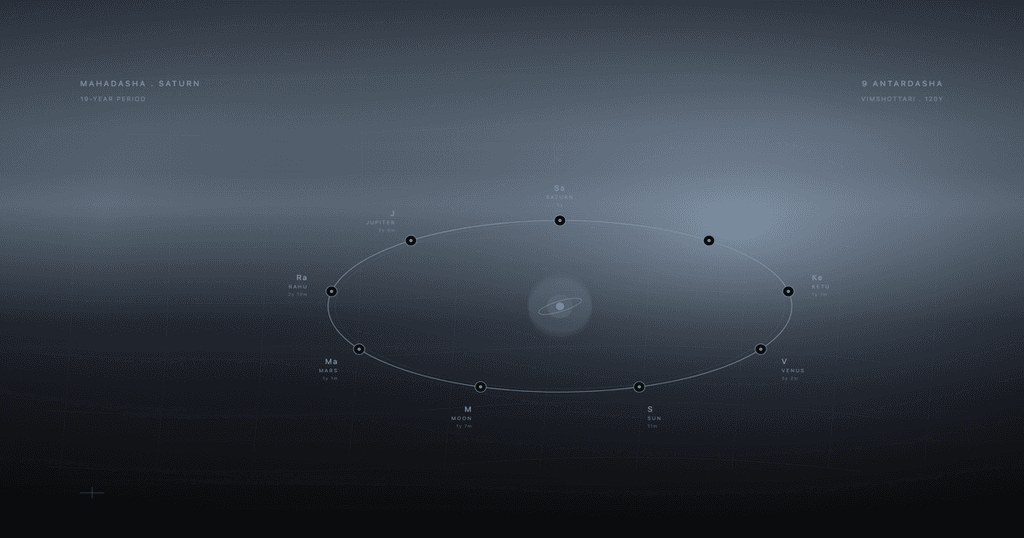
Saturn Mahadasha Rahu Antardasha: the institutional-expansion window
Rahu stands outside the seven-graha friendship scheme, and the maxim the tradition supplies, shanivat Rahu, says the north node behaves like Saturn itself, which is why this pairing is commonly read as a friendly one, two agents of the same slow appetite working the same ground. The Rahu antardasha is the eighth of nine sub-periods in the 19-year Saturn cycle and it opens as the friction of the 13-month Saturn-Mars period closes, trading contest for amplification.
Classical reading gives these 34 months the character of Saturn's ambitions enlarged past their usual scale, worldly reach, foreign ground and appetite wearing discipline's clothes. The texts respect the pairing's productivity and distrust its excess in equal measure.
Where the sub-period falls in the Vimshottari sequence
The 19-year Saturn mahadasha divides into nine antardasha sub-periods in fixed Vimshottari order starting with Saturn itself. The Rahu sub-period sits at position 8 of 9. Exact start and end dates for any chart can be computed from the natal Moon nakshatra-pada and the date of Saturn mahadasha onset. The Tempora dasha engine produces this to the day.
The arithmetic of this period
Rahu's 18 years of the 120 give the antardasha 19 times 18 over 120, or 2.85 years, which is 2 years 10 months 6 days, the third longest sub-period of the mahadasha. The seven periods before it total about 13 years 7 months, so Saturn-Rahu runs from roughly year 13.6 to year 16.5 of the 19.
Late position is much of its meaning. Nothing follows this period except the closing Jupiter antardasha, so what Rahu amplifies here is the mahadasha's nearly finished work rather than its plans, and a native entering it has lived under Saturn's register for a dozen years already. The whole sequence is mapped in the Saturn mahadasha overview and Rahu's own 18-year cycle in the Rahu mahadasha page.
The sequence gives it a hinge role. Before it stands the 13-month friction of Saturn-Mars, after it the closing counsel of Saturn-Jupiter, so Rahu inherits a contested field and hands on a nearly settled one. Its 2 years 10 months 6 days make it the longest of the mahadasha's final three sub-periods, which is why charts that remember the end of a Saturn mahadasha for its scale of worldly movement are usually remembering this stretch rather than the quieter Jupiter close.
The classical positions behind this reading
The BPHS antardasha chapters, Saturn mahadasha section, state the adverse case first for this combination: quarrels, mental agony, friction with sons, wasteful spending, government trouble and foreign journeys, all contingent on Rahu lacking exaltation or other auspicious placement. The favourable clause is equally conditional. Rahu joined to the lagna lord or a yogakaraka, exalted, in own sign or in a kendra or 11th from lagna or from the dasha lord is assigned enjoyment, wealth, agricultural increase, pilgrimage and family wellbeing at the start, with cordiality toward the king in the middle stretch. The chapter adds a sign-specific rider, rare in the antardasha literature: Rahu in Aries, Virgo, Cancer, Taurus, Pisces or Sagittarius brings opulence, royal cordiality and valuable clothes.
Phaladeepika's bhukti chapter sides with the stern baseline, wind and bile disease, wounds to the body and family discord. Where the two agree this firmly, the engine still routes the position through the natal Rahu before the sub-period carries any weight in a reading.
Friendship status and pairing reading
In the classical Parashari friendship matrix, Saturn views Rahu as friend. The friend-pair classification means the 2 years 10 months 6 days sub-period classically delivers outcomes where Saturn's register (discipline, longevity, institutional structure and sustained-effort outcomes) and Rahu's register (worldly desire, foreign-axis, amplification, taboo and the boundary-crossing register) integrate constructively. Events typically surface from both karaka domains in alignment rather than friction.
The Rahu karaka overlay
Rahu is the karaka of worldly desire, foreign-axis, amplification, taboo and the boundary-crossing register. Across the 2 years 10 months 6 days sub-period, this karaka set overlays on top of Saturn's 19-year discipline, longevity, institutional structure and sustained-effort outcomes register. The combined reading is the central output of the sub-period.
How Rahu's natal dignity shapes the reading
Rahu's natal sign and house set the floor for the 2 years 10 months 6 days sub-period. Rahu at exaltation gives the strongest reading. Own-sign and mooltrikona placement gives clean expression. Debilitation introduces friction that the sub-period must work through. Combust and retrograde state, conjunctions with malefics or benefics and the dispositor's strength all further modulate the reading. See the Rahu mahadasha overview for the per-dignity breakdown.
Event classes typical to Saturn-Rahu sub-period
The 2 years 10 months 6 days Saturn mahadasha Rahu antardasha typically surfaces events across these specific domains:
- Constructive integration of Saturn-register with Rahu-register: friend-pair sub-periods classically deliver outcomes where both planets' karakas align rather than friction.
- Events in Rahu's natural karaka domain: worldly desire, foreign-axis, amplification, taboo and the boundary-crossing register.
- Events specific to the natal house Rahu occupies in the chart.
- Events where the Saturn-mahalord and Rahu-antarlord houses (both natal and ruled) interact (aspect, mutual reception or natal conjunction).
Transit confirmation protocol
The sub-period reading sets a structural pressure floor of 2 years 10 months 6 days. Specific event timing inside that window requires the pratyantara (sub-sub-period) overlay and a transit cross-check.
Two transit overlays do most of the work. The standard targets to track: transit Rahu aspecting natal Saturn or natal Rahu, transit Saturn aspecting natal Rahu, transit Saturn through the natal 8th or 12th house, transit Saturn through Gemini or Virgo. These transits intensify the Saturn-Rahu dynamic within the broader sub-period and concentrate event timing on those windows.
The pratyantara (sub-sub-period) inside the antardasha gives finer timing. The Saturn-Rahu-Saturn pratyantara (about 3 months 23 days) and the Saturn-Rahu-Rahu pratyantara (about 4 months 5 days) carry the most concentrated amplification and opening signal within the 28-month closing sub-period. The Saturn-Rahu-Saturn pratyantara (about 4 months 13 days) reads as the institutional-consolidation window that often produces the definitive closing event of the entire Saturn Mahadasha. Cross-checking the pratyantara against the transit overlay gives event timing to the week. Tempora's dasha engine produces this data to the day for any chart.
What the framework does not predict
The Saturn-Rahu reading is structural. It flags a 34-month window where the conditional probability of three named event classes lifts above chance, but it does not predict that any specific native will experience a specific event inside that window, nor the direction of any event that does fire.
An opening or expansion event during the closing sub-period can read as the grand recognition of discipline-work built across the full 16 years or as an overreach whose meaning resolves only in the disciplined Saturn Mahadasha that follows; the chart's broader signals determine which. The framework times the pressure, not the result and timing finer than the antardasha band needs the pratyantara sequence and the transit overlay for the date in question.
How this connects to the broader Saturn Mahadasha
The Saturn-Rahu sub-period is the eighth antardasha inside the 19-year Saturn Mahadasha. Reading the sub-period in isolation captures the 2 years 10 months 6 days; reading it inside the Mahadasha gives the broader arc that places the discipline meets amplification reading in its proper structural context.
The Tempora Saturn Mahadasha method article covers the dispositor analysis, natal-house framework and the broader 6-year texture that this sub-period sits inside. The conditional probability framework holds across the full series: each antardasha is a flagged window for specific event classes whose probability is elevated relative to chance.
This period against the 2026 to 2028 sky
This is one of the few pairings where the 2026 to 2028 calendar dates both lords. Rahu has occupied Aquarius since 9 June 2025 and moves to Capricorn on 27 December 2026, which keeps the node in Saturn-ruled signs through 15 July 2028, an unusually literal echo of the shanivat maxim for anyone running this antardasha then. The 12 August 2026 solar eclipse on the Cancer-Leo cusp involves the nodal axis as well and earns a place in the same diary. Saturn meanwhile makes its own move, into Aries on 23 May 2027, back to Pisces on 4 November 2027 and finally into Aries on 11 February 2028. Set against all this signal is the usual weight of limitation, since sign-level transits describe a background shared by everyone alive in those months, and only the natal chart plus the mahadasha start date says whether a given native's Saturn-Rahu period touches the window at all.
The node's natal condition decides what the density of dates is worth. Rahu takes strength from its sign, its dispositor and its company rather than from an exaltation degree most lineages agree on. Well disposed, it gives the classical picture of worldly gain through unconventional routes, foreign ground and large collaborations that Saturn's discipline can actually hold. Afflicted, the same amplification turns to overreach, and the texts read obsession and misjudged scale into that variant of the pairing.
Frequently asked questions
How long is the Saturn Mahadasha Rahu Antardasha and where does it fall in the Vimshottari sequence?
The Saturn Mahadasha Rahu Antardasha runs 2 years 10 months 6 days. It is the eighth antardasha inside the 19-year Saturn Mahadasha, opening after the Saturn-Mars antardasha (1 year 1 month 9 days). The full sequence inside the Saturn Mahadasha runs Saturn-Saturn, Saturn-Mercury, Saturn-Ketu, Saturn-Venus, Saturn-Sun, Saturn-Moon, Saturn-Mars, Saturn-Rahu and Saturn-Jupiter. Exact start and end dates can be computed from the natal Saturn nakshatra-pada and the date of Saturn Mahadasha onset.
What does Rahu signify in this sub-period and why does it read as discipline meets amplification?
Rahu is the karaka of ambition, foreign things, unconventional success, fascination, taboo, expansion of desire, future-pointing, technology, intoxication. During the broader Saturn Mahadasha's discipline and structure reading, Rahu contributes the institutional-expansion overlay. The sub-period sits at the eighth position in the antardasha sequence and reads as the Saturn discipline register meeting Rahu's foreign, sudden, unconventional and amplification significations.
How does Rahu's natal dignity shape the Saturn-Rahu sub-period reading?
Rahu's natal house, sign and aspectual state set the floor for the 34-month sub-period. Rahu exalted in Taurus or Gemini (per different schools), in own sign no traditional own-sign assignment for the lunar nodes or in angular houses (1st, 4th, 7th, 10th) softens the reading toward more auspicious outcomes. Rahu debilitated in Scorpio or Sagittarius (per different schools) introduces friction. Aspects from Saturn bring sustained structural pressure; aspects from Saturn bring competitive or confrontational pressure.
What kinds of events historically correlate with the Saturn-Rahu sub-period?
Three event classes correlate. Foreign-expansion and unconventional-opening events: Foreign deals, international expansion, unusual career openings, audiences much larger than prior periods, viral or breakout success of teaching or advisory work. The Saturn-Rahu sub-period is th. Mahadasha-closing consolidation events: The themes built across the broader Mahadasha reach peak expression and begin to transition. Relationship, career and wisdom commitments consolidate into the form they will carry into Saturn Mahadasha. Overreach and recovery events: Ambition phases that produce stumbling blocks alongside opening, generosity that strains resources, faith-led decisions that produce mixed outcomes. The chart's Rahu placement and the native's br. The framework reads these as a structural-pressure window for the event class, not a deterministic predictor.
How does this sub-period connect to the broader Saturn Mahadasha?
The Saturn-Rahu sub-period is the eighth antardasha inside the 19-year Saturn Mahadasha. It opens after the Saturn-Mars antardasha (1 year 1 month 9 days). The sub-period reading is best held in tandem with the broader Saturn Mahadasha reading from the Tempora Saturn Mahadasha method article, which covers the natal house and dispositor framework that sets the texture of the full 16 years.
What does the Tempora framework not predict about this sub-period?
The framework identifies a structural-pressure window of approximately 2 years 10 months 6 days. It does not predict whether a specific native will experience a specific event in that window. It does not predict outcome direction. It does not predict timing finer than the sub-period band without overlaying the pratyantara (sub-sub-period) and the transit overlay for the date in question. The readings carry conventional weight from classical literature; the framework treats them as structural-pressure flags to cross-check against transit data.
How long is Saturn-Rahu and where does it sit in the sequence?
It is the eighth of the nine sub-periods and runs 2 years 10 months 6 days, from 19 times 18 over 120, or 2.85 years. The seven periods before it total about 13 years 7 months, so it occupies roughly years 13.6 to 16.5 of the mahadasha, with only the Jupiter antardasha after it. Among Saturn's sub-periods only the Venus antardasha and Saturn's own run longer.
What does Rahu's move to Capricorn on 27 December 2026 mean during this antardasha?
Rahu passes from Aquarius to Capricorn on that date, which moves the antardasha lord from one Saturn-ruled sign to another and keeps it on Saturn's ground until 15 July 2028. A native inside Saturn-Rahu across the change also holds the 12 August 2026 cusp eclipse and Saturn's own 2027 to 2028 Aries handover in the same stretch. The density of dates invites overreading, which is the caution to carry, since sign-level transits are shared by everyone and gain meaning only against an individual chart.
What do the classical texts say about Saturn-Rahu?
BPHS's Saturn mahadasha antardasha section leads with the adverse case, quarrels, agony and government trouble, when Rahu lacks dignity, then grants enjoyment, wealth, pilgrimage and royal cordiality to a Rahu joined to the lagna lord or a yogakaraka or well placed from either reference point, adding a rare sign-specific clause for six named rashis. Phaladeepika's bhukti chapter matches the stern baseline with disease, wounds and family discord. The engine conditions these classical assignments on the natal Rahu before flagging anything.
Read next
- Mahadasha: the nine-period Vimshottari framework · the broader cluster this sub-period sits inside
- Saturn Mahadasha Jupiter Antardasha · the next sub-period in the Vimshottari sequence
- Venus Mahadasha Rahu Antardasha · the complementary sub-period in the prior Mahadasha
- Jupiter Mahadasha Rahu Antardasha · the same antardasha planet in a different Mahadasha
- Mahadasha and Vimshottari planetary periods · the full nine-period framework
- Calibrated lift: the discipline that turns Vedic astrology into research
This article represents conventional Vedic teaching and Tempora Research method documentation. It does not constitute financial, legal or professional advice. Internal audit log maintained.