Jupiter Mahadasha Rahu Antardasha: the wisdom-amplification closing sub-period
Rahu closes the 16-year Jupiter mahadasha: its 2 years 4 months 24 days form the ninth and final sub-period, arriving after the 11 months 6 days of the Mars antardasha have spent the period's decisive energy. Rahu holds no seat in the Parashari friendship matrix, so convention treats the pair as neutral, and the classical name for their meeting, Guru Chandala, signals the tension the texts see in it: the dharmic teacher amplified, distorted or carried across boundaries by the shadow node. As a closing sub-period it does double work, magnifying whatever the mahadasha built while loosening the chart toward the 19-year Saturn mahadasha that follows in the cycle. Tradition reads foreign moves, unconventional teachers and appetite outrunning doctrine here, all of it conditioned by Rahu's natal sign and dispositor and none of it an empirical claim.
Where the sub-period falls in the Vimshottari sequence
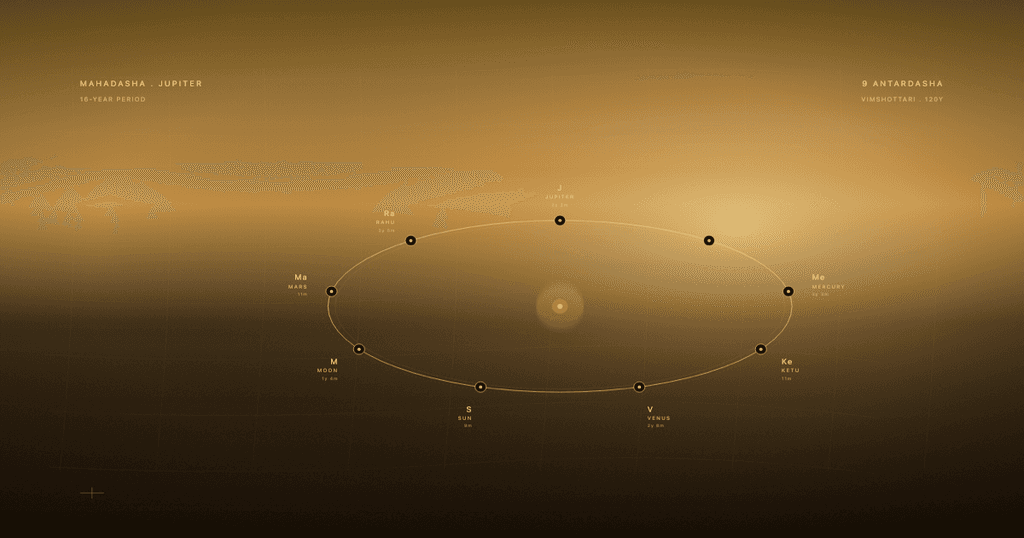
The 16-year Jupiter mahadasha divides into nine antardasha sub-periods in fixed Vimshottari order starting with Jupiter itself. The Rahu sub-period sits at position 9 of 9. Exact start and end dates for any chart can be computed from the natal Moon nakshatra-pada and the date of Jupiter mahadasha onset. The Tempora dasha engine produces this to the day.
Classical Guru-Chandala-Yoga pairing
Jupiter-Rahu conjunction or pairing produces the Guru-Chandala Yoga, classically read as wisdom-meeting-the-unconventional or dharmic-teacher under amplification. The Rahu antardasha inside Jupiter mahadasha brings this configuration forward: foreign-dharmic expansion, unconventional-teaching, eclipse-axis dharmic activations.
Friendship status and pairing reading
In the classical Parashari friendship matrix, Jupiter views Rahu as neutral. The neutral-pair classification means the 2 years 4 months 24 days sub-period takes the colouring of the natal placement of both planets. Jupiter's register (wisdom, dharma, children, expansion, teaching and the dignified-blessing register) and Rahu's register (worldly desire, foreign-axis, amplification, taboo and the boundary-crossing register) can integrate constructively or friction-prone depending on the broader chart configuration.
The Rahu karaka overlay
Rahu is the karaka of worldly desire, foreign-axis, amplification, taboo and the boundary-crossing register. Across the 2 years 4 months 24 days sub-period, this karaka set overlays on top of Jupiter's 16-year wisdom, dharma, children, expansion, teaching and the dignified-blessing register register. The combined reading is the central output of the sub-period.
How Rahu's natal dignity shapes the reading
Rahu's natal sign and house set the floor for the 2 years 4 months 24 days sub-period. Rahu at exaltation gives the strongest reading. Own-sign and mooltrikona placement gives clean expression. Debilitation introduces friction that the sub-period must work through. Combust and retrograde state, conjunctions with malefics or benefics and the dispositor's strength all further modulate the reading. See the Rahu mahadasha overview for the per-dignity breakdown.
Event classes typical to Jupiter-Rahu sub-period
The 2 years 4 months 24 days Jupiter mahadasha Rahu antardasha typically surfaces events across these specific domains:
- Configuration-dependent Jupiter-Rahu integration: neutral-pair sub-periods take the colouring of the natal placement of both planets.
- Activation of Guru-Chandala-Yoga (where the natal configuration supports it).
- Events in Rahu's natural karaka domain: worldly desire, foreign-axis, amplification, taboo and the boundary-crossing register.
- Events specific to the natal house Rahu occupies in the chart.
- Events where the Jupiter-mahalord and Rahu-antarlord houses (both natal and ruled) interact (aspect, mutual reception or natal conjunction).
Transit confirmation protocol
The sub-period reading sets a structural pressure floor of 2 years 4 months 24 days. Specific event timing inside that window requires the pratyantara (sub-sub-period) overlay and a transit cross-check.
Two transit overlays do most of the work. The standard targets to track: transit Rahu aspecting natal Jupiter or natal Rahu, transit Jupiter aspecting natal Rahu, transit Saturn through the natal 8th or 12th house, transit Jupiter through Gemini or Virgo. These transits intensify the Jupiter-Rahu dynamic within the broader sub-period and concentrate event timing on those windows.
The pratyantara (sub-sub-period) inside the antardasha gives finer timing. The Jupiter-Rahu-Jupiter pratyantara (about 3 months 23 days) and the Jupiter-Rahu-Rahu pratyantara (about 4 months 5 days) carry the most concentrated amplification and opening signal within the 28-month closing sub-period. The Jupiter-Rahu-Saturn pratyantara (about 4 months 13 days) reads as the institutional-consolidation window that often produces the definitive closing event of the entire Jupiter Mahadasha. Cross-checking the pratyantara against the transit overlay gives event timing to the week. Tempora's dasha engine produces this data to the day for any chart.
What the framework does not predict
The Jupiter-Rahu reading is structural. It flags a 28-month window where the conditional probability of three named event classes lifts above chance, but it does not predict that any specific native will experience a specific event inside that window, nor the direction of any event that does fire.
An opening or expansion event during the closing sub-period can read as the grand recognition of wisdom-work built across the full 16 years or as an overreach whose meaning resolves only in the disciplined Saturn Mahadasha that follows; the chart's broader signals determine which. The framework times the pressure, not the result and timing finer than the antardasha band needs the pratyantara sequence and the transit overlay for the date in question.
How this connects to the broader Jupiter Mahadasha
The Jupiter-Rahu sub-period is the ninth antardasha inside the 16-year Jupiter Mahadasha. Reading the sub-period in isolation captures the 2 years 4 months 24 days; reading it inside the Mahadasha gives the broader arc that places the wisdom meets ambition reading in its proper structural context.
The Tempora Jupiter Mahadasha method article covers the dispositor analysis, natal-house framework and the broader 20-year texture that this sub-period sits inside. The conditional probability framework holds across the full series: each antardasha is a flagged window for specific event classes whose probability is elevated relative to chance.
The arithmetic of this period
The constants first. Jupiter holds 16 years of the 120-year cycle and Rahu holds 18, so the antardasha runs 16 x 18 / 120 = 2.4 years exactly, which is 2 years 4.8 months, conventionally 2 years 4 months 24 days. Only Venus at 2 years 8 months and Saturn at 2 years 6 months run longer inside this mahadasha.
Because it comes last, its start date is the whole rest of the period summed: Jupiter about 2 years 2 months, Saturn 2 years 6 months, Mercury 2 years 3 months, Ketu 11 months, Venus 2 years 8 months, Sun 9.6 months, Moon 1 year 4 months and Mars 11 months, together about 13 years 7 months. Rahu therefore runs from roughly year 13.6 to the very end of year 16 of the Jupiter mahadasha.
A ninth-position antardasha is also a handover. Its closing months double as the approach to the next mahadasha, Saturn's 19 years in the fixed sequence, and classical practice treats the junction between mahadashas, the dasha-chidra, as its own sensitive zone. The same Rahu themes arriving mid-period would be an episode; arriving here they are the summary the next period inherits, which is why position in the sequence changes the reading as much as the lord does.
What BPHS alone records for this pairing
This combination rests on a single classical witness in the source record used here: the fetched chapter of Phaladeepika covering bhukti effects carries no line for the Rahu sub-period of Jupiter's dasha, so the BPHS antardasha chapters, Jupiter mahadasha section, stand alone for this pairing. That text gives a dignified Rahu, exalted, in mulatrikona or own sign, in a kendra or trikona or supported by benefics, an opening marked by attachment to yoga, wealth and grain concentrated in the first five months, sovereignty over a village or country, meetings with a foreign king and journeys to distant lands with bathing at holy places. Rahu keeping malefic company or standing in the 8th or 12th from the dasha lord draws the counter-list of danger from thieves, snakes and the king, wounds, antagonism with siblings, bad dreams and causeless quarrels. For Rahu tied to the 2nd or the 7th the chapter attaches health cautions and prescribes Mrityunjaya japa and the charity of a goat. Because no second text weighs in, the BPHS conditions carry the entire classical load for this sub-period. The engine takes that single-source position as input and conditions it on the natal Rahu, its sign lord and its house.
This period against the 2026 to 2028 sky
Both lords of this combination carry dated calendar material. Rahu itself changes signs once in the window: the axis shifts on 27 December 2026, Rahu moving from Aquarius into Capricorn and holding there until 15 July 2028. The 12 August 2026 solar eclipse on the Cancer-Leo cusp is a node event by construction, a dated flag for any native running a Rahu sub-period through that summer.
Behind both, the mahadasha lord runs an unusually dignified arc, exalted in Cancer from 27 May 2026 and settled in Leo from 19 June 2027, so the Guru-Chandala pairing plays out against a Jupiter at full transit strength. Classical readers would call that the amplifier amplified with the teacher dignified, a combination the texts respect and distrust in equal measure. The limitations bind as always: sign-level node positions are shared by every chart on earth for those eighteen months, an eclipse only matters where the natal chart is sensitive on its axis, and no transit condition overrides the natal Rahu that anchors this sub-period.
Natal condition then splits the verdict. Rahu well disposed, in the 3rd, 6th, 10th or 11th houses of the classical scheme or held by a strong dispositor, gives the closing years their expansive form, foreign gains and unconventional standing that consolidate. Rahu afflicted or in the sensitive houses gives the textbook Guru-Chandala caution, conviction inflated past its evidence just as the mahadasha ends. The node's 18-year period has its own treatment in the Rahu mahadasha overview.
Frequently asked questions
How long is the Jupiter Mahadasha Rahu Antardasha and where does it fall in the Vimshottari sequence?
The Jupiter Mahadasha Rahu Antardasha runs 2 years 4 months 24 days. It is the ninth antardasha inside the 16-year Jupiter Mahadasha, opening after the Jupiter-Mars antardasha (11 months 6 days). The full sequence inside the Jupiter Mahadasha runs Venus-Venus, Venus-Sun, Venus-Moon, Venus-Mars, Venus-Rahu, Venus-Jupiter, Venus-Saturn, Venus-Mercury and Venus-Ketu. Exact start and end dates can be computed from the natal Moon nakshatra-pada and the date of Jupiter Mahadasha onset.
What does Rahu signify in this sub-period and why does it read as wisdom meets ambition?
Rahu is the karaka of ambition, foreign things, unconventional success, fascination, taboo, expansion of desire, future-pointing, technology, intoxication. During the broader Jupiter Mahadasha's pleasure, relationship and refinement reading, Rahu contributes the amplification overlay. The sub-period sits at the ninth and closing position in the antardasha sequence and reads as the Jupiter dharma and expansion register meeting Rahu's ambition, foreign reach, unconventional success and amplified desire.
How does Rahu's natal dignity shape the Jupiter-Rahu sub-period reading?
Rahu's natal house, sign and aspectual state set the floor for the 28-month sub-period. Rahu exalted in Taurus or Gemini (per different schools), in own sign no traditional own-sign assignment for the lunar nodes or in angular houses (1st, 4th, 7th, 10th) softens the reading toward more auspicious outcomes. Rahu debilitated in Scorpio or Sagittarius (per different schools) introduces friction. Aspects from Saturn bring sustained structural pressure; aspects from Mars bring competitive or confrontational pressure.
What kinds of events historically correlate with the Jupiter-Rahu sub-period?
Three event classes correlate. Foreign-expansion and unconventional-opening events: Foreign deals, international expansion, unusual career openings, audiences much larger than prior periods, viral or breakout success of teaching or advisory work. The Jupiter-Rahu sub-period is t. Mahadasha-closing consolidation events: The themes built across the broader Mahadasha reach peak expression and begin to transition. Relationship, career and wisdom commitments consolidate into the form they will carry into Saturn Mahadasha. Overreach and recovery events: Ambition phases that produce stumbling blocks alongside opening, generosity that strains resources, faith-led decisions that produce mixed outcomes. The chart's Rahu placement and the native's br. The framework reads these as a structural-pressure window for the event class, not a deterministic predictor.
How does this sub-period connect to the broader Jupiter Mahadasha?
The Jupiter-Rahu sub-period is the ninth antardasha inside the 16-year Jupiter Mahadasha. It opens after the Jupiter-Mars antardasha (11 months 6 days). The sub-period reading is best held in tandem with the broader Jupiter Mahadasha reading from the Tempora Jupiter Mahadasha method article, which covers the natal house and dispositor framework that sets the texture of the full 16 years.
What does the Tempora framework not predict about this sub-period?
The framework identifies a structural-pressure window of approximately 2 years 4 months 24 days. It does not predict whether a specific native will experience a specific event in that window. It does not predict outcome direction. It does not predict timing finer than the sub-period band without overlaying the pratyantara (sub-sub-period) and the transit overlay for the date in question. The readings carry conventional weight from classical literature; the framework treats them as structural-pressure flags to cross-check against transit data.
Where exactly does the Rahu antardasha sit inside the Jupiter mahadasha?
Last of the nine. The eight sub-periods before it sum to about 13 years 7 months, so the Rahu window runs from roughly year 13.6 through the end of year 16, its 2 years 4 months 24 days computed as 16 x 18 / 120 = 2.4 years. Because it closes the mahadasha, its final months also form the dasha-chidra, the junction into the 19-year Saturn mahadasha, which classical practice watches as a sensitive transition of its own.
What changes on 27 December 2026 for a native running Jupiter-Rahu?
The nodal axis shifts: Rahu leaves Aquarius for Capricorn and stays there until 15 July 2028. For a native in this sub-period that means the antardasha lord changes sign mid-window, a dated transition worth marking, and it follows a summer in which the 12 August 2026 eclipse already flagged the nodal axis. Both are worldwide sign-level events, so they time attention rather than predict outcome; the natal Rahu and its houses decide whether either lands.
What do the classical texts say about Jupiter-Rahu?
Only one of the two classical texts consulted for this series covers the pairing: the fetched Phaladeepika bhukti chapter has no Rahu line under Jupiter's dasha, so the BPHS antardasha chapters, Jupiter mahadasha section, are the sole authority here. BPHS promises a dignified Rahu wealth concentrated in the first five months, distant journeys and meetings with a foreign king, while warning of thieves, wounds and quarrels for an afflicted one, with health cautions and remedies where Rahu is tied to the 2nd or 7th. The engine treats this single-source position as input conditioned on the natal Rahu.
Read next
- Jupiter Mahadasha: how to read the 20-year period · the broader Mahadasha this sub-period sits inside
- Ketu Mahadasha Rahu Antardasha · the complementary sub-period in the prior Mahadasha
- Mahadasha and Vimshottari planetary periods · the full nine-period framework
- Calibrated lift: the discipline that turns Vedic astrology into research
This article represents conventional Vedic teaching and Tempora Research method documentation. It does not constitute financial, legal or professional advice. Internal audit log maintained.