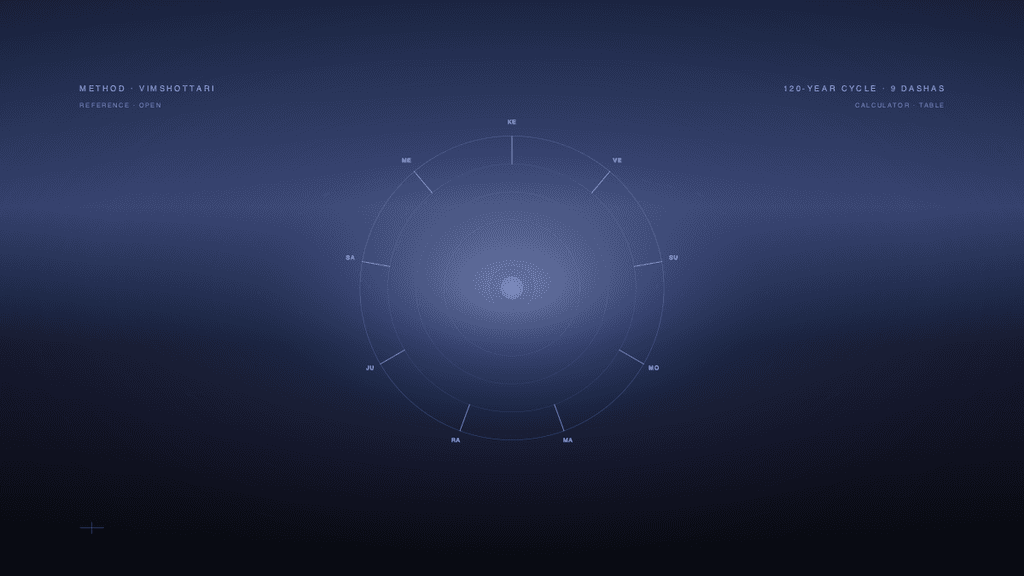
Vimshottari Dasha Calculator and Reference Table: 120-Year Mahadasha Sequence
A complete reference for the Vimshottari Dasha system. The 9 dasha lords and their fixed durations, the nakshatra-to-starting-dasha lookup table for all 27 nakshatras and the calculation framework Tempora uses with True Pushya Paksha ayanamsa via Swiss Ephemeris.
The 9 dasha lords and their durations
The Vimshottari Dasha system schedules nine planets through nine fixed windows. The total period spans 120 years. The sequence is cyclical and the order is fixed across all charts. The starting planet depends on the Moon's position at birth.
| Order | Dasha lord | Duration (years) | Traditional theme |
|---|---|---|---|
| 1 | Ketu | 7 | Release, transcendence, retreat |
| 2 | Venus (Shukra) | 20 | Expansion, partnership, commerce, sensory life |
| 3 | Sun (Surya) | 6 | Identity, leadership, recognition |
| 4 | Moon (Chandra) | 10 | Mind, mother, public-emotion themes |
| 5 | Mars (Mangal) | 7 | Action, conflict, energy expenditure |
| 6 | Rahu | 18 | Amplification, ambition, foreign elements |
| 7 | Jupiter (Guru) | 16 | Wisdom, teaching, structural expansion |
| 8 | Saturn (Shani) | 19 | Discipline, constraint, durable structure |
| 9 | Mercury (Budha) | 17 | Communication, commerce, intellect |
| Total | 120 years |
Whichever planet you start with at birth, the sequence continues in that fixed cyclical order. After Mercury (17 years) the cycle returns to Ketu (7 years) and begins again. For most charts the full 120-year cycle is not completed inside one lifetime, but the active mahadasha at any age is determinable from the starting dasha and elapsed years.
The 27 nakshatras and their dasha lords
The starting mahadasha is determined by which of the 27 nakshatras the Moon sits in at birth. Each nakshatra is 13 degrees 20 minutes (13.333 degrees) of sidereal arc and the 27 nakshatras together cover the full 360-degree zodiac. The nakshatra-to-dasha-lord assignment is fixed and repeats every 9 nakshatras.
| Dasha lord | Nakshatra 1 | Nakshatra 2 | Nakshatra 3 |
|---|---|---|---|
| Ketu | Ashwini (0°-13°20' Aries) | Magha (0°-13°20' Leo) | Mula (0°-13°20' Sagittarius) |
| Venus | Bharani (13°20'-26°40' Aries) | Purva Phalguni (13°20'-26°40' Leo) | Purva Ashadha (13°20'-26°40' Sagittarius) |
| Sun | Krittika (26°40' Aries - 10° Taurus) | Uttara Phalguni (26°40' Leo - 10° Virgo) | Uttara Ashadha (26°40' Sagittarius - 10° Capricorn) |
| Moon | Rohini (10°-23°20' Taurus) | Hasta (10°-23°20' Virgo) | Shravana (10°-23°20' Capricorn) |
| Mars | Mrigashira (23°20' Taurus - 6°40' Gemini) | Chitra (23°20' Virgo - 6°40' Libra) | Dhanishta (23°20' Capricorn - 6°40' Aquarius) |
| Rahu | Ardra (6°40'-20° Gemini) | Swati (6°40'-20° Libra) | Shatabhisha (6°40'-20° Aquarius) |
| Jupiter | Punarvasu (20° Gemini - 3°20' Cancer) | Vishakha (20° Libra - 3°20' Scorpio) | Purva Bhadrapada (20° Aquarius - 3°20' Pisces) |
| Saturn | Pushya (3°20'-16°40' Cancer) | Anuradha (3°20'-16°40' Scorpio) | Uttara Bhadrapada (3°20'-16°40' Pisces) |
| Mercury | Ashlesha (16°40'-30° Cancer) | Jyeshtha (16°40'-30° Scorpio) | Revati (16°40'-30° Pisces) |
To calculate your starting dasha lord: identify the sidereal longitude of your Moon at birth, find which 13°20' nakshatra band it sits in and read off the dasha lord from the table above. The elapsed portion of the starting dasha is the fraction of the nakshatra the Moon has already crossed times the dasha's total years. For example, if your Moon sits at 16° Aries (3°20' into Bharani, which spans 13°20' to 26°40' Aries), your Moon has crossed 2°40' of Bharani's 13°20' span (20 percent of the nakshatra), so 20 percent of Venus's 20-year mahadasha has already elapsed at birth, leaving 16 years of Venus mahadasha remaining from your birth.
Compute your dasha sequence with your birth details
For an accurate computation using Swiss Ephemeris and True Pushya Paksha ayanamsa, Tempora's Kaal Imprint tool returns your mahadasha sequence, current antardasha and the dasha timing around your major life events.
Open Kaal Imprint →Antardasha and deeper subdivisions
Each mahadasha is subdivided into 9 antardashas (sub-periods), one for each of the 9 dasha lords. The antardasha sequence within any mahadasha starts with the mahadasha lord itself and follows the standard cyclical order. The duration of each antardasha inside a mahadasha is proportional to the antardasha lord's own dasha years, scaled to the mahadasha's total duration.
Example: inside Saturn mahadasha (19 years), the Saturn antardasha duration is (19/120) times 19 years = roughly 3 years and 0.5 months. The Mercury antardasha duration inside Saturn mahadasha is (17/120) times 19 years = roughly 2 years and 8.5 months. And so on for each of the 9 antardashas. The sum of all 9 antardasha durations equals the total mahadasha duration of 19 years.
The sub-sub-divisions are called pratyantara (third level) and sookshma (fourth level), each computed by the same proportional rule. Tempora's calibrated forward calls track mahadasha, antardasha and pratyantara depth. The deepest sub-period (pratyantara) is what most calibrated lift figures resolve to in the corpus.
Antardasha sequence within each mahadasha
For reference, the antardasha sequence inside each of the 9 mahadashas follows the same fixed cyclical order. The first antardasha is always the mahadasha lord itself.
| Mahadasha | Antardasha 1 | Antardasha 2 | Antardasha 3 | Antardasha 4 | Antardasha 5 |
|---|---|---|---|---|---|
| Ketu (7 yr) | Ketu | Venus | Sun | Moon | Mars |
| Venus (20 yr) | Venus | Sun | Moon | Mars | Rahu |
| Sun (6 yr) | Sun | Moon | Mars | Rahu | Jupiter |
| Moon (10 yr) | Moon | Mars | Rahu | Jupiter | Saturn |
| Mars (7 yr) | Mars | Rahu | Jupiter | Saturn | Mercury |
| Rahu (18 yr) | Rahu | Jupiter | Saturn | Mercury | Ketu |
| Jupiter (16 yr) | Jupiter | Saturn | Mercury | Ketu | Venus |
| Saturn (19 yr) | Saturn | Mercury | Ketu | Venus | Sun |
| Mercury (17 yr) | Mercury | Ketu | Venus | Sun | Moon |
Each row shows the first 5 of 9 antardashas in that mahadasha (the remaining 4 continue the same cyclical order). For the full sequence and exact durations in years, months and days at your specific birth, use the Kaal Imprint tool linked above.
The ayanamsa question and why it matters
The sidereal longitude of your Moon at birth depends on the ayanamsa (the offset between the tropical and sidereal zodiacs). Different traditions use different ayanamsa values. The most common are Lahiri (Chitra Paksha), Raman, Krishnamurti and True Pushya Paksha (also known as PVRN Rao ayanamsa). The difference between Lahiri and True Pushya Paksha is approximately 47 arc-minutes as of 2026, which can shift a borderline Moon position into a different nakshatra and therefore change the starting dasha lord.
Tempora uses True Pushya Paksha ayanamsa computed with Swiss Ephemeris. This is the ayanamsa where the fixed star Pushya is anchored at the exact midpoint of sidereal Cancer (3°20' Cancer), as defined in classical sources. Tempora's calibrated forward calls (AI bubble US rahu over stellium 3.0x lift, Russia Mars-Rahu 5.46x lift, India dasha-lord-dusthana 3.70x lift) are all reproducible against this ayanamsa.
Frequently asked
What is Vimshottari Dasha?
Vimshottari Dasha is a 120-year planetary period system used in Vedic astrology to schedule which planet rules a chart's major life themes at any given time. The system rotates nine planets through nine fixed-duration windows. Ketu 7 years, Venus 20 years, Sun 6 years, Moon 10 years, Mars 7 years, Rahu 18 years, Jupiter 16 years, Saturn 19 years, Mercury 17 years. Total 120 years. The starting planet at birth is determined by the Moon's nakshatra position.
How do I calculate my Vimshottari Dasha sequence?
Three steps. Step 1: compute your Moon's sidereal longitude at birth (Tempora uses True Pushya Paksha ayanamsa with Swiss Ephemeris). Step 2: identify which of the 27 nakshatras your Moon sits in (each nakshatra is 13 degrees 20 minutes wide). Step 3: look up the dasha lord for that nakshatra using the table below. The elapsed portion of the starting dasha is the fraction of the nakshatra the Moon has already crossed times the dasha's total years.
Which nakshatra corresponds to which dasha lord?
The 27 nakshatras map to 9 dasha lords in a fixed repeating pattern. Ashwini, Magha and Mula are ruled by Ketu. Bharani, Purva Phalguni and Purva Ashadha are ruled by Venus. Krittika, Uttara Phalguni and Uttara Ashadha are ruled by Sun. Rohini, Hasta and Shravana are ruled by Moon. Mrigashira, Chitra and Dhanishta are ruled by Mars. Ardra, Swati and Shatabhisha are ruled by Rahu. Punarvasu, Vishakha and Purva Bhadrapada are ruled by Jupiter. Pushya, Anuradha and Uttara Bhadrapada are ruled by Saturn. Ashlesha, Jyeshtha and Revati are ruled by Mercury.
What is the fixed order of the dasha sequence?
The fixed cyclical order across all 120 years is Ketu, Venus, Sun, Moon, Mars, Rahu, Jupiter, Saturn, Mercury, then back to Ketu. Whichever planet you start with at birth, the sequence continues in that order. For example if you start in Saturn Mahadasha (19 years) the next mahadasha will be Mercury (17 years), then Ketu (7 years), then Venus (20 years) and so on.
What ayanamsa does Tempora use?
Tempora uses the True Pushya Paksha ayanamsa (also known as PVRN Rao ayanamsa) computed via Swiss Ephemeris. This is the ayanamsa where the fixed star Pushya is anchored at the exact midpoint of sidereal Cancer (3 degrees 20 minutes Cancer), as defined in classical sources. The ayanamsa difference matters because it changes which nakshatra the Moon sits in at borderline degrees, which can change the starting dasha lord. Tempora's calibrated forward calls all use this ayanamsa.
What is Antardasha?
Antardasha is the second-level subdivision of the Vimshottari Dasha system. Each Mahadasha (major period) is subdivided into 9 Antardashas (sub-periods), each ruled by one of the 9 dasha lords. The Antardasha sequence within any Mahadasha starts with the Mahadasha lord itself and then follows the standard cyclical order. The duration of each Antardasha inside a Mahadasha is proportional to the Antardasha lord's own dasha years. The sub-subdivision is called Pratyantara and the sub-sub-subdivision is called Sookshma. Tempora's calibrated forward calls track Mahadasha, Antardasha and Pratyantara depth.
Read next
This article is a method reference. The dasha durations, nakshatra-to-lord lookup and antardasha subdivisions follow the classical Vimshottari Dasha framework documented in Brihat Parashara Hora Shastra and reproduced in standard Vedic astrology references. Sidereal longitude and ayanamsa computations use Swiss Ephemeris with True Pushya Paksha ayanamsa. Internal audit log maintained. This article does not constitute medical, financial, legal or professional advice. First published 2026-05-20 by Tempora Research.