Yogini Dasha Calculator and Reference Table: The 36-Year 8-Yogini Cycle
A complete reference for the Yogini Dasha system described in BPHS Chapter 48. The 8 yoginis and their fixed durations, the planet each one carries, the nakshatra-to-starting-yogini lookup and the calculation framework Tempora uses with True Pushya Paksha ayanamsa via Swiss Ephemeris.
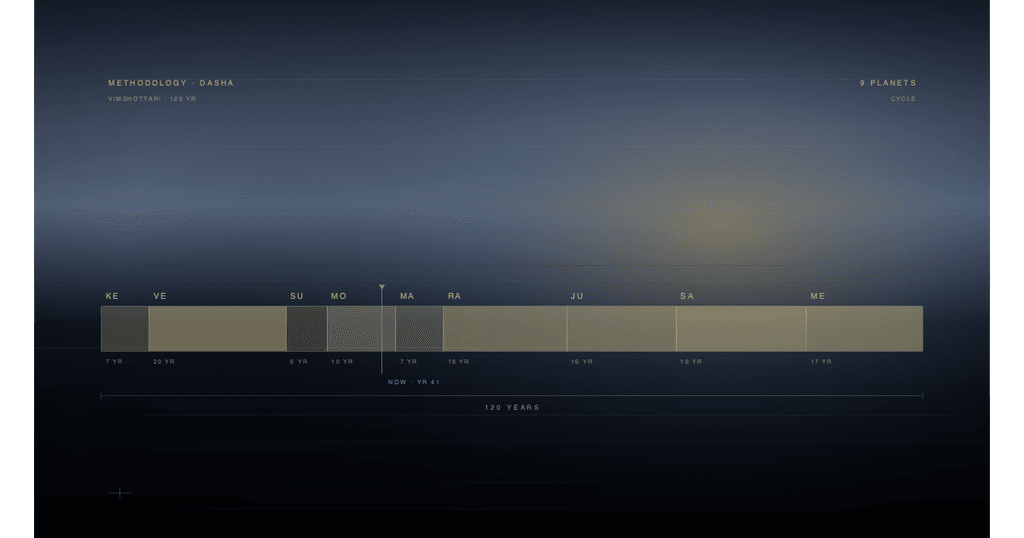
Yogini Dasha is the shorter counterpart to Vimshottari. Where Vimshottari runs 120 years over 9 planets, Yogini runs 36 years over 8 yoginis, and its faster turnover makes it a useful second timing lens. Both are keyed to the Moon's nakshatra at birth, so both start from the same input but schedule the life differently. Practitioners who run the two together look for the windows where they agree, and those windows carry more weight in the reading.
The 8 yoginis, their planets and durations
The cycle is fixed. Durations rise from 1 year for Mangala to 8 years for Sankata, summing to 36 years before the sequence repeats.
| # | Yogini | Planet | Duration | Temperament |
|---|---|---|---|---|
| 1 | Mangala | Moon | 1 year | gentle, nurturing start |
| 2 | Pingala | Sun | 2 years | visibility and ego, can scorch |
| 3 | Dhanya | Jupiter | 3 years | abundance, learning, dharma |
| 4 | Bhramari | Mars | 4 years | restless drive, scattered energy |
| 5 | Bhadrika | Mercury | 5 years | communication, skill, nervous tempo |
| 6 | Ulka | Saturn | 6 years | obstruction, delay, endurance |
| 7 | Siddha | Venus | 7 years | accomplishment, refinement, ease |
| 8 | Sankata | Rahu | 8 years | crisis, rupture, forced change |
Nakshatra to starting-yogini lookup
The yogini you begin life in is set by the nakshatra of your Moon at birth. The 8-yogini pattern repeats across the 27 nakshatras. Find your Moon nakshatra in the table and read the starting yogini and its planet.
| # | Moon nakshatra | Starting yogini | Planet | Years |
|---|---|---|---|---|
| 1 | Ashwini | Mangala | Moon | 1y |
| 2 | Bharani | Pingala | Sun | 2y |
| 3 | Krittika | Dhanya | Jupiter | 3y |
| 4 | Rohini | Bhramari | Mars | 4y |
| 5 | Mrigashira | Bhadrika | Mercury | 5y |
| 6 | Ardra | Ulka | Saturn | 6y |
| 7 | Punarvasu | Siddha | Venus | 7y |
| 8 | Pushya | Sankata | Rahu | 8y |
| 9 | Ashlesha | Mangala | Moon | 1y |
| 10 | Magha | Pingala | Sun | 2y |
| 11 | Purva Phalguni | Dhanya | Jupiter | 3y |
| 12 | Uttara Phalguni | Bhramari | Mars | 4y |
| 13 | Hasta | Bhadrika | Mercury | 5y |
| 14 | Chitra | Ulka | Saturn | 6y |
| 15 | Swati | Siddha | Venus | 7y |
| 16 | Vishakha | Sankata | Rahu | 8y |
| 17 | Anuradha | Mangala | Moon | 1y |
| 18 | Jyeshtha | Pingala | Sun | 2y |
| 19 | Mula | Dhanya | Jupiter | 3y |
| 20 | Purva Ashadha | Bhramari | Mars | 4y |
| 21 | Uttara Ashadha | Bhadrika | Mercury | 5y |
| 22 | Shravana | Ulka | Saturn | 6y |
| 23 | Dhanishta | Siddha | Venus | 7y |
| 24 | Shatabhisha | Sankata | Rahu | 8y |
| 25 | Purva Bhadrapada | Mangala | Moon | 1y |
| 26 | Uttara Bhadrapada | Pingala | Sun | 2y |
| 27 | Revati | Dhanya | Jupiter | 3y |
Read your Yogini and Vimshottari timelines together
Tempora computes both dasha systems from your birth data with True Pushya Paksha ayanamsa, then flags the windows where they agree.
Compute my chartHow the starting yogini is calculated
The calculation has three steps.
- Find the Moon's nakshatra. Compute the Moon's sidereal longitude with True Pushya Paksha ayanamsa and read the nakshatra from Ashwini.
- Map to the yogini. The nakshatra position within the repeating 8-yogini pattern gives the starting yogini, as in the lookup table above.
- Set the balance. The fraction of the nakshatra the Moon has already crossed, times the starting yogini's years, is the portion of that first period already elapsed at birth. The remainder runs forward from the birth date.
Tempora's engine follows the BPHS Chapter 48 construction, so the yogini periods it reports are reproducible from the same birth data and the same ayanamsa.
How to read Sankata and Siddha
Two yoginis carry the strongest reputations. Sankata, ruled by Rahu and the longest at 8 years, is the testing window: rupture, forced change and the collapse of arrangements that were not built to last. Siddha, ruled by Venus at 7 years, is the accomplishment window: refinement, ease and the arrival of things worked toward. The reading is not deterministic. A strong Rahu can make Sankata productive through sheer intensity, and a weak Venus can blunt Siddha. The yogini sets the weather and the natal strength of the ruling planet sets how the native meets it.
Frequently asked
What is Yogini Dasha?
Yogini Dasha is a 36-year planetary period system used in Vedic astrology, described in BPHS Chapter 48. It rotates 8 yoginis through fixed-duration windows: Mangala 1 year, Pingala 2 years, Dhanya 3 years, Bhramari 4 years, Bhadrika 5 years, Ulka 6 years, Siddha 7 years, Sankata 8 years, totalling 36 years before the cycle repeats. Each yogini is tied to a planet, so the dasha reads as that planet's period with the yogini's temperament layered on top.
How is Yogini Dasha different from Vimshottari?
Vimshottari is a 120-year cycle over 9 planets keyed to the Moon's nakshatra. Yogini is a shorter 36-year cycle over 8 yoginis, also keyed to the Moon's nakshatra but with different planet assignments and durations. Because the Yogini cycle is shorter, its periods turn over faster, which makes it useful as a second timing lens alongside Vimshottari. Many practitioners run both and look for windows where the two systems agree.
How do I find my starting yogini?
The starting yogini is set by the nakshatra your Moon occupies at birth. Count the nakshatra from Ashwini and take the position within the repeating 8-yogini pattern. Tempora computes this from the Moon's sidereal longitude using True Pushya Paksha ayanamsa via Swiss Ephemeris, then reads the starting yogini from the lookup table above. The elapsed portion of the first yogini is the fraction of the nakshatra the Moon has already crossed times that yogini's years.
Which planet rules each yogini?
The 8 yoginis map to planets as follows: Mangala is Moon, Pingala is Sun, Dhanya is Jupiter, Bhramari is Mars, Bhadrika is Mercury, Ulka is Saturn, Siddha is Venus and Sankata is Rahu. The yogini's temperament colours how that planet's period is read. Sankata, ruled by Rahu with an 8-year span, is traditionally the most testing window and Siddha, ruled by Venus, is traditionally the most favourable.
What is the fixed order of the Yogini sequence?
The order is always Mangala, Pingala, Dhanya, Bhramari, Bhadrika, Ulka, Siddha, Sankata, then back to Mangala. Whichever yogini you start with at birth, the sequence continues in that fixed order. Durations increase from 1 year for Mangala to 8 years for Sankata, so the cycle is front-light and back-heavy in each 36-year turn.
What ayanamsa does Tempora use for Yogini Dasha?
Tempora uses True Pushya Paksha ayanamsa, also called PVRN Rao ayanamsa, computed via Swiss Ephemeris. This anchors the star Pushya at the midpoint of sidereal Cancer. The ayanamsa matters because the starting yogini depends on the Moon's nakshatra, and at borderline degrees a different ayanamsa can move the Moon into the neighbouring nakshatra and change the starting yogini and the whole 36-year timeline.