Antardasha Calculator and Table: All 81 Vimshottari Sub-Periods
A complete antardasha reference for the Vimshottari system. Every one of the 81 sub-periods with its exact duration in decimal years, in years, months and days and in calendar days, plus the sequence rule, the formula behind every figure and a worked example for locating your current antardasha from a mahadasha start date.
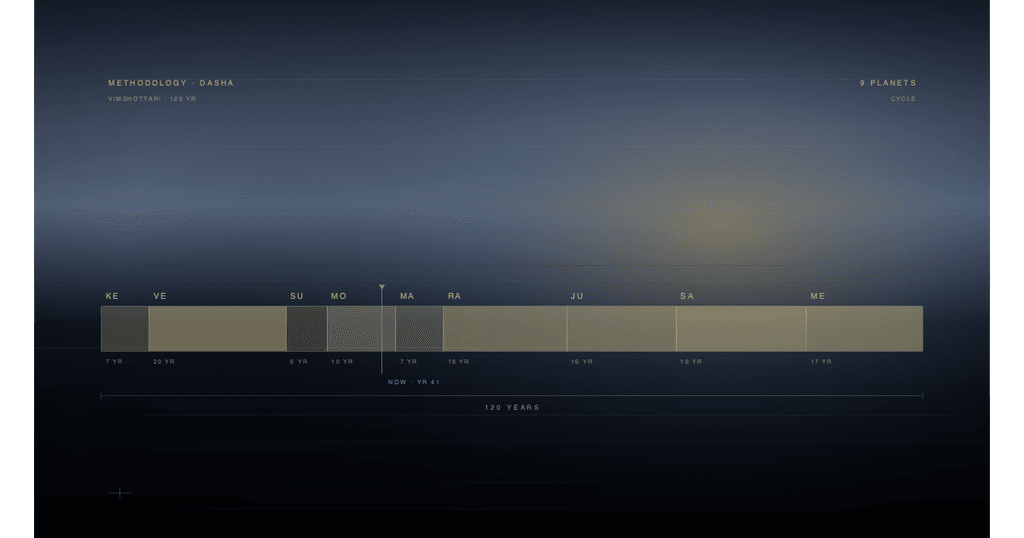
An antardasha is a sub-period inside a mahadasha. The Vimshottari cycle assigns the 9 dasha lords a combined 120 years, and each lord's mahadasha divides into 9 antardashas, one for every lord in the cycle, scaled to the mahadasha's length. That gives 81 mahadasha-antardasha combinations in all, and the antardasha lord acts as the second voice inside the mahadasha lord's longer theme.
This page is the sub-period companion to the Vimshottari dasha calculator table, which covers the 9 mahadashas, the 120-year sequence and the starting-dasha lookup by Moon nakshatra. Here the focus stays one level down: how long each antardasha runs, in what order the 9 arrive and how to place yourself inside a running mahadasha with nothing more than a start date and arithmetic. Every duration below is computed from the dasha-year constants in Tempora's engine, not copied from a printed table.
How to read these tables
Every duration on this page comes from one formula: antardasha years equal mahadasha years times the antardasha lord's own dasha years divided by 120. The inputs are the classical dasha-year constants that Tempora's dasha engine carries: Ketu 7, Venus 20, Sun 6, Moon 10, Mars 7, Rahu 18, Jupiter 16, Saturn 19 and Mercury 17, which sum to 120. Because the constants sum to 120, the 9 antardashas of any mahadasha sum back to that mahadasha's full length with no remainder. Each table below states this check explicitly.
A note on conventions, because they differ across software. Tempora's engine works in decimal years and converts to calendar dates at 365.25 days per year. It does not use the 360-day savana year that some classical tables assume, so a long antardasha can land a few weeks away from a 360-day computation. The decimal-years column is the engine's native figure. The years-months-days column subdivides the same figure the traditional way, 12 months to a year and 30 days to a month, which is exact for these ratios and matches how printed dasha tables have expressed durations for centuries. The days column multiplies the decimal years by 365.25 so you can walk a calendar directly.
One structural point before the tables. The order of antardashas inside a mahadasha is not arbitrary and it is not the same for every mahadasha. Each table below lists its 9 sub-periods in the exact order they run, starting with the mahadasha lord's own antardasha. The rule that produces this order has its own section after the tables.
Antardasha tables for all 9 mahadashas
The 9 tables follow the Vimshottari cycle order: Ketu, Venus, Sun, Moon, Mars, Rahu, Jupiter, Saturn and Mercury. Find your mahadasha, then read its sub-periods top to bottom. The row order is the order in which the antardashas actually arrive.
Ketu mahadasha (7 years): antardasha durations
| # | Antardasha | Lord years | Duration (decimal years) | Duration (y-m-d) | Days (365.25/yr) |
|---|---|---|---|---|---|
| 1 | Ketu | 7 | 0.4083 | 0y 4m 27d | 149.1 |
| 2 | Venus | 20 | 1.1667 | 1y 2m 0d | 426.1 |
| 3 | Sun | 6 | 0.3500 | 0y 4m 6d | 127.8 |
| 4 | Moon | 10 | 0.5833 | 0y 7m 0d | 213.1 |
| 5 | Mars | 7 | 0.4083 | 0y 4m 27d | 149.1 |
| 6 | Rahu | 18 | 1.0500 | 1y 0m 18d | 383.5 |
| 7 | Jupiter | 16 | 0.9333 | 0y 11m 6d | 340.9 |
| 8 | Saturn | 19 | 1.1083 | 1y 1m 9d | 404.8 |
| 9 | Mercury | 17 | 0.9917 | 0y 11m 27d | 362.2 |
Check: the 9 antardashas above sum to exactly 7.0000 years, the full Ketu mahadasha length.
Venus mahadasha (20 years): antardasha durations
| # | Antardasha | Lord years | Duration (decimal years) | Duration (y-m-d) | Days (365.25/yr) |
|---|---|---|---|---|---|
| 1 | Venus | 20 | 3.3333 | 3y 4m 0d | 1217.5 |
| 2 | Sun | 6 | 1.0000 | 1y 0m 0d | 365.2 |
| 3 | Moon | 10 | 1.6667 | 1y 8m 0d | 608.8 |
| 4 | Mars | 7 | 1.1667 | 1y 2m 0d | 426.1 |
| 5 | Rahu | 18 | 3.0000 | 3y 0m 0d | 1095.8 |
| 6 | Jupiter | 16 | 2.6667 | 2y 8m 0d | 974.0 |
| 7 | Saturn | 19 | 3.1667 | 3y 2m 0d | 1156.6 |
| 8 | Mercury | 17 | 2.8333 | 2y 10m 0d | 1034.9 |
| 9 | Ketu | 7 | 1.1667 | 1y 2m 0d | 426.1 |
Check: the 9 antardashas above sum to exactly 20.0000 years, the full Venus mahadasha length.
Sun mahadasha (6 years): antardasha durations
| # | Antardasha | Lord years | Duration (decimal years) | Duration (y-m-d) | Days (365.25/yr) |
|---|---|---|---|---|---|
| 1 | Sun | 6 | 0.3000 | 0y 3m 18d | 109.6 |
| 2 | Moon | 10 | 0.5000 | 0y 6m 0d | 182.6 |
| 3 | Mars | 7 | 0.3500 | 0y 4m 6d | 127.8 |
| 4 | Rahu | 18 | 0.9000 | 0y 10m 24d | 328.7 |
| 5 | Jupiter | 16 | 0.8000 | 0y 9m 18d | 292.2 |
| 6 | Saturn | 19 | 0.9500 | 0y 11m 12d | 347.0 |
| 7 | Mercury | 17 | 0.8500 | 0y 10m 6d | 310.5 |
| 8 | Ketu | 7 | 0.3500 | 0y 4m 6d | 127.8 |
| 9 | Venus | 20 | 1.0000 | 1y 0m 0d | 365.2 |
Check: the 9 antardashas above sum to exactly 6.0000 years, the full Sun mahadasha length.
Moon mahadasha (10 years): antardasha durations
| # | Antardasha | Lord years | Duration (decimal years) | Duration (y-m-d) | Days (365.25/yr) |
|---|---|---|---|---|---|
| 1 | Moon | 10 | 0.8333 | 0y 10m 0d | 304.4 |
| 2 | Mars | 7 | 0.5833 | 0y 7m 0d | 213.1 |
| 3 | Rahu | 18 | 1.5000 | 1y 6m 0d | 547.9 |
| 4 | Jupiter | 16 | 1.3333 | 1y 4m 0d | 487.0 |
| 5 | Saturn | 19 | 1.5833 | 1y 7m 0d | 578.3 |
| 6 | Mercury | 17 | 1.4167 | 1y 5m 0d | 517.4 |
| 7 | Ketu | 7 | 0.5833 | 0y 7m 0d | 213.1 |
| 8 | Venus | 20 | 1.6667 | 1y 8m 0d | 608.8 |
| 9 | Sun | 6 | 0.5000 | 0y 6m 0d | 182.6 |
Check: the 9 antardashas above sum to exactly 10.0000 years, the full Moon mahadasha length.
Mars mahadasha (7 years): antardasha durations
| # | Antardasha | Lord years | Duration (decimal years) | Duration (y-m-d) | Days (365.25/yr) |
|---|---|---|---|---|---|
| 1 | Mars | 7 | 0.4083 | 0y 4m 27d | 149.1 |
| 2 | Rahu | 18 | 1.0500 | 1y 0m 18d | 383.5 |
| 3 | Jupiter | 16 | 0.9333 | 0y 11m 6d | 340.9 |
| 4 | Saturn | 19 | 1.1083 | 1y 1m 9d | 404.8 |
| 5 | Mercury | 17 | 0.9917 | 0y 11m 27d | 362.2 |
| 6 | Ketu | 7 | 0.4083 | 0y 4m 27d | 149.1 |
| 7 | Venus | 20 | 1.1667 | 1y 2m 0d | 426.1 |
| 8 | Sun | 6 | 0.3500 | 0y 4m 6d | 127.8 |
| 9 | Moon | 10 | 0.5833 | 0y 7m 0d | 213.1 |
Check: the 9 antardashas above sum to exactly 7.0000 years, the full Mars mahadasha length.
Rahu mahadasha (18 years): antardasha durations
| # | Antardasha | Lord years | Duration (decimal years) | Duration (y-m-d) | Days (365.25/yr) |
|---|---|---|---|---|---|
| 1 | Rahu | 18 | 2.7000 | 2y 8m 12d | 986.2 |
| 2 | Jupiter | 16 | 2.4000 | 2y 4m 24d | 876.6 |
| 3 | Saturn | 19 | 2.8500 | 2y 10m 6d | 1041.0 |
| 4 | Mercury | 17 | 2.5500 | 2y 6m 18d | 931.4 |
| 5 | Ketu | 7 | 1.0500 | 1y 0m 18d | 383.5 |
| 6 | Venus | 20 | 3.0000 | 3y 0m 0d | 1095.8 |
| 7 | Sun | 6 | 0.9000 | 0y 10m 24d | 328.7 |
| 8 | Moon | 10 | 1.5000 | 1y 6m 0d | 547.9 |
| 9 | Mars | 7 | 1.0500 | 1y 0m 18d | 383.5 |
Check: the 9 antardashas above sum to exactly 18.0000 years, the full Rahu mahadasha length.
Jupiter mahadasha (16 years): antardasha durations
| # | Antardasha | Lord years | Duration (decimal years) | Duration (y-m-d) | Days (365.25/yr) |
|---|---|---|---|---|---|
| 1 | Jupiter | 16 | 2.1333 | 2y 1m 18d | 779.2 |
| 2 | Saturn | 19 | 2.5333 | 2y 6m 12d | 925.3 |
| 3 | Mercury | 17 | 2.2667 | 2y 3m 6d | 827.9 |
| 4 | Ketu | 7 | 0.9333 | 0y 11m 6d | 340.9 |
| 5 | Venus | 20 | 2.6667 | 2y 8m 0d | 974.0 |
| 6 | Sun | 6 | 0.8000 | 0y 9m 18d | 292.2 |
| 7 | Moon | 10 | 1.3333 | 1y 4m 0d | 487.0 |
| 8 | Mars | 7 | 0.9333 | 0y 11m 6d | 340.9 |
| 9 | Rahu | 18 | 2.4000 | 2y 4m 24d | 876.6 |
Check: the 9 antardashas above sum to exactly 16.0000 years, the full Jupiter mahadasha length.
Saturn mahadasha (19 years): antardasha durations
| # | Antardasha | Lord years | Duration (decimal years) | Duration (y-m-d) | Days (365.25/yr) |
|---|---|---|---|---|---|
| 1 | Saturn | 19 | 3.0083 | 3y 0m 3d | 1098.8 |
| 2 | Mercury | 17 | 2.6917 | 2y 8m 9d | 983.1 |
| 3 | Ketu | 7 | 1.1083 | 1y 1m 9d | 404.8 |
| 4 | Venus | 20 | 3.1667 | 3y 2m 0d | 1156.6 |
| 5 | Sun | 6 | 0.9500 | 0y 11m 12d | 347.0 |
| 6 | Moon | 10 | 1.5833 | 1y 7m 0d | 578.3 |
| 7 | Mars | 7 | 1.1083 | 1y 1m 9d | 404.8 |
| 8 | Rahu | 18 | 2.8500 | 2y 10m 6d | 1041.0 |
| 9 | Jupiter | 16 | 2.5333 | 2y 6m 12d | 925.3 |
Check: the 9 antardashas above sum to exactly 19.0000 years, the full Saturn mahadasha length.
Mercury mahadasha (17 years): antardasha durations
| # | Antardasha | Lord years | Duration (decimal years) | Duration (y-m-d) | Days (365.25/yr) |
|---|---|---|---|---|---|
| 1 | Mercury | 17 | 2.4083 | 2y 4m 27d | 879.6 |
| 2 | Ketu | 7 | 0.9917 | 0y 11m 27d | 362.2 |
| 3 | Venus | 20 | 2.8333 | 2y 10m 0d | 1034.9 |
| 4 | Sun | 6 | 0.8500 | 0y 10m 6d | 310.5 |
| 5 | Moon | 10 | 1.4167 | 1y 5m 0d | 517.4 |
| 6 | Mars | 7 | 0.9917 | 0y 11m 27d | 362.2 |
| 7 | Rahu | 18 | 2.5500 | 2y 6m 18d | 931.4 |
| 8 | Jupiter | 16 | 2.2667 | 2y 3m 6d | 827.9 |
| 9 | Saturn | 19 | 2.6917 | 2y 8m 9d | 983.1 |
Check: the 9 antardashas above sum to exactly 17.0000 years, the full Mercury mahadasha length.
The antardasha sequence rule
Two facts fix the order of every table above. First, the opening antardasha of any mahadasha always belongs to the mahadasha lord itself. Saturn mahadasha opens with Saturn-Saturn, Venus mahadasha opens with Venus-Venus and so on down the list. Second, after that opening period the sequence simply continues around the fixed Vimshottari cycle: Ketu, Venus, Sun, Moon, Mars, Rahu, Jupiter, Saturn, Mercury, wrapping from Mercury back to Ketu until all 9 lords have taken a turn.
So the antardasha order inside Jupiter mahadasha is Jupiter, Saturn, Mercury, Ketu, Venus, Sun, Moon, Mars, Rahu: start at Jupiter's position in the cycle and read forward, wrapping past Mercury. The same rotation logic runs at every depth of the system. A pratyantardasha sequence starts with the antardasha lord, a sookshma sequence starts with the pratyantara lord and so on. Learn the 9-lord cycle once and every level of the tree becomes readable.
A useful consequence: the final antardasha of any mahadasha belongs to the lord immediately before the mahadasha lord in the cycle, and the first antardasha of the next mahadasha belongs to that next lord itself. The junction where one mahadasha hands over to the next is called dasha sandhi and it pairs the outgoing lord's last sub-period with the incoming lord's first. The dasha sandhi page covers how these junction windows are read.
Worked example: find your current antardasha
Everything you need is your current mahadasha lord and the date it began. Both come from any Vimshottari calculation, including the mahadasha overview and the starting-dasha lookup on the Vimshottari calculator table. From there the walk is pure arithmetic.
Say your Saturn mahadasha began on 10 June 2021 and today is 3 August 2026. The elapsed span is 1880 days, which at 365.25 days per year is 5.1472 years. Now walk the Saturn table above, keeping a running total of durations:
- Saturn-Saturn runs 19 times 19 divided by 120, which is 3.0083 years. Running total: 3.0083 years. Your elapsed 5.1472 years is past this, so the Saturn antardasha is over. In calendar terms it ended 1098.8 days after the start, on 12 June 2024.
- Saturn-Mercury runs 19 times 17 divided by 120, which is 2.6917 years. Running total: 5.7000 years. Your elapsed 5.1472 years falls below this total, so the walk stops here. You are in the Mercury antardasha of Saturn mahadasha.
- To date the boundaries: Saturn-Mercury began on 12 June 2024 and runs 983.1 days, ending 20 February 2027. After that, Saturn-Ketu takes over for 1.1083 years.
The general recipe is the same for any chart. Convert elapsed days to years at 365.25, add antardasha durations down the mahadasha's table until the running total first exceeds the elapsed figure and the row where that happens is the current antardasha. Subtract the previous running total from the elapsed figure to see how far into the sub-period you are. The calculator at the top of this page performs exactly this walk and prints the boundary dates.
Get your full dasha tree computed from your birth data
Tempora computes your mahadasha, antardasha and pratyantara timeline from the Moon's exact position at birth with True Pushya Paksha ayanamsa via Swiss Ephemeris.
Compute my chartReading a mahadasha-antardasha pair
The durations above are mechanical. The reading is not. A mahadasha-antardasha pair is conventionally read as the antardasha lord operating inside the mahadasha lord's agenda, and the texture depends on how the two planets relate in the natal chart: their natural friendship, the houses they own and occupy and their respective strengths. The same Saturn-Mercury window that structures one chart's work output can scatter another's, depending on what Mercury rules from where.
Tempora maintains individual pages for the 72 mixed pairs. Three examples from the set: Jupiter mahadasha with Saturn antardasha, the 2.5333-year window where expansion meets structure, Saturn mahadasha with Mercury antardasha, the 2.6917-year window from the worked example above, and Venus mahadasha with Sun antardasha, which at exactly 1.0000 year is one of the cleanest round figures in the system. Each pair page carries the timing arithmetic plus the interpretive layer this reference page deliberately leaves out.
For a faster second opinion on timing, the Yogini dasha calculator table covers the 36-year 8-yogini cycle that many practitioners run alongside Vimshottari. Windows where both systems point the same way carry more weight in a reading than either alone.
Verification: why the totals prove the table
Every table above ends with a sum check, and the check is not decorative. Since each antardasha is mahadasha years times lord years over 120, summing across all 9 lords multiplies the mahadasha length by 120 over 120. The 9 sub-periods must reconstruct their parent exactly, and in these tables they do: the Ketu rows sum to 7.0000 years, the Venus rows to 20.0000, through to Mercury at 17.0000. All 81 durations were computed from the engine constants and cross-checked against these totals with exact fraction arithmetic before publication. If you ever meet an antardasha table whose rows do not sum to the mahadasha length, a rounding or transcription error has crept in somewhere.
Frequently asked
What is an antardasha?
An antardasha is a sub-period inside a mahadasha in the Vimshottari system. Each of the 9 mahadashas in the 120-year cycle divides into 9 antardashas, one for each dasha lord, giving 81 sub-periods in total. The first antardasha always belongs to the mahadasha lord itself and the rest follow the fixed Vimshottari order. The antardasha lord is read as the secondary influence layered on the mahadasha lord's longer theme.
How is antardasha duration calculated?
The duration of an antardasha equals the mahadasha years times the antardasha lord's own dasha years divided by 120. Inside Saturn mahadasha of 19 years, the Mercury antardasha runs 19 times 17 divided by 120, which is 2.6917 years or 2 years 8 months and 9 days. Because the 9 dasha lords' years sum to 120, the 9 antardashas of any mahadasha always sum back to the full mahadasha length.
Which antardasha comes first in a mahadasha?
The mahadasha lord's own antardasha always comes first. Saturn mahadasha opens with Saturn antardasha, Venus mahadasha opens with Venus antardasha and so on. After that opening period the sequence proceeds in the fixed Vimshottari order of Ketu, Venus, Sun, Moon, Mars, Rahu, Jupiter, Saturn and Mercury, wrapping around the cycle until all 9 lords have taken a turn.
How do I find my current antardasha?
Take your current mahadasha lord and its start date, then count the elapsed time from that start date to today. Walk down that mahadasha's antardasha table adding durations until the running total first exceeds your elapsed figure. The row where that happens is your current antardasha. The calculator on this page performs the same arithmetic in your browser once you enter the lord and the start date.
Why do different sources show slightly different antardasha dates?
Three conventions move the dates. Some software counts a year as 360 days, some as 365.25 days and some as the exact solar year, which can shift long sub-periods by weeks. The ayanamsa choice can move the Moon into a neighbouring nakshatra at birth and reset the whole timeline. And the recorded birth time sets the elapsed fraction of the first dasha. Tempora computes with 365.25-day years and True Pushya Paksha ayanamsa via Swiss Ephemeris.
What comes after the antardasha level?
The subdivision continues by the same proportional rule. Below the antardasha sits the pratyantardasha, below that the sookshma and below that the prana, each splitting its parent into 9 parts that open with the parent period's lord. Tempora's engine computes down to the prana level, though most timing work resolves at mahadasha, antardasha and pratyantara depth.
Read next
This article is a method reference. The antardasha proportional rule, the sequence order and the dasha-year constants follow the classical Vimshottari framework documented in Brihat Parashara Hora Shastra and reproduced in standard Vedic astrology references. All 81 durations on this page were derived from the dasha-year constants in Tempora's engine and verified to sum to their parent mahadasha lengths. Calendar conversions use 365.25-day years. Sidereal computations elsewhere on this site use Swiss Ephemeris with True Pushya Paksha ayanamsa. This article does not constitute medical, financial, legal or professional advice. First published 2026-08-03 by Tempora Research.