Jupiter Mahadasha Saturn Antardasha: the wisdom-discipline consolidation sub-period
The Saturn antardasha is the second sub-period of the 16-year Jupiter mahadasha, taking over from Jupiter's own opening antardasha of roughly 2 years 2 months. The handover is the sharpest tonal shift the mahadasha contains: the period begins with the lord amplifying itself, expansion running on its own fuel, and then Saturn arrives to test which of those openings can bear weight. In the Parashari matrix the two lords hold each other as neutral, counsellor and judge keeping formal distance, and the classical texture for this exact pairing is slow consolidation, duty pressed onto optimism and growth submitted to structure across 2 years 6 months 12 days. Tradition calls the combination heavy going where natal Saturn is weak and quietly constructive where it is dignified. That is inherited texture, offered as structure rather than evidence.
Where the sub-period falls in the Vimshottari sequence
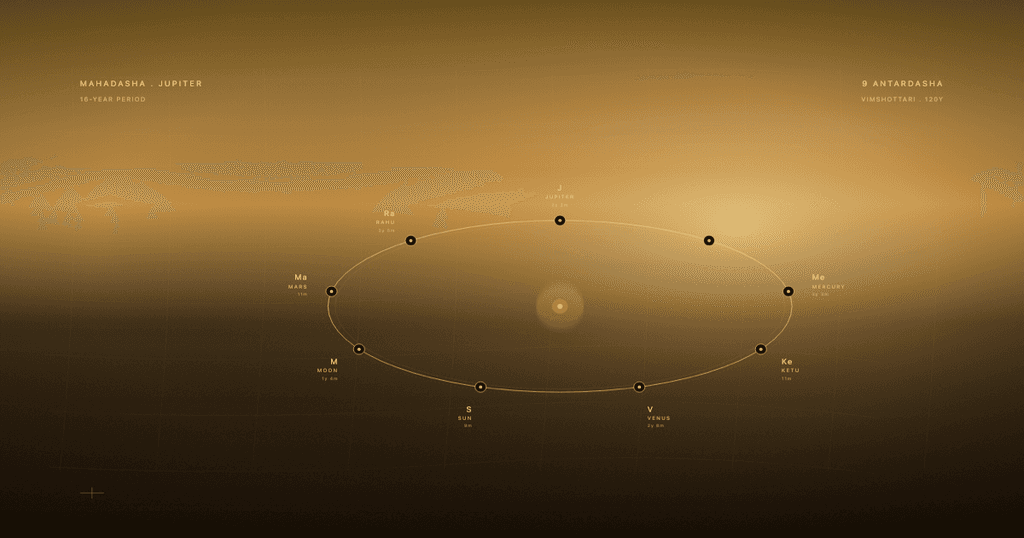
The 16-year Jupiter mahadasha divides into nine antardasha sub-periods in fixed Vimshottari order starting with Jupiter itself. The Saturn sub-period sits at position 2 of 9. Exact start and end dates for any chart can be computed from the natal Moon nakshatra-pada and the date of Jupiter mahadasha onset. The Tempora dasha engine produces this to the day.
Friendship status and pairing reading
In the classical Parashari friendship matrix, Jupiter views Saturn as neutral. The neutral-pair classification means the 2 years 6 months 12 days sub-period takes the colouring of the natal placement of both planets. Jupiter's register (wisdom, dharma, children, expansion, teaching and the dignified-blessing register) and Saturn's register (discipline, longevity, institutional structure and sustained-effort outcomes) can integrate constructively or friction-prone depending on the broader chart configuration.
The Saturn karaka overlay
Saturn is the karaka of discipline, longevity, institutional structure and sustained-effort outcomes. Across the 2 years 6 months 12 days sub-period, this karaka set overlays on top of Jupiter's 16-year wisdom, dharma, children, expansion, teaching and the dignified-blessing register register. The combined reading is the central output of the sub-period.
How Saturn's natal dignity shapes the reading
Saturn's natal sign and house set the floor for the 2 years 6 months 12 days sub-period. Saturn at exaltation gives the strongest reading. Own-sign and mooltrikona placement gives clean expression. Debilitation introduces friction that the sub-period must work through. Combust and retrograde state, conjunctions with malefics or benefics and the dispositor's strength all further modulate the reading. See the Saturn mahadasha overview for the per-dignity breakdown.
Event classes typical to Jupiter-Saturn sub-period
The 2 years 6 months 12 days Jupiter mahadasha Saturn antardasha typically surfaces events across these specific domains:
- Configuration-dependent Jupiter-Saturn integration: neutral-pair sub-periods take the colouring of the natal placement of both planets.
- Events in Saturn's natural karaka domain: discipline, longevity, institutional structure and sustained-effort outcomes.
- Events specific to the natal house Saturn occupies in the chart.
- Events where the Jupiter-mahalord and Saturn-antarlord houses (both natal and ruled) interact (aspect, mutual reception or natal conjunction).
Transit confirmation protocol
The sub-period reading sets a structural pressure floor of 2 years 6 months 12 days. Specific event timing inside that window requires the pratyantara (sub-sub-period) overlay and a transit cross-check.
Two transit overlays do most of the work. The standard targets to track: transit Saturn aspecting natal Jupiter or natal Saturn, transit Jupiter transiting the natal 10th house, transit Saturn through the natal 4th or 10th house, transit Mars-Saturn conjunctions or oppositions in any sign. These transits intensify the Jupiter-Saturn dynamic within the broader sub-period and concentrate event timing on those windows.
The pratyantara (sub-sub-period) inside the antardasha gives finer timing. The Jupiter-Saturn-Jupiter pratyantara (about 4 months) and the Jupiter-Saturn-Mercury pratyantara (about 3 months 17 days) carry the most concentrated career-consolidation signal within the 30-month sub-period. The Jupiter-Saturn-Sun pratyantara (about 1 month 15 days) reads as the recognition window within the consolidation. Cross-checking the pratyantara against the transit overlay gives event timing to the week. Tempora's dasha engine produces this data to the day for any chart.
What the framework does not predict
The Jupiter-Saturn reading is structural. It flags a 30-month window where the conditional probability of three named event classes lifts above chance, but it does not predict that any specific native will experience a specific event inside that window, nor the direction of any event that does fire.
A consolidation event during the sub-period can read as the institutional confirmation of work done across the broader Mahadasha or as a constraint the native must work within for the next several years; the chart's broader signals determine which. The framework times the pressure, not the result and timing finer than the antardasha band needs the pratyantara sequence and the transit overlay for the date in question.
How this connects to the broader Jupiter Mahadasha
The Jupiter-Saturn sub-period is the second antardasha inside the 16-year Jupiter Mahadasha. Reading the sub-period in isolation captures the 2 years 6 months 12 days; reading it inside the Mahadasha gives the broader arc that places the wisdom meets structural discipline reading in its proper structural context.
The Tempora Jupiter Mahadasha method article covers the dispositor analysis, natal-house framework and the broader 20-year texture that this sub-period sits inside. The conditional probability framework holds across the full series: each antardasha is a flagged window for specific event classes whose probability is elevated relative to chance.
The arithmetic of this period
The constants set the span. Jupiter carries 16 years of the 120-year cycle and Saturn carries 19, so the antardasha runs 16 x 19 / 120 = 2.533 years, which is 2 years 6.4 months, conventionally 2 years 6 months 12 days. Within this mahadasha only the Venus sub-period at 2 years 8 months runs longer.
Position needs almost no summing: only Jupiter's own opening antardasha precedes it, 16 x 16 / 120 = 2.133 years, about 2 years 2 months. The Saturn antardasha therefore occupies roughly years 2.1 to 4.7 of the 16-year Jupiter mahadasha, still entirely inside the period's first third.
That early seat is the point. The consolidation falls on expansion that is barely two years old, so what Saturn audits here is fresh growth rather than a finished record, and the verdicts it hands down set the terms for everything after: Mercury's working years, Ketu's subtraction and the long Venus middle all inherit whatever survives this window. The same antardasha landing late in a period would be closing accounts; here it is writing the syllabus.
What the classical texts assign here
In the BPHS antardasha chapters, Jupiter mahadasha section, the results of the Saturn sub-period hinge on Saturn's condition: exalted, in own sign or strong in a kendra or trikona it is credited with gain of position, wealth, grain, conveyances, cattle and happiness through sons and friends, down to the oddly specific gift of a blue-coloured horse and wealth received from the king. The same chapter turns the reading when Saturn sits in the 6th, 8th or 12th, combust or in an enemy sign, listing loss of wealth, fever, mental agony and inauspicious domestic events. Placement from the dasha lord carries its own clause, since Saturn in a kendra, trikona, 11th or 2nd from Jupiter is assigned land, a house, a son and riches arriving through an adversary. Where Saturn holds lordship of the 2nd or the 7th the text adds health cautions and prescribes remedial measures, Vishnu Sahasranama recitation and charity among them. Phaladeepika's chapter on the sub-divisions of dashas reads the same bhukti darkly, assigning association with courtesans, intoxication and sickness in the family, an adverse list that clashes with the favourable branch BPHS allows a dignified Saturn. The Tempora engine takes these classical positions as inputs and conditions them on the natal chart before any weight reaches a reading.
This period against the 2026 to 2028 sky
Both lords are on the engine's calendar and their arcs cross. Saturn has occupied Pisces, a sign Jupiter rules, since 20 March 2025. It enters Aries on 23 May 2027, retreats back into Pisces on 4 November 2027, re-enters Aries to stay on 11 February 2028 and holds that sign until 2030. Aries is Saturn's classical debilitation sign, so the antardasha lord spends the tail of this window at its weakest transit dignity, and the retreat means it does so twice.
Jupiter meanwhile is exalted in Cancer from 27 May 2026 and settles into Leo from 19 June 2027. For a native running Jupiter-Saturn months through this stretch the classical composite is a dignified period lord above a strained sub-lord: direction favoured, load-bearing questioned, with the 2027 to 2028 months the ones classical readers would treat most carefully before adding new structural weight. Every signal carries its limit. These are sign-level transits common to all charts, a debilitated transit Saturn says nothing about any particular natal Saturn, and the antardasha reading stands or falls on the birth chart alone.
Dignity forks the neutral pairing sharply. Saturn strong, exalted in Libra, in own Capricorn or Aquarius, gives the classical best case for this combination: institutions built during Jupiter's opening enthusiasm actually hold, duty and dharma pull in one harness. Saturn debilitated in Aries or heavily afflicted gives the textbook difficult stretch, obligations that outweigh returns and growth taxed before it matures. The full per-dignity treatment is in the Saturn mahadasha overview.
Frequently asked questions
How long is the Jupiter Mahadasha Saturn Antardasha and where does it fall in the Vimshottari sequence?
The Jupiter Mahadasha Saturn Antardasha runs 2 years 6 months 12 days. It is the second antardasha inside the 16-year Jupiter Mahadasha, opening after the Jupiter-Jupiter antardasha (2 years 1 month 18 days). The full sequence inside the Jupiter Mahadasha runs Venus-Venus, Venus-Sun, Venus-Moon, Venus-Mars, Venus-Rahu, Venus-Jupiter, Venus-Saturn, Venus-Mercury and Venus-Ketu. Exact start and end dates can be computed from the natal Moon nakshatra-pada and the date of Jupiter Mahadasha onset.
What does Saturn signify in this sub-period and why does it read as wisdom meets structural discipline?
Saturn is the karaka of discipline, responsibility, hard work, restriction, ageing, longevity, public duty, structure, time, consequence. During the broader Jupiter Mahadasha's pleasure, relationship and refinement reading, Saturn contributes the structural-discipline overlay. The sub-period sits at the second position in the antardasha sequence and reads as the Jupiter dharma and expansion register meeting Saturn's structure, restriction and consequence.
How does Saturn's natal dignity shape the Jupiter-Saturn sub-period reading?
Saturn's natal house, sign and aspectual state set the floor for the 30-month sub-period. Saturn exalted in Libra, in own sign Capricorn or Aquarius or in angular houses (1st, 4th, 7th, 10th) softens the reading toward more auspicious outcomes. Saturn debilitated in Aries introduces friction. Aspects from Saturn bring sustained structural pressure; aspects from Mars bring competitive or confrontational pressure.
What kinds of events historically correlate with the Jupiter-Saturn sub-period?
Three event classes correlate. Career consolidation events: Promotions, long-term contracts, partnership agreements, institutional affiliations. The texture is sustained build then formal recognition. The conditional probability is highest for natives whose na. Religious commitment and dharmic-institution events: Vows, formal teacher commitments, ashram or religious-institution affiliations, sustained practice habits consolidating into identity. Marriage in dharmic context. Institutional educational affiliatio. Property and long-term wealth events: Real estate purchases, pension or retirement-asset accumulation, long-term investment commitments. The Jupiter expansion meets Saturn's slow accumulation. Wealth here arrives through patience not spec. The framework reads these as a structural-pressure window for the event class, not a deterministic predictor.
How does this sub-period connect to the broader Jupiter Mahadasha?
The Jupiter-Saturn sub-period is the second antardasha inside the 16-year Jupiter Mahadasha. It opens after the Jupiter-Jupiter antardasha (2 years 1 month 18 days). The sub-period reading is best held in tandem with the broader Jupiter Mahadasha reading from the Tempora Jupiter Mahadasha method article, which covers the natal house and dispositor framework that sets the texture of the full 16 years.
What does the Tempora framework not predict about this sub-period?
The framework identifies a structural-pressure window of approximately 2 years 6 months 12 days. It does not predict whether a specific native will experience a specific event in that window. It does not predict outcome direction. It does not predict timing finer than the sub-period band without overlaying the pratyantara (sub-sub-period) and the transit overlay for the date in question. The readings carry conventional weight from classical literature; the framework treats them as structural-pressure flags to cross-check against transit data.
Why does the Saturn antardasha arrive so early in the Jupiter mahadasha?
The Vimshottari sequence runs Sun, Moon, Mars, Rahu, Jupiter, Saturn, Mercury, Ketu and Venus. Every mahadasha opens with its own lord's antardasha before continuing the cycle. Saturn follows Jupiter directly in that order, so its sub-period comes second. With Jupiter's own antardasha taking about 2 years 2 months, the Saturn window of 2 years 6 months 12 days (16 x 19 / 120 = 2.533 years) occupies roughly years 2.1 to 4.7 of the 16.
What does Saturn's 2027 Aries entry mean during a Jupiter-Saturn antardasha?
Saturn enters Aries, its classical debilitation sign, on 23 May 2027, retreats into Pisces on 4 November 2027 and re-enters Aries to stay on 11 February 2028. A native whose Jupiter-Saturn antardasha overlaps those months has the sub-period lord at its weakest transit dignity, which classical practice reads as a caution on new structural commitments rather than a verdict on existing ones. The limitation is standard: this is a sign-level transit shared by every chart, and the natal Saturn decides how much of it registers.
What do the classical texts say about Jupiter-Saturn?
BPHS, in its antardasha chapters under the Jupiter mahadasha section, makes the verdict depend on Saturn: dignified and strong it signals position, wealth, cattle and happiness through sons, while Saturn combust, in an enemy sign or in the 6th, 8th or 12th signals loss, fever and mental agony. Phaladeepika's bhukti chapter instead assigns a fixed adverse list of courtesan association, intoxication and family sickness. The two texts disagree on this pairing and the engine resolves the tension by conditioning both positions on the natal Saturn.
Read next
- Jupiter Mahadasha: how to read the 20-year period · the broader Mahadasha this sub-period sits inside
- Jupiter Mahadasha Mercury Antardasha · the next sub-period in the Vimshottari sequence
- Ketu Mahadasha Saturn Antardasha · the complementary sub-period in the prior Mahadasha
- Mahadasha and Vimshottari planetary periods · the full nine-period framework
- Calibrated lift: the discipline that turns Vedic astrology into research
This article represents conventional Vedic teaching and Tempora Research method documentation. It does not constitute financial, legal or professional advice. Internal audit log maintained.