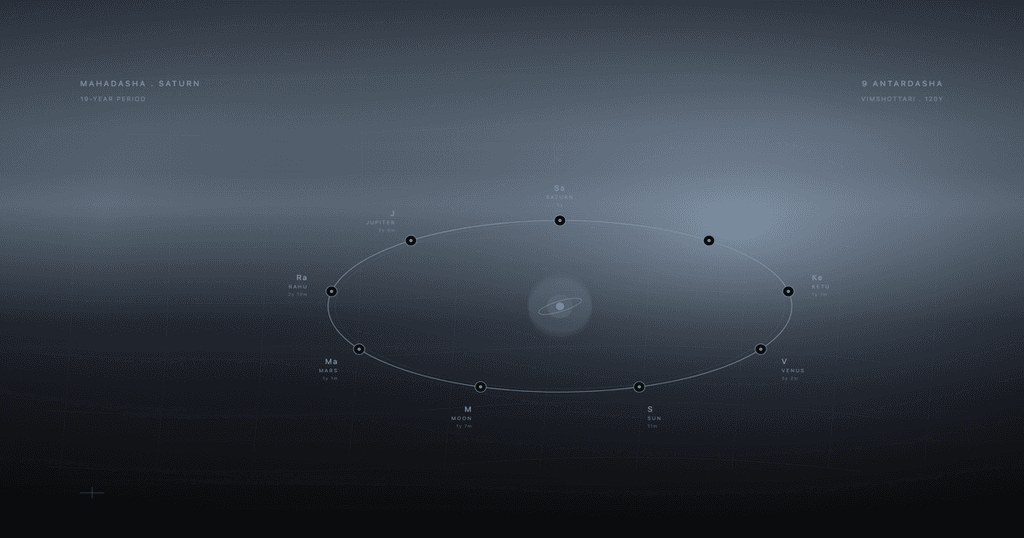
Saturn Mahadasha Mercury Antardasha: the structured-expression window
Saturn holds Mercury as a friend in the Parashari matrix, and Mercury returns a neutral regard, which classical compilers treat as a workable alliance rather than a warm one. The Mercury antardasha is the second sub-period of the 19-year Saturn cycle, the first change of voice after Saturn's own opening antardasha has run its first 3 years.
Where the opening period is pure Saturn, weight settling on every commitment, the arrival of Mercury gives the mahadasha its first instrument for articulation, accounts, drafting and trade. Tradition reads the 32 months of this friendly pairing as discipline finding its language, the stretch where the structure begun in the opening years gets written down, negotiated and put into circulation.
Where the sub-period falls in the Vimshottari sequence
The 19-year Saturn mahadasha divides into nine antardasha sub-periods in fixed Vimshottari order starting with Saturn itself. The Mercury sub-period sits at position 2 of 9. Exact start and end dates for any chart can be computed from the natal Moon nakshatra-pada and the date of Saturn mahadasha onset. The Tempora dasha engine produces this to the day.
The arithmetic of this period
Mercury's 17 years against Saturn's 19 give this antardasha 19 times 17 over 120 years, which works out to 2.69 years, or 2 years 8 months 9 days, the second longest sub-period of this mahadasha after Venus. Only Saturn's own antardasha precedes it, just over 3 years, so Saturn-Mercury runs from about year 3 to about year 5.7 of the 19.
Early position shapes the reading. The native is barely past the mahadasha's threshold, still absorbing the change of register from whatever dasha came before, and a communication-heavy period there sets the terms the remaining 13 years will execute. The long arc is in the Saturn mahadasha overview and Mercury's own 17-year cycle in the Mercury mahadasha page.
Both neighbours define it by difference. Before it lies the only sub-period with no second voice at all, Saturn running its own antardasha for just over 3 years, and after it comes the 13-month cut of Saturn-Ketu. Mercury is thus the mahadasha's first dialogue and its last sustained outward push before the severance period, which is why classical authors lean on it for the durable paperwork of the cycle, agreements, records and trained skill.
How the source texts grade this sub-period
The BPHS antardasha chapters, Saturn mahadasha section, grade this combination by placement: Mercury in a kendra or trikona is assigned public reverence, reputation, wealth, conveyances, bodily wellbeing and effects the text compares to a Raj-yoga. The affliction clause is distinctive for its shape in time. With Mercury in the 6th, 8th or 12th from lagna or from the dasha lord, or joined with the Sun, Mars or Rahu, the text describes a strong opening, kingdom-gain and headship of a village, followed by disease, failed ventures and anxiety through the middle and end, an explicitly front-loaded period. Where Mercury carries 2nd or 7th lordship the chapter attaches health cautions and prescribes Vishnu Sahasranama recitation and grain charity.
Phaladeepika's bhukti chapter gives a mixed short list for the pairing, prosperity, happiness, female company and disease of the three humours. The two records lean the same way here, and the engine reads both as classical inputs that the natal Mercury must confirm or discount.
Friendship status and pairing reading
In the classical Parashari friendship matrix, Saturn views Mercury as friend. The friend-pair classification means the 2 years 8 months 9 days sub-period classically delivers outcomes where Saturn's register (discipline, longevity, institutional structure and sustained-effort outcomes) and Mercury's register (intelligence, communication, commerce, writing and the youthful-skill register) integrate constructively. Events typically surface from both karaka domains in alignment rather than friction.
The Mercury karaka overlay
Mercury is the karaka of intelligence, communication, commerce, writing and the youthful-skill register. Across the 2 years 8 months 9 days sub-period, this karaka set overlays on top of Saturn's 19-year discipline, longevity, institutional structure and sustained-effort outcomes register. The combined reading is the central output of the sub-period.
How Mercury's natal dignity shapes the reading
Mercury's natal sign and house set the floor for the 2 years 8 months 9 days sub-period. Mercury at exaltation gives the strongest reading. Own-sign and mooltrikona placement gives clean expression. Debilitation introduces friction that the sub-period must work through. Combust and retrograde state, conjunctions with malefics or benefics and the dispositor's strength all further modulate the reading. See the Mercury mahadasha overview for the per-dignity breakdown.
Event classes typical to Saturn-Mercury sub-period
The 2 years 8 months 9 days Saturn mahadasha Mercury antardasha typically surfaces events across these specific domains:
- Constructive integration of Saturn-register with Mercury-register: friend-pair sub-periods classically deliver outcomes where both planets' karakas align rather than friction.
- Events in Mercury's natural karaka domain: intelligence, communication, commerce, writing and the youthful-skill register.
- Events specific to the natal house Mercury occupies in the chart.
- Events where the Saturn-mahalord and Mercury-antarlord houses (both natal and ruled) interact (aspect, mutual reception or natal conjunction).
Transit confirmation protocol
The sub-period reading sets a structural pressure floor of 2 years 8 months 9 days. Specific event timing inside that window requires the pratyantara (sub-sub-period) overlay and a transit cross-check.
Two transit overlays do most of the work. The standard targets to track: transit Saturn aspecting natal Mercury, transit Mercury through the natal 3rd or 10th house, transit Saturn-Mercury conjunctions or oppositions in earth signs, transit Mercury retrograde windows that coincide with editing or contract-revision phases. These transits intensify the Saturn-Mercury dynamic within the broader sub-period and concentrate event timing on those windows.
The pratyantara (sub-sub-period) inside the antardasha gives finer timing. The Saturn-Mercury-Saturn pratyantara (about 5 months 7 days) and the Saturn-Mercury-Mercury pratyantara (about 4 months 22 days) carry the most concentrated structured-articulation signal within the 32-month sub-period. The Saturn-Mercury-Jupiter pratyantara (about 4 months 11 days) reads as the moral-publication window. Cross-checking the pratyantara against the transit overlay gives event timing to the week. Tempora's dasha engine produces this data to the day for any chart.
What the framework does not predict
The Saturn-Mercury reading is structural. It flags a 32-month window where the conditional probability of three named event classes lifts above chance, but it does not predict that any specific native will experience a specific event inside that window, nor the direction of any event that does fire.
A publication or commercial-formalisation event during the sub-period can read as the structured establishment of the native's institutional articulation or as a high-volume output phase whose individual pieces achieve formal recognition over time; the chart's broader 3rd house signals determine which. The framework times the pressure, not the result and timing finer than the antardasha band needs the pratyantara sequence and the transit overlay for the date in question.
How this connects to the broader Saturn Mahadasha
The Saturn-Mercury sub-period is the second antardasha inside the 19-year Saturn Mahadasha. Reading the sub-period in isolation captures the 2 years 8 months 9 days; reading it inside the Mahadasha gives the broader arc that places the discipline meets articulation reading in its proper structural context.
The Tempora Saturn Mahadasha method article covers the dispositor analysis, natal-house framework and the broader 6-year texture that this sub-period sits inside. The conditional probability framework holds across the full series: each antardasha is a flagged window for specific event classes whose probability is elevated relative to chance.
This period against the 2026 to 2028 sky
Mercury carries no dated event in the 2026 to 2028 transit calendar, so the window turns on the mahadasha lord alone. Saturn has been in Pisces, the sign of Mercury's debilitation, since 20 March 2025, and a native running Saturn-Mercury under that sky has the mahadasha lord standing in the antardasha lord's weakest sign. That changes on 23 May 2027 when Saturn first enters Aries, though the move is provisional, with a retreat into Pisces on 4 November 2027 and the lasting entry on 11 February 2028. Classical reading takes the handover as a genuine change of background for the pairing. The limitation stands as always, a sign-level transit is context and never a trigger, and whether these months even fall inside a given native's Saturn-Mercury antardasha depends wholly on when the mahadasha began in that chart.
The transit backdrop matters less than the natal Mercury it falls upon. Strong at birth, own-sign in Gemini or exalted in Virgo, Mercury is read as giving the friendly pair its full value, contracts that hold, writing that compounds, accounts that balance under Saturn's patience. Debilitated in Pisces or combust, the same antardasha is delineated as tangled paperwork and misfired words, which is why the classical commentaries check Mercury's state before promising this period's fluency.
Frequently asked questions
How long is the Saturn Mahadasha Mercury Antardasha and where does it fall in the Vimshottari sequence?
The Saturn Mahadasha Mercury Antardasha runs 2 years 8 months 9 days. It is the second antardasha inside the 19-year Saturn Mahadasha, opening after the Saturn-Saturn antardasha (3 years 3 days). The full sequence inside the Saturn Mahadasha runs Saturn-Saturn, Saturn-Mercury, Saturn-Ketu, Saturn-Venus, Saturn-Sun, Saturn-Moon, Saturn-Mars, Saturn-Rahu and Saturn-Jupiter. Exact start and end dates can be computed from the natal Saturn nakshatra-pada and the date of Saturn Mahadasha onset.
What does Mercury signify in this sub-period and why does it read as discipline meets articulation?
Mercury is the karaka of speech, intellect, commerce, business, writing, analysis, communication, education, youthful expression. During the broader Saturn Mahadasha's discipline and structure reading, Mercury contributes the structured-expression overlay. The sub-period sits at the second position in the antardasha sequence and reads as the Saturn discipline and structure register meeting Mercury's intellect, speech, commerce and analysis significations.
How does Mercury's natal dignity shape the Saturn-Mercury sub-period reading?
Mercury's natal house, sign and aspectual state set the floor for the 32-month sub-period. Mercury exalted in Virgo, in own sign Gemini or Virgo or in angular houses (1st, 4th, 7th, 10th) softens the reading toward more auspicious outcomes. Mercury debilitated in Pisces introduces friction. Aspects from Saturn bring sustained structural pressure; aspects from Saturn bring competitive or confrontational pressure.
What kinds of events historically correlate with the Saturn-Mercury sub-period?
Three event classes correlate. Long-form writing and publication events: Books published, long-form essays drafted, institutional curricula formalised, multi-year content programmes initiated. The Saturn-Mercury sub-period is the most concentrated structured-articulation w. Sustained commerce and contract events: Multi-year commercial contracts signed, institutional partnership formalised, long-running client relationships consolidated. Founders, advisors and commercial professionals describe the sub-period as. Formal education and credentialing milestones: Degrees awarded, formal courses completed, scholar appointments, multi-year academic programmes entered or finished. The Mercury student function activates inside Saturn's structural register, produci. The framework reads these as a structural-pressure window for the event class, not a deterministic predictor.
How does this sub-period connect to the broader Saturn Mahadasha?
The Saturn-Mercury sub-period is the second antardasha inside the 19-year Saturn Mahadasha. It opens after the Saturn-Saturn antardasha (3 years 3 days). The sub-period reading is best held in tandem with the broader Saturn Mahadasha reading from the Tempora Saturn Mahadasha method article, which covers the natal house and dispositor framework that sets the texture of the full 16 years.
What does the Tempora framework not predict about this sub-period?
The framework identifies a structural-pressure window of approximately 2 years 8 months 9 days. It does not predict whether a specific native will experience a specific event in that window. It does not predict outcome direction. It does not predict timing finer than the sub-period band without overlaying the pratyantara (sub-sub-period) and the transit overlay for the date in question. The readings carry conventional weight from classical literature; the framework treats them as structural-pressure flags to cross-check against transit data.
When does the Saturn-Mercury antardasha begin inside the mahadasha?
Immediately after Saturn's own opening antardasha, which runs just over 3 years. Saturn-Mercury therefore spans from about year 3 to about year 5.7 of the 19-year cycle, computed from its own duration of 2 years 8 months 9 days. Being the second sub-period, it sets the working language of a mahadasha that still has more than 13 years to run, which is why classical authors give the early antardashas outsize descriptive weight.
Does Saturn transiting Pisces affect this sub-period?
Pisces is the sign of Mercury's debilitation and Saturn has stood there since 20 March 2025, so a native running Saturn-Mercury under this sky has the mahadasha lord placed in the antardasha lord's weakest sign. That background lifts on 23 May 2027 when Saturn first touches Aries, though the change only completes on 11 February 2028 after the retreat of 4 November 2027. As always the transit describes a sky every chart shares, and the natal Mercury decides how much of it registers.
What do the classical texts say about Saturn-Mercury?
BPHS's Saturn mahadasha antardasha section assigns reverence, reputation and Raj-yoga-like effects to a Mercury in a kendra or trikona, and describes an afflicted Mercury period as front-loaded, strong at the opening and anxious through the middle and end. Health cautions with Vishnu Sahasranama and grain charity attach under 2nd or 7th lordship. Phaladeepika's bhukti chapter gives a mixed list, prosperity, happiness, female company and disease of the three humours. The engine scores these positions against the natal Mercury.
Read next
- Mahadasha: the nine-period Vimshottari framework · the broader cluster this sub-period sits inside
- Saturn Mahadasha Ketu Antardasha · the next sub-period in the Vimshottari sequence
- Venus Mahadasha Mercury Antardasha · the complementary sub-period in the prior Mahadasha
- Jupiter Mahadasha Mercury Antardasha · the same antardasha planet in a different Mahadasha
- Mahadasha and Vimshottari planetary periods · the full nine-period framework
- Calibrated lift: the discipline that turns Vedic astrology into research
This article represents conventional Vedic teaching and Tempora Research method documentation. It does not constitute financial, legal or professional advice. Internal audit log maintained.