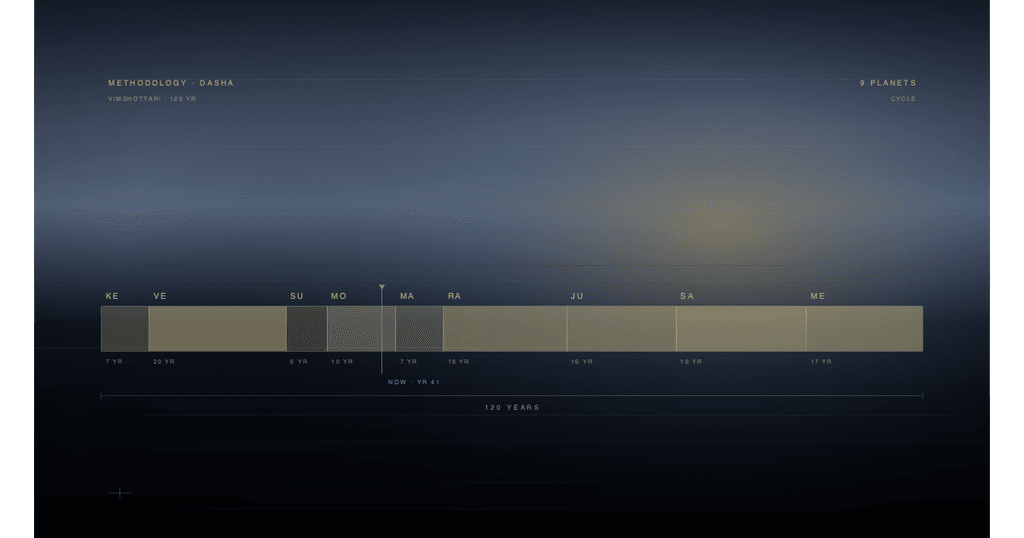
Kshema Tara: when the dasha starting nakshatra shifts.
When Moon at birth sits in the second or sixth house from the ascendant, the Vimshottari dasha does not start from Moon's own nakshatra. It starts from the nakshatra three places ahead. The rule is from Brihat Parashara Hora Shastra, chapter 52. Most software does not apply it. Tempora's engine does, and your reading is marked when it fires.
The standard rule and where it breaks
Standard Vimshottari dasha computes the first major period from the nakshatra Moon occupies at the moment of birth. That nakshatra has a planetary lord, and the lord's full dasha runs from a proportional starting point.
This is the Janma Tara method: dasha starts at the birth-nakshatra itself. It is what every textbook teaches and what most software implements as the default. For most charts, this is correct.
Brihat Parashara Hora Shastra contains a fine-print clause that almost every modern reading ignores. When Moon at birth occupies certain houses from the ascendant, the dasha should start from a different nakshatra than the one Moon physically sits in. The shift is by a fixed offset of nakshatras forward from Moon's nakshatra, named after the type of tara the shift corresponds to.
House of Moon decides the dasha-starting nakshatra.
If Moon is placed in the second or sixth house from the rising sign, the dasha begins from the nakshatra three places ahead of Moon's nakshatra. This is the Kshema variant.
, Brihat Parashara Hora Shastra, chapter 52 (Nakshatra Dasha Selection)The four variants and when they apply
The full set of tara-shift rules covers four cases. The classical sequence of nine taras counted from Moon's nakshatra gives a name to each forward offset: Janma, Sampat, Vipat, Kshema, Pratyak, Sadhaka, Vadha, Mitra, Atimitra. Of these, four are used for dasha-starting selection.
| Variant | Moon house from lagna | Dasha starts from | Offset |
|---|---|---|---|
| Janma | 1, 5, 9 | Moon's own nakshatra | +0 |
| Kshema | 2, 6 | Three nakshatras ahead | +3 |
| Utpanna | 3, 11 | Nakshatra immediately ahead | +1 |
| Adhana | 8, 12 | Five nakshatras ahead | +5 |
Houses 4, 7 and 10 are not covered by a shift rule in this enumeration. Janma is the default for those positions in most modern engine implementations, including Tempora's.
Why the rule exists
The rationale is not stated explicitly in the surviving chapter but the texture of the Parashari logic implies it. Moon in 2 or 6 from lagna sits in a house traditionally read as carrying material accumulation (2nd) or contested ground (6th). The classical view is that dasha computed from such a Moon would not represent the soul-arc of the native cleanly. The forward shift selects a nakshatra whose lord more accurately reflects the chart's actual unfolding.
Whether the underlying intuition is correct is testable. The work of testing it across reconciled charts is part of what the Tempora engine catalogue tracks.
How the shift changes the reading
The practical consequence is significant. If Moon sits in Pushya (Saturn-ruled, twelfth-nakshatra), Janma would start the dasha from Saturn. Kshema would start it from Mercury (the lord of the +3 nakshatra Ashlesha) , three nakshatras ahead.
The implications:
- The order of mahadashas shifts. A native who would have run Saturn → Mercury → Ketu → Venus under Janma will run Mercury → Ketu → Venus → Sun under Kshema. The decade-scale chapters are completely re-ordered.
- The age-windows for each planet change. A 30-year-old running Mercury (Janma) might be running Ketu (Kshema). The texture of their current period , the kind of life work asked for , is read off a different planet.
- The Sookshma and Pratyantara also re-align. Sub-periods are computed proportionally from the new starting point, so the day-scale and week-scale windows shift with the major periods.
Two charts with identical Moon positions but different lagnas , one with Moon in 5th, one with Moon in 6th , will run entirely different dasha sequences from the moment of birth.
Moon in Pisces · ascendant Gemini · 10th house
Moon is at Pisces 4°21' in Revati nakshatra. Tenth house from Gemini lagna. Tenth is not in the Kshema set (2 or 6), so the default Janma applies. Dasha begins from Revati, ruled by Mercury.
Now imagine a different chart with the same Moon position but a Capricorn ascendant. Moon at Pisces falls in the third house from Capricorn, putting this chart in the Utpanna set (+1 offset). The dasha would start from Ashwini, ruled by Ketu, not Revati.
Then: Ketu → Venus → Sun → Moon
Then: Venus → Sun → Moon → Mars
Why most software skips it
Three reasons.
First, the rule is not consistently taught in the modern Vedic curriculum. Most readers of BPHS treat the tara classification as a transit indicator (a chart-to-chart relational reading) rather than as a dasha-construction rule. The chapter-52 application is genuinely obscure in modern practice.
Second, computing it requires holding two pieces of state , Moon's nakshatra and Moon's house from lagna , and conditionally branching. Simpler engines compute Vimshottari purely from Moon's nakshatra without ever consulting the lagna. They are not wrong by their own assumptions; they just do not implement the conditional rule.
Third, the user-facing implications are substantial enough that engines applying the rule produce dasha sequences that disagree with mainstream software. For a software vendor, disagreeing with every other tool on the market is a hard sell unless the underlying calls are dated and verifiable. Tempora's calls are.
How Tempora marks it in your reading
When you submit a chart and the engine fires the Kshema Tara rule, the dasha row in your Key Placements panel carries a small asterisk. Hover the asterisk and the tooltip names the variant that fired. The chart still computes correctly; the asterisk only signals that the result is the variant case rather than the default Janma.
The reading itself uses the shifted dasha as authoritative. If your chart fires Kshema, the windows we name and the texture we read against are computed from the +3 starting point. We do not mix the two and we do not silently fall back to Janma.
This is part of the lineage discipline. If a rule from the classical text applies to your chart, it applies. If it does not, it does not. The engine catalogue lists 152 such rules across the personal canon, of which P16 is one. Every firing is logged.
Frequently asked
Does this rule change the predictions for my chart compared to other readings?
If your chart fires Kshema and the other reading used Janma, yes. The entire mahadasha sequence is re-ordered. The current period your reading names will differ from what other tools tell you. Both readings cannot be simultaneously correct under the Parashari framework. The disagreement traces to a single methodological choice, and BPHS chapter 52 is explicit about it.
How common are the non-Janma cases?
Houses 2 and 6 cover 1 of 6 possible Moon positions if charts were uniformly distributed across houses. Adding Utpanna (3, 11) and Adhana (8, 12) brings the non-Janma cases to roughly half of all natal positions. Empirically the distribution skews toward Janma because of how Moon transits intersect with daily ascendant motion, but a non-trivial fraction of charts ship with a tara shift.
Why no shift for houses 4, 7, 10?
The classical enumeration of nine taras covers all houses, but only four are conventionally used for dasha-starting selection. The remaining houses default to Janma in modern implementations including ours. There are some commentaries that introduce additional shifts here. We have not adopted them because the source texts are less consensual.
Where can I check the source for myself?
Brihat Parashara Hora Shastra, chapter 52. The Sharma critical edition (Sagar Publications) is the most reliable English translation. The Santhanam translation also covers it. The verse on the Kshema variant is in the dasha-selection section toward the end of the chapter.