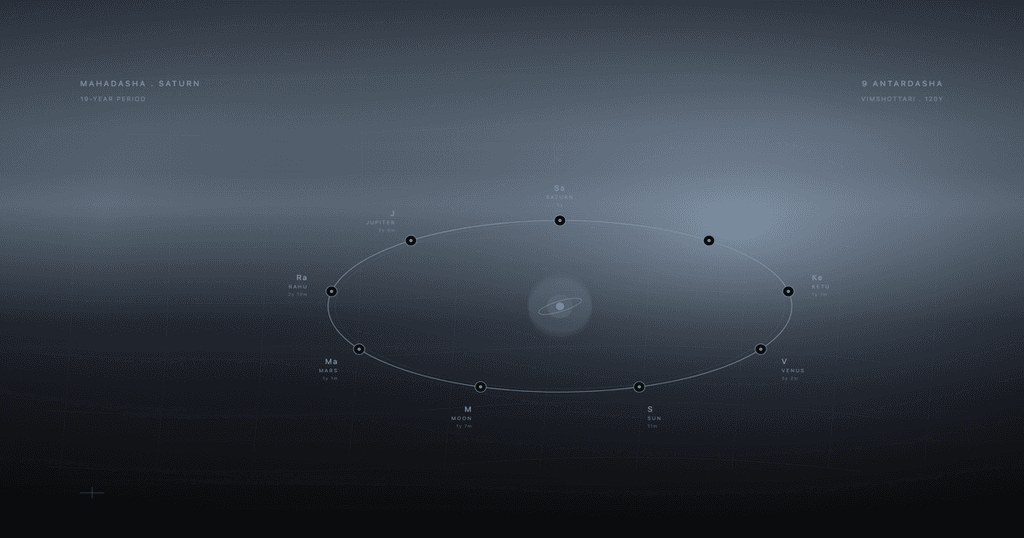
Saturn Mahadasha Sun Antardasha: the formal-authority sub-period
No pairing in this mahadasha carries older tension. Saturn and the Sun hold each other as enemies in the Parashari matrix, and the puranic frame makes them estranged father and son, authority confronting the slow judge it produced. The Sun antardasha is the fifth sub-period of the 19-year Saturn cycle, arriving after the 3 years 2 months of Saturn-Venus have run the mahadasha through its most comfortable stretch, so the change of register is abrupt, ease giving way to examination.
Classical authors read these 11 months as the sharpest short passage of the mahadasha, the period where position, title and the father-line come under Saturn's audit, and they grade its outcome by the natal Sun's dignity before anything else.
Where the sub-period falls in the Vimshottari sequence
The 19-year Saturn mahadasha divides into nine antardasha sub-periods in fixed Vimshottari order starting with Saturn itself. The Sun sub-period sits at position 5 of 9. Exact start and end dates for any chart can be computed from the natal Moon nakshatra-pada and the date of Saturn mahadasha onset. The Tempora dasha engine produces this to the day.
The arithmetic of this period
The Sun's 6 years are the smallest share of the 120-year cycle, so its antardasha under a 19-year lord is the mahadasha's briefest, 19 times 6 over 120, or 0.95 years, which is 11 months 12 days. The four preceding sub-periods sum to just under 10 years, placing Saturn-Sun from roughly year 10 to year 10.9, beginning just past the nine-and-a-half-year midpoint.
A short period at the hinge of a long one concentrates attention. The native crosses into the second half of the 19 years around these months, and the tradition treats hinge-placed antardashas as summary judgements on the half just finished. The surrounding structure is in the Saturn mahadasha overview and the Sun's own 6-year cycle in the Sun mahadasha page.
The neighbours frame the audit. Saturn-Venus before it is the mahadasha's longest and most hospitable sub-period at 3 years 2 months, and Saturn-Moon after it turns the pressure inward for 19 months, so the Sun's 11 months are the abrupt doorway between comfort and interiority. It also opens the run of three consecutive enemy-pair antardashas, Sun then Moon then Mars, that occupies the mahadasha from roughly year 10 to year 13.6.
What the old texts put on record for Saturn-Sun
The BPHS antardasha chapters, Saturn mahadasha section, condition everything on the Sun's state: exalted, in own sign, joined with the 9th lord or benefic-supported in a kendra or trikona, the Sun is assigned good relations with the employer, family wellbeing, happiness from children and gains of conveyances and cattle. In the 8th or 12th from lagna or from the dasha lord the same chapter assigns heart disease, defamation, loss of position, mental agony and obstacles in ventures. Where the Sun carries 2nd or 7th lordship the text attaches health cautions and prescribes Sun worship as the remedial measure.
Phaladeepika's chapter on the sub-divisions of dashas runs uniformly adverse for this bhukti, danger from enemies, sickness among elders, loss of wealth and disease of the belly and eyes. The gap between the two is structural: Mantreswara hard-codes a fixed effect list where Parashara makes every outcome hinge on the antardasha lord's dignity and its placement from lagna and from the dasha lord. The engine resolves that difference by treating both records as inputs conditioned on the natal Sun.
Classical Sun-Saturn Friction pairing
Saturn and Sun are classical enemies (father-vs-son mythological pair). The Sun antardasha inside Saturn mahadasha is one of the most friction-prone sub-periods in the Vimshottari sequence: authority-restriction, institutional-burden, defining career-tension events. Classical warning against initiating new-authority ventures during this window.
Friendship status and pairing reading
In the classical Parashari friendship matrix, Saturn views Sun as enemy. The enemy-pair classification means the 11 months 12 days sub-period classically delivers outcomes through friction between Saturn's register (discipline, longevity, institutional structure and sustained-effort outcomes) and Sun's register (authority, identity, the father-line, dignified-recognition and the visible self). Classical guidance suggests sustained-effort and patience over decisive-action during enemy-pair sub-periods. Events surface through the friction rather than around it.
The Sun karaka overlay
Sun is the karaka of authority, identity, the father-line, dignified-recognition and the visible self. Across the 11 months 12 days sub-period, this karaka set overlays on top of Saturn's 19-year discipline, longevity, institutional structure and sustained-effort outcomes register. The combined reading is the central output of the sub-period.
How Sun's natal dignity shapes the reading
Sun's natal sign and house set the floor for the 11 months 12 days sub-period. Sun at exaltation gives the strongest reading. Own-sign and mooltrikona placement gives clean expression. Debilitation introduces friction that the sub-period must work through. Combust and retrograde state, conjunctions with malefics or benefics and the dispositor's strength all further modulate the reading. See the Sun mahadasha overview for the per-dignity breakdown.
Event classes typical to Saturn-Sun sub-period
The 11 months 12 days Saturn mahadasha Sun antardasha typically surfaces events across these specific domains:
- Friction between Saturn-register and Sun-register: enemy-pair sub-periods classically require careful navigation. Events surface through the friction rather than around it.
- Activation of Sun-Saturn Friction (where the natal configuration supports it).
- Events in Sun's natural karaka domain: authority, identity, the father-line, dignified-recognition and the visible self.
- Events specific to the natal house Sun occupies in the chart.
- Events where the Saturn-mahalord and Sun-antarlord houses (both natal and ruled) interact (aspect, mutual reception or natal conjunction).
Transit confirmation protocol
The sub-period reading sets a structural pressure floor of 11 months 12 days. Specific event timing inside that window requires the pratyantara (sub-sub-period) overlay and a transit cross-check.
Two transit overlays do most of the work. The standard targets to track: transit Sun aspecting natal Saturn or natal Sun, transit Saturn through the natal 5th or 10th house, transit Sun-Saturn conjunctions or oppositions across the 4-10 axis. These transits intensify the Saturn-Sun dynamic within the broader sub-period and concentrate event timing on those windows.
The pratyantara (sub-sub-period) inside the antardasha gives finer timing. The Saturn-Sun-Saturn pratyantara (about 15 days) and the Saturn-Sun-Sun pratyantara (about 16 days) concentrate the public-recognition signal within the 6-month closing window. The Saturn-Sun-Saturn pratyantara (about 29 days) reads as the institutional-formalisation window. Cross-checking the pratyantara against the transit overlay gives event timing to the week. Tempora's dasha engine produces this data to the day for any chart.
What the framework does not predict
The Saturn-Sun reading is structural. It flags a 11-month window where the conditional probability of three named event classes lifts above chance, but it does not predict that any specific native will experience a specific event inside that window, nor the direction of any event that does fire.
A recognition or authority-figure event during the closing sub-period can read as the grand acknowledgment of emotional work built across the full 10 years or as a one-off event whose meaning resolves in the Saturn Mahadasha that follows; the chart's broader 4th and 10th house signals determine which. The framework times the pressure, not the result and timing finer than the antardasha band needs the pratyantara sequence and the transit overlay for the date in question.
How this connects to the broader Saturn Mahadasha
The Saturn-Sun sub-period is the fifth antardasha inside the 19-year Saturn Mahadasha. Reading the sub-period in isolation captures the 11 months 12 days; reading it inside the Mahadasha gives the broader arc that places the discipline meets authority reading in its proper structural context.
The Tempora Saturn Mahadasha method article covers the dispositor analysis, natal-house framework and the broader 6-year texture that this sub-period sits inside. The conditional probability framework holds across the full series: each antardasha is a flagged window for specific event classes whose probability is elevated relative to chance.
This period against the 2026 to 2028 sky
Both lords answer to dated events in this window. The 12 August 2026 solar eclipse falls on the Cancer-Leo cusp, at the doorstep of the Sun's own sign, and a solar eclipse during a Sun antardasha is a textbook observation window, though a cusp eclipse either touches a specific natal chart or it does not, and for most charts it does not. The larger structural note is Saturn's sign change of 23 May 2027, because Aries is at once the Sun's exaltation sign and Saturn's debilitation sign, so the mahadasha lord crosses into the one sign where the enemy pair's polarity inverts, retreats to Pisces on 4 November 2027 and completes the entry on 11 February 2028. From then Saturn holds that ground until 2030. How to read a debilitated mahadasha lord standing in the antardasha lord's exaltation sign is contested across lineages, which is itself the honest signal, and none of it applies unless a native's own dasha calendar puts Saturn-Sun inside these months.
Which way the audit runs is a natal question before it is a transit one. A Sun strong at birth, exalted in Aries or in its own Leo, is the classical case where authority survives examination and comes out confirmed, the father-line steadies and position consolidates. A Sun debilitated in Libra or otherwise weakly placed gives the harsher delineation, friction with superiors and questions of standing, which is why the texts grade this enemy-pair period by the Sun's dignity before all else.
Frequently asked questions
How long is the Saturn Mahadasha Sun Antardasha and where does it fall in the Vimshottari sequence?
The Saturn Mahadasha Sun Antardasha runs 11 months 12 days. It is the fifth antardasha inside the 19-year Saturn Mahadasha, opening after the Saturn-Venus antardasha (3 years 2 months). The full sequence inside the Saturn Mahadasha runs Saturn-Saturn, Saturn-Mercury, Saturn-Ketu, Saturn-Venus, Saturn-Sun, Saturn-Moon, Saturn-Mars, Saturn-Rahu and Saturn-Jupiter. Exact start and end dates can be computed from the natal Saturn nakshatra-pada and the date of Saturn Mahadasha onset.
What does Sun signify in this sub-period and why does it read as discipline meets authority?
Sun is the karaka of authority, identity, ego, soul, vitality, father, government, leadership, recognition, prestige. During the broader Saturn Mahadasha's discipline and structure reading, Sun contributes the formal-authority overlay. The sub-period sits at the fifth position in the antardasha sequence and reads as the Saturn discipline register meeting Sun's authority, identity, father and government significations.
How does Sun's natal dignity shape the Saturn-Sun sub-period reading?
Sun's natal house, sign and aspectual state set the floor for the 11-month sub-period. Sun exalted in Aries, in own sign Leo or in angular houses (1st, 4th, 7th, 10th) softens the reading toward more auspicious outcomes. Sun debilitated in Libra introduces friction. Aspects from Saturn bring sustained structural pressure; aspects from Saturn bring competitive or confrontational pressure.
What kinds of events historically correlate with the Saturn-Sun sub-period?
Three event classes correlate. Public-facing emotional recognition events: Mother-related authority events, family standing acknowledged publicly, mass-audience emotional moments tied to the native's identity. The conditional probability is highest for natives whose natal 4t. Father and authority-figure milestones: Father health events, formal succession decisions, father-child resolution events. The Sun karaka of father activates within the Saturn mind register, often producing events that consolidate or close . Identity-clarity events: Resolution-of-position events. The native arrives at a settled emotional stance after the 19-year Saturn Mahadasha's flux. These often precede a Saturn Mahadasha that channels the settled identity int. The framework reads these as a structural-pressure window for the event class, not a deterministic predictor.
How does this sub-period connect to the broader Saturn Mahadasha?
The Saturn-Sun sub-period is the fifth antardasha inside the 19-year Saturn Mahadasha. It opens after the Saturn-Venus antardasha (3 years 2 months). The sub-period reading is best held in tandem with the broader Saturn Mahadasha reading from the Tempora Saturn Mahadasha method article, which covers the natal house and dispositor framework that sets the texture of the full 16 years.
What does the Tempora framework not predict about this sub-period?
The framework identifies a structural-pressure window of approximately 11 months 12 days. It does not predict whether a specific native will experience a specific event in that window. It does not predict outcome direction. It does not predict timing finer than the sub-period band without overlaying the pratyantara (sub-sub-period) and the transit overlay for the date in question. The readings carry conventional weight from classical literature; the framework treats them as structural-pressure flags to cross-check against transit data.
Why is the Sun antardasha the shortest period of the Saturn mahadasha?
Duration in Vimshottari is proportional to the antardasha lord's share of the 120-year cycle, and the Sun's share is the smallest at 6 years. Under a 19-year mahadasha lord that yields 19 times 6 over 120, or 0.95 years, which is 11 months 12 days. It begins just past the mahadasha's nine-and-a-half-year midpoint, after the four earlier sub-periods have consumed close to 10 years, so a brief period lands at a structurally weighty spot.
How does Saturn's 2027 move into Aries bear on the Saturn-Sun pairing?
Aries carries opposite meanings for the two lords, exaltation for the Sun and debilitation for Saturn. Saturn first crosses in on 23 May 2027, falls back to Pisces on 4 November 2027 and completes the entry on 11 February 2028, holding the sign until 2030. Lineages differ on how to read a debilitated mahadasha lord standing in the antardasha lord's exaltation sign, and that disagreement is worth knowing before borrowing anyone's certainty. Only a native whose dasha calendar puts Saturn-Sun inside those months holds the question at all.
What do the classical texts say about Saturn-Sun?
BPHS, in its Saturn mahadasha antardasha section, ties the outcome to the Sun's dignity and its house from lagna and from the dasha lord, employer favour and family wellbeing when supported, heart trouble and loss of position when placed in the 8th or 12th, with health cautions and Sun worship prescribed under maraka lordship. Phaladeepika's chapter on dasha sub-divisions gives a fixed adverse list for the same bhukti, sickness among elders and disease of the belly and eyes included. The disagreement is real and Tempora keeps it, feeding both positions into a reading conditioned on the natal Sun.
Read next
- Mahadasha: the nine-period Vimshottari framework · the broader cluster this sub-period sits inside
- Saturn Mahadasha Moon Antardasha · the next sub-period in the Vimshottari sequence
- Venus Mahadasha Sun Antardasha · the complementary sub-period in the prior Mahadasha
- Jupiter Mahadasha Sun Antardasha · the same antardasha planet in a different Mahadasha
- Mahadasha and Vimshottari planetary periods · the full nine-period framework
- Calibrated lift: the discipline that turns Vedic astrology into research
This article represents conventional Vedic teaching and Tempora Research method documentation. It does not constitute financial, legal or professional advice. Internal audit log maintained.