Jupiter Mahadasha Sun Antardasha: the wisdom-authority recognition sub-period
The Sun antardasha arrives sixth inside the 16-year Jupiter mahadasha, opening after the 2 years 8 months of the Venus sub-period have worked through partnership, comfort and the relational field. Jupiter and Sun hold one of the few fully mutual friendships in the Parashari matrix: Sun counts Jupiter a friend and Jupiter returns the count. The classical tradition reads their pairing as counsel meeting the crown, the preceptor's blessing landing on the king, so the texture assigned to these 9 months 18 days is recognition, office, honours and father-line resolution rather than acquisition. After the long Venus stretch the beam narrows from the shared field to the native's own name and standing. All of this is classical texture, conditioned throughout by natal Sun's dignity, and it is offered as structure rather than as a measured claim.
Where the sub-period falls in the Vimshottari sequence
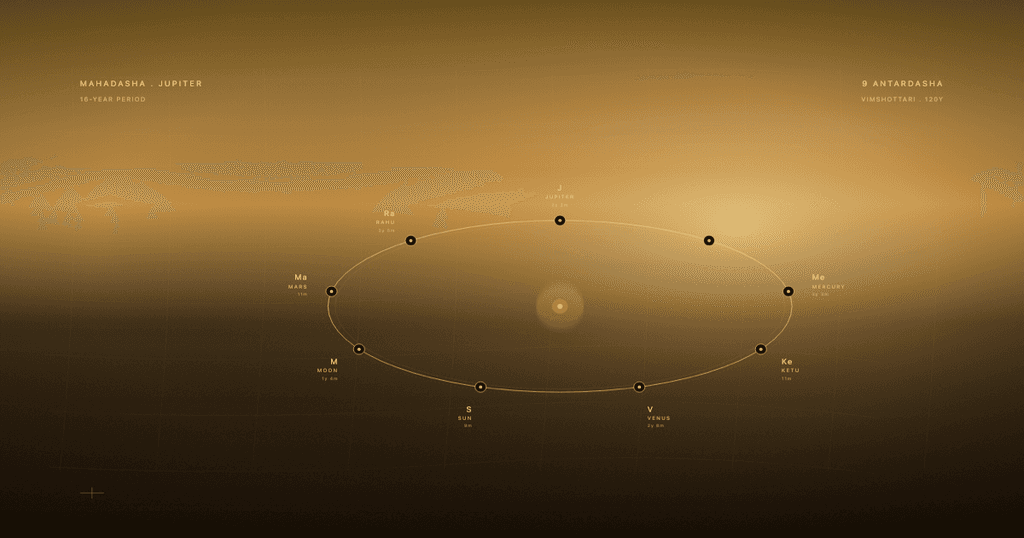
The 16-year Jupiter mahadasha divides into nine antardasha sub-periods in fixed Vimshottari order starting with Jupiter itself. The Sun sub-period sits at position 6 of 9. Exact start and end dates for any chart can be computed from the natal Moon nakshatra-pada and the date of Jupiter mahadasha onset. The Tempora dasha engine produces this to the day.
Friendship status and pairing reading
In the classical Parashari friendship matrix, Jupiter views Sun as friend. The friend-pair classification means the 9 months 18 days sub-period classically delivers outcomes where Jupiter's register (wisdom, dharma, children, expansion, teaching and the dignified-blessing register) and Sun's register (authority, identity, the father-line, dignified-recognition and the visible self) integrate constructively. Events typically surface from both karaka domains in alignment rather than friction.
The Sun karaka overlay
Sun is the karaka of authority, identity, the father-line, dignified-recognition and the visible self. Across the 9 months 18 days sub-period, this karaka set overlays on top of Jupiter's 16-year wisdom, dharma, children, expansion, teaching and the dignified-blessing register register. The combined reading is the central output of the sub-period.
How Sun's natal dignity shapes the reading
Sun's natal sign and house set the floor for the 9 months 18 days sub-period. Sun at exaltation gives the strongest reading. Own-sign and mooltrikona placement gives clean expression. Debilitation introduces friction that the sub-period must work through. Combust and retrograde state, conjunctions with malefics or benefics and the dispositor's strength all further modulate the reading. See the Sun mahadasha overview for the per-dignity breakdown.
Event classes typical to Jupiter-Sun sub-period
The 9 months 18 days Jupiter mahadasha Sun antardasha typically surfaces events across these specific domains:
- Constructive integration of Jupiter-register with Sun-register: friend-pair sub-periods classically deliver outcomes where both planets' karakas align rather than friction.
- Events in Sun's natural karaka domain: authority, identity, the father-line, dignified-recognition and the visible self.
- Events specific to the natal house Sun occupies in the chart.
- Events where the Jupiter-mahalord and Sun-antarlord houses (both natal and ruled) interact (aspect, mutual reception or natal conjunction).
Transit confirmation protocol
The sub-period reading sets a structural pressure floor of 9 months 18 days. Specific event timing inside that window requires the pratyantara (sub-sub-period) overlay and a transit cross-check.
Two transit overlays do most of the work. The standard targets to track: transit Jupiter aspecting natal Sun, transit Sun through the natal 5th or 10th house, transit Saturn through the natal 4th from natal Sun, transit Jupiter through Leo or its trines. These transits intensify the Jupiter-Sun dynamic within the broader sub-period and concentrate event timing on those windows.
The pratyantara (sub-sub-period) inside the antardasha gives finer timing. The Jupiter-Sun-Jupiter pratyantara (about 1 month 7 days) and the Jupiter-Sun-Sun pratyantara (about 17 days) carry the most concentrated recognition signal within the 9-month sub-period. The Jupiter-Sun-Saturn pratyantara (about 1 month 15 days) reads as the institutional-recognition window where awards or formal appointments get processed. Cross-checking the pratyantara against the transit overlay gives event timing to the week. Tempora's dasha engine produces this data to the day for any chart.
What the framework does not predict
The Jupiter-Sun reading is structural. It flags a 9-month window where the conditional probability of three named event classes lifts above chance, but it does not predict that any specific native will experience a specific event inside that window, nor the direction of any event that does fire.
A recognition or father event during the sub-period can read as the long-awaited public acknowledgment of wisdom work built quietly across the Mahadasha or as a single visibility moment that does not consolidate into ongoing authority; the chart's natal Sun strength determines which. The framework times the pressure, not the result and timing finer than the antardasha band needs the pratyantara sequence and the transit overlay for the date in question.
How this connects to the broader Jupiter Mahadasha
The Jupiter-Sun sub-period is the sixth antardasha inside the 16-year Jupiter Mahadasha. Reading the sub-period in isolation captures the 9 months 18 days; reading it inside the Mahadasha gives the broader arc that places the wisdom meets authority reading in its proper structural context.
The Tempora Jupiter Mahadasha method article covers the dispositor analysis, natal-house framework and the broader 20-year texture that this sub-period sits inside. The conditional probability framework holds across the full series: each antardasha is a flagged window for specific event classes whose probability is elevated relative to chance.
The arithmetic of this period
The duration follows from the Vimshottari constants. Jupiter carries 16 years of the 120-year cycle and Sun carries 6, so the sub-period runs 16 x 6 / 120 = 0.8 years, which is 9.6 months, written conventionally as 9 months 18 days. That makes it the shortest antardasha anywhere in the Jupiter mahadasha.
Position follows from summing what comes before. Jupiter opens with its own antardasha of about 2 years 2 months, then Saturn takes 2 years 6 months, Mercury 2 years 3 months, Ketu 11 months and Venus 2 years 8 months. Those five sub-periods together consume close to 10 years 6 months, so the Sun antardasha occupies roughly years 10.5 to 11.3 of the 16-year Jupiter mahadasha, deep in the second half.
The neighbours sharpen the reading. The Sun window is a hinge between the two longest lunar-benefic stretches of the period: it closes the 2 years 8 months of Venus, the longest sub-period of the cycle, and opens onto the 1 year 4 months of the Moon. Nine and a half months of solar concentration between those two soft expanses is why the classical texts read this antardasha as a moment of focus rather than a season. Position matters for a second reason: a native who entered the Jupiter mahadasha at 25 meets this window around 35, with a decade of Jupiter-flavoured work already banked, so a late antardasha audits what the first ten years actually built where an early one would only be testing promise.
The classical positions behind this window
In the BPHS antardasha chapters, Jupiter mahadasha section, the Sun's sub-period yields wealth, reverence, conveyances, the birth of children and cordiality with the king when the Sun is exalted, in own sign or strong in a kendra, trikona, 2nd, 3rd or 11th. The same passage reverses under affliction, giving a Sun in the 6th, 8th or 12th from the lagna or from Jupiter effects of fever, lethargy, reluctance in good deeds and separation from kin. Where the Sun carries lordship of the 2nd or the 7th the text attaches health cautions and prescribes recitation of the Aditya Hridaya as remedy. Phaladeepika's chapter on bhukti effects states victory, royal honour, fame and prosperity outright for this pairing, with none of the hedging. The difference illustrates the broader habit of the two texts, in which Phaladeepika fixes a single verdict per sub-period while BPHS suspends every verdict on the antardasha lord's dignity, its house from the lagna and its distance from the dasha lord. The engine ingests these positions as classical priors and conditions them on the natal Sun before they touch a reading.
This period against the 2026 to 2028 sky
A native running the Jupiter-Sun antardasha through 2026 to 2028 has calendar material on both lords. The mahadasha lord is exalted: Jupiter holds Cancer for its full stay from 27 May 2026, the strongest transit dignity Jupiter can take, which classically firms the whole dasha stack this sub-period hangs from. The antardasha lord's own sign then receives that Jupiter: the Leo taste runs 23 October 2026 to 3 February 2027 and the full Leo stay begins 19 June 2027, placing the period lord of the moment inside the Sun's own house room.
The 12 August 2026 solar eclipse falls on the Cancer-Leo cusp, and an eclipse is a Sun event by definition, so a Jupiter-Sun native has that date flagged twice over. The limitation cuts against each signal in turn: a transit dignity is a background condition shared by everyone alive in those months, an eclipse marks a zone of the zodiac that may touch nothing angular in a given chart, and none of it fires without the natal Sun and the houses involved. The calendar sharpens attention. The birth chart decides relevance.
The classical fork on placement is worth stating plainly. A well placed Sun, exalted in Aries, in Leo or angular, is read as letting the friendship of the lords run clean, recognition arriving through legitimate office and the father-line steadying. A poorly placed Sun, debilitated in Libra or combust logic inverted onto a cramped house, turns the same window into contested authority, title without substance or friction with superiors and father figures. The pairing stays friendly either way in the Parashari sense; what varies is whether the crown fits. The per-dignity groundwork sits in the Sun mahadasha overview.
Frequently asked questions
How long is the Jupiter Mahadasha Sun Antardasha and where does it fall in the Vimshottari sequence?
The Jupiter Mahadasha Sun Antardasha runs 9 months 18 days. It is the sixth antardasha inside the 16-year Jupiter Mahadasha, opening after the Jupiter-Venus antardasha (2 years 8 months). The full sequence inside the Jupiter Mahadasha runs Venus-Venus, Venus-Sun, Venus-Moon, Venus-Mars, Venus-Rahu, Venus-Jupiter, Venus-Saturn, Venus-Mercury and Venus-Ketu. Exact start and end dates can be computed from the natal Moon nakshatra-pada and the date of Jupiter Mahadasha onset.
What does Sun signify in this sub-period and why does it read as wisdom meets authority?
Sun is the karaka of ego-self, authority, recognition, father, vitality, leadership, the visible self, soul. During the broader Jupiter Mahadasha's pleasure, relationship and refinement reading, Sun contributes the authority-recognition overlay. The sub-period sits at the sixth position in the antardasha sequence and reads as the Jupiter dharma and expansion register meeting the Sun's authority, recognition and visible leadership.
How does Sun's natal dignity shape the Jupiter-Sun sub-period reading?
Sun's natal house, sign and aspectual state set the floor for the 9-month sub-period. Sun exalted in Aries, in own sign Leo or in angular houses (1st, 4th, 7th, 10th) softens the reading toward more auspicious outcomes. Sun debilitated in Libra introduces friction. Aspects from Saturn bring sustained structural pressure; aspects from Mars bring competitive or confrontational pressure.
What kinds of events historically correlate with the Jupiter-Sun sub-period?
Three event classes correlate. Recognition and honours events: Awards, formal appointments to advisory roles, honours connected to teaching or wisdom-domain work. The 9-month window is the most concentrated recognition window in the Jupiter Mahadasha. The conditi. Father and authority-figure events: Father health transitions, inheritance matters, mentor relationship shifts, authority-figure dynamics resolving. Where the native carries unresolved father-line or mentor-line material, the Jupiter-Su. Career advancement events: Promotions to leadership positions, visible appointments to advisory boards or formal roles, public-facing career transitions. The Jupiter wisdom register meets Sun visibility register to produce auth. The framework reads these as a structural-pressure window for the event class, not a deterministic predictor.
How does this sub-period connect to the broader Jupiter Mahadasha?
The Jupiter-Sun sub-period is the sixth antardasha inside the 16-year Jupiter Mahadasha. It opens after the Jupiter-Venus antardasha (2 years 8 months). The sub-period reading is best held in tandem with the broader Jupiter Mahadasha reading from the Tempora Jupiter Mahadasha method article, which covers the natal house and dispositor framework that sets the texture of the full 16 years.
What does the Tempora framework not predict about this sub-period?
The framework identifies a structural-pressure window of approximately 9 months 18 days. It does not predict whether a specific native will experience a specific event in that window. It does not predict outcome direction. It does not predict timing finer than the sub-period band without overlaying the pratyantara (sub-sub-period) and the transit overlay for the date in question. The readings carry conventional weight from classical literature; the framework treats them as structural-pressure flags to cross-check against transit data.
When inside the 16-year Jupiter mahadasha does the Sun antardasha run?
Summing the five sub-periods before it gives the answer. Jupiter's own antardasha (about 2 years 2 months), Saturn (2 years 6 months), Mercury (2 years 3 months), Ketu (11 months) and Venus (2 years 8 months) together take close to 10 years 6 months. The Sun antardasha therefore occupies roughly years 10.5 to 11.3 of the mahadasha, a 9 months 18 days window deep in the second half, computed as 16 x 6 / 120 = 0.8 years.
Does the 12 August 2026 solar eclipse change the Jupiter-Sun antardasha reading?
It adds a dated transit flag without changing the structural reading. The eclipse falls on the Cancer-Leo cusp while Jupiter, the mahadasha lord, is exalted in Cancer, and an eclipse is by definition a Sun event, so a native in this sub-period has an unusually specific date to watch. Whether it matters for a given chart depends on what that chart holds near the cusp. The framework treats the eclipse as a cross-check and the sub-period band as the primary structure.
What do the classical texts say about Jupiter-Sun?
BPHS, in the antardasha chapters under its Jupiter mahadasha section, conditions the Sun sub-period on dignity and house, wealth and royal cordiality for a strong Sun against fever and lethargy for an afflicted one, with health cautions and the Aditya Hridaya prescribed where the Sun rules the 2nd or 7th. Phaladeepika's bhukti chapter simply declares victory, royal honour and fame. The two verdicts differ mainly in method and the engine reconciles them by evaluating the natal Sun before applying either.
Read next
- Jupiter Mahadasha: how to read the 20-year period · the broader Mahadasha this sub-period sits inside
- Jupiter Mahadasha Moon Antardasha · the next sub-period in the Vimshottari sequence
- Ketu Mahadasha Sun Antardasha · the complementary sub-period in the prior Mahadasha
- Mahadasha and Vimshottari planetary periods · the full nine-period framework
- Calibrated lift: the discipline that turns Vedic astrology into research
This article represents conventional Vedic teaching and Tempora Research method documentation. It does not constitute financial, legal or professional advice. Internal audit log maintained.