Jupiter Mahadasha Moon Antardasha: the wisdom-emotion and Gajakesari-resonance sub-period
Seventh of the nine sub-periods in the 16-year Jupiter mahadasha, the Moon antardasha opens the moment the 9 months 18 days of the Sun antardasha close, and the classical handover is precise: the Sun window pushed the native's name and office into view, the Moon window asks how all that visibility actually sits in the mind. The friendship between the lords is directional in the Parashari matrix, Jupiter counting the Moon a full friend while the Moon holds Jupiter as neutral, yet tradition still treats the pairing as one of the gentler combinations the cycle offers, two sattvic benefics sharing a period. The texture the texts assign to this 1 year 4 months is nourishment, public reception, mother-line themes and the settling of dharma into feeling rather than doctrine. Natal Moon dignity and nakshatra condition every line of that reading, which stays classical texture and makes no measured claim.
Where the sub-period falls in the Vimshottari sequence
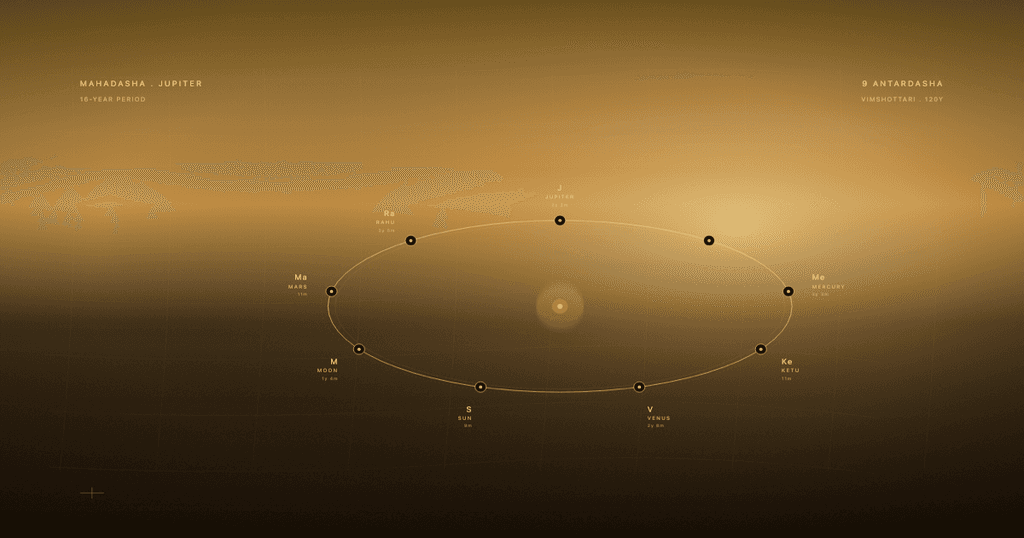
The 16-year Jupiter mahadasha divides into nine antardasha sub-periods in fixed Vimshottari order starting with Jupiter itself. The Moon sub-period sits at position 7 of 9. Exact start and end dates for any chart can be computed from the natal Moon nakshatra-pada and the date of Jupiter mahadasha onset. The Tempora dasha engine produces this to the day.
Classical Gajakesari Yoga pairing
When Jupiter and Moon are within sight of each other in the natal chart, the Gajakesari Yoga activates. The sub-period is read classically as fame, dignity and dharmic-emotional expansion. The Moon antardasha inside Jupiter mahadasha brings the Gajakesari combination forward at maximum intensity.
Friendship status and pairing reading
In the classical Parashari friendship matrix, Jupiter views Moon as friend. The friend-pair classification means the 1 year 4 months sub-period classically delivers outcomes where Jupiter's register (wisdom, dharma, children, expansion, teaching and the dignified-blessing register) and Moon's register (mind, mother, emotional foundation, public reception and the cyclic register) integrate constructively. Events typically surface from both karaka domains in alignment rather than friction.
The Moon karaka overlay
Moon is the karaka of mind, mother, emotional foundation, public reception and the cyclic register. Across the 1 year 4 months sub-period, this karaka set overlays on top of Jupiter's 16-year wisdom, dharma, children, expansion, teaching and the dignified-blessing register register. The combined reading is the central output of the sub-period.
How Moon's natal dignity shapes the reading
Moon's natal sign and house set the floor for the 1 year 4 months sub-period. Moon at exaltation gives the strongest reading. Own-sign and mooltrikona placement gives clean expression. Debilitation introduces friction that the sub-period must work through. Combust and retrograde state, conjunctions with malefics or benefics and the dispositor's strength all further modulate the reading. See the Moon mahadasha overview for the per-dignity breakdown.
Event classes typical to Jupiter-Moon sub-period
The 1 year 4 months Jupiter mahadasha Moon antardasha typically surfaces events across these specific domains:
- Constructive integration of Jupiter-register with Moon-register: friend-pair sub-periods classically deliver outcomes where both planets' karakas align rather than friction.
- Activation of Gajakesari Yoga (where the natal configuration supports it).
- Events in Moon's natural karaka domain: mind, mother, emotional foundation, public reception and the cyclic register.
- Events specific to the natal house Moon occupies in the chart.
- Events where the Jupiter-mahalord and Moon-antarlord houses (both natal and ruled) interact (aspect, mutual reception or natal conjunction).
Transit confirmation protocol
The sub-period reading sets a structural pressure floor of 1 year 4 months. Specific event timing inside that window requires the pratyantara (sub-sub-period) overlay and a transit cross-check.
Two transit overlays do most of the work. The standard targets to track: transit Jupiter aspecting natal Moon, transit Moon through the natal 4th house, transit Saturn aspecting natal Moon, transit Jupiter through Cancer or its trines. These transits intensify the Jupiter-Moon dynamic within the broader sub-period and concentrate event timing on those windows.
The pratyantara (sub-sub-period) inside the antardasha gives finer timing. The Jupiter-Moon-Jupiter pratyantara (about 2 months 5 days) and the Jupiter-Moon-Moon pratyantara (about 1 month 10 days) carry the most concentrated mother and emotional-clarity signal within the 16-month sub-period. The Jupiter-Moon-Saturn pratyantara (about 2 months 17 days) reads as the longevity-and-ageing window for mother-line concerns. Cross-checking the pratyantara against the transit overlay gives event timing to the week. Tempora's dasha engine produces this data to the day for any chart.
What the framework does not predict
The Jupiter-Moon reading is structural. It flags a 16-month window where the conditional probability of three named event classes lifts above chance, but it does not predict that any specific native will experience a specific event inside that window, nor the direction of any event that does fire.
A mother event or home consolidation during the sub-period can read as the loving recognition of a long-built foundation or as a difficult transition that opens a different stage of life; the chart's broader natal Moon strength determines emotional integration capacity. The framework times the pressure, not the result and timing finer than the antardasha band needs the pratyantara sequence and the transit overlay for the date in question.
How this connects to the broader Jupiter Mahadasha
The Jupiter-Moon sub-period is the seventh antardasha inside the 16-year Jupiter Mahadasha. Reading the sub-period in isolation captures the 1 year 4 months; reading it inside the Mahadasha gives the broader arc that places the wisdom meets emotion reading in its proper structural context.
The Tempora Jupiter Mahadasha method article covers the dispositor analysis, natal-house framework and the broader 20-year texture that this sub-period sits inside. The conditional probability framework holds across the full series: each antardasha is a flagged window for specific event classes whose probability is elevated relative to chance.
The arithmetic of this period
The constants fix the length. Jupiter holds 16 of the 120 cycle years and the Moon holds 10, so the antardasha runs 16 x 10 / 120 = 1.333 years, exactly 1 year 4 months.
Where it falls comes from adding the six sub-periods before it: Jupiter about 2 years 2 months, Saturn 2 years 6 months, Mercury 2 years 3 months, Ketu 11 months, Venus 2 years 8 months and Sun 9.6 months, together about 11 years 4 months. The Moon antardasha therefore runs from roughly year 11.3 to year 12.7 of the Jupiter mahadasha, the third act of the period.
Its neighbours frame it. The brief solar concentration of the Sun antardasha precedes it and the 11 months 6 days of Mars follow, so this window is the last soft interval before the mahadasha turns kinetic and then hands its final years to Rahu. The late position also changes what the same lord means: a Moon antardasha arriving this deep in a 16-year cycle works on material already accumulated, the households, audiences and emotional commitments of more than a decade, where the identical sub-period early in some other mahadasha would still be laying first foundations.
Where the old texts land on Jupiter-Moon
The BPHS antardasha chapters, Jupiter mahadasha section, make the Moon's brightness the hinge of this sub-period: when the Moon is full and strong, exalted or in own sign or seated in a kendra, trikona or the 11th and well placed from the dasha lord, it is assigned royal reverence, opulence, good food, reputation earned through good deeds and the growth of children and grandchildren. A Moon that is weak or afflicted or that sits in the 6th, 8th or 12th whether counted from the lagna or from Jupiter draws the opposite column of loss of wealth and kin, foreign wandering, disputes with co-heirs and distress to the mother. Where the Moon holds 2nd or 7th lordship the chapter records health cautions and sets the Durga Saptashati path as the remedial measure. Phaladeepika's bhukti chapter sits close to the favourable branch, listing gain of wealth and farmland, the company of a young woman and the defeat of enemies. On this pairing the two texts pull in the same direction, which is worth registering given how often they diverge elsewhere in the same chapters. The engine consumes these positions as classical inputs whose force depends on the natal Moon's phase, sign and house.
This period against the 2026 to 2028 sky
The 2026 to 2028 calendar speaks directly to both lords of this combination. Jupiter's exaltation sign is Cancer, the Moon's own sign, and Jupiter holds it for the full stay from 27 May 2026 until the Leo shift of 19 June 2027, which in classical terms places the mahadasha lord as a guest in the antardasha lord's house at the guest's own strongest dignity. A native whose Jupiter-Moon antardasha overlaps that window is running the pairing while the sky repeats it.
Two complications keep the reading honest. The 12 August 2026 solar eclipse lands on the Cancer-Leo cusp, and every eclipse is a Sun, Moon and node event, so the lunar side of this sub-period carries a dated flag whose per-chart weight is unknown in advance. From 27 December 2026 Ketu also occupies Cancer, sharing the sign with exalted Jupiter once Jupiter returns from its Leo taste on 3 February 2027, and tradition reads a node beside a dignified benefic as a complication of the blessing without agreeing on its size. Sign-level transits are shared by everyone alive in those months. The natal chart, the natal Moon above all here, decides what any of it touches.
Placement splits the classical reading cleanly. A strong Moon, exalted in Taurus, in Cancer, bright and waxing, is read as letting the Gajakesari resonance of this pairing express as public warmth, fortunate mother-line developments and a mind at ease with its gains. An afflicted Moon, debilitated in Scorpio, dark or hemmed by malefics, turns the same window inward, and the texts then speak of moodiness under blessing, popularity that tires the native and emotional accounts coming due. The friendly pairing sets the stage either way; the Moon's condition writes the script. The lunar dignities are mapped in the Moon mahadasha overview.
Frequently asked questions
How long is the Jupiter Mahadasha Moon Antardasha and where does it fall in the Vimshottari sequence?
The Jupiter Mahadasha Moon Antardasha runs 1 year 4 months. It is the seventh antardasha inside the 16-year Jupiter Mahadasha, opening after the Jupiter-Sun antardasha (9 months 18 days). The full sequence inside the Jupiter Mahadasha runs Venus-Venus, Venus-Sun, Venus-Moon, Venus-Mars, Venus-Rahu, Venus-Jupiter, Venus-Saturn, Venus-Mercury and Venus-Ketu. Exact start and end dates can be computed from the natal Moon nakshatra-pada and the date of Jupiter Mahadasha onset.
What does Moon signify in this sub-period and why does it read as wisdom meets emotion?
Moon is the karaka of mind, emotions, mother, home, comfort, womanly figures, intuition, mental fluctuation, lunar cycles. During the broader Jupiter Mahadasha's pleasure, relationship and refinement reading, Moon contributes the emotional-resonance overlay. The sub-period sits at the seventh position in the antardasha sequence and reads as the Jupiter dharma and expansion register meeting the Moon's mind, emotion, mother signification and intuitive wisdom.
How does Moon's natal dignity shape the Jupiter-Moon sub-period reading?
Moon's natal house, sign and aspectual state set the floor for the 16-month sub-period. Moon exalted in Taurus, in own sign Cancer or in angular houses (1st, 4th, 7th, 10th) softens the reading toward more auspicious outcomes. Moon debilitated in Scorpio introduces friction. Aspects from Saturn bring sustained structural pressure; aspects from Mars bring competitive or confrontational pressure.
What kinds of events historically correlate with the Jupiter-Moon sub-period?
Three event classes correlate. Mother events: Mother health transitions, mother relationship shifts (deepening or distance), inheritance matters from mother's line, womanly-elder mentor relationships activating. The Jupiter signification over the. Home and lifestyle events: Home purchases or renovations, relocations to long-term residence, lifestyle consolidation decisions, family expansion through marriage or birth events. The Moon-home register combined with Jupiter ex. Emotional and intuitive milestones: Therapeutic openings, emotional integration of long-running material, intuitive insight events, mental clarity phases. Native therapists, teachers and emotionally-attuned professionals describe t. The framework reads these as a structural-pressure window for the event class, not a deterministic predictor.
How does this sub-period connect to the broader Jupiter Mahadasha?
The Jupiter-Moon sub-period is the seventh antardasha inside the 16-year Jupiter Mahadasha. It opens after the Jupiter-Sun antardasha (9 months 18 days). The sub-period reading is best held in tandem with the broader Jupiter Mahadasha reading from the Tempora Jupiter Mahadasha method article, which covers the natal house and dispositor framework that sets the texture of the full 16 years.
What does the Tempora framework not predict about this sub-period?
The framework identifies a structural-pressure window of approximately 1 year 4 months. It does not predict whether a specific native will experience a specific event in that window. It does not predict outcome direction. It does not predict timing finer than the sub-period band without overlaying the pratyantara (sub-sub-period) and the transit overlay for the date in question. The readings carry conventional weight from classical literature; the framework treats them as structural-pressure flags to cross-check against transit data.
How is the 1 year 4 months duration of the Jupiter-Moon antardasha computed?
From the Vimshottari constants: Jupiter carries 16 years of the 120-year cycle and the Moon carries 10, so the antardasha runs 16 x 10 / 120 = 1.333 years, exactly 1 year 4 months. Summing the six sub-periods that precede it, about 11 years 4 months in total, places the window at roughly years 11.3 to 12.7 of the 16-year mahadasha.
What does Jupiter's Cancer exaltation from 27 May 2026 mean for a running Jupiter-Moon antardasha?
Cancer is both Jupiter's exaltation sign and the Moon's own sign, so from 27 May 2026 until 19 June 2027 the mahadasha lord transits the antardasha lord's sign at its strongest dignity, a sky-level echo of the pairing itself. That is context rather than verdict: the transit is shared by every chart alive in those months, and whether it lands for a particular native depends on the natal Moon, the houses Cancer occupies in the birth chart and the running pratyantara.
What do the classical texts say about Jupiter-Moon?
The BPHS antardasha chapters, Jupiter mahadasha section, rate this period by the Moon's strength and phase, generous when the Moon is full, dignified and well placed from Jupiter and harsh when it is weak or in the 6th, 8th or 12th, with health cautions and the Durga Saptashati given where the Moon rules the 2nd or 7th. Phaladeepika's bhukti chapter also reads the pairing warmly, naming wealth, farmland and the defeat of enemies. The engine takes this concordant record as input and conditions it on the natal Moon.
Read next
- Jupiter Mahadasha: how to read the 20-year period · the broader Mahadasha this sub-period sits inside
- Jupiter Mahadasha Mars Antardasha · the next sub-period in the Vimshottari sequence
- Ketu Mahadasha Moon Antardasha · the complementary sub-period in the prior Mahadasha
- Mahadasha and Vimshottari planetary periods · the full nine-period framework
- Calibrated lift: the discipline that turns Vedic astrology into research
This article represents conventional Vedic teaching and Tempora Research method documentation. It does not constitute financial, legal or professional advice. Internal audit log maintained.