Jupiter Mahadasha Mars Antardasha: the wisdom-action and decisive-move sub-period
Mars takes the eighth sub-period of the 16-year Jupiter mahadasha, following the 1 year 4 months of the Moon antardasha, and the sequence itself carries the classical logic: after a long reflective stretch the chart passes to the planet of action, so decisions that sat in feeling through the Moon window now demand execution. Jupiter and Mars are mutual friends in the Parashari matrix, teacher and soldier of the same court, and tradition marks the pairing as dharma armed: principled initiative, disputes fought and settled on merit, property, brothers and in the harder charts surgery. Coming this late in the mahadasha, the 11 months 6 days tend to spend accumulated Jupiter capital decisively rather than gather more of it. Whether the execution runs clean or rash is read from natal Mars, and the whole account remains classical texture offered without empirical claim.
Where the sub-period falls in the Vimshottari sequence
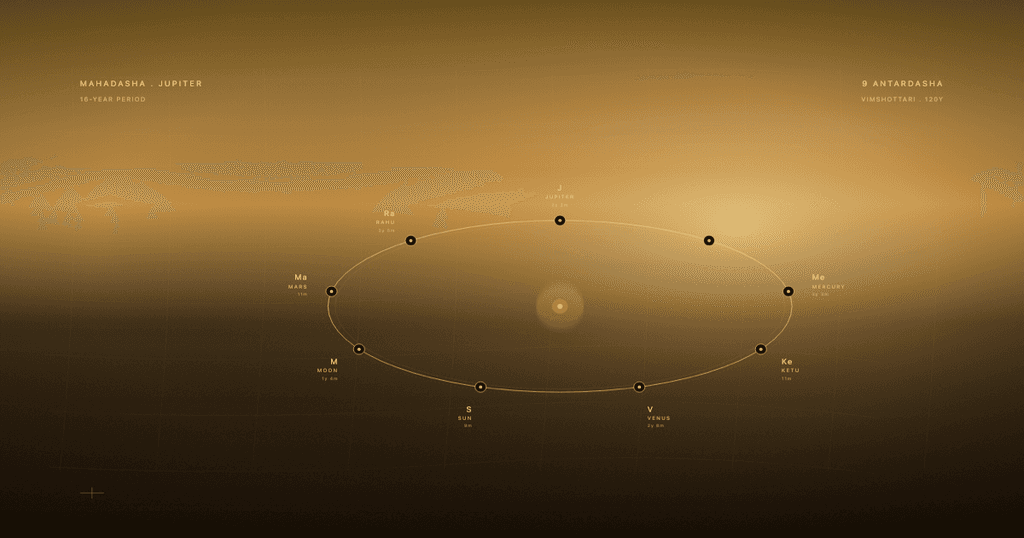
The 16-year Jupiter mahadasha divides into nine antardasha sub-periods in fixed Vimshottari order starting with Jupiter itself. The Mars sub-period sits at position 8 of 9. Exact start and end dates for any chart can be computed from the natal Moon nakshatra-pada and the date of Jupiter mahadasha onset. The Tempora dasha engine produces this to the day.
Friendship status and pairing reading
In the classical Parashari friendship matrix, Jupiter views Mars as friend. The friend-pair classification means the 11 months 6 days sub-period classically delivers outcomes where Jupiter's register (wisdom, dharma, children, expansion, teaching and the dignified-blessing register) and Mars's register (action, courage, brothers, surgery, property and the warrior register) integrate constructively. Events typically surface from both karaka domains in alignment rather than friction.
The Mars karaka overlay
Mars is the karaka of action, courage, brothers, surgery, property and the warrior register. Across the 11 months 6 days sub-period, this karaka set overlays on top of Jupiter's 16-year wisdom, dharma, children, expansion, teaching and the dignified-blessing register register. The combined reading is the central output of the sub-period.
How Mars's natal dignity shapes the reading
Mars's natal sign and house set the floor for the 11 months 6 days sub-period. Mars at exaltation gives the strongest reading. Own-sign and mooltrikona placement gives clean expression. Debilitation introduces friction that the sub-period must work through. Combust and retrograde state, conjunctions with malefics or benefics and the dispositor's strength all further modulate the reading. See the Mars mahadasha overview for the per-dignity breakdown.
Event classes typical to Jupiter-Mars sub-period
The 11 months 6 days Jupiter mahadasha Mars antardasha typically surfaces events across these specific domains:
- Constructive integration of Jupiter-register with Mars-register: friend-pair sub-periods classically deliver outcomes where both planets' karakas align rather than friction.
- Events in Mars's natural karaka domain: action, courage, brothers, surgery, property and the warrior register.
- Events specific to the natal house Mars occupies in the chart.
- Events where the Jupiter-mahalord and Mars-antarlord houses (both natal and ruled) interact (aspect, mutual reception or natal conjunction).
Transit confirmation protocol
The sub-period reading sets a structural pressure floor of 11 months 6 days. Specific event timing inside that window requires the pratyantara (sub-sub-period) overlay and a transit cross-check.
Two transit overlays do most of the work. The standard targets to track: transit Jupiter aspecting natal Mars, transit Mars through the natal 3rd or 10th house, transit Saturn aspecting natal Mars, transit Mars through Aries or Scorpio or Capricorn. These transits intensify the Jupiter-Mars dynamic within the broader sub-period and concentrate event timing on those windows.
The pratyantara (sub-sub-period) inside the antardasha gives finer timing. The Jupiter-Mars-Jupiter pratyantara (about 1 month 15 days) and the Jupiter-Mars-Mars pratyantara (about 22 days) carry the most concentrated decisive-action signal within the 11-month sub-period. The Jupiter-Mars-Saturn pratyantara (about 1 month 23 days) reads as the durable-execution window for property and land decisions. Cross-checking the pratyantara against the transit overlay gives event timing to the week. Tempora's dasha engine produces this data to the day for any chart.
What the framework does not predict
The Jupiter-Mars reading is structural. It flags a 11-month window where the conditional probability of three named event classes lifts above chance, but it does not predict that any specific native will experience a specific event inside that window, nor the direction of any event that does fire.
A decisive-action event during the sub-period can read as the well-timed execution of long-built intention or as an impulsive move whose consequences extend beyond the 11-month window; the chart's Mars strength and natal aspect pattern determines which. The framework times the pressure, not the result and timing finer than the antardasha band needs the pratyantara sequence and the transit overlay for the date in question.
How this connects to the broader Jupiter Mahadasha
The Jupiter-Mars sub-period is the eighth antardasha inside the 16-year Jupiter Mahadasha. Reading the sub-period in isolation captures the 11 months 6 days; reading it inside the Mahadasha gives the broader arc that places the wisdom meets action reading in its proper structural context.
The Tempora Jupiter Mahadasha method article covers the dispositor analysis, natal-house framework and the broader 20-year texture that this sub-period sits inside. The conditional probability framework holds across the full series: each antardasha is a flagged window for specific event classes whose probability is elevated relative to chance.
The arithmetic of this period
Duration first. Jupiter holds 16 years of the 120-year cycle and Mars holds 7, so the antardasha runs 16 x 7 / 120 = 0.933 years, which is 11.2 months, the conventional 11 months 6 days. Only the Sun's 9.6 months is shorter within this mahadasha; Ketu's sub-period, sharing Mars's 7-year constant, is exactly as long.
Position comes from the running sum. The seven sub-periods before it, Jupiter about 2 years 2 months, Saturn 2 years 6 months, Mercury 2 years 3 months, Ketu 11 months, Venus 2 years 8 months, Sun 9.6 months and Moon 1 year 4 months, add to about 12 years 8 months. Mars therefore runs from roughly year 12.7 to year 13.6 of the Jupiter mahadasha, the last short sub-period before Rahu closes the cycle with 2 years 4 months 24 days.
Position is meaning here. An antardasha this deep lands on a life stage the mahadasha has already shaped for more than a decade, so identical Mars themes read as consolidation-stage moves, the lawsuit finally filed, the property finally bought, the break finally made. The same lord arriving early in some other mahadasha would be opening skirmishes instead. And because Rahu follows immediately, classical readers watch whether the actions taken in these 11 months set the terms the amplifying final sub-period will magnify.
Reading this sub-period in the classical sources
In the BPHS antardasha chapters, Jupiter mahadasha section, a Mars exalted or in own sign or in such navamshas is assigned marriage-class celebrations, gains of land or a village and a rise in strength and valour. With benefic support in a kendra, trikona, 11th or 2nd the same text adds wealth and grain, fine sweet food, royal pleasure and the happiness of wife and children. The adverse clause is phase-structured: Mars in the 8th or 12th from the dasha lord, debilitated or afflicted, brings loss of wealth and house with the trouble stated to be heaviest at the opening of the antardasha and easing as it runs. Where Mars carries 2nd or 7th lordship the chapter notes strain of body and mind and prescribes the charity of a bull as remedy. Phaladeepika's chapter on bhukti effects aligns with the afflicted branch, naming distress to relations, mental anguish and danger from thieves. The engine holds these classical assignments as inputs and lets the natal Mars set which branch carries weight.
This period against the 2026 to 2028 sky
Only one lord of this pairing has dated calendar material in the 2026 to 2028 window, and it is the mahadasha lord. Jupiter holds its exaltation sign Cancer for the full stay beginning 27 May 2026, then settles into Leo on 19 June 2027 after a first taste from 23 October 2026 to 3 February 2027. Classical doctrine adds a wrinkle specific to this combination: Cancer, where Jupiter is strongest, is the sign of Mars's debilitation, so the stretch of sky that dignifies the period lord sits in the one sign where the sub-period lord classically loses composure.
A native running Jupiter-Mars months under the exalted Jupiter would be read as favoured in principle and still advised to check natal Mars before forcing outcomes. The Leo year from mid-2027 shifts the balance, Leo being a fire sign ruled by the Sun, a friend to both lords, and the classical reading warms accordingly. The limitations ride alongside: these are sign-level transits shared with everyone alive in those months, a transit statement about Cancer says nothing about any particular natal Mars, and no background sky overrides the birth chart that anchors the sub-period.
Placement decides the register. A dignified Mars, exalted in Capricorn, in own Aries or Scorpio, gives the friend-pair its clean expression: courage in service of principle, effort that lands where it aims. A debilitated or afflicted Mars turns the same window litigious and accident-prone in the classical telling, energy spent proving rather than building. The martial dignities have their own treatment in the Mars mahadasha overview.
Frequently asked questions
How long is the Jupiter Mahadasha Mars Antardasha and where does it fall in the Vimshottari sequence?
The Jupiter Mahadasha Mars Antardasha runs 11 months 6 days. It is the eighth antardasha inside the 16-year Jupiter Mahadasha, opening after the Jupiter-Moon antardasha (1 year 4 months). The full sequence inside the Jupiter Mahadasha runs Venus-Venus, Venus-Sun, Venus-Moon, Venus-Mars, Venus-Rahu, Venus-Jupiter, Venus-Saturn, Venus-Mercury and Venus-Ketu. Exact start and end dates can be computed from the natal Moon nakshatra-pada and the date of Jupiter Mahadasha onset.
What does Mars signify in this sub-period and why does it read as wisdom meets action?
Mars is the karaka of action, courage, war, sport, surgery, real estate, brothers, energy, conflict, competition, land. During the broader Jupiter Mahadasha's pleasure, relationship and refinement reading, Mars contributes the action overlay. The sub-period sits at the eighth position in the antardasha sequence and reads as the Jupiter dharma and expansion register meeting Mars's action, courage, conflict and property.
How does Mars's natal dignity shape the Jupiter-Mars sub-period reading?
Mars's natal house, sign and aspectual state set the floor for the 11-month sub-period. Mars exalted in Capricorn, in own sign Aries or Scorpio or in angular houses (1st, 4th, 7th, 10th) softens the reading toward more auspicious outcomes. Mars debilitated in Cancer introduces friction. Aspects from Saturn bring sustained structural pressure; aspects from Mars bring competitive or confrontational pressure.
What kinds of events historically correlate with the Jupiter-Mars sub-period?
Three event classes correlate. Decisive-action events: Strategic moves, long-deferred decisions executed, career pivots completed, business-launch events. The Jupiter-Mars sub-period is the most concentrated decisive-action window in the Jupiter Mahadasha. Property and real-estate events: Property purchases, sales, construction milestones, real-estate development decisions, land acquisitions. The Mars bhumi-karaka register combined with Jupiter's expansion produces concentrated propert. Sibling and brother events: Brother health transitions, sibling-led family decisions, brother-relationship transitions. Where the native carries unresolved sibling material, the sub-period often brings it to definition. The framework reads these as a structural-pressure window for the event class, not a deterministic predictor.
How does this sub-period connect to the broader Jupiter Mahadasha?
The Jupiter-Mars sub-period is the eighth antardasha inside the 16-year Jupiter Mahadasha. It opens after the Jupiter-Moon antardasha (1 year 4 months). The sub-period reading is best held in tandem with the broader Jupiter Mahadasha reading from the Tempora Jupiter Mahadasha method article, which covers the natal house and dispositor framework that sets the texture of the full 16 years.
What does the Tempora framework not predict about this sub-period?
The framework identifies a structural-pressure window of approximately 11 months 6 days. It does not predict whether a specific native will experience a specific event in that window. It does not predict outcome direction. It does not predict timing finer than the sub-period band without overlaying the pratyantara (sub-sub-period) and the transit overlay for the date in question. The readings carry conventional weight from classical literature; the framework treats them as structural-pressure flags to cross-check against transit data.
Why does the Jupiter-Mars antardasha fall so late in the Jupiter mahadasha?
Because of the fixed Vimshottari order. The mahadasha opens with Jupiter's own sub-period and then follows the cycle, so Mars arrives eighth of nine. Summing the seven earlier antardashas gives about 12 years 8 months, placing the 11 months 6 days Mars window at roughly years 12.7 to 13.6 of the 16, with only Rahu's closing sub-period after it. The duration itself is 16 x 7 / 120 = 0.933 years.
How does Jupiter's 2026 to 2027 Cancer exaltation interact with a Mars antardasha?
Ambivalently, in classical terms. Jupiter in Cancer from 27 May 2026 is the mahadasha lord at its strongest transit dignity, which supports the whole period, yet Cancer is also the sign of Mars's debilitation, so the sub-period lord's register is classically uneasy in exactly that part of the sky. Practitioners read the combination as favour with a caution attached, and the deciding factor stays the natal Mars, its sign, house and aspects, which no transit condition can rewrite.
What do the classical texts say about Jupiter-Mars?
In the BPHS antardasha chapters, Jupiter mahadasha section, a dignified Mars points to celebrations, land gains and valour while an afflicted Mars points to losses that the text says bite hardest at the start of the period and fade later, with health cautions and remedial charity prescribed where Mars rules the 2nd or 7th. Phaladeepika's bhukti chapter echoes the difficult branch with distress to relations and danger from thieves. The engine reads both against the natal Mars before assigning any weight.
Read next
- Jupiter Mahadasha: how to read the 20-year period · the broader Mahadasha this sub-period sits inside
- Jupiter Mahadasha Rahu Antardasha · the next sub-period in the Vimshottari sequence
- Ketu Mahadasha Mars Antardasha · the complementary sub-period in the prior Mahadasha
- Mahadasha and Vimshottari planetary periods · the full nine-period framework
- Calibrated lift: the discipline that turns Vedic astrology into research
This article represents conventional Vedic teaching and Tempora Research method documentation. It does not constitute financial, legal or professional advice. Internal audit log maintained.