Moon Mahadasha Mercury Antardasha: the personal-expression window
Moon and Mercury form the classic one-sided friendship of the matrix: the Moon counts Mercury a friend while Mercury holds the Moon as an enemy. Classical commentary traces the asymmetry to the mythic parentage of Mercury and lets it shape the sub-period, the feeling register extending trust while the analytic register keeps its guard up. The antardasha opens after Moon-Saturn, 1 year 7 months of compression and audit, and Mercury's arrival loosens the mahadasha toward speech, trade, writing and quick exchange. The texture assigned to this pairing is busy and verbal, the mind of the Moon mahadasha put to articulate work.
Where the sub-period falls in the Vimshottari sequence
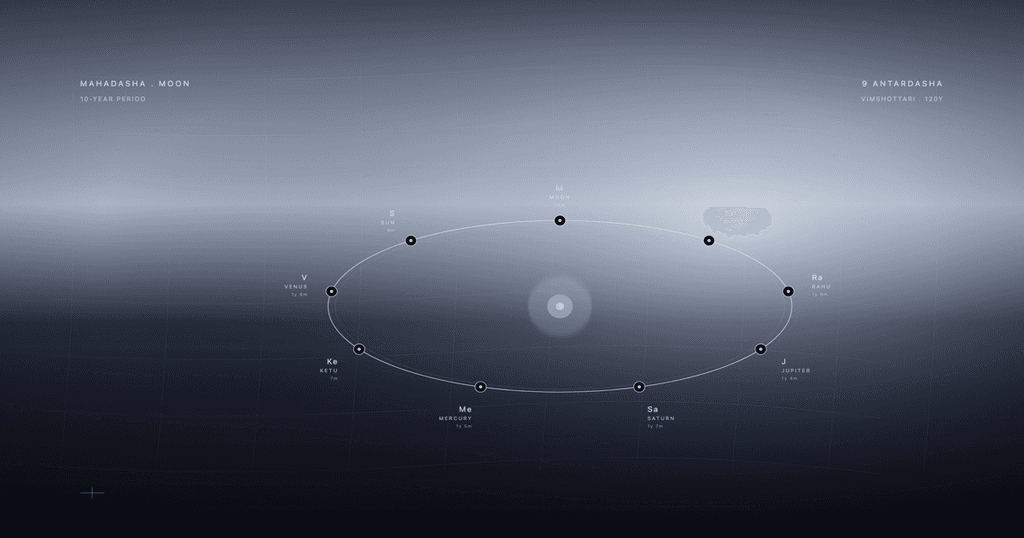
The 10-year Moon mahadasha divides into nine antardasha sub-periods in fixed Vimshottari order starting with Moon itself. The Mercury sub-period sits at position 6 of 9. Exact start and end dates for any chart can be computed from the natal Moon nakshatra-pada and the date of Moon mahadasha onset. The Tempora dasha engine produces this to the day.
The arithmetic of this period
With Mercury holding 17 of the 120 Vimshottari years, its share of the Moon's 10-year mahadasha comes to 10 x 17 / 120 = 1.42 years, which is 1 year 5 months. It stands sixth of nine. The five earlier sub-periods total 5 years 10 months (10 months, 7 months, 1 year 6 months, 1 year 4 months and 1 year 7 months in sequence order), so Moon-Mercury runs from 5 years 10 months to 7 years 3 months of the cycle, its later-middle stretch. Ketu, Venus and Sun follow it to the close of the decade.
An antardasha this deep into the cycle reads differently from the same pairing early on. By year six the Moon's themes have a track record, and Mercury's register arrives to name, document and trade on what the earlier sub-periods built, where an identical window at the top of a mahadasha would be drafting on a blank page. Mercury's full 17-year cycle is covered in the Mercury mahadasha overview.
Its neighbours sharpen its meaning. Saturn before it compressed and the short Ketu window after it will withdraw, so Moon-Mercury is the mahadasha's talkative middle passage, the stretch where the decade explains itself. The classical read follows Mercury's standing: well placed, in Gemini, its exalted Virgo or a kendra from the natal Moon, the 17 months favour writing, trade and agreements that hold. Poorly placed or combust, the same window scatters into unfinished conversations, the one-sided friendship of the pair surfacing as second-guessing between feeling and analysis.
How the source texts read this sub-period
In the BPHS antardasha chapters, Moon mahadasha section, a strong Mercury in a kendra or trikona, in own sign or at exaltation, is assigned wealth, royal recognition, shastra discussion, learning in learned company, children, business profits and gains of conveyances and ornaments. Counted from the dasha lord, a Mercury in a kendra, trikona, 11th or 2nd adds marriage, charity, closeness to power, pearls, corals and gems, good health and fine food. Debilitated or in the 6th, 8th or 12th from the dasha lord, the same Mercury is assigned body pains, agricultural losses, imprisonment and family distress.
Where Mercury carries 2nd or 7th lordship the text records fever-related cautions and prescribes Vishnu Sahasranama recitation and goat charity as remedial measures. Phaladeepika's bhukti chapter grants this pairing acquisition of wealth and animals along with happiness, a reading in step with the favourable Parashari branch. Inside the Tempora engine every one of these classical assignments functions as an input whose force is conditioned on the natal chart.
Friendship status and pairing reading
In the classical Parashari friendship matrix, Moon views Mercury as friend. The friend-pair classification means the 1 year 5 months sub-period classically delivers outcomes where Moon's register (mind, mother, emotional foundation, public reception and the cyclic register) and Mercury's register (intelligence, communication, commerce, writing and the youthful-skill register) integrate constructively. Events typically surface from both karaka domains in alignment rather than friction.
The Mercury karaka overlay
Mercury is the karaka of intelligence, communication, commerce, writing and the youthful-skill register. Across the 1 year 5 months sub-period, this karaka set overlays on top of Moon's 10-year mind, mother, emotional foundation, public reception and the cyclic register register. The combined reading is the central output of the sub-period.
How Mercury's natal dignity shapes the reading
Mercury's natal sign and house set the floor for the 1 year 5 months sub-period. Mercury at exaltation gives the strongest reading. Own-sign and mooltrikona placement gives clean expression. Debilitation introduces friction that the sub-period must work through. Combust and retrograde state, conjunctions with malefics or benefics and the dispositor's strength all further modulate the reading. See the Mercury mahadasha overview for the per-dignity breakdown.
Event classes typical to Moon-Mercury sub-period
The 1 year 5 months Moon mahadasha Mercury antardasha typically surfaces events across these specific domains:
- Constructive integration of Moon-register with Mercury-register: friend-pair sub-periods classically deliver outcomes where both planets' karakas align rather than friction.
- Events in Mercury's natural karaka domain: intelligence, communication, commerce, writing and the youthful-skill register.
- Events specific to the natal house Mercury occupies in the chart.
- Events where the Moon-mahalord and Mercury-antarlord houses (both natal and ruled) interact (aspect, mutual reception or natal conjunction).
Transit confirmation protocol
The sub-period reading sets a structural pressure floor of 1 year 5 months. Specific event timing inside that window requires the pratyantara (sub-sub-period) overlay and a transit cross-check.
Two transit overlays do most of the work. The standard targets to track: transit Moon aspecting natal Mercury, transit Mercury through the natal 3rd or 9th house, transit Saturn aspecting natal Mercury during a writing or commercial-deal phase, transit Mercury retrograde windows that frequently coincide with editing or contract-revision phases. These transits intensify the Moon-Mercury dynamic within the broader sub-period and concentrate event timing on those windows.
The pratyantara (sub-sub-period) inside the antardasha gives finer timing. The Moon-Mercury-Moon pratyantara (about 3 months 17 days) and the Moon-Mercury-Mercury pratyantara (about 3 months 27 days) carry the most concentrated articulation signal within the 27-month sub-period. The Moon-Mercury-Saturn pratyantara (about 4 months 9 days) reads as the formalisation window where written work gets institutional recognition. Cross-checking the pratyantara against the transit overlay gives event timing to the week. Tempora's dasha engine produces this data to the day for any chart.
What the framework does not predict
The Moon-Mercury reading is structural. It flags a 17-month window where the conditional probability of three named event classes lifts above chance, but it does not predict that any specific native will experience a specific event inside that window, nor the direction of any event that does fire.
A publication or commercial-expansion event during the sub-period can read as the turn that establishes the native's articulated voice or as a high-volume output phase whose individual pieces are forgotten; the broader chart determines durability. The framework times the pressure, not the result and timing finer than the antardasha band needs the pratyantara sequence and the transit overlay for the date in question.
How this connects to the broader Moon Mahadasha
The Moon-Mercury sub-period is the sixth antardasha inside the 10-year Moon Mahadasha. Reading the sub-period in isolation captures the 1 year 5 months; reading it inside the Mahadasha gives the broader arc that places the emotion meets articulation reading in its proper structural context.
The Tempora Moon Mahadasha method article covers the dispositor analysis, natal-house framework and the broader 6-year texture that this sub-period sits inside. The conditional probability framework holds across the full series: each antardasha is a flagged window for specific event classes whose probability is elevated relative to chance.
This period against the 2026 to 2028 sky
Mercury carries no dated event in the engine's 2026 to 2028 transit calendar, so the sky-side interest in this combination comes from the mahadasha lord. The solar eclipse of 12 August 2026 falls on the Cancer-Leo cusp, at the edge of the Moon's own sign, and classical practice treats an eclipse brushing a live dasha lord's sign as a window to observe with no verdict attached. A native running Moon-Mercury across August 2026 would weigh that eclipse against the natal chart first, since the house it strikes depends on the ascendant and the strength of natal Mercury sets the sub-period's floor regardless of any transit. The nodes then swap signs on 27 December 2026, with Ketu moving into Cancer until 15 July 2028, another touch on the mahadasha lord's sign that says nothing by itself about outcome. Whether any of these windows overlaps this antardasha at all is a per-chart fact, computed from the birth data.
Frequently asked questions
How long is the Moon Mahadasha Mercury Antardasha and where does it fall in the Vimshottari sequence?
The Moon Mahadasha Mercury Antardasha runs 1 year 5 months. It is the sixth antardasha inside the 10-year Moon Mahadasha, opening after the Moon-Saturn antardasha (1 year 7 months). The full sequence inside the Moon Mahadasha runs Moon-Moon, Moon-Mars, Moon-Rahu, Moon-Jupiter, Moon-Saturn, Moon-Mercury, Moon-Ketu, Moon-Venus and Moon-Sun. Exact start and end dates can be computed from the natal Moon nakshatra-pada and the date of Moon Mahadasha onset.
What does Mercury signify in this sub-period and why does it read as emotion meets articulation?
Mercury is the karaka of speech, intellect, commerce, business, writing, analysis, communication, education, youthful expression. During the broader Moon Mahadasha's mind and emotional-life reading, Mercury contributes the personal-expression overlay. The sub-period sits at the sixth position in the antardasha sequence and reads as the Moon mind and emotion register meeting Mercury's speech, intellect, commerce and analysis significations.
How does Mercury's natal dignity shape the Moon-Mercury sub-period reading?
Mercury's natal house, sign and aspectual state set the floor for the 17-month sub-period. Mercury exalted in Virgo, in own sign Gemini or Virgo or in angular houses (1st, 4th, 7th, 10th) softens the reading toward more auspicious outcomes. Mercury debilitated in Pisces introduces friction. Aspects from Saturn bring sustained structural pressure; aspects from Mars bring competitive or confrontational pressure.
What kinds of events historically correlate with the Moon-Mercury sub-period?
Three event classes correlate. Authorship and publication events: Books, long-form essays, formal teaching content, public-facing articulation milestones. The Moon-Mercury sub-period is the most concentrated authorship window in the entire 10-year Moon Mahadasha. Th. Business and commercial growth events: Contract signings, partnership deals, business expansion through communication, client acquisition, product or service launches that depend on messaging. Founders, advisors and commercial professional. Education milestones: Degrees awarded, formal courses completed, learning programmes entered or finished, scholarly publications. The Mercury student function activates inside Moon authority function, often producing the s. The framework reads these as a structural-pressure window for the event class, not a deterministic predictor.
How does this sub-period connect to the broader Moon Mahadasha?
The Moon-Mercury sub-period is the sixth antardasha inside the 10-year Moon Mahadasha. It opens after the Moon-Saturn antardasha (1 year 7 months). The sub-period reading is best held in tandem with the broader Moon Mahadasha reading from the Tempora Moon Mahadasha method article, which covers the natal house and dispositor framework that sets the texture of the full 16 years.
What does the Tempora framework not predict about this sub-period?
The framework identifies a structural-pressure window of approximately 1 year 5 months. It does not predict whether a specific native will experience a specific event in that window. It does not predict outcome direction. It does not predict timing finer than the sub-period band without overlaying the pratyantara (sub-sub-period) and the transit overlay for the date in question. The readings carry conventional weight from classical literature; the framework treats them as structural-pressure flags to cross-check against transit data.
When does the Mercury antardasha arrive inside the Moon mahadasha?
It is the sixth of nine sub-periods. The five before it sum to 5 years 10 months, so Moon-Mercury opens 5 years 10 months into the mahadasha and runs 1 year 5 months (10 x 17 / 120 years), closing at 7 years 3 months.
Is there any dated 2026 to 2028 transit that matters for Moon-Mercury?
Mercury itself has no dated event in the engine's calendar for that stretch. The Moon-side windows are the 12 August 2026 solar eclipse on the Cancer-Leo cusp and Ketu's move into Cancer on 27 December 2026, both touching the mahadasha lord's sign. Classical practice reads them as observation windows whose meaning depends on the ascendant and the natal chart, and whether they overlap this antardasha at all is computed per chart.
What do the classical texts say about Moon-Mercury?
The BPHS antardasha chapters, Moon mahadasha section, grant a strong Mercury wealth, royal recognition, learning, children and business profits, with marriage, charity and gems added when Mercury sits well from the dasha lord. Debilitated or in the 6th, 8th or 12th from the dasha lord, Mercury is assigned body pains, agricultural losses and family distress, and 2nd or 7th lordship carries fever-related cautions with Vishnu Sahasranama and goat charity prescribed. Phaladeepika's bhukti chapter lists acquisition of wealth and animals along with happiness, agreeing with the favourable branch. These assignments enter the engine as inputs conditioned on the natal chart.
Read next
- Mahadasha: the nine-period Vimshottari framework · the broader cluster this sub-period sits inside
- Moon Mahadasha Ketu Antardasha · the next sub-period in the Vimshottari sequence
- Venus Mahadasha Mercury Antardasha · the complementary sub-period in the prior Mahadasha
- Jupiter Mahadasha Mercury Antardasha · the same antardasha planet in a different Mahadasha
- Mahadasha and Vimshottari planetary periods · the full nine-period framework
- Calibrated lift: the discipline that turns Vedic astrology into research
This article represents conventional Vedic teaching and Tempora Research method documentation. It does not constitute financial, legal or professional advice. Internal audit log maintained.