Moon Mahadasha for Aquarius Ascendant: the 6th Lord's Ten Years in a Collective Chart
Aquarius rising is the collective sign, fixed air, ruled by Saturn. The Moon holds the 6th house of service, workload, health and open enemies here, and Saturn-Moon classical relationship is enmity. The ten-year Moon mahadasha for this ascendant reads through the 6th-house rulership, moderated by ascendant lord friendship and Moon's exaltation-in-Taurus and debilitation-in-Scorpio status.
Aquarius rising and Moon's 6th-house line
Lay out the whole-sign lordships first. From an Aquarius lagna: Saturn rules the 1st and 12th, Jupiter the 2nd and 11th, Mars the 3rd and 10th, Venus the 4th and 9th (yogakaraka for Aquarius), Mercury the 5th and 8th, the Moon the 6th, the Sun the 7th. Moon's line is clean single-house dusthana ownership. Saturn-Moon enmity is the caveat.
Moon as 6L for Aquarius risings with Saturn-Moon enmity gives the mahadasha a service-and-workload signature that runs against ascendant lord temperament. The ten years concentrate on service, competition, workload and health themes, but through emotionally-charged channels. The productive expression is Vipareeta Raja Yoga when Moon sits in own 6th house (Cancer) or in exalted Taurus in a dusthana. Public-service careers, medical practice, nursing, therapy and adversarial-work themes activate.
What Moon brings and what Moon takes here
Moon is the natural karaka of mother, mind, emotional register, water, food, milk, home, general public, women (in some contexts), memory and mental peace. Wherever Moon sits by house, those themes activate during Moon mahadasha, and the 6th-house rulership for Aquarius risings determines where they concentrate structurally.
Moon does not do well: matters requiring emotional detachment, matters requiring sustained intellectual precision without emotional register, matters requiring pure action without reflection, or matters requiring long silence without inner processing. These themes tend to stall during Moon mahadasha regardless of ascendant.
Walking the sub-periods
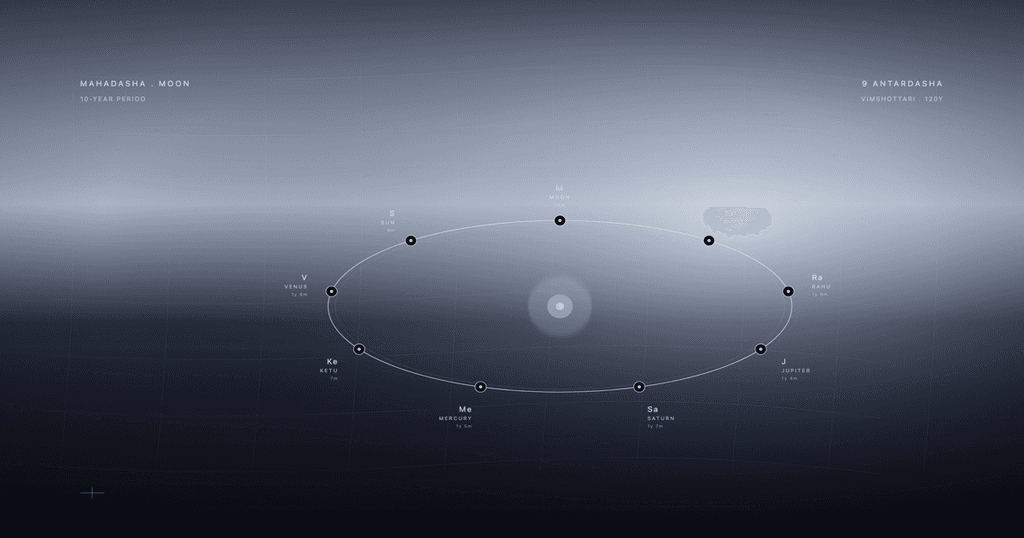
Nine antardashas fill the mahadasha in fixed order, Moon first. Durations are universal; the third column reads through Aquarius lagna's whole-sign lordships.
| Antardasha | Runs for | What the sub-lord owns from a Aquarius lagna |
|---|---|---|
| Moon-Moon | 0y 10m 0d | Sub-period lord's house rulership themes for Aquarius lagna. |
| Moon-Mars | 0y 7m 0d | Sub-period lord's house rulership themes for Aquarius lagna. |
| Moon-Rahu | 1y 6m 0d | Sub-period lord's house rulership themes for Aquarius lagna. |
| Moon-Jupiter | 1y 4m 0d | Sub-period lord's house rulership themes for Aquarius lagna. |
| Moon-Saturn | 1y 7m 0d | Sub-period lord's house rulership themes for Aquarius lagna. |
| Moon-Mercury | 1y 5m 0d | Sub-period lord's house rulership themes for Aquarius lagna. |
| Moon-Ketu | 0y 7m 0d | Sub-period lord's house rulership themes for Aquarius lagna. |
| Moon-Venus | 1y 8m 0d | Sub-period lord's house rulership themes for Aquarius lagna. |
| Moon-Sun | 0y 6m 0d | Sub-period lord's house rulership themes for Aquarius lagna. |
Sub-period sequence: Moon-Moon opens the mahadasha for 10 months, setting the ten-year tone. Moon-Venus (1 year 8 months) is the longest sub-period. Moon-Saturn (1 year 7 months) and Moon-Rahu (1 year 6 months) are the second-longest. Moon-Mars (7 months) and Moon-Ketu (7 months) are the two shortest.
Placements that help and placements that fight
Reasoning from lordships, the friendliest homes for natal Moon in a Aquarius-rising chart:
- 6th house (Cancer, own sign). Moon in own sign in the dusthana it rules. Vipareeta Raja Yoga configuration: workplace competition and enemies reverse in the native's favour.
- 4th house (Taurus, own exaltation). Moon exalted in Taurus in the home kendra disposited by yogakaraka Venus. Home compounds with exalted lord and yogakaraka.
- 9th house (Libra). Moon in Venus's air sign in the fortune trine disposited by yogakaraka Venus. Doctrine compounds with yogakaraka.
The placements that demand the most:
- 10th house (Scorpio, own debilitation). Moon debilitated in Scorpio in the career kendra. Career themes strain unless Neechabhanga fires.
- 12th house (Capricorn). Moon disposited by Saturn but in the loss house. Foreign expenditure runs the mahadasha.
- 2nd house (Pisces). Moon in Jupiter's water sign in the money maraka. Family finances take strain.
Each line above is a structural prior. A strong aspect, a benefic conjunction, Neechabhanga Raja Yoga or Vipareeta Raja Yoga formations, or a contrary divisional chart can outvote any of them.
Late 2026: transit hooks for Aquarius risings
Transit Moon completes the zodiac every 27 days, so a Aquarius rising native in Moon mahadasha receives a full Moon tour of the chart every month. The specific 2027 transit windows for this ascendant are mapped in Aquarius ascendant 2027. Broader nodal and Jupiter transits for the year are at 2027 by ascendant. Transit Jupiter reaches Leo on 19 June 2027, which from an Aquarius lagna is the 7th house of partnership. Moon mahadasha natives receive a signature that warms marriage and working alliances.
The limits of an ascendant-only reading
This page knows your rising sign and nothing else. It cannot see natal Moon's house or sign, the dignity of its dispositor, its companions, or Neechabhanga or Vipareeta formations that qualify all of them, and those unknowns are the majority of the reading. Nor can it see when the ten years run for you: that comes from the Moon's nakshatra at birth. A page like this describes the stage. It has not seen the play.
Vimshottari is one timing system among several that the tradition kept alive in parallel. Tempora's reasons for computing it first, and what the alternatives change, are set out in which dasha system.
Dates, tools and the scoreboard
To find where the Moon years fall in a specific life, start from the Vimshottari reference table, which carries the nakshatra-to-lord lookup. The Kaal engine runs the full computation from birth details, Swiss Ephemeris under the True Pushya Paksha ayanamsa, down to sub-sub-periods. Tempora's dated public calls built on this machinery sit on the tracker with falsifiers attached, because a timing method that cannot be scored is a mood, not a method.
Frequently asked
Why does Moon's 6th house rulership matter for Aquarius ascendant?
Because for Aquarius risings the Moon holds the 6th house governing service, workload, health and open enemies, and the ten-year Moon mahadasha runs those themes through the lunar register. Other ascendants receive Moon mahadasha through different houses, which changes the mahadasha's theme entirely. The 6th house is the structural centre for how a Aquarius rising experiences the ten years.
How long is Moon Mahadasha and how do the sub-periods split?
Moon Mahadasha is 10 years. The 9 antardashas run in fixed order starting with Moon: Moon (10 months), Mars (7 months), Rahu (1y 6m), Jupiter (1y 4m), Saturn (1y 7m), Mercury (1y 5m), Ketu (7 months), Venus (1y 8m), Sun (6 months). Each sub-period runs its own lord's house rulerships for the ascendant chart.
Is Moon mahadasha difficult for Aquarius ascendant?
Structurally more demanding than for Cancer or Libra because Moon rules the 6th house dusthana for Aquarius risings and Saturn (ascendant lord) is Moon's classical enemy. But Vipareeta Raja Yoga can fire strongly: when Moon sits in own 6th house (Cancer), or when Moon is exalted in Taurus (which is the 4th house kendra for Aquarius, though this is the exalted-in-kendra rather than Vipareeta configuration), the mahadasha can convert workplace competition to gains. Careers in healthcare, nursing, therapy, public service, medicine and adversarial work often activate constructively. Moon-Venus antardasha (1 year 8 months, Venus is yogakaraka for Aquarius) is the strongest sub-period.
How does natal Moon's dignity modulate Moon mahadasha for Aquarius ascendant?
Natal Moon's dignity is the single largest modulator across all ascendants. Exalted Moon (up to 3 degrees Taurus) runs the mahadasha at strongest expression. Moon in own sign (Cancer) is nearly as strong. Debilitated Moon (up to 3 degrees Scorpio) runs the mahadasha at weakest expression unless Neechabhanga Raja Yoga fires. Full Moon (paksha bala) is treated as a classical benefic; new Moon (dark fortnight) reads more as a natural malefic. Waxing versus waning fortnight of natal Moon significantly modulates the reading.
When will a Aquarius ascendant person enter Moon Mahadasha?
The ascendant has no say in it. The Vimshottari clock starts from the Moon's nakshatra at birth and runs the nine periods in fixed order, so the Moon years can fall in childhood, midlife or not at all within a lifetime. The dates come from the birth time and the Moon, which is why this page discusses structure and leaves timing to computation.
Which classical sources define Vimshottari and the Moon period?
Brihat Parashara Hora Shastra chapters 46 to 50 lay out the framework: the 120-year total, the nine planetary shares, the antardasha proportions and the nakshatra-to-starting-lord lookup. Phaladeepika by Mantreshwara adds per-planet interpretive depth. Tempora computes Vimshottari via Swiss Ephemeris under the True Pushya Paksha ayanamsa; the reasons are set out in the ayanamsa methodology page linked from the sidebar.
Read next
This article is a method reference for the Vimshottari Moon Mahadasha applied to Aquarius ascendant. The house-rulership map follows the standard Parashari (Brihat Parashara Hora Shastra chapters 46-50) framework. Yogakaraka identification follows the kendra-trine connection rule with lagna-lord override. Kendradhipati Dosha applies only to natural benefics. Antardasha durations are the standard Vimshottari proportional decomposition. Engine: Swiss Ephemeris with True Pushya Paksha (PVRN Rao) ayanamsa. Internal audit log maintained. This article does not constitute medical, financial, legal or professional advice. First published 2026-05-21 by Tempora Research.