Moon Mahadasha Venus Antardasha: the relationship and marriage window
The Moon holds Venus as a neutral while Venus counts the Moon among its enemies, a coolness on the antardasha lord's side that classical commentary ties to their rivalry over the feeling life: the Moon carries emotion as instinct, Venus carries it as taste. This sub-period opens after the 7-month Moon-Ketu withdrawal, and Venus's arrival turns the mahadasha back outward, toward partnership, comfort, art and the senses. By the Vimshottari constants it is the longest antardasha the Moon can host, a 20-of-120 share stretched across the decade's late years. The tradition gives Moon-Venus a rich, relational texture, appetite refined into aesthetics inside the Moon mahadasha.
Where the sub-period falls in the Vimshottari sequence
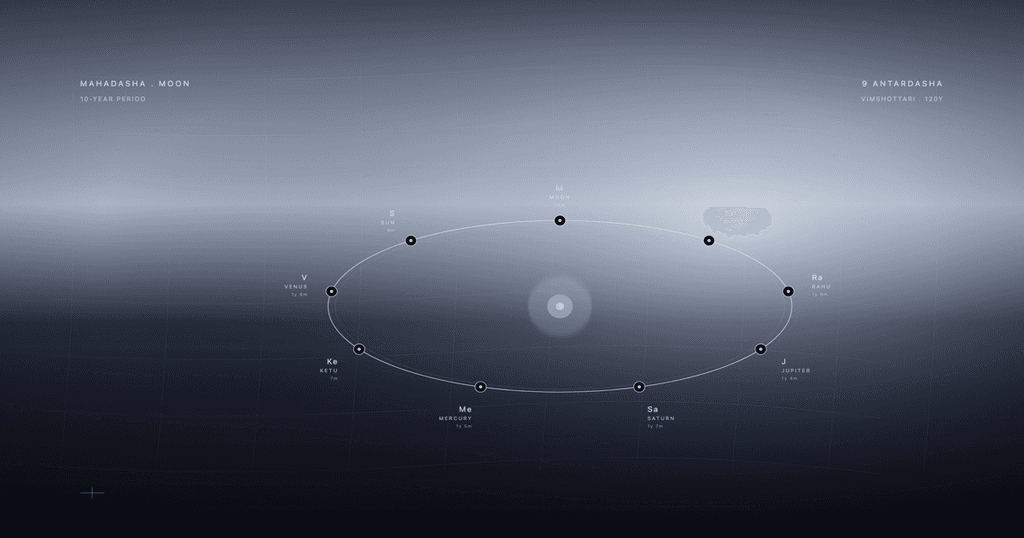
The 10-year Moon mahadasha divides into nine antardasha sub-periods in fixed Vimshottari order starting with Moon itself. The Venus sub-period sits at position 8 of 9. Exact start and end dates for any chart can be computed from the natal Moon nakshatra-pada and the date of Moon mahadasha onset. The Tempora dasha engine produces this to the day.
The arithmetic of this period
Venus holds 20 of the 120 Vimshottari years, so its share of the Moon's 10 is 10 x 20 / 120 = 1.67 years, which is 1 year 8 months, the longest of the nine sub-periods in this mahadasha. It stands eighth in sequence. The seven antardashas before it total 7 years 10 months, so Moon-Venus runs from 7 years 10 months to 9 years 6 months, occupying most of the mahadasha's final quarter. Only the Sun's 6 months separate its close from the end of the whole cycle.
Arriving that late gives the pairing a harvesting quality. A relational signature in years eight and nine works with an emotional decade nearly complete, settling and enjoying what earlier sub-periods assembled, where the identical window early in a cycle would be reaching for material that does not yet exist. Venus's own 20-year period has its treatment in the Venus mahadasha overview.
Its neighbours make the contrast plain. Ketu before it withdrew for 7 months and the Sun after it will close the decade in 6, so Venus holds the long late-cycle stretch between a renunciation and a signature. The classical tone follows Venus's seat: dignified in Taurus, Libra or its exalted Pisces, or friendly to the natal Moon's position, the 20 months lean toward marriage, partnership and material ease gathered without strain. A debilitated Venus in Virgo or one afflicted by malefics inclines the same span toward indulgence and relational friction, comfort pursued past its point of return.
The classical position on Moon-Venus
The BPHS antardasha chapters, Moon mahadasha section, give a well-placed Venus one of the richest lists in the Moon cycle. In a kendra, trikona, 11th, 4th or 9th, exalted or in own sign, the text assigns kingdom-like gain, clothes, ornaments, cattle, conveyances, construction of a new house, daily sweet food, romance and sound health, and a Venus in the 2nd at exaltation or own sign, or joined with the 11th lord, is even credited with hidden underground treasure, land and a son. Debilitated, combust or afflicted, the same Venus is assigned loss of landed property, children, wife and cattle with opposition from the state, while a placement in the 6th, 8th or 12th from the dasha lord adds sorrows, displacement and danger from thieves and snakes.
Where Venus rules the 2nd or 7th the section attaches health cautions and prescribes Rudra japa with charity of a white cow and silver. Phaladeepika's chapter on dasha sub-divisions assigns transactions in water-borne products and gold alongside gain of children and friends, a compact list agreeing with the favourable Parashari branch. Each of these classical readings enters the engine as an input, weighed against the dignity and placement of the natal Venus.
Friendship status and pairing reading
In the classical Parashari friendship matrix, Moon views Venus as neutral. The neutral-pair classification means the 1 year 8 months sub-period takes the colouring of the natal placement of both planets. Moon's register (mind, mother, emotional foundation, public reception and the cyclic register) and Venus's register (marriage, partnership, luxury, arts, comfort and aesthetic-relational refinement) can integrate constructively or friction-prone depending on the broader chart configuration.
The Venus karaka overlay
Venus is the karaka of marriage, partnership, luxury, arts, comfort and aesthetic-relational refinement. Across the 1 year 8 months sub-period, this karaka set overlays on top of Moon's 10-year mind, mother, emotional foundation, public reception and the cyclic register register. The combined reading is the central output of the sub-period.
How Venus's natal dignity shapes the reading
Venus's natal sign and house set the floor for the 1 year 8 months sub-period. Venus at exaltation gives the strongest reading. Own-sign and mooltrikona placement gives clean expression. Debilitation introduces friction that the sub-period must work through. Combust and retrograde state, conjunctions with malefics or benefics and the dispositor's strength all further modulate the reading. See the Venus mahadasha overview for the per-dignity breakdown.
Event classes typical to Moon-Venus sub-period
The 1 year 8 months Moon mahadasha Venus antardasha typically surfaces events across these specific domains:
- Configuration-dependent Moon-Venus integration: neutral-pair sub-periods take the colouring of the natal placement of both planets.
- Events in Venus's natural karaka domain: marriage, partnership, luxury, arts, comfort and aesthetic-relational refinement.
- Events specific to the natal house Venus occupies in the chart.
- Events where the Moon-mahalord and Venus-antarlord houses (both natal and ruled) interact (aspect, mutual reception or natal conjunction).
Transit confirmation protocol
The sub-period reading sets a structural pressure floor of 1 year 8 months. Specific event timing inside that window requires the pratyantara (sub-sub-period) overlay and a transit cross-check.
Two transit overlays do most of the work. The standard targets to track: transit Moon aspecting natal Venus, transit Venus through the natal 7th house, transit Moon or Venus through the natal 2nd house of wealth, transit Saturn through the natal 7th house. These transits intensify the Moon-Venus dynamic within the broader sub-period and concentrate event timing on those windows.
The pratyantara (sub-sub-period) inside the antardasha gives finer timing. The Moon-Venus-Moon pratyantara (about 4 months 8 days) and the Moon-Venus-Venus pratyantara (about 4 months 16 days) carry the most concentrated marriage and partnership signal within the 32-month sub-period. The Moon-Venus-Moon pratyantara (about 2 months 20 days) reads as the emotional-bonding window often associated with engagement or first-meeting events. Cross-checking the pratyantara against the transit overlay gives event timing to the week. Tempora's dasha engine produces this data to the day for any chart.
What the framework does not predict
The Moon-Venus reading is structural. It flags a 20-month window where the conditional probability of three named event classes lifts above chance, but it does not predict that any specific native will experience a specific event inside that window, nor the direction of any event that does fire.
A marriage or wealth event during the sub-period can read as the formal recognition of compatibility and accumulation built across the earlier Moon Mahadasha sub-periods or as a one-off event that does not predict the broader relationship texture; the chart's deeper compatibility analysis determines durability. The framework times the pressure, not the result and timing finer than the antardasha band needs the pratyantara sequence and the transit overlay for the date in question.
How this connects to the broader Moon Mahadasha
The Moon-Venus sub-period is the eighth antardasha inside the 10-year Moon Mahadasha. Reading the sub-period in isolation captures the 1 year 8 months; reading it inside the Mahadasha gives the broader arc that places the emotion meets pleasure reading in its proper structural context.
The Tempora Moon Mahadasha method article covers the dispositor analysis, natal-house framework and the broader 6-year texture that this sub-period sits inside. The conditional probability framework holds across the full series: each antardasha is a flagged window for specific event classes whose probability is elevated relative to chance.
This period against the 2026 to 2028 sky
Venus carries no dated event in the engine's 2026 to 2028 calendar, so the dated windows relevant to this combination arrive through the mahadasha lord. The solar eclipse of 12 August 2026 lands on the Cancer-Leo cusp at the edge of the Moon's own sign, and classical practice logs an eclipse against a live dasha lord's sign as a window worth watching with no verdict implied. From 27 December 2026 Ketu occupies Cancer until 15 July 2028, keeping a nodal presence in the mahadasha lord's sign through much of that stretch. For a native actually running Moon-Venus across those dates the reading stays chart-first: the houses depend on the ascendant, natal Venus sets the sub-period's floor and transit context can sharpen a flagged window without creating one. Whether an individual's 20-month antardasha touches these dates at all is computed from the birth chart, never assumed from the calendar.
Frequently asked questions
How long is the Moon Mahadasha Venus Antardasha and where does it fall in the Vimshottari sequence?
The Moon Mahadasha Venus Antardasha runs 1 year 8 months. It is the eighth antardasha inside the 10-year Moon Mahadasha, opening after the Moon-Ketu antardasha (7 months). The full sequence inside the Moon Mahadasha runs Moon-Moon, Moon-Mars, Moon-Rahu, Moon-Jupiter, Moon-Saturn, Moon-Mercury, Moon-Ketu, Moon-Venus and Moon-Sun. Exact start and end dates can be computed from the natal Moon nakshatra-pada and the date of Moon Mahadasha onset.
What does Venus signify in this sub-period and why does it read as emotion meets pleasure?
Venus is the karaka of pleasure, relationships, art, beauty, wealth, vehicles, comfort, marriage, partnership, aesthetic refinement. During the broader Moon Mahadasha's mind and emotional-life reading, Venus contributes the relationship-pleasure overlay. The sub-period sits at the eighth position in the antardasha sequence and reads as the Moon emotion and home register meeting Venus's pleasure, beauty, marriage, art and ceremonial significations.
How does Venus's natal dignity shape the Moon-Venus sub-period reading?
Venus's natal house, sign and aspectual state set the floor for the 20-month sub-period. Venus exalted in Pisces, in own sign Taurus or Libra or in angular houses (1st, 4th, 7th, 10th) softens the reading toward more auspicious outcomes. Venus debilitated in Virgo introduces friction. Aspects from Saturn bring sustained structural pressure; aspects from Mars bring competitive or confrontational pressure.
What kinds of events historically correlate with the Moon-Venus sub-period?
Three event classes correlate. Marriage and partnership events: Engagement, marriage, formal partnership commitments, significant relationship transitions. The Moon-Venus sub-period is the highest-conditional-probability marriage window in the Moon Mahadasha. The . Wealth and beauty-domain events: Wealth accumulation through arts, design, hospitality, fashion or luxury services. Vehicle purchases. Jewellery acquisition. Real-estate-as-comfort decisions. The texture is accumulation through Venus. Children events: Conception, pregnancy, childbirth, formal recognition of children (adoption, naming ceremonies, education milestones for existing children). The Moon putra-karaka signification combined with Venus rel. The framework reads these as a structural-pressure window for the event class, not a deterministic predictor.
How does this sub-period connect to the broader Moon Mahadasha?
The Moon-Venus sub-period is the eighth antardasha inside the 10-year Moon Mahadasha. It opens after the Moon-Ketu antardasha (7 months). The sub-period reading is best held in tandem with the broader Moon Mahadasha reading from the Tempora Moon Mahadasha method article, which covers the natal house and dispositor framework that sets the texture of the full 16 years.
What does the Tempora framework not predict about this sub-period?
The framework identifies a structural-pressure window of approximately 1 year 8 months. It does not predict whether a specific native will experience a specific event in that window. It does not predict outcome direction. It does not predict timing finer than the sub-period band without overlaying the pratyantara (sub-sub-period) and the transit overlay for the date in question. The readings carry conventional weight from classical literature; the framework treats them as structural-pressure flags to cross-check against transit data.
Which stretch of the Moon mahadasha does the Venus antardasha occupy?
The eighth of nine positions, from 7 years 10 months to 9 years 6 months after the mahadasha opens. Its 1 year 8 months (10 x 20 / 120 years) make it the longest sub-period inside the Moon mahadasha.
Are there dated 2026 to 2028 transits that touch a Moon-Venus antardasha?
None belong to Venus itself in the engine's calendar. The Moon-side dates are the 12 August 2026 solar eclipse on the Cancer-Leo cusp and Ketu's stay in Cancer from 27 December 2026 to 15 July 2028, both touching the mahadasha lord's sign. Classical practice treats them as observation windows conditioned by the ascendant and the natal chart, and the overlap with any individual's antardasha is a computed fact.
What do the classical texts say about Moon-Venus?
The BPHS antardasha chapters, Moon mahadasha section, give a well-placed Venus kingdom-like gain, a new house, conveyances, romance and sound health, with hidden treasure and a son credited to a strong Venus in the 2nd. A debilitated or afflicted Venus is assigned loss of property and family distress, and Venus ruling the 2nd or 7th carries health cautions with Rudra japa and charity prescribed. Phaladeepika's chapter on dasha sub-divisions lists transactions in water-borne products and gold with gain of children and friends, in step with the favourable branch. The engine takes each reading as an input conditioned on the natal Venus.
Read next
- Mahadasha: the nine-period Vimshottari framework · the broader cluster this sub-period sits inside
- Moon Mahadasha Sun Antardasha · the next sub-period in the Vimshottari sequence
- Venus Mahadasha Venus Antardasha · the complementary sub-period in the prior Mahadasha
- Jupiter Mahadasha Venus Antardasha · the same antardasha planet in a different Mahadasha
- Mahadasha and Vimshottari planetary periods · the full nine-period framework
- Calibrated lift: the discipline that turns Vedic astrology into research
This article represents conventional Vedic teaching and Tempora Research method documentation. It does not constitute financial, legal or professional advice. Internal audit log maintained.