Jupiter Mahadasha Venus Antardasha: the wisdom-refinement and benefic-pairing sub-period
Venus takes the fifth sub-period of the 16-year Jupiter mahadasha, arriving after the 11 months 6 days of the Ketu antardasha have thinned the native's attachments, and its arrival reverses the current: where Ketu subtracted, Venus restores the world of partnership, comfort, art and pleasure across a full 2 years 8 months, the longest sub-period the Jupiter mahadasha contains. The two great benefics are nonetheless uneasy company in the Parashari matrix, Jupiter counting Venus an enemy while Venus holds Jupiter as neutral, the preceptor of the devas and the preceptor of the asuras keeping formal distance. Tradition therefore reads the pairing double, abundance, marriage and refinement on the surface with a quiet contest underneath over whether enjoyment serves dharma or distracts from it. Natal Venus arbitrates that contest, and everything here is classical texture rather than a measured result.
Where the sub-period falls in the Vimshottari sequence
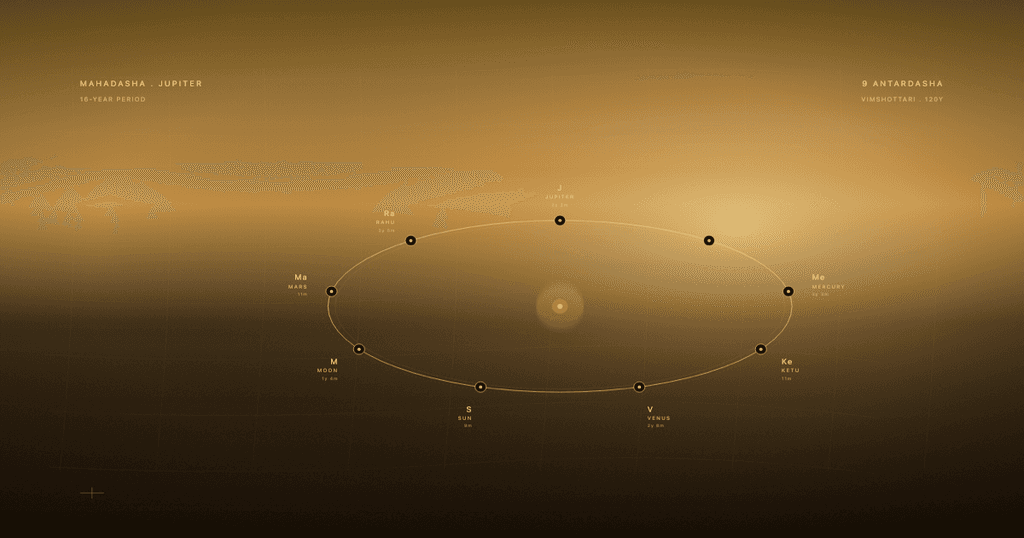
The 16-year Jupiter mahadasha divides into nine antardasha sub-periods in fixed Vimshottari order starting with Jupiter itself. The Venus sub-period sits at position 5 of 9. Exact start and end dates for any chart can be computed from the natal Moon nakshatra-pada and the date of Jupiter mahadasha onset. The Tempora dasha engine produces this to the day.
Classical Two-Great-Benefics Pairing pairing
Jupiter and Venus together carry both great-benefic registers but are classical enemies (dharmic-teacher vs aesthetic-teacher mythological tension). The Venus antardasha inside Jupiter mahadasha produces visible-public expansion events: marriage with dharmic register, luxury-with-blessing, aesthetic-philosophical integration.
Friendship status and pairing reading
In the classical Parashari friendship matrix, Jupiter views Venus as enemy. The enemy-pair classification means the 2 years 8 months sub-period classically delivers outcomes through friction between Jupiter's register (wisdom, dharma, children, expansion, teaching and the dignified-blessing register) and Venus's register (marriage, partnership, luxury, arts, comfort and aesthetic-relational refinement). Classical guidance suggests sustained-effort and patience over decisive-action during enemy-pair sub-periods. Events surface through the friction rather than around it.
The Venus karaka overlay
Venus is the karaka of marriage, partnership, luxury, arts, comfort and aesthetic-relational refinement. Across the 2 years 8 months sub-period, this karaka set overlays on top of Jupiter's 16-year wisdom, dharma, children, expansion, teaching and the dignified-blessing register register. The combined reading is the central output of the sub-period.
How Venus's natal dignity shapes the reading
Venus's natal sign and house set the floor for the 2 years 8 months sub-period. Venus at exaltation gives the strongest reading. Own-sign and mooltrikona placement gives clean expression. Debilitation introduces friction that the sub-period must work through. Combust and retrograde state, conjunctions with malefics or benefics and the dispositor's strength all further modulate the reading. See the Venus mahadasha overview for the per-dignity breakdown.
Event classes typical to Jupiter-Venus sub-period
The 2 years 8 months Jupiter mahadasha Venus antardasha typically surfaces events across these specific domains:
- Friction between Jupiter-register and Venus-register: enemy-pair sub-periods classically require careful navigation. Events surface through the friction rather than around it.
- Activation of Two-Great-Benefics Pairing (where the natal configuration supports it).
- Events in Venus's natural karaka domain: marriage, partnership, luxury, arts, comfort and aesthetic-relational refinement.
- Events specific to the natal house Venus occupies in the chart.
- Events where the Jupiter-mahalord and Venus-antarlord houses (both natal and ruled) interact (aspect, mutual reception or natal conjunction).
Transit confirmation protocol
The sub-period reading sets a structural pressure floor of 2 years 8 months. Specific event timing inside that window requires the pratyantara (sub-sub-period) overlay and a transit cross-check.
Two transit overlays do most of the work. The standard targets to track: transit Jupiter aspecting natal Venus, transit Venus through the natal 7th house, transit Jupiter or Venus through the natal 2nd house of wealth, transit Saturn through the natal 7th house. These transits intensify the Jupiter-Venus dynamic within the broader sub-period and concentrate event timing on those windows.
The pratyantara (sub-sub-period) inside the antardasha gives finer timing. The Jupiter-Venus-Jupiter pratyantara (about 4 months 8 days) and the Jupiter-Venus-Venus pratyantara (about 4 months 16 days) carry the most concentrated marriage and partnership signal within the 32-month sub-period. The Jupiter-Venus-Moon pratyantara (about 2 months 20 days) reads as the emotional-bonding window often associated with engagement or first-meeting events. Cross-checking the pratyantara against the transit overlay gives event timing to the week. Tempora's dasha engine produces this data to the day for any chart.
What the framework does not predict
The Jupiter-Venus reading is structural. It flags a 32-month window where the conditional probability of three named event classes lifts above chance, but it does not predict that any specific native will experience a specific event inside that window, nor the direction of any event that does fire.
A marriage or wealth event during the sub-period can read as the formal recognition of compatibility and accumulation built across the earlier Jupiter Mahadasha sub-periods or as a one-off event that does not predict the broader relationship texture; the chart's deeper compatibility analysis determines durability. The framework times the pressure, not the result and timing finer than the antardasha band needs the pratyantara sequence and the transit overlay for the date in question.
How this connects to the broader Jupiter Mahadasha
The Jupiter-Venus sub-period is the fifth antardasha inside the 16-year Jupiter Mahadasha. Reading the sub-period in isolation captures the 2 years 8 months; reading it inside the Mahadasha gives the broader arc that places the wisdom meets refinement reading in its proper structural context.
The Tempora Jupiter Mahadasha method article covers the dispositor analysis, natal-house framework and the broader 20-year texture that this sub-period sits inside. The conditional probability framework holds across the full series: each antardasha is a flagged window for specific event classes whose probability is elevated relative to chance.
The arithmetic of this period
The length falls out of the constants. Venus holds 20 years of the 120-year cycle, the largest share of any lord, and Jupiter holds 16, so the antardasha runs 16 x 20 / 120 = 2.667 years, exactly 2 years 8 months, the longest of the nine sub-periods in this mahadasha.
Four sub-periods precede it: Jupiter's own at about 2 years 2 months, Saturn at 2 years 6 months, Mercury at 2 years 3 months and Ketu at 11 months, together about 7 years 10 months. The Venus antardasha therefore spans roughly years 7.9 to 10.5 of the Jupiter mahadasha, sitting astride the exact midpoint at year 8.
Straddling the middle is its own reading. This window neither inherits a fresh period nor closes one; it receives a mahadasha at full maturity, after Saturn's consolidation and Mercury's commerce and Ketu's pruning, and holds it through the turn of its second half. Classical readers note the neighbour contrast as well: eleven ascetic months of Ketu directly before, the brief solar spotlight of the Sun antardasha directly after, with these 2 years 8 months of accumulation and enjoyment stretched between renunciation and recognition. Position, as much as lordship, is why the same Venus reads differently here than at the edge of a period.
How the source texts read this combination
For this sub-period the BPHS antardasha chapters, Jupiter mahadasha section, tie the outcome to Venus's placement: in a kendra, trikona or the 11th or else in own sign under benefic aspect, the text assigns palanquin and elephant conveyances, royal wealth, extraordinary income from eastward journeys, family wellbeing and works of charity such as reservoir building. A specific co-presence warning follows, for a Venus joined by Saturn or Rahu is linked to quarrels, danger from the king, friction with the wife and disputes with in-laws and brothers. Measured from the dasha lord, Venus in a kendra, trikona or the 2nd is credited with marital happiness, audience with the king, music, learned company and sweet food. Where Venus rules the 2nd or the 7th the chapter appends health cautions along with a remedial charity of a tawny cow or buffalo. Phaladeepika's bhukti chapter runs in the same favourable direction here, naming ample material acquisition, devotion and worship of God, so the two texts agree on this pairing more cleanly than on most. The engine reads all of this as classical input and lets the natal Venus decide how much of it applies.
This period against the 2026 to 2028 sky
Venus has no dated event in the engine's 2026 to 2028 calendar, so the transit story for this combination belongs to the mahadasha lord alone, and it is a long arc rather than a single date. Jupiter is exalted in Cancer for its full stay from 27 May 2026, tastes Leo from 23 October 2026 to 3 February 2027, settles in Leo from 19 June 2027 and first touches Virgo from 18 November 2027 to 9 March 2028.
For a native running the Jupiter-Venus antardasha through those years the classical reading tilts with the arc. The Cancer phase dignifies the period lord and is read as softening the enemy-pair friction, blessing arriving faster than the contest underneath it. The Virgo phase places Jupiter in the sign of Venus's classical debilitation, a transit echo of the pairing's tension, and would be read as the stretch where enjoyment gets audited. Each claim carries its limitation in the same breath: these are sign-level placements shared by every chart alive, an exalted transit Jupiter cannot repair a weak natal Venus, and the antardasha is finally read from the birth chart alone.
The natal fork is wide in this combination. Venus dignified, exalted in Pisces, in own Taurus or Libra, gives the classical best case, marriage and wealth and art with dharmic sanction, the enemy-pair friction resolving into complementary registers. Venus debilitated in Virgo or afflicted gives the harder telling, comfort pursued against counsel and partnerships that flatter rather than nourish. The sub-lord's dignities are covered in the Venus mahadasha overview.
Frequently asked questions
How long is the Jupiter Mahadasha Venus Antardasha and where does it fall in the Vimshottari sequence?
The Jupiter Mahadasha Venus Antardasha runs 2 years 8 months. It is the fifth antardasha inside the 16-year Jupiter Mahadasha, opening after the Jupiter-Ketu antardasha (11 months 6 days). The full sequence inside the Jupiter Mahadasha runs Venus-Venus, Venus-Sun, Venus-Moon, Venus-Mars, Venus-Rahu, Venus-Jupiter, Venus-Saturn, Venus-Mercury and Venus-Ketu. Exact start and end dates can be computed from the natal Moon nakshatra-pada and the date of Jupiter Mahadasha onset.
What does Venus signify in this sub-period and why does it read as wisdom meets refinement?
Venus is the karaka of pleasure, relationships, art, beauty, wealth, vehicles, comfort, marriage, partnership, aesthetic refinement. During the broader Jupiter Mahadasha's pleasure, relationship and refinement reading, Venus contributes the benefic-pairing overlay. The sub-period sits at the fifth position in the antardasha sequence and reads as the Jupiter dharma and expansion register meeting Venus's pleasure, relationship, refinement and wealth.
How does Venus's natal dignity shape the Jupiter-Venus sub-period reading?
Venus's natal house, sign and aspectual state set the floor for the 32-month sub-period. Venus exalted in Pisces, in own sign Taurus or Libra or in angular houses (1st, 4th, 7th, 10th) softens the reading toward more auspicious outcomes. Venus debilitated in Virgo introduces friction. Aspects from Saturn bring sustained structural pressure; aspects from Mars bring competitive or confrontational pressure.
What kinds of events historically correlate with the Jupiter-Venus sub-period?
Three event classes correlate. Marriage and partnership events: Engagement, marriage, formal partnership commitments, significant relationship transitions. The Jupiter-Venus sub-period is the highest-conditional-probability marriage window in the Jupiter Mahadasha. Wealth and beauty-domain events: Wealth accumulation through arts, design, hospitality, fashion or luxury services. Vehicle purchases. Jewellery acquisition. Real-estate-as-comfort decisions. The texture is accumulation through Venus. Children events: Conception, pregnancy, childbirth, formal recognition of children (adoption, naming ceremonies, education milestones for existing children). The Jupiter putra-karaka signification combined with Venus . The framework reads these as a structural-pressure window for the event class, not a deterministic predictor.
How does this sub-period connect to the broader Jupiter Mahadasha?
The Jupiter-Venus sub-period is the fifth antardasha inside the 16-year Jupiter Mahadasha. It opens after the Jupiter-Ketu antardasha (11 months 6 days). The sub-period reading is best held in tandem with the broader Jupiter Mahadasha reading from the Tempora Jupiter Mahadasha method article, which covers the natal house and dispositor framework that sets the texture of the full 16 years.
What does the Tempora framework not predict about this sub-period?
The framework identifies a structural-pressure window of approximately 2 years 8 months. It does not predict whether a specific native will experience a specific event in that window. It does not predict outcome direction. It does not predict timing finer than the sub-period band without overlaying the pratyantara (sub-sub-period) and the transit overlay for the date in question. The readings carry conventional weight from classical literature; the framework treats them as structural-pressure flags to cross-check against transit data.
Why is the Venus antardasha the longest sub-period in the Jupiter mahadasha?
Because antardasha length is proportional to the sub-lord's share of the 120-year cycle and Venus holds the largest share, 20 years. The computation is 16 x 20 / 120 = 2.667 years, exactly 2 years 8 months, ahead of Saturn's 2 years 6 months 12 days and Rahu's 2 years 4 months 24 days. Summing the four prior sub-periods, about 7 years 10 months, places the window at roughly years 7.9 to 10.5, astride the mahadasha's midpoint.
How does Jupiter's transit arc from Cancer to Virgo bear on a Jupiter-Venus antardasha?
The arc tilts the classical reading across the window. Jupiter exalted in Cancer from 27 May 2026 dignifies the mahadasha lord and is read as easing the enemy-pair friction, while the Virgo taste from 18 November 2027 to 9 March 2028 puts Jupiter in the sign of Venus's debilitation, echoing the pairing's underlying tension. Both are background conditions shared by every chart in those months, so they shade the reading rather than decide it; the natal Venus remains the deciding factor.
What do the classical texts say about Jupiter-Venus?
The BPHS antardasha chapters, Jupiter mahadasha section, grant a well placed Venus conveyances, royal wealth, family wellbeing and charitable works, warn specifically about Venus joined by Saturn or Rahu and attach health cautions with remedies where Venus rules the 2nd or 7th. Phaladeepika's bhukti chapter concurs, listing ample acquisition, devotion and worship of God. Agreement between the texts is comparatively clean here and the engine treats their shared verdict as an input weighted by the natal Venus.
Read next
- Jupiter Mahadasha: how to read the 20-year period · the broader Mahadasha this sub-period sits inside
- Jupiter Mahadasha Sun Antardasha · the next sub-period in the Vimshottari sequence
- Ketu Mahadasha Venus Antardasha · the complementary sub-period in the prior Mahadasha
- Mahadasha and Vimshottari planetary periods · the full nine-period framework
- Calibrated lift: the discipline that turns Vedic astrology into research
This article represents conventional Vedic teaching and Tempora Research method documentation. It does not constitute financial, legal or professional advice. Internal audit log maintained.