Rahu Mahadasha Mars Antardasha: 1.05 years and the classical malefic stack
Mars antardasha inside Rahu runs 1.05 years and is the ninth and final sub-period of the 18-year Rahu Mahadasha. Mars and Rahu are both classical malefics; the sub-period carries the most-intense friction signature of the Mahadasha. What the classical reading actually claims, how natal Mars dignity modulates it and where the framework reads structural-pressure versus where it does not predict.
Mars closes the Rahu mahadasha. Its 1.05-year antardasha is the ninth and final sub-period, following the introspective Moon window and preceding the handover to the 16-year Jupiter mahadasha, which opens with Jupiter running its own sub-period. The classical matrix counts Rahu and Mars as enemies, and their pairing carries a named charge, the Angarak signature, in which the node's amplification meets the planet of force and the result runs hot. Tradition reads a closing enemy sub-period as the cycle's unfinished business surfacing as action: disputes pressed, breaks made, physical and competitive matters demanding settlement before the ledger changes hands. The texture is abrupt by design, an eighteen-year arc ending on its most kinetic note.
Where the sub-period falls in the Vimshottari sequence
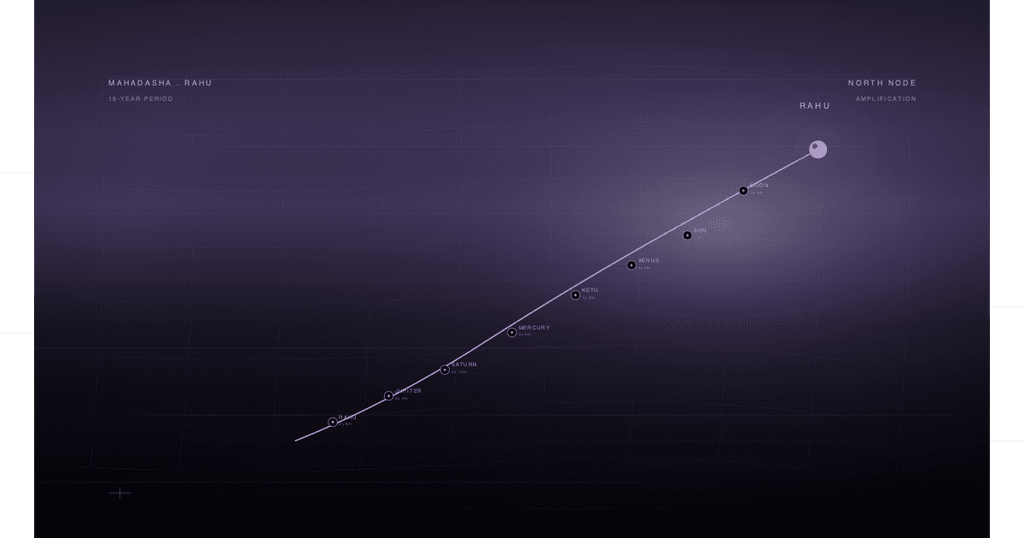
The 18-year Rahu mahadasha divides into nine antardasha sub-periods in fixed Vimshottari order starting with Rahu itself. The Mars sub-period sits at position 9 of 9. Exact start and end dates for any chart can be computed from the natal Moon nakshatra-pada and the date of Rahu mahadasha onset. The Tempora dasha engine produces this to the day.
Classical Angarak Yoga pairing
Mars-Rahu conjunction produces the Angarak Yoga, classically read as concentrated-action under amplification. The Mars antardasha inside Rahu mahadasha activates this configuration. This signature carries calibrated weight on national charts: 5.46x on Russia 1991 chart (under recalibration per 2026-05-09 audit).
Friendship status and pairing reading
In the classical Parashari friendship matrix, Rahu views Mars as enemy. The enemy-pair classification means the 1 year 18 days sub-period classically delivers outcomes through friction between Rahu's register (worldly desire, foreign-axis, amplification, taboo and the boundary-crossing register) and Mars's register (action, courage, brothers, surgery, property and the warrior register). Classical guidance suggests sustained-effort and patience over decisive-action during enemy-pair sub-periods. Events surface through the friction rather than around it.
The Mars karaka overlay
Mars is the karaka of action, courage, brothers, surgery, property and the warrior register. Across the 1 year 18 days sub-period, this karaka set overlays on top of Rahu's 18-year worldly desire, foreign-axis, amplification, taboo and the boundary-crossing register register. The combined reading is the central output of the sub-period.
How Mars's natal dignity shapes the reading
Mars's natal sign and house set the floor for the 1 year 18 days sub-period. Mars at exaltation gives the strongest reading. Own-sign and mooltrikona placement gives clean expression. Debilitation introduces friction that the sub-period must work through. Combust and retrograde state, conjunctions with malefics or benefics and the dispositor's strength all further modulate the reading. See the Mars mahadasha overview for the per-dignity breakdown.
Event classes typical to Rahu-Mars sub-period
The 1 year 18 days Rahu mahadasha Mars antardasha typically surfaces events across these specific domains:
- Friction between Rahu-register and Mars-register: enemy-pair sub-periods classically require careful navigation. Events surface through the friction rather than around it.
- Activation of Angarak Yoga (where the natal configuration supports it).
- Events in Mars's natural karaka domain: action, courage, brothers, surgery, property and the warrior register.
- Events specific to the natal house Mars occupies in the chart.
- Events where the Rahu-mahalord and Mars-antarlord houses (both natal and ruled) interact (aspect, mutual reception or natal conjunction).
What the framework does not predict
The framework reads structural pressure on the action-and-conflict axis. It does not predict that a specific native will experience a specific accident, conflict event or surgical intervention on a specific date inside the 1.05-year band.
It does not predict outcome direction. Whether a conflict that fires resolves favourably or unfavourably, whether a surgical intervention succeeds, whether a legal dispute settles in the native's favour, is not specified by the structural-pressure reading. The chart times the pressure; the actor decides the form and the broader environment decides the outcome.
It does not predict timing finer than the sub-period band. The 1.05-year duration can be subdivided into pratyantara (third-level) sub-periods for finer timing and the pratyantara overlay plus the transit cross-check is needed for date-specific event identification. The mahadasha-antardasha reading alone gives a window, not a date.
The classical readings carry historical and conventional weight. The framework treats them as structural-pressure flags to be cross-checked against transit data, dasha context and natal-dignity modulation. The combination of factors produces a specific reading for any specific chart. The general framework gives the window; the specific chart produces the form.
How Rahu-Mars closes the Rahu Mahadasha
Rahu-Mars is the closing sub-period of the 18-year Rahu Mahadasha. The native has been through the foundational Rahu-Rahu identity-reset phase, the Rahu-Jupiter Guru-Chandala friction, the Rahu-Saturn structural contraction, the Rahu-Mercury commerce amplification, the Rahu-Ketu dissolution, the Rahu-Venus partnership and luxury amplification, the Rahu-Sun authority-axis pressure and the Rahu-Moon emotional-axis processing. Rahu-Mars closes the cycle with action-and-completion events.
The classical pattern reads the closing sub-period of any Mahadasha as carrying the resolution events that close out themes opened earlier. For Rahu Mahadasha specifically, this often expresses as the action-axis events that complete the foreign-element, boundary-crossing or unconventional patterns the Mahadasha established. A native who built an unconventional career during the Mahadasha may close it with the decisive consolidation event in Rahu-Mars. A native who navigated international moves during the Mahadasha may close it with the final relocation or return event. The pattern is closing-action rather than opening-pattern, which gives the sub-period a distinct character from the same Mars sub-period in other Mahadashas.
The transition out of Rahu Mahadasha opens Jupiter Mahadasha, which runs 16 years on a fundamentally different structural pattern. Jupiter is the natural benefic of the Vedic system, the karaka of expansion, wisdom and dharma. The Rahu-to-Jupiter Mahadasha transition is one of the most significant in the Vimshottari cycle because it shifts the chart from amplification-axis pressure to expansion-axis support. The closing Rahu-Mars sub-period often produces the events that mark this transition, with the new pattern of Jupiter Mahadasha registering in the months after Rahu-Mars closes.
The arithmetic of this period
Mars holds 7 of the 120 Vimshottari years, giving 18 multiplied by 7 divided by 120: 1.05 years, about 1 year and 1 month. As position 9 of 9 it needs no forward sum, only the total behind it: the eight prior sub-periods account for 16.95 years, so Mars runs from roughly year 16.95 to the mahadasha's end at year 18. The adjacency tells the story of the close, with the reflective 1.5-year Moon antardasha before it and the Jupiter-Jupiter opening of the next mahadasha after it, so the native passes from feeling to action to counsel across barely three years.
A final antardasha lands on a life stage no earlier sub-period sees: eighteen years of nodal direction are complete, and whatever Mars ignites here is worked out under the incoming lord. The classical writers pay the junction special attention, since dasha-sandhi, the seam between two major periods, is held to blur the closing and opening sub-periods into one transitional passage. The outgoing cycle is mapped in the Rahu mahadasha overview; Mars running a full 7-year major period of its own, a different proposition from this compressed close, is covered in the Mars mahadasha article.
BPHS and Phaladeepika on this period
In the BPHS antardasha chapters, Rahu mahadasha section, the Mars sub-period turns on placement: a Mars in the third, fifth, ninth, eleventh or a kendra, benefic-aspected or in exaltation or own sign, is assigned recovery of lost position and wealth, growth of property and agriculture, the blessing of the household deity, happiness from children and good food. Counted from the dasha lord, Mars in a kendra or in the third, fifth, ninth or eleventh brings red garments, journeys, audience with the king, command of an army and wealth arriving through kin. The adverse branch carries its own condition, with Mars in the sixth, eighth or twelfth from the dasha lord under malefic aspect given distress to wife, children and siblings, loss of position, theft danger, wounds and body pain. Where Mars holds lordship of the second or seventh house the text attaches health cautions and prescribes charity of a cow or bull as remedy. Phaladeepika, in its chapter on the sub-divisions of dashas, reads the period through danger from the king, threats of fire and weapons and severe disease, wording that shadows the Parashari adverse branch. The engine ingests both positions as conditional inputs and lets the natal Mars determine which branch carries weight.
This period against the 2026 to 2028 sky
Mars has no dated entry in the engine's 2026 to 2028 calendar, so the pairing's sky relevance in this span runs through the mahadasha lord alone. Rahu's ingress from Aquarius into Capricorn on 27 December 2026, with Ketu crossing into Cancer opposite, re-sets the nodal terrain until 15 July 2028; a native whose closing Mars sub-period overlaps those months sees the departing major lord change signs even as its long period winds down. Classical reading locates the effect through the houses Capricorn and Cancer occupy from the natal ascendant, and notes one flavour specific to this pairing: Capricorn is Mars's sign of exaltation, so the node finishing its cycle from the antardasha lord's strongest sign is at least a coherent image for a directed close. The limitation deserves equal weight, since a nodal ingress happens for every chart on earth at the same instant, and whether it overlaps any particular native's Rahu-Mars is a fact about that chart's clock, established only by computing it. Natal Mars decides the register regardless of the transit: exalted in Capricorn or strong in its own Aries or Scorpio it closes the mahadasha with directed force, debilitated in Cancer it inclines the Angarak signature toward friction without traction. The birth chart and the computed dasha calendar settle both questions.
Frequently asked questions
How long is the Rahu Mahadasha Mars Antardasha and where does it fall in the Vimshottari sequence?
The Rahu Mahadasha Mars Antardasha runs exactly 1.05 years (1 year 18 days). It is the ninth and final sub-period inside the 18-year Rahu Mahadasha. The Vimshottari sub-period order within Rahu Mahadasha is Rahu, Jupiter, Saturn, Mercury, Ketu, Venus, Sun, Moon, Mars. The native is approximately 16 years 11 months into the Rahu Mahadasha when Rahu-Mars opens and the sub-period closes the 18-year Mahadasha entirely. Exact start and end dates depend on natal Moon nakshatra-pada and the date the Rahu Mahadasha opened.
Why is Rahu-Mars considered the most-intense sub-period of Rahu Mahadasha?
Mars and Rahu are both classical malefics in Vedic astrology. Mars is the karaka of conflict, aggression, accidents, fevers, surgery and combative action. Rahu amplifies whatever planet runs concurrent dasha with it. The combination of two malefics, with Rahu specifically amplifying Mars's combative-conflict character, produces the most-intense friction signature available in the Rahu Mahadasha. The classical literature flags the sub-period for sudden events, accidents, conflict-axis activations, surgical interventions, legal-disputes and the kinds of inflection events that Mars classically rules but with the boundary-crossing and amplified character that Rahu adds. The 1.05-year duration is short, which concentrates the intensity rather than spreading it across a long band.
How does Mars's natal dignity shape the Rahu-Mars sub-period reading?
Mars's natal house, sign and aspectual state set the floor for the 1.05-year sub-period. Mars exalted in Capricorn, in own signs Aries or Scorpio or in angular houses (1st, 4th, 7th, 10th) substantially modulates the reading. A dignified Mars under Rahu's amplification often produces purposeful action, decisive career inflections, surgical or precision interventions that succeed and competitive events where the native handles aggressive context well. Mars debilitated in Cancer, combust with the Sun or under malefic aspect produces the harder side of the reading: accidents, conflict that does not resolve cleanly, legal entanglements, ill-considered combative decisions. Mars aspected by Jupiter softens the reading and brings discernment into the action-axis decisions. Mars aspected by Saturn produces slow-developing conflict patterns with structural-pressure overlay.
What kinds of events historically correlate with Rahu-Mars sub-periods?
The classical Parashari literature associates Rahu-Mars with several event classes: sudden-action events (accidents, surgical interventions, vehicle incidents, fire-related events), conflict-axis events (legal disputes, business-partnership friction, family-axis confrontations) often with the boundary-crossing or foreign-element character Rahu adds, competitive and combat-axis career events (sports inflections, military-axis transitions, high-stakes negotiations) and sometimes property and real-estate inflections through forced-action mechanisms. The Tempora framework reads the sub-period as a structural-pressure window for these event classes rather than a deterministic predictor. The conditional probability is elevated relative to chance, particularly when natal Mars is weak by dignity. The 1.05-year duration concentrates the intensity, so when events fire they often fire with magnitude.
How does this sub-period close the broader Rahu Mahadasha?
Rahu-Mars is the closing sub-period of the 18-year Rahu Mahadasha. The Mahadasha opened 17 years earlier with Rahu-Rahu (identity-reset, foundational pattern setting) and ran through Jupiter (friction with dharma), Saturn (structural contraction), Mercury (commerce amplification), Ketu (dissolution), Venus (wealth and partnership), Sun (authority axis) and Moon (emotional axis) before reaching Mars. The classical pattern reads the 18-year Mahadasha as concluding with action-and-completion events under Mars, often the resolution events that close out themes opened earlier in the Mahadasha. The transition out of Rahu Mahadasha at the close of Rahu-Mars opens Jupiter Mahadasha, which begins with Jupiter-Jupiter and runs 16 years on a fundamentally different structural pattern.
What does the Tempora framework not predict about this sub-period?
The framework identifies a 1.05-year structural-pressure window with elevated conditional probability for Mars-axis event classes. It does not predict whether a specific native will experience a specific accident, conflict or surgical intervention in that window. It does not predict outcome direction (whether a conflict that fires resolves favourably or unfavourably, whether a surgical intervention succeeds, whether a legal dispute settles). It does not predict timing finer than the sub-period band without the pratyantara overlay and the transit cross-check. The classical readings carry historical and conventional weight, but the framework treats them as structural-pressure flags to be cross-checked against transit data and chart-specific natal Mars dignity, not as deterministic forecasts.
Which years of the Rahu mahadasha does the Mars antardasha cover?
Roughly years 16.95 to 18, the final stretch. The duration is 18 multiplied by 7 divided by 120, which is 1.05 years, about 1 year and 1 month. It is position 9 of 9: the eight sub-periods before it sum to 16.95 years, and when Mars completes, the mahadasha ends and the 16-year Jupiter mahadasha opens with its own Jupiter-Jupiter sub-period. A native who entered Rahu mahadasha at 30 runs Rahu-Mars between about 46.95 and 48.
What is dasha-sandhi and why does it matter for this sub-period?
Dasha-sandhi is the classical name for the seam where one mahadasha ends and the next begins. Rahu-Mars sits directly on that seam as the closing sub-period of the 18-year cycle, and tradition holds that the last antardasha of an outgoing mahadasha and the first of the incoming one blur into a single transitional passage. Practically, events near the junction are read with both lords in mind, Mars closing Rahu's agenda and Jupiter opening its own. The exact junction date is chart-specific and comes from the Vimshottari computation on the birth data.
What do the classical texts say about Rahu-Mars?
The BPHS antardasha chapters, Rahu mahadasha section, assign recovery of lost position, property growth and happiness from children when Mars is dignified or well housed from the lagna or the dasha lord, and distress to family, loss of position, wounds and theft danger when Mars sits afflicted in the sixth, eighth or twelfth from the dasha lord, with health cautions and cattle charity prescribed where Mars holds maraka lordship. Phaladeepika, in its chapter on the sub-divisions of dashas, lists danger from the king, fire and weapon threats and severe disease, close to the Parashari adverse branch. The engine weighs the two records as inputs against the natal Mars before either branch is applied.
Read next
- Rahu Mahadasha Mercury Antardasha · the commerce-amplification sub-period earlier in the Mahadasha
- Rahu Mahadasha Venus Antardasha · the wealth-and-partnership sub-period that opens before Mars
- Rahu Mahadasha Saturn Antardasha · the structural-contraction phase early in the Mahadasha
- Calibrated lift astrology · the methodology behind the conditional-probability claim
- Jupiter Mahadasha: how to read the 16-year period
This article represents conventional Vedic teaching and Tempora Research method documentation. It does not constitute financial, legal or professional advice. Internal audit log maintained.