Rahu Mahadasha Mercury Antardasha: 2.55 years and the business-axis amplification
Mercury antardasha inside Rahu runs 2.55 years and sits in the fourth sub-period slot. Mercury rules commerce, intelligence and communication; Rahu amplifies whatever planet runs concurrent with it. What the structural-amplification window actually does, how natal Mercury dignity modulates it and what the framework predicts versus what it does not.
By the time Mercury's turn arrives, the Rahu mahadasha has already run its opening statement, its expansion and its audit. The 2 years and roughly 7 months of Rahu-Mercury follow the Saturn antardasha, and the shift is from bearing weight to moving fast: Mercury is the karaka of commerce, language, analysis and exchange, and Rahu counts it a friend in the classical matrix. Tradition gives this friendly pairing an unusually fluent texture, since the node's appetite for the unconventional and Mercury's talent for turning anything into a transaction reinforce each other willingly. The classical caution concerns proportion rather than conflict: amplified cleverness can outrun scruple, and speech carries further than intended under a lord that magnifies. This is the stretch of the mahadasha where the ambition learns to talk.
Where the sub-period falls in the Vimshottari sequence
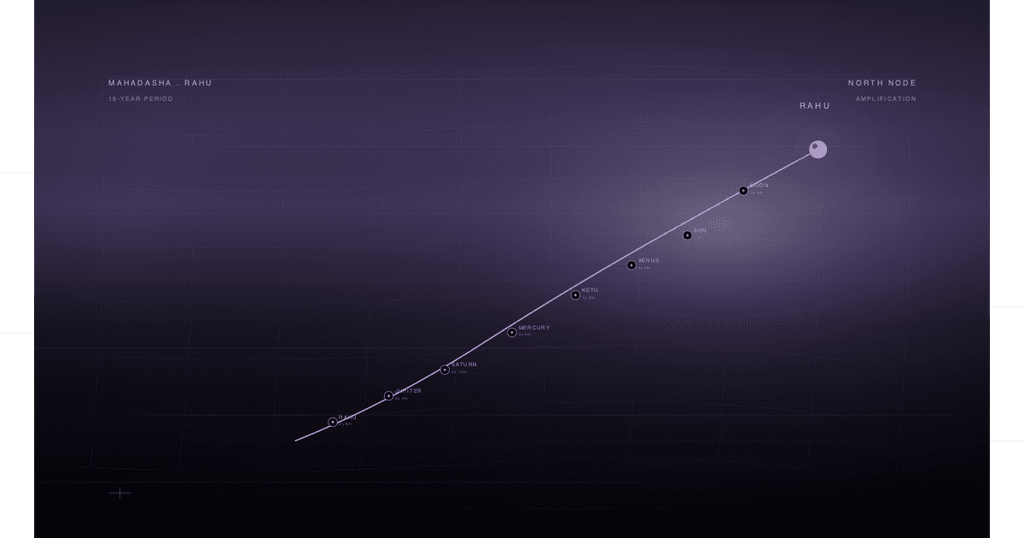
The 18-year Rahu mahadasha divides into nine antardasha sub-periods in fixed Vimshottari order starting with Rahu itself. The Mercury sub-period sits at position 4 of 9. Exact start and end dates for any chart can be computed from the natal Moon nakshatra-pada and the date of Rahu mahadasha onset. The Tempora dasha engine produces this to the day.
Friendship status and pairing reading
In the classical Parashari friendship matrix, Rahu views Mercury as friend. The friend-pair classification means the 2 years 6 months 18 days sub-period classically delivers outcomes where Rahu's register (worldly desire, foreign-axis, amplification, taboo and the boundary-crossing register) and Mercury's register (intelligence, communication, commerce, writing and the youthful-skill register) integrate constructively. Events typically surface from both karaka domains in alignment rather than friction.
The Mercury karaka overlay
Mercury is the karaka of intelligence, communication, commerce, writing and the youthful-skill register. Across the 2 years 6 months 18 days sub-period, this karaka set overlays on top of Rahu's 18-year worldly desire, foreign-axis, amplification, taboo and the boundary-crossing register register. The combined reading is the central output of the sub-period.
How Mercury's natal dignity shapes the reading
Mercury's natal sign and house set the floor for the 2 years 6 months 18 days sub-period. Mercury at exaltation gives the strongest reading. Own-sign and mooltrikona placement gives clean expression. Debilitation introduces friction that the sub-period must work through. Combust and retrograde state, conjunctions with malefics or benefics and the dispositor's strength all further modulate the reading. See the Mercury mahadasha overview for the per-dignity breakdown.
Event classes typical to Rahu-Mercury sub-period
The 2 years 6 months 18 days Rahu mahadasha Mercury antardasha typically surfaces events across these specific domains:
- Constructive integration of Rahu-register with Mercury-register: friend-pair sub-periods classically deliver outcomes where both planets' karakas align rather than friction.
- Events in Mercury's natural karaka domain: intelligence, communication, commerce, writing and the youthful-skill register.
- Events specific to the natal house Mercury occupies in the chart.
- Events where the Rahu-mahalord and Mercury-antarlord houses (both natal and ruled) interact (aspect, mutual reception or natal conjunction).
What the framework does not predict
The framework reads structural pressure on the commerce-and-intelligence axis. It does not predict that a specific native will experience a specific business formation, a specific publishing event or a specific analytical-career inflection on a specific date inside the 2.55-year band.
It does not predict outcome direction. Whether a business formed in the sub-period succeeds or fails, whether a commerce inflection durably compounds or reverses, whether a publishing project reaches scale or disappears, is not specified by the structural-pressure reading. The chart times the pressure; the actor decides the form and the broader environment decides the durability.
It does not predict timing finer than the sub-period band. The 2.55-year duration can be subdivided into pratyantara (third-level) sub-periods for finer timing and the pratyantara overlay plus the transit cross-check is needed for date-specific event identification. The mahadasha-antardasha reading alone gives a window, not a date.
The classical readings carry historical and conventional weight. The framework treats them as structural-pressure flags to be cross-checked against transit data, dasha context and natal-dignity modulation. The combination of factors produces a specific reading for any specific chart. The general framework gives the window; the specific chart produces the form.
How Rahu-Mercury connects to the broader Rahu Mahadasha
Rahu-Mercury sits in the fourth sub-period slot of the 18-year Rahu Mahadasha. By the time it opens, the native has been through the foundational Rahu-Rahu identity-reset phase, the Rahu-Jupiter Guru-Chandala friction phase and the Rahu-Saturn structural-contraction phase. The Rahu-Mercury opens the middle phase of the Mahadasha where the established Rahu pattern starts producing its core commerce-and-amplification outcomes.
The sub-period closes the way Rahu-Ketu (the dissolution sub-period) opens. Rahu-Ketu runs 1.05 years and produces the cleanup-axis events that often follow the commerce-axis expansion of Rahu-Mercury. After Rahu-Ketu comes Rahu-Venus, the longest sub-period at 3 years, which carries the partnership and luxury-axis amplification.
Reading Rahu-Mercury without the broader Mahadasha context gives a partial picture. The Mahadasha's natal-house position, dispositor analysis and the natal Rahu's specific configuration set the texture that the sub-period operates within. The Tempora Rahu Mahadasha method article covers the dispositor analysis and natal-house framework that informs the full 18-year arc.
The arithmetic of this period
Mercury brings 17 of the 120 cycle years to Rahu's 18, so the sub-period runs 18 multiplied by 17 divided by 120: 2.55 years, about 2 years and 7 months. It is position 4 of 9. Summing the sub-periods before it, Rahu's 2.7, Jupiter's 2.4 and Saturn's 2.85 make 7.95 years, so Mercury holds roughly years 7.95 to 10.5, carrying the mahadasha across its halfway mark at year 9. Its neighbours throw it into relief: Saturn before it consolidates, the brief 1.05-year Ketu antardasha after it dissolves, and Mercury sits between them as the productive plateau of the cycle.
Position matters here in a specific way: an antardasha straddling the midpoint of an 18-year cycle works on a native whose Rahu-era identity is already established, so its commerce tends to monetise existing direction rather than invent a new one. The long arc is mapped in the Rahu mahadasha overview, and Mercury's own 17-year major period is treated in the Mercury mahadasha article.
How the source texts read this sub-period
The BPHS antardasha chapters, Rahu mahadasha section, give a strong Mercury an unusually generous slate: exalted or placed in a kendra or the fifth, it earns results the text compares to Raj-yoga, alongside family wellbeing, business profits, conveyances, marriage and other celebrations, increase of cattle and the comforts of perfume. The text adds a timing signature found almost nowhere else in the chapter, saying the results fructify notably on Wednesdays and in Mercury's own month. Counted from the dasha lord, Mercury in a kendra or in the third, ninth, tenth or eleventh promises sound health, Isht Siddhi, discourses on the Puranas, marriage, oblations and charity. The reverse condition, Mercury in the sixth, eighth or twelfth or under Saturn's aspect, is assigned irreverence, decline of fortune, lying, unwise acts, fear of snakes, thieves and the state and quarrels at home, and where Mercury holds maraka lordship the text attaches health cautions with the Vishnu Sahasranama prescribed. Phaladeepika, in its chapter on the sub-divisions of dashas, grants acquisition of sons and wealth, meeting of friends and cleverness in business, which tracks the favourable Parashari branch closely. The engine carries these positions as dignity-conditioned inputs, resolved per chart by natal Mercury's actual state.
This period against the 2026 to 2028 sky
Mercury carries no dated event in the engine's 2026 to 2028 calendar, but the mahadasha lord does. On 27 December 2026 Rahu leaves Aquarius for Capricorn and Ketu leaves Leo for Cancer, an axis that holds until 15 July 2028. For a native running Rahu-Mercury, the mahadasha lord changing signs mid sub-period shifts the backdrop against which the period's commerce and communication themes play out, and the houses Capricorn and Cancer occupy from the natal ascendant name the affected terrain. The limitation is the standard one: a nodal ingress is shared by every chart alive, so it sets weather rather than appointment. Natal condition does the discriminating work, since a Mercury exalted in its own Virgo or otherwise well placed gives this friendly sub-period its fluent best, while a Mercury debilitated in Pisces or combust turns the same fluency toward scatter and overcommitment. Locating the window against a specific birth takes the chart and the Vimshottari computation, which the free computed reading produces to the day.
Frequently asked questions
How long is the Rahu Mahadasha Mercury Antardasha and where does it fall in the Vimshottari sequence?
The Rahu Mahadasha Mercury Antardasha runs exactly 2.55 years (2 years 6 months 18 days). It is the fourth sub-period inside the 18-year Rahu Mahadasha, after Rahu-Rahu, Rahu-Jupiter and Rahu-Saturn. The native is approximately 7 years 11 months into the Rahu Mahadasha when Rahu-Mercury opens and the sub-period closes about 10 years 6 months into the broader Mahadasha. Exact start and end dates can be computed from natal Moon nakshatra-pada and the date of Rahu Mahadasha onset.
Why is Rahu-Mercury considered the business and commerce amplification window?
Mercury is the karaka of commerce, intelligence, communication, calculation, trade and the analytical mind. Rahu amplifies whatever planet it operates in concurrent dasha alignment with. The Rahu-Mercury combination over 2.55 years produces structural amplification of Mercury-axis domains: business-formation events, commerce-scaling, communication-driven career inflections, analytical-work expansion and trade-axis activity. Classical readings flag the sub-period for both genuine commercial-success patterns and for the speculation-and-overreach patterns that follow Rahu's amplification when natal Mercury is weakly placed.
How does Mercury's natal dignity shape the Rahu-Mercury sub-period reading?
Mercury's natal house, sign and aspectual state set the floor for the 2.55-year sub-period. Mercury exalted in Virgo, in own signs Gemini or Virgo or in angular houses (1st, 4th, 7th, 10th) substantially modulates the reading toward genuine commerce-axis gain and analytical-work expansion. Mercury debilitated in Pisces, combust in tight conjunction with the Sun or under malefic aspect amplifies the speculation-and-misjudgment reading and produces more complicated commerce-axis events. Mercury aspected by Jupiter brings discernment into the commerce decisions and softens the Rahu amplification. Mercury aspected by Saturn introduces structural-discipline pressure that often produces durable commerce-axis outcomes rather than speculative ones.
What kinds of events historically correlate with Rahu-Mercury sub-periods?
The conventional Parashari reading associates Rahu-Mercury with three event classes: business-formation and commerce-scaling events (startup formation, business expansion, trade-axis growth) often with unconventional or boundary-crossing models given Rahu's character, communication-and-publishing events (book launches, media-axis career inflections, public-speaking work) at scale beyond the chart's prior baseline and analytical-work expansion events where Mercury-ruled domains (data, calculation, technical research) produce career inflections. The Tempora framework reads the sub-period as a structural-pressure window for these classes of event rather than a deterministic predictor. The conditional probability is elevated relative to chance, not certain. The 2.55-year duration often produces multiple events of this class rather than a single inflection.
How does this sub-period connect to the broader Rahu Mahadasha?
Rahu-Mercury is the commerce-and-intelligence amplification window inside the broader 18-year Rahu Mahadasha. It comes after the three earlier sub-periods (Rahu-Rahu identity reset, Rahu-Jupiter Guru-Chandala friction, Rahu-Saturn structural contraction) and sits in the middle phase of the Mahadasha. By the time Rahu-Mercury opens, the native has been through the foundational and friction phases of the Mahadasha and enters the commerce-amplification window with the structural patterns of the broader Mahadasha already established. The Tempora Rahu Mahadasha method article covers the dispositor analysis and natal-house framework that sets the texture of the whole 18 years.
What does the Tempora framework not predict about this sub-period?
The framework identifies a 2.55-year structural-amplification window. It does not predict whether a specific native will experience a specific commerce or communication event in that window. It does not predict outcome direction (whether a business formed in the sub-period succeeds or fails, whether a commerce inflection durably compounds or reverses). It does not predict timing finer than the sub-period band without the pratyantara overlay and the transit cross-check. The classical readings carry historical and conventional weight, but the framework treats them as structural-pressure flags to be cross-checked against transit data, not as deterministic forecasts.
Which years of the Rahu mahadasha does the Mercury antardasha cover?
Roughly years 7.95 to 10.5, straddling the midpoint of the 18-year cycle. The duration is 18 multiplied by 17 divided by 120, which is 2.55 years, about 2 years and 7 months. The three sub-periods before it (Rahu 2.7 years, Jupiter 2.4, Saturn 2.85) sum to 7.95 years, and the Ketu antardasha follows at roughly year 10.5. A native who entered the mahadasha at 30 runs Rahu-Mercury between about 37.95 and 40.5.
Does the 27 December 2026 nodal sign change matter during Rahu-Mercury?
It matters as backdrop. Transit Rahu enters Capricorn and Ketu enters Cancer on 27 December 2026, holding until 15 July 2028, so a native in this sub-period across that date sees the mahadasha lord change signs mid period. The tradition treats a period lord's ingress as a shift in the terrain its themes work through, read by the houses Capricorn and Cancer occupy from the natal ascendant. Because the ingress is simultaneous for every chart, it cannot date personal events; the sub-period's own start and end come from the birth chart's Vimshottari clock.
What do the classical texts say about Rahu-Mercury?
The BPHS antardasha chapters, Rahu mahadasha section, promise Raj-yoga-like results, business profits, celebrations and comforts for a strong Mercury, note that the results ripen on Wednesdays and in Mercury's month, and reverse to decline of fortune, lying, unwise acts and quarrels when Mercury sits in the sixth, eighth or twelfth or under Saturn's aspect, adding health cautions and a prescribed remedy where maraka lordship applies. Phaladeepika, in its chapter on the sub-divisions of dashas, gives acquisition of sons and wealth, meeting of friends and business cleverness, in line with the favourable branch. The engine holds both records as dignity-conditioned inputs read through the natal Mercury.
Read next
- Rahu Mahadasha Jupiter Antardasha · the friction sub-period that precedes Mercury
- Rahu Mahadasha Saturn Antardasha · the structural-contraction phase that opens before Mercury
- Rahu Mahadasha Venus Antardasha · the partnership and luxury amplification window later in the Mahadasha
- Calibrated lift astrology · the methodology behind the conditional-probability claim
- Sun Mahadasha: how to read the 6-year period
This article represents conventional Vedic teaching and Tempora Research method documentation. It does not constitute financial, legal or professional advice. Internal audit log maintained.