Rahu Mahadasha Venus Antardasha: the 3-year wealth and desire amplification
The Venus sub-period inside the 18-year Rahu Mahadasha. Three years long, the single longest antardasha across the entire Vimshottari system. Wealth-and-desire amplification, with the natal-dignity floor that determines whether the reach reads as gain or as excess.
Venus gives the Rahu mahadasha its longest single sub-period: a full 3 years in which the node's ambitions are hosted by the karaka of partnership, pleasure, wealth and art. It follows the year-long Ketu austerity, and the swing could hardly be wider, from the significator of renunciation to the significator of enjoyment. Rahu counts Venus a friend in the classical matrix, and the affinity is real: both lords deal in desire, Venus by refining it and Rahu by enlarging it, so the pairing tends to co-operate. The texture the tradition assigns is silk over appetite, comfort and relationship and acquisition pursued on the mahadasha's amplified scale. The classical caution follows directly: sweetness at that amplitude can become excess, and what is enjoyed can become what owns.
Where the sub-period falls in the Vimshottari sequence
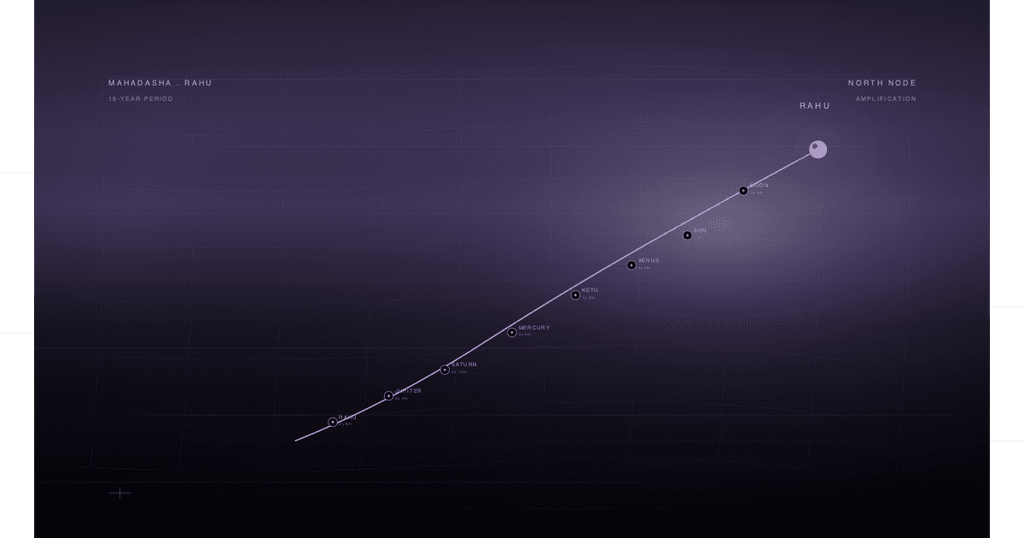
The 18-year Rahu mahadasha divides into nine antardasha sub-periods in fixed Vimshottari order starting with Rahu itself. The Venus sub-period sits at position 6 of 9. Exact start and end dates for any chart can be computed from the natal Moon nakshatra-pada and the date of Rahu mahadasha onset. The Tempora dasha engine produces this to the day.
Friendship status and pairing reading
In the classical Parashari friendship matrix, Rahu views Venus as friend. The friend-pair classification means the 3 years sub-period classically delivers outcomes where Rahu's register (worldly desire, foreign-axis, amplification, taboo and the boundary-crossing register) and Venus's register (marriage, partnership, luxury, arts, comfort and aesthetic-relational refinement) integrate constructively. Events typically surface from both karaka domains in alignment rather than friction.
The Venus karaka overlay
Venus is the karaka of marriage, partnership, luxury, arts, comfort and aesthetic-relational refinement. Across the 3 years sub-period, this karaka set overlays on top of Rahu's 18-year worldly desire, foreign-axis, amplification, taboo and the boundary-crossing register register. The combined reading is the central output of the sub-period.
How Venus's natal dignity shapes the reading
Venus's natal sign and house set the floor for the 3 years sub-period. Venus at exaltation gives the strongest reading. Own-sign and mooltrikona placement gives clean expression. Debilitation introduces friction that the sub-period must work through. Combust and retrograde state, conjunctions with malefics or benefics and the dispositor's strength all further modulate the reading. See the Venus mahadasha overview for the per-dignity breakdown.
Event classes typical to Rahu-Venus sub-period
The 3 years Rahu mahadasha Venus antardasha typically surfaces events across these specific domains:
- Constructive integration of Rahu-register with Venus-register: friend-pair sub-periods classically deliver outcomes where both planets' karakas align rather than friction.
- Events in Venus's natural karaka domain: marriage, partnership, luxury, arts, comfort and aesthetic-relational refinement.
- Events specific to the natal house Venus occupies in the chart.
- Events where the Rahu-mahalord and Venus-antarlord houses (both natal and ruled) interact (aspect, mutual reception or natal conjunction).
Transit confirmation protocol
The sub-period reading sets a structural-pressure floor of 3 years. Specific event timing inside that window requires the pratyantara (sub-sub-period) overlay and a transit cross-check.
Two transit overlays do most of the work. The first: transit Venus aspecting natal Rahu or transit Rahu within tight orb of natal Venus. These transits intensify the Rahu-Venus dynamic within the broader sub-period and concentrate event timing on those windows. The second: transit Jupiter or transit Saturn through the natal 7th house from the Moon (the partnership-axis house in Vedic mundane readings). These transits modulate the partnership-formation likelihood across specific months inside the broader 3-year band.
The pratyantara (sub-sub-period) inside the antardasha gives finer timing. The opening Rahu-Venus-Rahu pratyantara (about 5 months 24 days) and the Venus-Venus pratyantara (about 5 months 27 days) carry the most concentrated amplification signal. The Venus-Saturn pratyantara introduces commitment-discipline timing inside the broader amplification.
What the framework does not predict
The Rahu-Venus sub-period reading is structural, not deterministic. The framework identifies a 3-year window where the conditional probability of three named event classes is elevated. It does not predict that a specific native will experience a specific event in that window.
The framework does not predict outcome direction. A partnership formed during the sub-period can be durable or temporary. A material acquisition can appreciate or depreciate. The chart's broader signals determine which.
The framework does not predict timing finer than the antardasha band without the transit and pratyantara overlay. The Tempora dasha engine produces this data to the day for any chart.
The framework also does not predict the social or institutional content of the events. A partnership during Rahu-Venus could read as marriage, as long-term partnership, as business co-founding or as a non-traditional pairing structure. The chart's 7th house Venus and the dispositor placements each contribute to the specific form.
How this connects to the broader Rahu Mahadasha
Rahu-Venus is the wealth-and-partnership amplification window inside the broader 18-year Rahu Mahadasha. It comes after the two friction sub-periods (Rahu-Jupiter Guru-Chandala expansion-with-caution covered in the Rahu Mahadasha Jupiter Antardasha piece and Rahu-Saturn structural contraction covered in the Rahu Mahadasha Saturn Antardasha piece). It also comes after the commerce-amplification of Rahu-Mercury and the dissolution-and-detachment of Rahu-Ketu.
By the time Rahu-Venus opens, the native has been through the structural-pressure phases of the Mahadasha and is in the latter half of the 18-year arc. The Rahu-Venus phase often produces the durable wealth and partnership gains that the chart was building toward across the earlier sub-periods. For some natives this is the most positive 3-year stretch inside the entire 18-year Mahadasha.
The Tempora Rahu Mahadasha method article covers the dispositor analysis, natal-house framework and the broader 18-year texture this sub-period sits inside. Reading the sub-period in isolation captures the 3 years; reading it inside the Mahadasha gives the longer arc that places the amplification reading in context.
The arithmetic of this period
Venus holds 20 of the 120 Vimshottari years, the largest allotment of any lord, and 18 multiplied by 20 divided by 120 gives exactly 3 years, with no odd months. That makes Rahu-Venus the longest of the nine sub-periods inside this mahadasha. It sits at position 6 of 9; the five sub-periods before it total 11.55 years, so Venus runs from roughly year 11.55 to year 14.55. Its neighbours mark its character by contrast: the 1.05-year Ketu antardasha before it is the cycle's austerity and the brisk 0.9-year Sun antardasha after it turns the mahadasha toward authority and visibility.
Three years landing in years 11.55 to 14.55 of eighteen shape a distinct life stage: the mahadasha is past its midpoint, its directions proven, and Venus arrives to reward and bind rather than to found. The same antardasha placed early in a cycle would be furnishing a life still under construction. The surrounding architecture is described in the Rahu mahadasha overview, and Venus's conduct across its own 20-year major period in the Venus mahadasha article.
The classical assignments for this combination
The BPHS antardasha chapters, Rahu mahadasha section, grade this sub-period through Venus's dignity in layers. A strong Venus in a kendra, trikona or the eleventh is assigned wealth through brahmins, increase of cattle, celebration for the birth of a son, kingdom-gain and high government position. Exaltation or own sign, in rashi or navamsha, earns a further list: construction of a new house, sweet food, happiness of wife and children, charity of grains and business profits the text calls extraordinary. The adverse branch requires affliction, with Venus debilitated, in an enemy sign, in the sixth, eighth or twelfth or accompanied by Saturn, Mars or Rahu bringing disease, quarrels, separation from son or father and stomach pain, and malefic placement from the dasha lord adding urinary and blood disorders, imprisonment and state fines. Where Venus holds maraka lordship the text attaches health cautions and prescribes the worship of Durga and Lakshmi as remedy. Phaladeepika, in its chapter on the sub-divisions of dashas, grants acquisition of a wife, comforts of the bed and the companionship of animals, keeping company with the favourable Parashari branch. The engine registers these graded positions as inputs and computes which layer applies from the natal Venus itself.
This period against the 2026 to 2028 sky
Venus itself carries no dated entry in the engine's 2026 to 2028 transit calendar, so the sky relevance of this window comes through the mahadasha lord. Rahu crosses from Aquarius into Capricorn on 27 December 2026, taking Ketu into Cancer opposite, and the axis holds until 15 July 2028; a native running Rahu-Venus across that date watches the major lord change terrain in the middle of the sub-period. Classical practice reads the ingress through the houses Capricorn and Cancer hold from the natal ascendant, which is where the period's partnership and wealth themes would register the shift. The usual limit applies with full force, because a nodal sign change is simultaneous for everyone alive and therefore carries no personal timing information at all. What separates one native's Rahu-Venus from another's is natal: Venus exalted in Pisces or strong in Taurus or Libra gives the friendly pairing its generous register, while Venus debilitated in Virgo or combust bends the same three years toward overreach in pleasure and partnership. Placing the window's exact dates against a birth requires the chart itself and the computed Vimshottari clock.
Frequently asked questions
How long is the Rahu Mahadasha Venus Antardasha and where does it fall in the Vimshottari sequence?
The Rahu Mahadasha Venus Antardasha runs exactly 3 years. It is the longest single antardasha across the entire Vimshottari major-period system. The sub-period sits in the sixth slot inside the 18-year Rahu Mahadasha, after Rahu-Rahu, Rahu-Jupiter, Rahu-Saturn, Rahu-Mercury and Rahu-Ketu. The native is approximately 10 years 6 months into the Rahu Mahadasha when Rahu-Venus opens and the sub-period closes about 13 years 6 months into the broader Mahadasha. Exact start and end dates can be computed from natal Moon nakshatra-pada and the date of Rahu Mahadasha onset.
Why is Rahu-Venus considered the wealth and desire amplification window?
Venus is the karaka of luxury, partnership, sensual experience, art, beauty, vehicles and material comfort. Rahu amplifies whatever planet it operates in concurrent dasha alignment with. The Rahu-Venus combination over 3 years produces structural amplification of the Venus-axis domains: partnership formation or upgrading, accumulation of luxury assets, artistic or aesthetic-career expansion, sensual experience seeking and the reach for material refinement that the chart did not previously support. Classical readings flag the sub-period for both genuine wealth-and-partnership gains and for the excess-of-desire patterns that can follow Rahu's compulsion when natal Venus is weakly placed.
How does Venus's natal dignity shape the Rahu-Venus sub-period reading?
Venus's natal house, sign and aspectual state set the floor for the 3-year sub-period. Venus exalted in Pisces, in own signs Taurus or Libra or in angular houses (1st, 4th, 7th, 10th) substantially modulates the reading toward genuine partnership and material gain. Venus debilitated in Virgo or combust in close-orb conjunction with the Sun amplifies the excess-of-desire reading and produces more complicated partnership or material-acquisition events. Venus aspected by Jupiter softens the Rahu amplification and brings dharmic discernment into the partnership-axis. Venus aspected by Saturn introduces age-difference or commitment-discipline pressure into Venus-axis events during the sub-period.
What kinds of events historically correlate with Rahu-Venus sub-periods?
The conventional Parashari reading associates Rahu-Venus with three event classes: partnership-formation events (marriage, business partnership, foreign-residence pairing) often with unconventional or non-traditional partners given Rahu's boundary-crossing character, material-acquisition events (real estate, vehicles, luxury, art purchase) at scale beyond the chart's prior baseline and aesthetic or creative-career expansion events where Rahu's amplification reaches into Venus-ruled domains. The Tempora framework reads the sub-period as a structural-pressure window for these classes of event rather than a deterministic predictor. The conditional probability is elevated relative to chance, not certain. The 3-year duration means the sub-period often produces multiple events of this class rather than a single inflection.
How does this sub-period connect to the broader Rahu Mahadasha?
Rahu-Venus is the wealth-and-partnership amplification window inside the broader 18-year Rahu Mahadasha. It comes after the two friction sub-periods Rahu-Jupiter (Guru-Chandala) and Rahu-Saturn (structural contraction) and after the commerce-amplification of Rahu-Mercury and the dissolution sub-period of Rahu-Ketu. By the time Rahu-Venus opens, the native has been through the friction phases of the Mahadasha and is in the latter half of the 18-year arc. The Tempora Rahu Mahadasha method article covers the dispositor analysis and natal-house framework that sets the texture of the whole 18 years.
What does the Tempora framework not predict about this sub-period?
The framework identifies a 3-year structural-amplification window. It does not predict whether a specific native will experience a specific event in that window. It does not predict outcome direction (whether a partnership formed in the sub-period is durable or temporary, whether a material acquisition appreciates or depreciates). It does not predict timing finer than the sub-period band without the pratyantara overlay and the transit cross-check. The classical readings carry historical and conventional weight, but the framework treats them as structural-pressure flags to be cross-checked against transit data, not as deterministic forecasts.
Which years of the Rahu mahadasha does the Venus antardasha cover?
Roughly years 11.55 to 14.55. The duration is 18 multiplied by 20 divided by 120, which is exactly 3 years, the longest of the nine sub-periods in this mahadasha. The five sub-periods before it (Rahu 2.7 years, Jupiter 2.4, Saturn 2.85, Mercury 2.55, Ketu 1.05) sum to 11.55 years, and the Sun antardasha follows at roughly year 14.55. A native who entered the mahadasha at 30 runs Rahu-Venus between about 41.55 and 44.55.
How is a Rahu-Venus antardasha located against the 2026 to 2028 sky?
Venus has no dated transit event in the engine's 2026 to 2028 calendar, so the marked event for this pairing is the mahadasha lord's ingress: Rahu enters Capricorn with Ketu opposite in Cancer on 27 December 2026, holding until 15 July 2028. A native whose Rahu-Venus overlaps that date reads the shift through the houses Capricorn and Cancer occupy from the natal ascendant. The ingress applies to every chart simultaneously, so personal timing still rests entirely on the birth chart and its computed dasha calendar.
What do the classical texts say about Rahu-Venus?
The BPHS antardasha chapters, Rahu mahadasha section, grade the period by Venus's dignity: strong placement earns wealth through brahmins, kingdom-gain and high position, exaltation or own sign adds a new house, family happiness and outsized business profits, and affliction or malefic company reverses the list toward disease, quarrels and separation, with health cautions and Durga-Lakshmi worship where maraka lordship applies. Phaladeepika, in its chapter on the sub-divisions of dashas, assigns acquisition of a wife, comforts of the bed and animal companionship, in agreement with the favourable branch. The engine loads the graded record as inputs and computes the applicable layer from the natal Venus.
Read next
- Rahu Mahadasha Saturn Antardasha · the structural-contraction sub-period earlier in the Mahadasha
- Rahu Mahadasha Jupiter Antardasha · the Guru-Chandala sub-period
- Rahu Mahadasha: how to read the 18-year period · the broader framework
- Marriage and Venus: timing the partnership inflection · the Venus-axis partnership reading
- Mars mahadasha career: 7 years that test your structure
- Rahu Mahadasha Ketu Antardasha: 1.05 years and the dissolution sub-period
- Rahu Mahadasha Moon Antardasha: 1.5 years and the emotional-axis amplification
- Rahu Mahadasha Rahu Antardasha: 2.7 years and the identity-reset opening
- Rahu Mahadasha Sun Antardasha: 0.9 years and the authority-axis pressure
- Yogini dasha explained: the 36-year alternative to Vimshottari
- Ketu Mahadasha: how to read the 7-year period
- Venus Mahadasha: how to read the 20-year period
- Jupiter Mahadasha: how to read the 16-year period
- Sun Mahadasha: how to read the 6-year period
- Moon Mahadasha: how to read the 10-year period
- Mars Mahadasha: how to read the 7-year period
- Saturn Mahadasha: how to read the 19-year period
- How Tempora Reads India's National Chart for Economic Cycles
- Rahu Mahadasha: how to read the 18-year period
This article represents conventional Vedic teaching and Tempora Research method documentation. It does not constitute financial, legal or professional advice. Internal audit log maintained.