Rahu Mahadasha Rahu Antardasha: 2.7 years and the identity-reset opening
The Rahu sub-period that opens Rahu Mahadasha runs 2.7 years and produces the strongest Rahu signature available in the 18-year cycle. The dasha lord running on itself activates Rahu's character at maximum intensity. Identity-reset, boundary-crossing themes and foundational pattern-setting events define the sub-period and set the texture of the broader Mahadasha.
Rahu-Rahu is the one stretch of the 18-year cycle where no second lord tempers the node: the shadow planet holds the mahadasha seat and the antardasha seat at once, so the usual question of friendship between the two period lords never arises. It arrives at the close of the 7-year Mars mahadasha, whose final Mars-Moon sub-period hands seven years of martial effort and an emotionally saturated ending over to a planet with no body, no sign rulership and no loyalty to the departing agenda. The classical texture assigned to the doubling is appetite without counterweight: worldly desire, the foreign axis and the boundary-crossing impulse run at full amplitude for 2.7 years. Whatever the chart promises through natal Rahu's sign and house gets stated here in its plainest form, before Jupiter, Saturn and the seven remaining lords begin qualifying it.
Rahu's classical karakatva covers boundary-crossing elements, foreign-axis themes, unconventional or non-traditional models, technology-axis adoption, amplification and the reaching-for-more impulse. The opening sub-period activates this character at full strength. The native often experiences the identity-reset pattern in which the broader life-direction shifts toward Rahu-axis themes and the conventional patterns from the previous Mahadasha lose grip.
Where Rahu-Rahu sits in the Vimshottari sequence
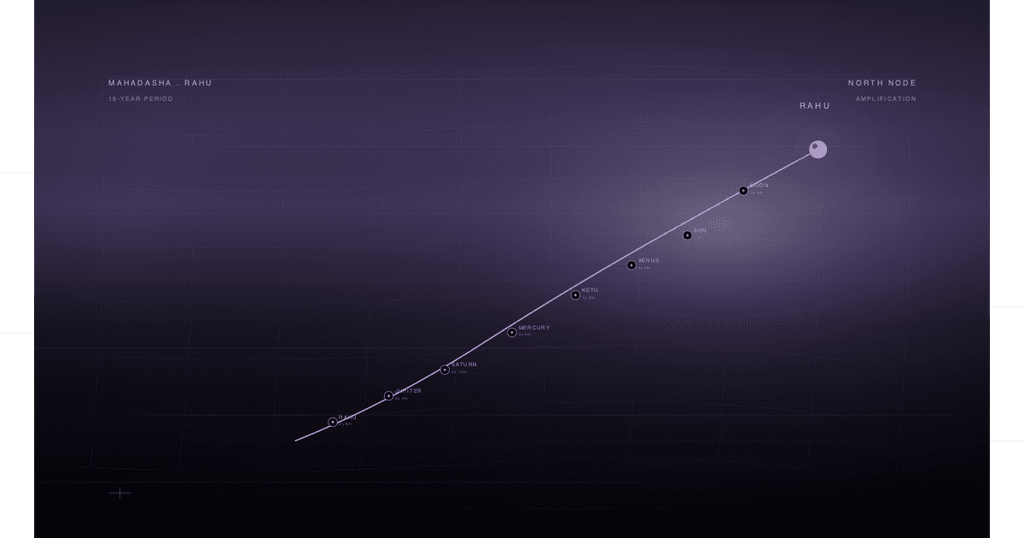
The Vimshottari mahadasha system runs 120 years across nine major periods. Rahu Mahadasha lasts 18 years and contains nine sub-periods in the standard order: Rahu, Jupiter, Saturn, Mercury, Ketu, Venus, Sun, Moon and Mars. Rahu is the opening sub-period.
The sub-period duration is calculated as the product of the antardasha lord's Vimshottari years and the mahadasha lord's Vimshottari years, divided by 120. For Rahu-Rahu: 18 (Rahu years) multiplied by 18 (Rahu years), divided by 120, equals 2.7 years exactly. The Rahu-Rahu sub-period is the third-longest sub-period in the Mahadasha after Rahu-Venus (3 years) and Rahu-Saturn (2.85 years).
Every Mahadasha opens with its own planet as the antardasha lord because the Vimshottari sequence is structurally circular: the order within each Mahadasha follows the same Sun-Moon-Mars-Rahu-Jupiter-Saturn-Mercury-Ketu-Venus pattern starting from the Mahadasha lord itself. So Sun Mahadasha opens with Sun-Sun, Moon Mahadasha opens with Moon-Moon and Rahu Mahadasha opens with Rahu-Rahu.
What the classical literature says about the opening sub-period
The opening sub-period of any Mahadasha carries structural weight beyond its proportional duration. The classical reading is that the dasha lord running concurrent alignment with itself produces the strongest signature of that planet's character available across the entire Mahadasha. The themes that open in the first sub-period typically define the broader Mahadasha arc.
For Rahu specifically, the opening Rahu-Rahu activates the planet's karakatva at maximum intensity. Rahu rules the boundary-crossing axis (foreign places, foreign languages, cross-cultural contexts), the unconventional or non-traditional models (alternative careers, non-mainstream life-paths, technology-driven domains), the amplification and reaching-for-more impulse and the identity-axis reset where the native's previous life-direction releases grip and new directions open.
The 2.7-year duration is long enough for the foundational pattern to establish. Natives often experience multiple identity-reset events during the opening sub-period rather than a single dominant inflection. The first year typically carries the release of previous patterns; the second year carries the orientation toward new directions; the third year carries the consolidation of the new pattern that the broader Mahadasha will run with.
The three event classes the framework reads
Identity-axis reset events. The native's broader life-direction shifts toward Rahu-axis themes. Career-axis identity shifts where the native enters a fundamentally different professional domain, relationship-axis identity shifts where the native's relational pattern changes substantially and the broader self-representation shifts in which how the native describes their life-direction in conversation with others changes. The classical reading associates these events with the foundational pattern-setting character of the opening sub-period.
Boundary-crossing events. International relocations, cross-cultural relationship formations, sector-crossing career transitions, the broader pattern of crossing previously-fixed boundaries (geographic, cultural, professional, social). Rahu's karakatva is specifically the boundary-crossing axis and the opening sub-period often produces the boundary-crossing events that define the Mahadasha's character.
Foundational pattern-setting events. The events that establish the texture the broader Mahadasha will run with. A native who opens a foreign-axis career direction in Rahu-Rahu often spends the next 15.3 years building on that direction. A native who opens a technology-axis venture often spends the Mahadasha scaling it. A native who opens an unconventional relationship pattern often spends the Mahadasha working through its implications. The opening sub-period is structurally determinative; the later sub-periods read as variations or developments of the opening pattern.
How natal Rahu placement modulates the reading
Rahu is a shadow planet without physical body. The dignity hierarchy applied to other planets does not apply directly to Rahu. The classical schools differ on Rahu's exaltation: some assign Taurus, some Gemini. Rahu's natal reading depends primarily on the sign and house Rahu occupies and the planets Rahu conjoins or aspects.
Rahu in airy signs (Gemini, Libra, Aquarius). Often produces unconventional or technology-driven Rahu-axis themes. The opening sub-period typically opens directions in commerce-axis, communication-axis or social-axis domains with boundary-crossing character.
Rahu in earthy signs (Taurus, Virgo, Capricorn). Often produces material-axis or wealth-axis themes. The opening sub-period typically opens material-accumulation directions or career-axis transitions with structural character.
Rahu in fiery signs (Aries, Leo, Sagittarius). Often produces ambition or recognition themes. The opening sub-period typically opens career-axis recognition events or authority-axis transitions with the reaching-for-more character Rahu rules.
Rahu in watery signs (Cancer, Scorpio, Pisces). Often produces emotional-axis or boundary-dissolution themes. The opening sub-period typically opens emotional-axis transitions, inner-life shifts or boundary-dissolution events with the watery-axis character of the natal sign.
Rahu in angular houses (1st, 4th, 7th, 10th). The angular placements give Rahu structural prominence regardless of sign. The opening sub-period reads as foundational pattern-setting on the angular-house axis, which produces life-direction-defining events more often than not.
Rahu in trine houses (1st, 5th, 9th). The trine placements give Rahu access to dharmic and creative domains. The opening sub-period often produces creative or dharma-axis themes with boundary-crossing character.
Rahu in malefic houses (6th, 8th, 12th). The classical upachaya or hidden-axis placements. The opening sub-period often produces events in these domains specifically: 6th-house service or competition events, 8th-house transformation or shared-resource events, 12th-house foreign-axis or isolation events.
Rahu conjoined or aspected by other planets. Modifies the basic reading. Rahu with Jupiter (Guru-Chandala) brings dharma-axis friction; Rahu with Saturn brings structural-amplification pressure; Rahu with Mars brings combative-amplification (the Angarak Yoga family); Rahu with Mercury brings commerce-amplification; Rahu with Venus brings partnership and luxury amplification; Rahu with Sun brings the eclipse-axis configuration; Rahu with Moon brings the emotional-axis intensification. The natal conjunction or aspect determines which event-shape the opening sub-period most likely produces.
What the framework does not predict
The framework reads structural pressure on the identity-axis and the Rahu-axis themes. It does not predict that a specific native will experience a specific identity-reset event, foreign-axis transition or technology-axis inflection on a specific date inside the 2.7-year band.
It does not predict outcome direction. Whether the identity-reset reads as productive or destabilising, whether the foreign-axis move produces durable or temporary results, whether the technology-axis venture scales or fades, is not specified by the structural-pressure reading. The chart times the pressure; the actor decides the form and the broader environment decides the outcome.
It does not predict timing finer than the sub-period band without the pratyantara overlay and the transit cross-check.
How the opening sub-period sets the entire Mahadasha
The classical reading treats the opening Rahu-Rahu sub-period as structurally determinative for the 18-year Mahadasha. The themes that open in the first 2.7 years often define the broader Mahadasha arc, with the eight subsequent sub-periods (Jupiter, Saturn, Mercury, Ketu, Venus, Sun, Moon, Mars) reading as variations or developments of the opening pattern rather than independent themes.
A native who opens a foreign-axis career direction in Rahu-Rahu often spends Rahu-Jupiter working through the dharma-axis friction of that direction, Rahu-Saturn working through the structural contraction phase, Rahu-Mercury scaling the commerce side, Rahu-Ketu dissolving aspects that did not work, Rahu-Venus building partnerships in the new direction, Rahu-Sun working through authority-axis pressure on the direction, Rahu-Moon processing the emotional-axis implications and Rahu-Mars closing out with action-axis events. The pattern set in the opening 2.7 years runs through all 18 years.
This structural-determinism is what makes natal Rahu's sign and house placement the most important diagnostic for any chart entering Rahu Mahadasha. The opening sub-period activates Rahu's specific natal configuration and the activation defines the texture of the broader 18-year cycle.
The arithmetic of this period
Rahu holds 18 of the 120 Vimshottari years, so its own sub-period inside its own mahadasha runs 18 multiplied by 18 divided by 120: exactly 2.7 years, about 2 years and 8 months. It sits at position 1 of 9 and covers years 0 to 2.7 of the mahadasha, since nothing precedes it inside the cycle. The two periods on either side frame what makes it distinct: behind it lies the closing Moon antardasha of the Mars mahadasha, ahead of it the 2.4-year Jupiter antardasha that brings the first outside lord into the 18-year cycle. Rahu-Rahu is therefore the only window in which the node speaks unedited.
Position matters because the same sub-period landing late in a long mahadasha meets a different life stage than one landing early. An antardasha in years 0 to 2.7 works on a native still carrying the habits of the previous major period, which is why the classical writers treat the opening window as pattern-setting: it has no prior sub-period inside the cycle to inherit from. The dispositor framework that reads the whole 18 years is laid out in the Rahu mahadasha overview, and the next lord's own long cycle is covered in the Jupiter mahadasha article.
The classical position on Rahu's own sub-period
For Rahu running its own sub-period, the BPHS antardasha chapters, Rahu mahadasha section, set a condition rare in the text: the favourable results require Rahu in Cancer, Scorpio, Virgo or Sagittarius while also standing in the third, sixth, tenth or eleventh, or else joined to an exalted yogakaraka. Meet that double test and the assignment is kingdom-gain, enthusiasm, cordiality with the king, happiness from wife and children and increase of property. Rahu in the eighth or twelfth or accompanied by malefics is given theft danger, wounds, friction with officials and distress to wife and children instead. Where Rahu occupies or rules the second or seventh the text attaches health cautions and prescribes worship of Rahu with charity of the things Rahu governs. Phaladeepika, in its chapter on the sub-divisions of dashas, lists illness from poison, the sighting of serpents and loss of near relations, an assignment that keeps to the adverse Parashari baseline. The engine loads both texts as conditional inputs and tests the natal Rahu against the sign and house requirements before any branch is scored.
This period against the 2026 to 2028 sky
A native running Rahu-Rahu through 2026 and 2027 carries the doubled node into two dated events. On 27 December 2026 the nodal axis changes signs: Rahu moves from Aquarius into Capricorn and Ketu from Leo into Cancer, a placement held until 15 July 2028. For a period ruled twice over by Rahu, this transit re-points the very planet the dasha is amplifying, and the houses Capricorn and Cancer occupy from the natal ascendant show where the re-pointing lands. The limitation is blunt: the sign change touches every chart on earth on the same day, while the antardasha belongs only to charts whose Vimshottari clock has reached it, so the transit sets atmosphere and never personal timing. The 12 August 2026 solar eclipse on the Cancer-Leo cusp falls along the outgoing nodal axis, and the tradition reads eclipse windows as Rahu-flavoured intensification. An eclipse is a day-scale event inside a 2.7-year sub-period; it can colour a season of the window and it cannot date a life event on its own. How strongly any of this registers depends on natal Rahu's sign, house and conjunctions, since a node takes its character from what it touches: a well-supported natal Rahu meets these windows as opportunity pressure, an afflicted one meets them as exposure.
Frequently asked questions
How long is the Rahu Mahadasha Rahu Antardasha and where does it fall in the Vimshottari sequence?
The Rahu Mahadasha Rahu Antardasha runs exactly 2.7 years (2 years 8 months 12 days). It is the opening sub-period of the 18-year Rahu Mahadasha. Every Vimshottari mahadasha opens with its own planet as the antardasha lord, so the first sub-period of every Mahadasha is the dasha lord running on itself. The native enters Rahu-Rahu at the start of the Mahadasha and runs through 2.7 years before transitioning to Rahu-Jupiter. Exact start and end dates depend on natal Moon nakshatra-pada and the date the Rahu Mahadasha opened.
Why is the opening sub-period called the identity-reset window?
Every Vimshottari Mahadasha opens with the dasha lord running on itself, which produces the strongest signature of the Mahadasha lord's character. Rahu running concurrent dasha alignment with itself amplifies the Rahu character to maximum intensity. Rahu's karakatva is boundary-crossing, foreign elements, unconventional models, technology-axis adoption, amplification and reaching-for-more. The opening 2.7 years activate this character at full strength and the native often experiences the identity-reset pattern: the broader life-direction shifts toward Rahu-axis themes, conventional patterns from the previous Mahadasha lose grip, new boundary-crossing or foreign-element directions open. The opening sub-period is the foundational pattern-setting window for the entire 18-year Mahadasha.
How does natal Rahu placement shape the Rahu-Rahu sub-period reading?
Rahu is a shadow planet without physical body, so the dignity hierarchy applied to other planets does not apply directly. The classical schools differ on Rahu's exaltation; some assign Taurus, some Gemini. Rahu's natal reading depends primarily on the sign and house it occupies and the planets it conjoins or aspects. Rahu in airy signs (Gemini, Libra, Aquarius) often produces unconventional or technology-driven Rahu-axis themes; Rahu in earthy signs (Taurus, Virgo, Capricorn) often produces material-axis or wealth-axis themes; Rahu in fiery signs (Aries, Leo, Sagittarius) often produces ambition or recognition themes; Rahu in watery signs (Cancer, Scorpio, Pisces) often produces emotional-axis or boundary-dissolution themes. Rahu's natal house placement determines the life-domain where the identity-reset themes concentrate. The natal house Rahu occupies is the primary diagnostic for the Mahadasha's full 18-year arc.
What kinds of events historically correlate with Rahu-Rahu sub-periods?
The classical Parashari reading associates Rahu-Rahu with several event classes: identity-axis reset events where the native's life-direction shifts toward Rahu-axis themes (foreign-axis moves, technology-axis career inflections, unconventional life-path adoptions), boundary-crossing events that open new domains (international relocations, cross-cultural relationship formations, sector-crossing career transitions) and the broader foundational pattern-setting events that establish the texture of the remaining 15.3 years of the Mahadasha. The Tempora framework reads the sub-period as a structural-pressure window for these classes of event rather than a deterministic predictor. The 2.7-year duration is long enough that natives often experience multiple foundational events rather than a single inflection.
How does this sub-period set the texture of the entire Rahu Mahadasha?
Rahu-Rahu is the opening sub-period and consequently the foundational pattern-setting window. The themes that open in the first 2.7 years often define the broader Mahadasha arc. A native who opens a foreign-axis career direction in Rahu-Rahu often spends the next 15 years building on that direction; a native who opens a technology-axis venture in Rahu-Rahu often spends the Mahadasha scaling it; a native who opens an unconventional relationship pattern in Rahu-Rahu often spends the Mahadasha working through its implications. The classical reading treats the opening sub-period as structurally determinative for the Mahadasha's character, with the later sub-periods (Jupiter, Saturn, Mercury, etc.) reading as variations or developments of the opening pattern rather than independent themes.
What does the Tempora framework not predict about this sub-period?
The framework identifies a 2.7-year structural-pressure window with elevated conditional probability for Rahu-axis event classes. It does not predict whether a specific native will experience a specific identity-reset event, foreign-axis transition or technology-axis inflection in that window. It does not predict outcome direction (whether the identity-reset reads as productive or destabilising, whether the foreign-axis move produces durable or temporary results). It does not predict timing finer than the sub-period band without the pratyantara overlay and the transit cross-check. The classical readings carry historical and conventional weight, but the framework treats them as structural-pressure flags to be cross-checked against transit data and chart-specific natal Rahu placement, not as deterministic forecasts.
Which years of the Rahu mahadasha does the Rahu antardasha cover?
Years 0 to 2.7. The duration is 18 multiplied by 18 divided by 120, which is exactly 2.7 years, about 2 years and 8 months. It is position 1 of 9, so it begins on the first day of the mahadasha and hands over to the Jupiter antardasha at roughly year 2.7. A native who enters Rahu mahadasha at age 30 runs Rahu-Rahu from 30 to about 32.7.
Does the nodal sign change of 27 December 2026 affect a running Rahu-Rahu antardasha?
It changes the backdrop rather than the clock. On 27 December 2026 transit Rahu moves from Aquarius into Capricorn and Ketu from Leo into Cancer, holding until 15 July 2028. For a native in Rahu-Rahu this re-points the planet the dasha is amplifying, and the houses Capricorn and Cancer occupy from the natal ascendant show where the shift lands. The transit touches every chart on the same day, so it cannot time anything personal by itself; the antardasha dates come from the birth chart and the Vimshottari computation.
What do the classical texts say about Rahu-Rahu?
The BPHS antardasha chapters, Rahu mahadasha section, make the favourable case unusually specific: Rahu must occupy Cancer, Scorpio, Virgo or Sagittarius while standing in the third, sixth, tenth or eleventh, or be joined to an exalted yogakaraka, to earn kingdom-gain, enthusiasm and property increase. Otherwise the text lists theft danger, wounds, official friction and family distress, with health cautions and Rahu worship prescribed where the second or seventh house is involved. Phaladeepika, in its chapter on the sub-divisions of dashas, gives illness from poison, sighting of serpents and loss of near relations, matching that harsher line. The engine evaluates the sign and house conditions on the natal Rahu before scoring either branch.
Read next
- Rahu Mahadasha Jupiter Antardasha · the dharma-friction sub-period that follows the opening
- Rahu Mahadasha Saturn Antardasha · the structural-contraction phase early in the Mahadasha
- Rahu Mahadasha Ketu Antardasha · the dissolution sub-period that follows Mercury
- Calibrated lift astrology · the methodology behind the conditional-probability claim
- Moon Mahadasha: how to read the 10-year period
This article represents conventional Vedic teaching and Tempora Research method documentation. It does not constitute financial, legal or professional advice. Internal audit log maintained.