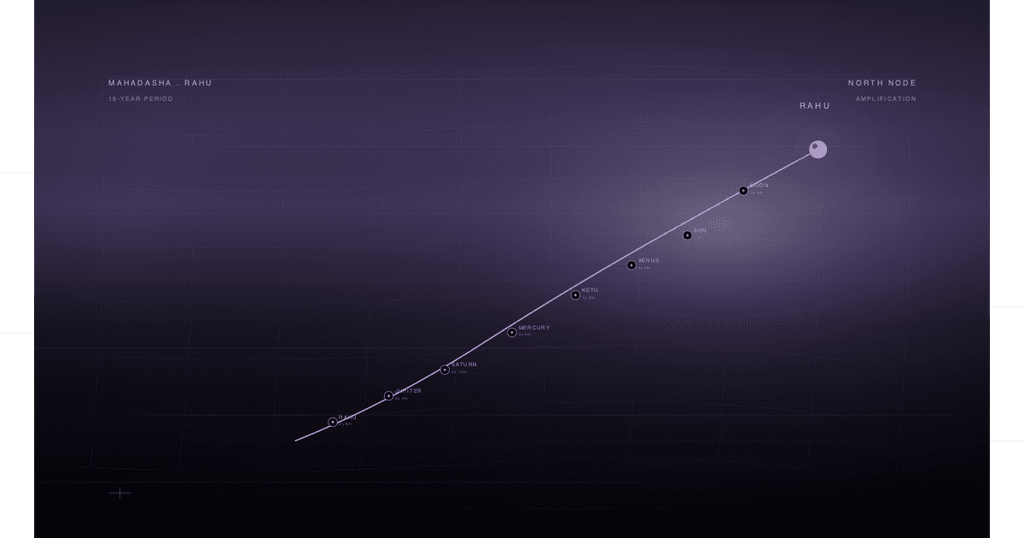
Rahu Mahadasha Ketu Antardasha: 1.05 years and the dissolution sub-period
Ketu antardasha inside Rahu Mahadasha runs 1.05 years and is the fifth sub-period of the 18-year Mahadasha. Rahu and Ketu are the two lunar nodes, opposite ends of the same axis. The sub-period carries the classical dissolution and detachment reading: things ending without obvious cause, spiritual openings, withdrawal patterns and the kind of strange not-arrival events that Ketu classically rules.
Rahu-Ketu is the axis reading itself: the antardasha lord is the mahadasha lord's own opposite end, the two nodes being one severed body in the old myth, permanently 180 degrees apart in the sky. After the busy 2.55-year Mercury sub-period, Ketu's arrival reverses the current, since the south node's register is release, austerity and the tail of things while Rahu's is appetite and the head. The classical matrix calls the pair neutral, but the relationship is closer to structural opposition inside a single mechanism: for just over a year the period of grasping is administered by the significator of letting go. Tradition reads the texture as interruption with meaning, the mahadasha's ambitions questioned from inside rather than opposed from outside.
Where the sub-period falls in the Vimshottari sequence
The 18-year Rahu mahadasha divides into nine antardasha sub-periods in fixed Vimshottari order starting with Rahu itself. The Ketu sub-period sits at position 5 of 9. Exact start and end dates for any chart can be computed from the natal Moon nakshatra-pada and the date of Rahu mahadasha onset. The Tempora dasha engine produces this to the day.
Classical Node-axis Pair pairing
The Rahu-Ketu pairing brings the node-axis together at maximum intensity. Eclipse-axis activation peaks during this sub-period; past-life-axis events and significant karmic-decision moments surface. Classically the most karmically-decisive sub-period of the Rahu mahadasha.
Friendship status and pairing reading
In the classical Parashari friendship matrix, Rahu views Ketu as neutral. The neutral-pair classification means the 1 year 18 days sub-period takes the colouring of the natal placement of both planets. Rahu's register (worldly desire, foreign-axis, amplification, taboo and the boundary-crossing register) and Ketu's register (moksha, dissolution, past-life karma, spiritual fire and the detachment register) can integrate constructively or friction-prone depending on the broader chart configuration.
The Ketu karaka overlay
Ketu is the karaka of moksha, dissolution, past-life karma, spiritual fire and the detachment register. Across the 1 year 18 days sub-period, this karaka set overlays on top of Rahu's 18-year worldly desire, foreign-axis, amplification, taboo and the boundary-crossing register register. The combined reading is the central output of the sub-period.
How Ketu's natal dignity shapes the reading
Ketu's natal sign and house set the floor for the 1 year 18 days sub-period. Ketu at exaltation gives the strongest reading. Own-sign and mooltrikona placement gives clean expression. Debilitation introduces friction that the sub-period must work through. Combust and retrograde state, conjunctions with malefics or benefics and the dispositor's strength all further modulate the reading. See the Ketu mahadasha overview for the per-dignity breakdown.
Event classes typical to Rahu-Ketu sub-period
The 1 year 18 days Rahu mahadasha Ketu antardasha typically surfaces events across these specific domains:
- Configuration-dependent Rahu-Ketu integration: neutral-pair sub-periods take the colouring of the natal placement of both planets.
- Activation of Node-axis Pair (where the natal configuration supports it).
- Events in Ketu's natural karaka domain: moksha, dissolution, past-life karma, spiritual fire and the detachment register.
- Events specific to the natal house Ketu occupies in the chart.
- Events where the Rahu-mahalord and Ketu-antarlord houses (both natal and ruled) interact (aspect, mutual reception or natal conjunction).
What the framework does not predict
The framework reads structural pressure on the dissolution and detachment axis. It does not predict that a specific native will experience a specific dissolution event, spiritual inflection or withdrawal transition on a specific date inside the 1.05-year band.
It does not predict outcome direction. Whether a dissolution event reads as loss (the native loses something valued) or as release (the native is freed from something constraining) is not specified by the structural-pressure reading. The chart times the pressure; the actor's relationship to the dissolving domain decides whether the event is felt as loss or release.
It does not predict timing finer than the sub-period band without the pratyantara overlay and the transit cross-check.
How Rahu-Ketu sits in the broader Mahadasha
Rahu-Ketu is the fifth sub-period of the 18-year Rahu Mahadasha and the middle inflection point of the cycle. The four earlier sub-periods (Rahu-Rahu, Rahu-Jupiter, Rahu-Saturn, Rahu-Mercury) consume the first 10.5 years and establish the Mahadasha's foundational patterns. Rahu-Ketu opens the dissolution phase that releases those patterns. The four later sub-periods (Rahu-Venus, Rahu-Sun, Rahu-Moon, Rahu-Mars) then build new patterns on the cleared ground.
The classical reading treats the dissolution as structurally necessary. The Mahadasha cannot run its full second-half patterns without releasing the first-half patterns first and the Rahu-Ketu sub-period serves that release function. A native who passes through Rahu-Ketu without significant dissolution often finds that the second-half sub-periods carry residual friction from un-released first-half patterns. Conversely, a native who passes through Rahu-Ketu with clean dissolution often finds the second-half patterns open more freely.
The arithmetic of this period
Ketu holds 7 of the 120 Vimshottari years, so its sub-period inside Rahu's 18 runs 18 multiplied by 7 divided by 120: 1.05 years, about 1 year and 1 month. It sits at position 5 of 9, the exact middle slot of the nine. The four sub-periods before it total 10.5 years (2.7 plus 2.4 plus 2.85 plus 2.55), placing Rahu-Ketu across roughly years 10.5 to 11.55. The contrast with its neighbours is sharp: it follows Mercury's long commercial plateau and precedes the 3-year Venus antardasha, the most comfortable stretch of the cycle, so a short austerity sits wedged between the two most worldly sub-periods.
Falling at the midpoint matters: by year 10.5 the mahadasha's directions are set, which is why the classical reading treats this brief window as a mid-course correction rather than a demolition. The full sequence is laid out in the Rahu mahadasha overview, and what Ketu does with a whole 7-year major period of its own is covered in the Ketu mahadasha article.
The textual record on this pairing
The BPHS antardasha chapters, Rahu mahadasha section, state the adverse case first for this pairing: foreign journeys, danger from the king, rheumatic fever and loss of cattle, with bodily distress and mental tension added when Ketu keeps company with the eighth lord. The conditions then open a favourable branch, since a Ketu associated with or aspected by benefics gives enjoyment, wealth, royal recognition and gain of gold, and a Ketu related to the lagna lord gives Isht Siddhi, the attainment of the cherished aim, along with definite wealth. Kendra or trikona placement adds increase of cattle. A weak Ketu in the eighth or twelfth turns the reading toward danger from snakes and thieves, wounds, separation from parents and antagonism among kin, and where Ketu carries maraka lordship the text attaches health cautions with goat charity prescribed as remedy. Phaladeepika, in its chapter on the sub-divisions of dashas, lists fever, danger from fire, trembling of the body and poisoned wounds, which lands squarely on the Parashari adverse baseline. Both texts enter the engine as conditional inputs, and the natal chart decides how much of the harsh baseline any single chart actually carries.
This period against the 2026 to 2028 sky
Both lords of this sub-period are the nodes, so the one dated nodal event in the window concerns them doubly. On 27 December 2026 Rahu moves from Aquarius into Capricorn and Ketu from Leo into Cancer, an alignment that runs to 15 July 2028; a native in Rahu-Ketu across that date has both period lords changing signs on the same day, which the tradition reads as the entire axis of the dasha re-orienting at once. The 12 August 2026 solar eclipse on the Cancer-Leo cusp belongs to the nodes as well, since eclipses are the nodal phenomenon proper, and classical writers treat an eclipse falling in a node-ruled period as an intensifier of its themes. Each signal carries its limit: the ingress and the eclipse are sky-wide facts shared by every chart, so neither can time a personal event, and an eclipse is conventionally read through the natal houses the Cancer-Leo axis occupies, which differs chart by chart. The nodes also take dignity loosely, having no rulerships of their own, so the working question is what natal Ketu touches by sign, house and conjunction: a supported Ketu reads as clean detachment, an afflicted one as rupture. The birth chart, and only the birth chart, settles which.
Frequently asked questions
How long is the Rahu Mahadasha Ketu Antardasha and where does it fall in the Vimshottari sequence?
The Rahu Mahadasha Ketu Antardasha runs exactly 1.05 years (1 year 18 days). It is the fifth sub-period inside the 18-year Rahu Mahadasha. The Vimshottari sub-period order is Rahu, Jupiter, Saturn, Mercury, Ketu, Venus, Sun, Moon, Mars. The native is approximately 10 years 6 months into the Rahu Mahadasha when Rahu-Ketu opens and the sub-period closes at approximately 11 years 6 months into the Mahadasha. Exact start and end dates depend on natal Moon nakshatra-pada and the date the Rahu Mahadasha opened.
Why is Rahu-Ketu called the dissolution sub-period?
Rahu and Ketu are the two lunar nodes, the points where the Moon's orbit crosses the ecliptic. They are exactly 180 degrees apart in every chart and operate as a single axis with two ends. Rahu is the north node, classically associated with reaching-for-more, ambition, foreign elements and amplification. Ketu is the south node, classically associated with releasing, detachment, spirituality and dissolution. The Rahu-Ketu sub-period combines the Mahadasha lord (Rahu, amplification) with the antardasha lord (Ketu, dissolution) on opposite ends of the same axis. The classical reading is that themes opened in the earlier Mahadasha sub-periods begin to dissolve or release in this window, producing the kind of strange not-arrival pattern that Ketu classically rules. The sub-period often reads as the window where things end without obvious cause.
How does Ketu's natal placement shape the Rahu-Ketu sub-period reading?
Ketu is a shadow planet without physical body, so the dignity hierarchy applied to other planets does not apply directly. The classical schools differ on Ketu's exaltation; some assign Scorpio, some Sagittarius. Ketu's natal reading depends primarily on the sign and house it occupies and the planets it conjoins or aspects. Ketu in spiritual signs (Pisces, Sagittarius) or in dharma houses (5th, 9th) typically softens the dissolution reading and produces the sub-period as spiritual-opening rather than loss. Ketu in material-axis houses (2nd, 4th, 10th, 11th) often produces material-axis dissolution events during the sub-period: separations, asset-axis losses, work-axis disruptions. Ketu conjoined Jupiter (Guru-Chandala) carries the friction-axis reading; Ketu conjoined Mars adds combative-dissolution character; Ketu conjoined Venus often produces relationship-axis dissolution. The natal Rahu-Ketu axis house placement is the primary diagnostic for the sub-period.
What kinds of events historically correlate with Rahu-Ketu sub-periods?
The classical Parashari reading associates Rahu-Ketu with several event classes: dissolution events where something ends without obvious mechanical cause (relationships dissolving, projects closing, work-axis arrangements winding down), spiritual or philosophical inflection events (the native turning toward spiritual practice, away from material accumulation, toward inner-life concerns), detachment-axis events where the native withdraws from previously-engaged domains (career disengagement, social-withdrawal, geographic isolation) and the kind of strange not-arrival events where expected things do not happen and the native is left in a structural-emptiness state. The Tempora framework reads the sub-period as a structural-pressure window for these classes of event rather than a deterministic predictor.
How does this sub-period connect to the broader Rahu Mahadasha?
Rahu-Ketu is the fifth sub-period of the 18-year Rahu Mahadasha and sits in the middle of the Mahadasha. By the time Rahu-Ketu opens, the native has been through the foundational Rahu-Rahu phase, the Rahu-Jupiter friction, the Rahu-Saturn structural contraction and the Rahu-Mercury commerce amplification. Rahu-Ketu opens the dissolution phase that releases the patterns established earlier in the Mahadasha and clears space for the second half: Rahu-Venus partnership amplification, Rahu-Sun authority pressure, Rahu-Moon emotional processing and Rahu-Mars action closure. The dissolution sub-period is structurally necessary for the Mahadasha's second-half patterns to find room. The Tempora Rahu Mahadasha method article covers the broader 18-year structural arc.
What does the Tempora framework not predict about this sub-period?
The framework identifies a 1.05-year structural-pressure window with elevated conditional probability for Ketu-axis event classes. It does not predict whether a specific native will experience a specific dissolution event, spiritual opening or detachment-axis transition in that window. It does not predict outcome direction (whether a dissolution event reads as loss or release, whether a spiritual opening produces durable practice or transient experience). It does not predict timing finer than the sub-period band without the pratyantara overlay and the transit cross-check. The classical readings carry historical and conventional weight, but the framework treats them as structural-pressure flags to be cross-checked against transit data and chart-specific natal Ketu placement, not as deterministic forecasts.
Which years of the Rahu mahadasha does the Ketu antardasha cover?
Roughly years 10.5 to 11.55. The duration is 18 multiplied by 7 divided by 120, which is 1.05 years, about 1 year and 1 month. It is position 5 of 9; the Rahu, Jupiter, Saturn and Mercury sub-periods before it sum to 10.5 years, and the 3-year Venus antardasha follows it from roughly year 11.55. A native who entered the mahadasha at 30 runs Rahu-Ketu between about 40.5 and 41.55.
What happens if the 27 December 2026 nodal ingress falls inside a running Rahu-Ketu antardasha?
Both period lords change signs on the same day: Rahu enters Capricorn and Ketu enters Cancer, holding until 15 July 2028. The tradition reads a simultaneous ingress of both lords as the dasha's whole axis re-orienting, with the affected life areas named by the houses Capricorn and Cancer occupy from the natal ascendant. The event is shared by every chart on earth, so it cannot single out one native or date one event; it recolours a window whose personal boundaries are fixed by the birth chart's Vimshottari computation.
What do the classical texts say about Rahu-Ketu?
Both sources lean adverse. The BPHS antardasha chapters, Rahu mahadasha section, open with foreign journeys, danger from the king, rheumatic fever and loss of cattle, then admit a favourable branch for a benefic-supported Ketu or one related to the lagna lord, which earns enjoyment, wealth, royal recognition and attainment of the cherished aim, with health cautions and a goat-charity remedy where maraka lordship applies. Phaladeepika, in its chapter on the sub-divisions of dashas, lists fever, fire danger, trembling of the body and poisoned wounds, in step with that baseline. The engine treats the pair of records as conditioned inputs measured against the natal Ketu.
Read next
- Rahu Mahadasha Venus Antardasha · the partnership and luxury sub-period that opens after Ketu
- Rahu Mahadasha Mercury Antardasha · the commerce-amplification sub-period that closes before Ketu
- Rahu Mahadasha Saturn Antardasha · the structural-contraction phase earlier in the Mahadasha
- Calibrated lift astrology · the methodology behind the conditional-probability claim
- Jupiter Mahadasha: how to read the 16-year period
This article represents conventional Vedic teaching and Tempora Research method documentation. It does not constitute financial, legal or professional advice. Internal audit log maintained.