Rahu Mahadasha Sun Antardasha: 0.9 years and the authority-axis pressure
Sun antardasha inside Rahu runs 0.9 years and is the seventh sub-period of the 18-year Mahadasha. Sun rules authority, identity, father and public-prestige domains. Rahu and Sun are mutual enemies in the classical planetary friendship system, so the combination produces friction rather than clean amplification. What the structural-pressure window does and how natal Sun dignity modulates it.
The Sun's antardasha is the briefest visit any lord pays to the Rahu mahadasha, under eleven months, and it is also the most adversarial on paper: the classical matrix sets Rahu and the Sun as enemies, the node being the eclipser and the Sun the eclipsed. It follows the three comfortable years of the Venus sub-period, and the handover swaps indulgence for exposure, since the Sun's register is authority, visibility, the father line and the integrity of the self. Tradition reads the enemy pairing as a contest over legitimacy in which the mahadasha's unconventional ambitions must stand in full light and answer to authority, institutional or paternal or internal. The mythic image underneath is exact rather than decorative: Rahu is the shadow that swallows the Sun, and the sub-period carries that charge in miniature.
Where the sub-period falls in the Vimshottari sequence
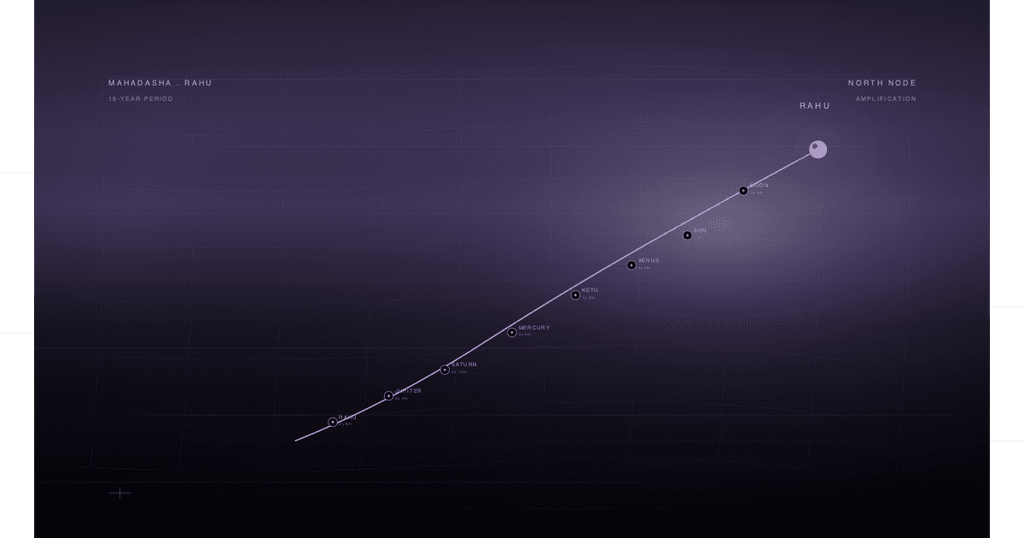
The 18-year Rahu mahadasha divides into nine antardasha sub-periods in fixed Vimshottari order starting with Rahu itself. The Sun sub-period sits at position 7 of 9. Exact start and end dates for any chart can be computed from the natal Moon nakshatra-pada and the date of Rahu mahadasha onset. The Tempora dasha engine produces this to the day.
Friendship status and pairing reading
In the classical Parashari friendship matrix, Rahu views Sun as enemy. The enemy-pair classification means the 10 months 24 days sub-period classically delivers outcomes through friction between Rahu's register (worldly desire, foreign-axis, amplification, taboo and the boundary-crossing register) and Sun's register (authority, identity, the father-line, dignified-recognition and the visible self). Classical guidance suggests sustained-effort and patience over decisive-action during enemy-pair sub-periods. Events surface through the friction rather than around it.
The Sun karaka overlay
Sun is the karaka of authority, identity, the father-line, dignified-recognition and the visible self. Across the 10 months 24 days sub-period, this karaka set overlays on top of Rahu's 18-year worldly desire, foreign-axis, amplification, taboo and the boundary-crossing register register. The combined reading is the central output of the sub-period.
How Sun's natal dignity shapes the reading
Sun's natal sign and house set the floor for the 10 months 24 days sub-period. Sun at exaltation gives the strongest reading. Own-sign and mooltrikona placement gives clean expression. Debilitation introduces friction that the sub-period must work through. Combust and retrograde state, conjunctions with malefics or benefics and the dispositor's strength all further modulate the reading. See the Sun mahadasha overview for the per-dignity breakdown.
Event classes typical to Rahu-Sun sub-period
The 10 months 24 days Rahu mahadasha Sun antardasha typically surfaces events across these specific domains:
- Friction between Rahu-register and Sun-register: enemy-pair sub-periods classically require careful navigation. Events surface through the friction rather than around it.
- Events in Sun's natural karaka domain: authority, identity, the father-line, dignified-recognition and the visible self.
- Events specific to the natal house Sun occupies in the chart.
- Events where the Rahu-mahalord and Sun-antarlord houses (both natal and ruled) interact (aspect, mutual reception or natal conjunction).
What the framework does not predict
The framework reads structural pressure on the authority axis. It does not predict that a specific native will experience a specific identity-axis confrontation, father-axis event or institutional friction on a specific date inside the 0.9-year band.
It does not predict outcome direction. Whether an identity-axis confrontation resolves through clarification or escalation, whether a father-axis event reads as growth or loss, whether an institutional friction settles favourably, is not specified by the structural-pressure reading.
It does not predict timing finer than the sub-period band without the pratyantara overlay and the transit cross-check.
How Rahu-Sun connects to the broader Mahadasha
Rahu-Sun is the seventh sub-period and sits in the late second half of the 18-year Rahu Mahadasha. The earlier sub-periods (Rahu through Venus) consumed the first 14.55 years and established the Mahadasha's patterns: identity-reset (Rahu-Rahu), dharma-friction (Rahu-Jupiter), structural contraction (Rahu-Saturn), commerce amplification (Rahu-Mercury), dissolution (Rahu-Ketu) and partnership-and-luxury amplification (Rahu-Venus). The Rahu-Sun authority-axis pressure tests these accumulated patterns under the chart's primary self-representation domain.
The classical reading treats Rahu-Sun as structurally diagnostic rather than productive. The sub-period often produces the inflection events that test the patterns established in earlier sub-periods: whether the foreign-axis career direction built in Rahu-Mercury holds under authority-axis scrutiny, whether the partnership patterns from Rahu-Venus survive identity-axis pressure, whether the dissolution from Rahu-Ketu produced clean ground for the second-half patterns. The sub-period is a check on the Mahadasha's coherence before the closing sub-periods.
The arithmetic of this period
The Sun holds 6 of the 120 Vimshottari years, the smallest share of any lord, so its sub-period inside Rahu's 18 runs 18 multiplied by 6 divided by 120: 0.9 years, about 10 months and 24 days. It occupies position 7 of 9. The six sub-periods before it total 14.55 years, which places Rahu-Sun across roughly years 14.55 to 15.45 of the mahadasha. Its brevity is itself a datum when set against its neighbours, since it follows the 3-year Venus antardasha and precedes the 1.5-year Moon antardasha; the mahadasha compresses sharply here, running its last three lords in barely more time than the Venus period took alone.
Arriving this late matters: an antardasha in years 14 and 15 of eighteen addresses a native whose Rahu-era life is largely built, so the authority questions it raises tend to concern standing and recognition within that structure rather than new departures. The cycle-level view is in the Rahu mahadasha overview, and the Sun's own 6-year major period is described in the Sun mahadasha article.
Reading this pairing in the classical sources
The BPHS antardasha chapters, Rahu mahadasha section, are noticeably restrained about this sub-period even in the favourable case: a Sun exalted, in own sign, in the eleventh or in a kendra or trikona is promised cordial relations with the king, increase of wealth and grain, some popularity and the possibility of heading a village, a modest list by the chapter's standards. The promises widen when the Sun keeps company with the lord of the lagna, the second or the tenth, where the text assigns reputation, state support, foreign journeys and ambitions fulfilled. A debilitated Sun, or one in the sixth, eighth or twelfth from the dasha lord, is given fevers, dysentery, quarrels and royal antagonism, while good placement from the dasha lord earns recognition from foreign sovereigns. Where the Sun carries maraka lordship the text attaches health cautions and prescribes Sun worship as remedy. Phaladeepika, in its chapter on the sub-divisions of dashas, runs uniformly dark here, listing trouble from enemies, eye pain and danger from poison, fire and weapons, so the two sources diverge in emphasis: what Mantreswara fixes as a single adverse list, Parashara distributes across conditions of dignity and placement, and that structural difference between the two texts repeats across many pairings. The engine takes both records as inputs and lets the natal Sun's condition arbitrate between them.
This period against the 2026 to 2028 sky
The Sun's dated event in this window is the solar eclipse of 12 August 2026 on the Cancer-Leo cusp, and an eclipse is precisely the Rahu-Sun encounter in the sky, the node crossing the luminary this pairing dramatises. A native running Rahu-Sun over that date has the sub-period's central myth enacted overhead, which classical writers would read as a marked intensification of its authority and visibility themes. The limits are firm, because an eclipse lasts hours, is visible to part of one hemisphere and belongs to no single chart, so it can mark a season of an eleven-month sub-period without dating any event in it. The nodal ingress of 27 December 2026, Rahu into Capricorn and Ketu into Cancer until 15 July 2028, moves the mahadasha lord as well, read through the houses those signs hold from the natal ascendant. Natal condition again does the sorting: a Sun exalted in Aries or seated in its own Leo meets the enemy sub-period with dignity intact, while a Sun debilitated in Libra or closely conjunct natal Rahu gives the eclipser more to work with. Whether any of this touches a given chart in those years is a question for the birth data, since most natives running Rahu-Sun will do so nowhere near 2026.
Frequently asked questions
How long is the Rahu Mahadasha Sun Antardasha and where does it fall in the Vimshottari sequence?
The Rahu Mahadasha Sun Antardasha runs exactly 0.9 years (10 months 24 days). It is the seventh sub-period inside the 18-year Rahu Mahadasha. The Vimshottari sub-period order is Rahu, Jupiter, Saturn, Mercury, Ketu, Venus, Sun, Moon, Mars. The native is approximately 14 years 7 months into the Rahu Mahadasha when Rahu-Sun opens and the sub-period closes at approximately 15 years 5 months into the Mahadasha. Exact start and end dates depend on natal Moon nakshatra-pada and the date the Rahu Mahadasha opened.
Why is Rahu-Sun called the authority-axis pressure window?
Sun is the karaka of authority, identity, father, government and the central self. Sun rules the public-prestige axis and the chart's primary self-representation domain. Rahu amplifies whatever planet runs concurrent dasha alignment with it. The classical reading of Rahu-Sun is structurally distinct from other Rahu sub-periods because Rahu and Sun are mutual enemies in the classical planetary friendship system. The combination produces friction rather than clean amplification. The sub-period typically reads as pressure on authority-axis domains: identity-axis confrontations, father-axis events, public-prestige inflections, government or institutional friction. The 0.9-year duration is short, which concentrates the pressure rather than spreading it across a longer band.
How does Sun's natal dignity shape the Rahu-Sun sub-period reading?
Sun's natal house, sign and aspectual state set the floor for the 0.9-year sub-period. Sun exalted in Aries, in own sign Leo or in angular houses (1st, 4th, 7th, 10th) substantially modulates the reading toward identity-axis maturation, durable career inflections in authority-axis work and father-axis events that strengthen rather than destabilise. Sun debilitated in Libra or under malefic aspect amplifies the friction reading and produces more complicated authority-axis events: prestige-axis losses, identity-axis confrontations, father-axis health or relationship friction. Sun aspected by Jupiter softens the reading and brings dharmic clarity into the authority decisions. Sun conjoined or aspected by Rahu in the natal chart compounds the sub-period intensity because the dasha lord (Rahu) and the antardasha lord (Sun) are already linked by natal aspect, the classical Surya-Rahu eclipse-axis configuration.
What kinds of events historically correlate with Rahu-Sun sub-periods?
The classical Parashari reading associates Rahu-Sun with several event classes: identity-axis confrontation events (career-axis identity conflicts, public-image inflections, the surfacing of identity questions the native had not addressed), father-axis events (father's health changes, father-axis relationship transitions, paternal-line family events), government and institutional friction events (regulatory issues, formal authority confrontations, institutional-process disruptions) and public-prestige inflections where the native's standing with authority figures or institutions shifts. The Tempora framework reads the sub-period as a structural-pressure window for these classes of event rather than a deterministic predictor. Rahu's amplification often gives these events boundary-crossing context.
How does this sub-period connect to the broader Rahu Mahadasha?
Rahu-Sun is the seventh sub-period of the 18-year Rahu Mahadasha. It opens after the Rahu-Venus partnership-and-luxury amplification (3 years, the longest single sub-period) and closes into Rahu-Moon emotional processing. By the time Rahu-Sun opens, the native has been through the foundational and middle phases of the Mahadasha. The Rahu-Sun authority-axis pressure often produces the inflection events that test the patterns established in earlier sub-periods: whether the foreign-axis career direction built in Rahu-Mercury holds under authority-axis scrutiny, whether the partnership patterns from Rahu-Venus survive identity-axis pressure, whether the dissolution from Rahu-Ketu produced clean ground for the second-half patterns. The sub-period is structurally diagnostic rather than productive.
What does the Tempora framework not predict about this sub-period?
The framework identifies a 0.9-year structural-pressure window with elevated conditional probability for Sun-axis event classes. It does not predict whether a specific native will experience a specific identity-axis confrontation, father-axis event or institutional friction in that window. It does not predict outcome direction (whether an identity-axis confrontation resolves through clarification or escalation, whether a father-axis event reads as growth or loss). It does not predict timing finer than the sub-period band without the pratyantara overlay and the transit cross-check. The classical readings carry historical and conventional weight, but the framework treats them as structural-pressure flags to be cross-checked against transit data and chart-specific natal Sun dignity, not as deterministic forecasts.
Which years of the Rahu mahadasha does the Sun antardasha cover?
Roughly years 14.55 to 15.45. The duration is 18 multiplied by 6 divided by 120, which is 0.9 years, about 10 months and 24 days, the shortest sub-period of the nine. The six sub-periods before it sum to 14.55 years, and the 1.5-year Moon antardasha follows. A native who entered the mahadasha at 30 runs Rahu-Sun between about 44.55 and 45.45.
Why is the 12 August 2026 solar eclipse relevant to the Rahu-Sun antardasha?
A solar eclipse is the sky enacting exactly the pairing this sub-period runs: the node crossing the Sun. The 12 August 2026 eclipse falls on the Cancer-Leo cusp, and a native whose Rahu-Sun overlaps that date would classically read it as an intensifier of the period's authority and visibility themes, located by the houses Cancer and Leo occupy from the natal ascendant. An eclipse is a brief, hemisphere-wide event, so it cannot time a personal outcome, and only charts whose Vimshottari clock actually places Rahu-Sun across mid 2026 are concerned at all.
What do the classical texts say about Rahu-Sun?
The BPHS antardasha chapters, Rahu mahadasha section, keep the favourable case modest, cordiality with the king, wealth and grain increase and possible village headship, widening only when the Sun joins the lords of the lagna, second or tenth, and turning to fevers, quarrels and royal antagonism when the Sun is debilitated or badly placed from the dasha lord, with health cautions and Sun worship attached where maraka lordship applies. Phaladeepika, in its chapter on the sub-divisions of dashas, is uniformly dark, listing enemy trouble, eye pain and danger from poison, fire and weapons, so the emphasis of the two texts diverges on this pairing. The engine accepts both positions as inputs conditioned on the natal Sun.
Read next
- Rahu Mahadasha Moon Antardasha · the emotional-axis sub-period that opens after Sun
- Rahu Mahadasha Venus Antardasha · the partnership-and-luxury sub-period that closes before Sun
- Rahu Mahadasha Mars Antardasha · the closing sub-period of the Mahadasha
- Calibrated lift astrology · the methodology behind the conditional-probability claim
- Mars Mahadasha: how to read the 7-year period
This article represents conventional Vedic teaching and Tempora Research method documentation. It does not constitute financial, legal or professional advice. Internal audit log maintained.