Yogini dasha explained: the 36-year alternative to Vimshottari
Yogini dasha is the 8-yogini, 36-year alternative dasha system that runs alongside Vimshottari. The shorter cycle gives short-window precision that Vimshottari's longer periods do not. Mechanics, sub-period structure and how Tempora uses Yogini as a precision overlay on the main mahadasha framework.
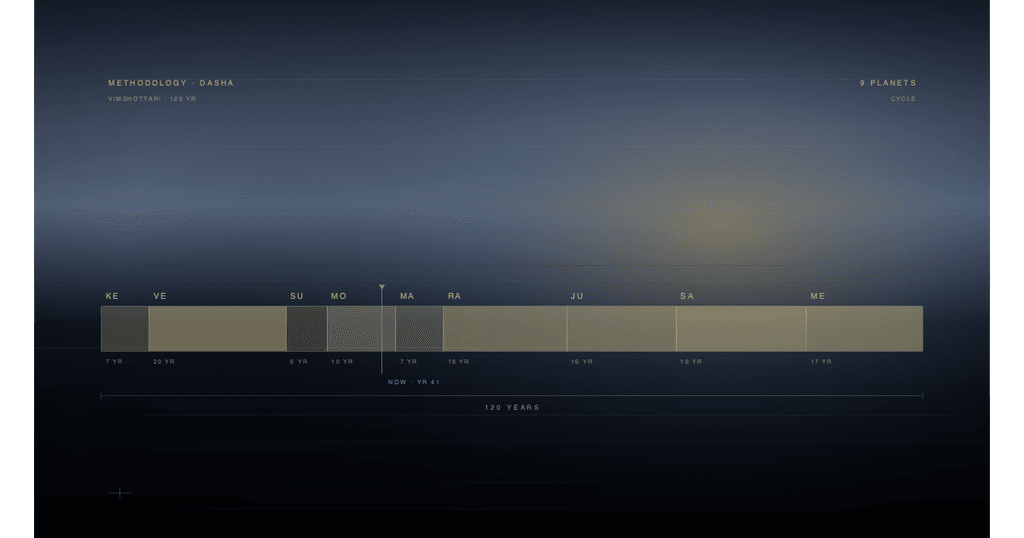
Most English-language Vedic astrology defaults to Vimshottari dasha as the primary timing system. The 120-year, 9-graha Vimshottari is the most widely documented dasha system in the Parashari tradition and the one most contemporary practitioners use as their primary timing framework. But Vimshottari is one of several dasha systems described in the classical literature and the others give different timing windows on the same chart.
Yogini dasha is the most widely used alternative dasha system. It runs 36 years across 8 periods called yoginis, each ruled by a planet and named for a classical quality. The shorter cycle gives short-window precision that Vimshottari's longer periods do not and the system is the primary timing framework in several north Indian and tantric astrology traditions.
The 8 yoginis and their ruling planets
The 8 yoginis are named for classical Sanskrit qualities. Each carries a duration in years, a ruling planet and a classical event-shape association.
| Yogini | Years | Ruling planet | Classical signification |
|---|---|---|---|
| Mangala | 1 | Moon | Auspicious openings, emotional-axis beginnings |
| Pingala | 2 | Sun | Authority, prestige, identity-axis events |
| Dhanya | 3 | Jupiter | Wealth, learning, expansion |
| Bhramari | 4 | Mars | Travel, competition, confrontation |
| Bhadrika | 5 | Mercury | Commerce, communication, balanced activity |
| Ulka | 6 | Saturn | Obstruction, separation, structural pressure |
| Siddha | 7 | Venus | Accomplishment, partnership, refinement |
| Sankata | 8 | Rahu | Crisis, amplification, boundary-crossing pressure |
The cycle totals 36 years (1+2+3+4+5+6+7+8) and repeats. Most natives experience two full Yogini cycles in a typical lifetime, with the second cycle running through middle age and into late life.
How the opening yogini is calculated
The opening yogini for any chart is calculated from the natal Moon's nakshatra. The 27 nakshatras are distributed across the 8 yoginis on a rotating basis. Ashwini (the first nakshatra) opens Mangala. Bharani opens Pingala. Krittika opens Dhanya. The rotation continues through the 8 yoginis and back to Mangala for the 9th nakshatra (Ashlesha) and so on.
The longitude of the Moon within its nakshatra determines how much of the opening yogini has already elapsed at birth. A native born with the Moon at the start of Ashwini has the full Mangala yogini ahead. A native born with the Moon at the end of Ashwini has only a small fraction of Mangala remaining and will transition to Pingala soon after birth.
The remaining portion of the opening yogini runs from birth to the first yogini transition. After that, each successive yogini runs its full period in sequence, cycling through the 8 yoginis indefinitely.
The sub-period structure inside each yogini
Each major yogini contains sub-periods called antar-yogini. The sub-yoginis follow the same 8-yogini sequence as the major periods, but the opening sub-yogini inside any major yogini is the major yogini itself.
So Mangala mahayogini opens with Mangala sub-yogini, then Pingala, Dhanya, Bhramari and so on through the 8-yogini cycle. Sankata mahayogini opens with Sankata sub-yogini, then Mangala, Pingala and so on.
The proportional duration of each sub-period follows the same formula as Vimshottari antardashas. Major-yogini years multiplied by sub-yogini years, divided by 36 (the total yogini cycle). For Sankata mahayogini (8 years total), the Sankata sub-yogini runs 8 multiplied by 8 divided by 36, which equals 1.78 years. The Mangala sub-yogini inside Sankata runs 8 multiplied by 1 divided by 36, which equals 0.22 years (about 80 days).
Sub-yoginis give a second level of timing granularity inside the 36-year framework. The Tempora framework reads sub-yoginis the same way it reads Vimshottari antardashas: structural-pressure windows on the ruling planet's domains, modulated by the natal dignity of the ruling planet and the broader transit context.
How Yogini differs from Vimshottari in practice
Both systems take the natal Moon's nakshatra as their primary input. Both produce a sequence of periods that runs across the native's life. Both follow a structural pattern where each period is ruled by a planet and the period's event-shape is shaped by that planet's natal dignity.
The differences are in the period lengths and the underlying planet set.
Period length. Vimshottari periods range from 6 years (Sun) to 20 years (Venus). Yogini periods range from 1 year (Mangala, Moon) to 8 years (Sankata, Rahu). Yogini's shorter periods give finer event-timing windows. A 6-year Vimshottari Sun mahadasha contains roughly two complete Yogini transitions.
Planet set. Vimshottari uses 9 grahas: Sun, Moon, Mars, Mercury, Jupiter, Venus, Saturn, Rahu, Ketu. Yogini uses 8 ruling planets: Moon, Sun, Jupiter, Mars, Mercury, Saturn, Venus, Rahu. Ketu is not represented as a Yogini ruling planet, which is a structural difference that affects how the south-node axis reads in the two systems.
Starting formula. Vimshottari's opening dasha is determined by which nakshatra group the natal Moon falls in (Ashwini, Magha and Mula open with Ketu; Bharani, Purvaphalguni and Purvashada open with Venus; and so on). Yogini's opening yogini is determined by the position of the Moon's nakshatra in a different ordering (Ashwini opens Mangala, Bharani opens Pingala and so on). The two systems open at different points in their respective cycles for the same chart.
Cumulative cycle. Vimshottari's full 120-year cycle exceeds most human lifespans, so most natives experience at most one complete Vimshottari cycle. Yogini's 36-year cycle repeats two or three times in a typical lifetime, which gives the system a different long-term structural reading.
How Tempora reads Yogini as a precision overlay
The Tempora framework uses Vimshottari as the primary dasha system. The calibration corpus is built on Vimshottari periods and most classical predictive literature aligns with Vimshottari. Yogini dasha is used as a precision overlay for two specific cases.
Short-cycle event timing. When the Vimshottari sub-period is long (the longest is Saturn-Venus at 3.16 years) and the chart-state needs finer granularity, Yogini's shorter periods give a second timing window that often falls within the Vimshottari sub-period. The convergence of Vimshottari sub-period and Yogini period on the same event-shape gives a narrower window than either system gives alone.
Corroborative reading. When the Vimshottari mahadasha-antardasha indication is ambiguous (multiple natal patterns could fire, the dispositor analysis is mixed, the natal dignity of the dasha lord is moderate rather than strong or weak), Yogini provides a second independent timing read. If both systems flag the same event-shape and the same approximate window, the confidence in the indication is meaningfully higher than from Vimshottari alone.
The two systems are not strictly statistically independent. Both take the natal Moon nakshatra as the common input, so a chart that has a strong Moon-axis pattern in Vimshottari often has a related Moon-axis pattern in Yogini. But the period structures and starting formulas are different enough that the timing windows often diverge and the convergence-or-divergence pattern between the two systems is an empirical input the framework uses.
When the framework does not use Yogini
Yogini dasha is not used as the primary timing system in Tempora's framework. Three reasons.
First, the calibration corpus that scores Tempora's structural signatures is built on Vimshottari periods. The Monte Carlo baselines, the event-set sizes and the lift figures all reference Vimshottari mahadasha-antardasha alignment. Running the same calibration on Yogini periods would require building a parallel calibration corpus, which has not been done.
Second, the contemporary predictive literature in English is heavily Vimshottari-oriented. Cross-referencing readings against published material is structurally easier in Vimshottari. The Yogini literature is largely in Sanskrit and Hindi sources and the English-language documentation is sparse.
Third, the Yogini system is the primary dasha in some tantric and ritual contexts where the framework's analytical mode does not always apply. The shorter cycle and the named-quality framing of the yoginis lends itself to ritual-axis interpretation that operates differently from the structural-pressure-window framing the Tempora framework uses.
None of these reasons argues against using Yogini at all. They argue for using it as an overlay where the additional precision is useful, while the primary framework remains anchored in Vimshottari.
The verse trail: Yogini dasha in Brihat Parashara Hora Shastra 46.195 to 199
The version of Yogini dasha that can be verified against a fetched classical text sits in chapter forty-six of the Brihat Parashara Hora Shastra, verses 195 to 199, read in the Ranjan Publications English translation (the R. Santhanam edition). The passage attributes the system to Lord Mahadeva and lists the eight yoginis in one sequence with their lords and year counts: Mangala under the Moon for one year, Pingala under the Sun for two, Dhanya under Jupiter for three, Bhramari under Mars for four, Bhadrika under Mercury for five, Ulka under Saturn for six, Siddha under Venus for seven and Sankata under Rahu for eight.
The starting rule in the same verses is arithmetic. Add three to the number of the janma nakshatra, divide by eight and read the remainder against the yogini sequence: remainder one gives Mangala, remainder two gives Pingala and so on, with remainder zero pointing to the eighth yogini, Sankata. The text carries its own worked example. Mrigashira is the fifth nakshatra; five plus three is eight; eight divided by eight leaves no remainder, so the dasha opens in Sankata. The balance of the opening yogini at birth is worked out proportionally from the elapsed and total time of the Moon in the janma nakshatra, the same Bhayat and Bhabhog procedure the chapter uses for its nakshatra dashas.
Two honesty notes belong beside that rule. First, the verse arithmetic and the direct table printed earlier on this page give different openings for some nakshatras. The direct-table convention starts Ashwini at Mangala; the verse formula sends Ashwini (nakshatra one, plus three, remainder four) to Bhramari. Both conventions circulate in practice. The verse formula is the one read in the fetched text and the worked example above is the text's own. Second, the thirty-six-year cycle total is derived arithmetic. The passage lists the eight year counts; summing one through eight to thirty-six is our addition and the verses read do not spell that total out as a sentence.
The input grain is worth stating in dated terms. The Moon crosses one nakshatra roughly every day on its 27.3-day circuit, so the janma nakshatra, the single input this start rule consumes, changes about daily and the elapsed fraction within it changes hour by hour. Two births a day apart routinely open in different yoginis. That sensitivity is shared with Vimshottari, which reads the same Moon position through a different mapping, and it is why the framework treats birth-time quality as a first-order concern for either clock. Yogini remains one timing frame among several here; the survey at which dasha system to use places it beside the alternatives without ranking any of them as the sole method.
Frequently asked questions
What is Yogini dasha in Vedic astrology?
Yogini dasha is an 8-period dasha system that runs a 36-year cycle. Each period is called a yogini and is ruled by a specific planet. The eight yoginis in order are: Mangala (1 year, ruled by Moon), Pingala (2 years, Sun), Dhanya (3 years, Jupiter), Bhramari (4 years, Mars), Bhadrika (5 years, Mercury), Ulka (6 years, Saturn), Siddha (7 years, Venus) and Sankata (8 years, Rahu). The cycle totals 36 years (1+2+3+4+5+6+7+8) and repeats. Yogini dasha is described in Narada Purana, Tantric texts and several classical Vedic astrology handbooks and is most commonly used in north Indian and tantric traditions.
How is Yogini dasha different from Vimshottari dasha?
Vimshottari dasha runs 120 years across 9 grahas with the periods ranging from 6 years (Sun) to 20 years (Venus). Yogini dasha runs 36 years across 8 yoginis with the periods ranging from 1 year (Mangala) to 8 years (Sankata). The two systems give different timing windows for the same chart. Vimshottari is the primary timing system in most south Indian and Parashari traditions; Yogini is the primary timing system in some north Indian traditions and is used as a secondary overlay in others. The cycles are independent: any given birth date opens at a specific point in each cycle and the two run alongside each other through life. Tempora's framework uses Vimshottari as the primary system and reads Yogini as a precision overlay for short-cycle event timing.
How is the opening Yogini calculated for a chart?
The opening Yogini and the elapsed portion are calculated from the natal Moon's nakshatra. The standard formula assigns each of the 27 nakshatras to one of the 8 yoginis on a rotating basis (Ashwini opens Mangala, Bharani opens Pingala, Krittika opens Dhanya and so on through the cycle, with the rotation continuing past Sankata back to Mangala for the next nakshatra). The longitude of the Moon within its nakshatra determines how much of the opening yogini has already elapsed at birth. The remaining portion of the opening yogini runs from birth to the first yogini transition. The next yogini in sequence then runs its full period and so on through the cycle.
What does each yogini classically signify?
The eight yoginis carry classical event-shape associations from their names and ruling planets. Mangala (Moon, 1 year) reads as auspicious openings and emotional-axis beginnings. Pingala (Sun, 2 years) reads as authority, prestige and identity-axis events. Dhanya (Jupiter, 3 years) reads as wealth, learning and expansion. Bhramari (Mars, 4 years) reads as travel, competition and confrontation. Bhadrika (Mercury, 5 years) reads as commerce, communication and balanced activity. Ulka (Saturn, 6 years) reads as obstruction, separation and structural pressure. Siddha (Venus, 7 years) reads as accomplishment, partnership and refinement. Sankata (Rahu, 8 years) reads as crisis, amplification and boundary-crossing pressure. The actual reading for any chart depends on the yogini's ruling planet's natal dignity and the specific transit context at the time the yogini fires.
When does Tempora use Yogini dasha instead of Vimshottari?
Tempora uses Vimshottari as the primary dasha system because the calibration corpus is built on Vimshottari periods and most classical predictive literature aligns with it. Yogini dasha is used as a precision overlay for two specific cases: short-cycle event timing where the Vimshottari sub-period is long and the chart-state needs finer granularity and corroborative reading where the Vimshottari mahadasha-antardasha indication is ambiguous and a second independent timing system confirms or refutes the indication. Both systems are run on the same natal Moon nakshatra, so they are not independent in the strict statistical sense, but the period structures are different enough that the timing windows often differ and the convergence or divergence between the two systems gives useful precision.
What is the sub-period structure inside each yogini?
Each yogini contains sub-periods (antar-yogini) of the same 8-yogini structure scaled to the major yogini's duration. The order of sub-yoginis inside any major yogini follows the same Mangala-Pingala-Dhanya-Bhramari-Bhadrika-Ulka-Siddha-Sankata sequence starting from the major yogini itself. So Sankata mahayogini opens with Sankata sub-yogini, then Mangala, Pingala and so on. The proportional duration of each sub-period is calculated the same way as Vimshottari antardashas: major-yogini-years multiplied by sub-yogini-years, divided by 36 (the total yogini cycle). The sub-periods give a second level of timing granularity inside the 36-year framework.
Where is Yogini dasha described in a classical text?
The verifiable classical source read for this page is the Brihat Parashara Hora Shastra, chapter forty-six, verses 195 to 199, in the Ranjan Publications English translation. The passage attributes the system to Lord Mahadeva, lists the eight yoginis with their lords and year counts from Mangala under the Moon (one year) to Sankata under Rahu (eight years) and gives the starting rule: add three to the janma nakshatra number, divide by eight and read the remainder against the yogini sequence, with remainder zero pointing to Sankata. The thirty-six-year total is derived by summing the eight listed year counts; the verses read list the counts without stating the total. Yogini dasha is one timing frame among several and is read beside Vimshottari, never as a replacement for it.
Read next
- Jaimini Chara dasha explained · another alternative dasha system based on sign rotation
- Dasha sandhi junction periods · how to read transition windows between dashas
- Moon nakshatra prediction · the nakshatra-axis input that both Vimshottari and Yogini use
- Calibrated lift astrology · the methodology behind the calibration claim
- Saturn Mahadasha: how to read the 19-year period
This article represents conventional Vedic teaching and Tempora Research method documentation. It does not constitute financial, legal or professional advice. Internal audit log maintained.