Rahu Mahadasha for Aquarius Ascendant: Rahu on Home Ground
Aquarius is the one rising sign where Rahu arrives sounding like a native speaker. The chart is Saturn-ruled air: already unconventional, already network-first, already sceptical of inherited rules. The node's 18 years amplify a register this chart never had to learn.
Why this pairing reads differently
In most charts the node's period is an interruption. An Aries rising gets ambushed by appetite for things Mars never planned. A Cancer rising watches the node unsettle a Moon-run household. An Aquarius rising recognises the visitor. The lagna belongs to Saturn in its airy sign, the register of systems, collectives and deliberate distance from convention, and several lineages outside the Parashari mainstream go further and hand Rahu partial lordship of the sign itself. The Vimshottari framework does not use that assignment, and no house in this chart answers to Rahu. But the temperament fit is real, and it is the singular fact of this pairing: nodal amplification with no identity crisis attached.
The cost of fluency is that nothing feels foreign enough to trip an alarm. A Capricorn rising experiences nodal overreach as a violation of its own sequence, a friction described in Rahu Mahadasha for Capricorn Ascendant, and a Pisces rising meets it as pressure on a dissolving boundary, the mechanism of Rahu Mahadasha for Pisces Ascendant. Here escalation simply feels like more of oneself. Excess arrives as a slow drift, not an announcement, which is why the audit points inside this period matter more for Aquarius risings than for anyone else.
The lordship grid underneath the period
Whole-sign rulerships for an Aquarius lagna, the rows Rahu can borrow:
| Lord | Houses ruled | Register |
|---|---|---|
| Saturn | 1st and 12th | Self-definition bound to retreat and loss |
| Jupiter | 2nd and 11th | Savings joined to gains: the money spine |
| Mars | 3rd and 10th | Initiative joined to career |
| Venus | 4th and 9th | Foundation joined to fortune: the classical yogakaraka for Aquarius risings |
| Mercury | 5th and 8th | Speculation joined to the vault |
| Moon | 6th alone | Service, health routines, dispute |
| Sun | 7th alone | Partnership and the public other |
Three pairings define the economy of this chart. Jupiter holding the 2nd and 11th means one planet owns both ends of the income pipeline. Saturn holding the 1st and 12th means the self shares a lord with the archive of loss, which is why withdrawal phases are constitutional for this rising rather than pathological. And Venus joining an angle to a trine makes it the yogakaraka, the chart's single most constructive agent. Whichever of these disposits natal Rahu sets the dominant storyline of the 18 years.
The sub-periods that carry the plot
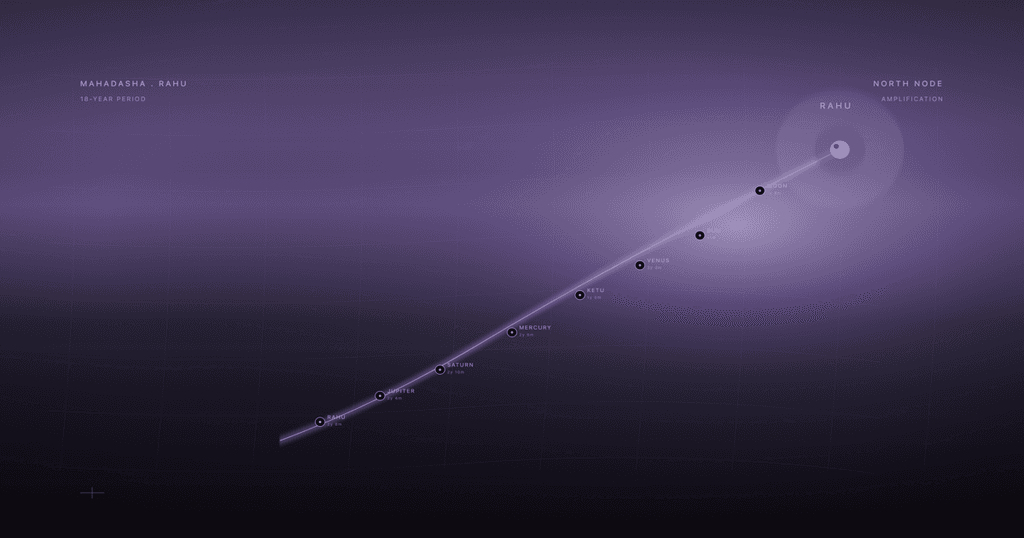
The order never varies: Rahu, Jupiter, Saturn, Mercury, Ketu, Venus, Sun, Moon, Mars. Full duration arithmetic sits in the Vimshottari calculator and reference table. Five stretches matter most for this rising.
Rahu-Rahu, 2 years 8 months 12 days
The natal statement, delivered without translation. Because the chart offers the node so little resistance, the opening years often pass without the disorientation other risings report, which makes it easy to miss that the volume has already gone up.
Rahu-Jupiter, 2 years 4 months 24 days
The wealth window. Both money houses answer to the activated lord at once, so income lines multiply and networks begin to monetise. The caution is nodal in flavour: gains built on leverage during these years get re-priced later, in Rahu-Mercury.
Rahu-Saturn, 2 years 10 months 6 days
The strangest stretch this rising gets. Saturn is lagna lord and 12th lord at once, so the longest sub-period braids self-redefinition with retreat: sabbaticals, foreign postings, hospital corridors, back-office years, ashram time. Rarely comfortable, frequently the most valuable years of the period in hindsight.
Rahu-Mercury, 2 years 6 months 18 days
The 5th and 8th under nodal pressure: speculation meets the vault. Positions taken in the Jupiter window get stress-tested here. Research, depth study and joint-asset renegotiation cluster in this stretch.
Rahu-Venus, 3 years 0 months 0 days
The yogakaraka stretch and the longest. Property, vehicles, the mother, mentors, doctrine and publishing all sit in Venus's 4th-9th portfolio, and the sub-period tends to settle what the earlier windows churned. For many Aquarius risings these are the quietly decisive years.
Of the remainder, Rahu-Mars (1 year 1 month 18 days) deserves its own note: Mars rules the 3rd and 10th, so the closing months of the whole period often deliver a compressed career event. Rahu-Sun (10 months 24 days) spotlights the 7th, partnership decisions under authority pressure. Rahu-Moon (1 year 6 months) runs through the 6th, workload and health routines. Rahu-Ketu (1 year 18 days) is the axis pulling taut before Venus begins.
Natal seats that help, natal seats that strain
Reasoned from the rulership table above, not from generic node lore:
- 11th house (Sagittarius). Jupiter disposits the node into its own gains portfolio. The cleanest wealth signature this rising can hand Rahu.
- 10th house (Scorpio). Mars disposits; career amplification with an investigative or technical edge, backed by the 3rd-house initiative Mars also rules.
- 9th house (Libra). The yogakaraka disposits. Fortune, teachers, publication and long journeys carry the period.
- 8th house (Virgo). Demanding. Mercury's 5th-8th portfolio folds back on the vault: speculative losses and joint-asset turbulence are the standard classical readings.
- 6th house (Cancer). The Moon rules the 6th and disposits from inside it, doubling the dispute-and-health register, though the house's improve-under-pressure character rewards natives who take on the fight deliberately.
- 12th house (Capricorn). Saturn disposits and drags the lagna lord's loss-side portfolio forward: expense and exile themes, softened only when the chart genuinely lives abroad.
Each line is a structural prior. Conjunctions within orb and the navamsha regularly overturn them.
The 2026-2028 sky note
Rahu transits Capricorn from 27 Dec 2026 to 15 Jul 2028. For Aquarius risings that is a 12th-house passage: the node moving through the sign behind your lagna, classically a season of expenses, foreign stays and endings that clear space, and the immediate prelude to Rahu arriving on the Aquarius lagna itself in mid-2028. Charts running Rahu mahadasha at the same time tend to taste the withdrawal texture of Rahu-Saturn even outside that sub-period. The year's structural windows for this rising are laid out in Aquarius Ascendant 2027, with the full wheel compared in 2027 by Ascendant.
Limits, stated plainly
The affinity argument is a temperament claim, not a measurement. No counted case set shows Aquarius risings running statistically smoother Rahu periods, and this page will not pretend one exists; the dated calls Tempora is willing to be wrong about live on the Tracker. Natal specifics outrank everything written here: degree, nakshatra, conjunctions within orb and the navamsha all sit above the lagna-level grid. Vimshottari is also one dasha framework among several that disagree about when this period even runs, a disagreement Which Dasha System walks through. To see your own sequence computed rather than inferred, Kaal returns engine dates against a stated ayanamsa. And the south node's period, shorter and inverse in method, is read at Ketu Mahadasha for Aquarius Ascendant.
Frequently asked
Does Rahu co-rule Aquarius and does that change the mahadasha?
Some lineages assign Rahu co-lordship of Aquarius alongside Saturn. The Vimshottari framework this page uses does not: Rahu rules no houses for any ascendant and its period is read through its dispositor and natal house. What the tradition preserves is a temperament fit. The node's unconventional, network-hungry register matches the Saturn-aired lagna, so the period tends to feel fluent for this rising rather than foreign.
Which antardasha brings money for Aquarius ascendant in Rahu mahadasha?
Rahu-Jupiter, 2 years 4 months 24 days, is the classical wealth window because Jupiter rules both the 2nd and the 11th for this rising, savings and gains under a single activated lord. The follow-through matters: Rahu-Mercury afterwards runs the 5th and 8th and stress-tests whatever leverage the Jupiter years took on.
What is the hardest stretch of Rahu mahadasha for Aquarius risings?
Structurally, Rahu-Mercury: the 5th and 8th together put speculation and joint assets under nodal pressure. Experientially, often Rahu-Saturn: the longest sub-period binds the lagna lord to its 12th-house portfolio, so nearly three years carry a withdrawal and expense texture. Neither is uniformly negative; the Saturn years in particular tend to look valuable in hindsight.
Where is natal Rahu strongest for an Aquarius ascendant?
By lordship reasoning the 11th (Sagittarius) is the cleanest seat: Jupiter disposits the node into its own gains portfolio. The 10th (Scorpio, Mars dispositor) and the 9th (Libra, dispositored by yogakaraka Venus) follow. The 8th (Virgo) and the 6th (Cancer) are the demanding seats, doubling the vault and dispute registers respectively.
What does the 2026-2028 Rahu transit in Capricorn do for Aquarius risings?
From 27 Dec 2026 to 15 Jul 2028 the node moves through your 12th house. Classically a quiet passage: expenses, foreign stays, back-stage work and endings that clear space. It is also the immediate prelude to Rahu crossing the Aquarius lagna itself from mid-2028, so directions set during 2027 tend to get amplified in the transit that follows.
Is Rahu mahadasha good for career for an Aquarius ascendant?
The career carrier here is Mars, ruling the 3rd and 10th. A Mars-dispositored Rahu, meaning the natal node in Aries or Scorpio, makes profession the period's main theme, and the closing Rahu-Mars antardasha often compresses a visible career event into its final 13-plus months. With other dispositors the career effect runs second to whichever houses that planet rules.
Read next
This page reads the Vimshottari Rahu mahadasha through the standard Parashari whole-sign rulerships for Aquarius ascendant. Rahu's co-lordship of Aquarius in some lineages is noted as tradition, not used in computation. Venus's yogakaraka status follows the angle-trine rule. Sub-period lengths follow the standard proportional decomposition. Engine: Swiss Ephemeris with True Pushya Paksha (PVRN Rao) ayanamsa. Temperament and affinity claims are classical readings, not measured results. This article does not constitute medical, financial, legal or professional advice. First published 2026-05-21 by Tempora Research.