Rahu Mahadasha for Libra Ascendant: the Yogakaraka Receives the Longest Sub-period
Libra rising is the diplomat sign, cardinal air, ruled by Venus, oriented outward. Rahu is a shadow that borrows every register it works through. Yet this ascendant holds one of the four charts in the zodiac where a single planet owns an angle and a trine at once, and the eighteen years turn on the fact that the node hands its longest sub-period to precisely that planet.
A diplomat chart with one exceptional ally
Lay out the whole-sign lordships first. From a Libra lagna: Venus rules the 1st and 8th, Mars the 2nd and 7th, Jupiter the 3rd and 6th, Saturn the 4th and 5th, Mercury the 9th and 12th, the Moon the 10th and the Sun the 11th. The headline is the Saturn line. A single planet holding an angle and a trine together is what the older writers called yogakaraka, the constructive-and-fortunate configuration a chart can inherit, and for Libra risings that planet is Saturn.
Venus as lagna lord sets the temperament: relational, aesthetic, negotiation-oriented, allergic to overt aggression. Rahu is the opposite register: hunger, boundary-crossing, willingness to burn what refuses to move. When the node's period arrives in a Libra-rising life the usual shape is prolonged consultation that finally resolves into a single decisive step, rather than the continuous outward motion a fire chart would produce. The diplomatic temperament is not obstacle to the mahadasha, it is what channels the amplifier's force into deliberate moves rather than reactive ones.
Note what Venus carries besides the 1st: the 8th, the house of transformation, joint resources and other people's money. The ascendant lord doubling as 8th lord is a specific structural fact of Libra risings, and it means personal identity is tied to the transformation channel by design. Rahu amplifying Venus themes amplifies both sides of that ledger.
What the node borrows here
Rahu holds no lordship in the Parashari scheme, for Libra risings or anyone else. Its eighteen years are furnished by three things it does not own: the house it occupies at birth, the planet ruling the sign it occupies and whoever shares that house with it. The luckiest borrowings for this ascendant are the Saturn-ruled ones, since Saturn holds fortune and home together for this chart. A natal Rahu in Capricorn or Aquarius hands the amplifier to the yogakaraka, and the whole period inherits that orientation.
Everything else on this page describes the fixed scaffolding every Libra rising shares. What a person actually lives through comes from the natal chart alone.
Walking the sub-periods
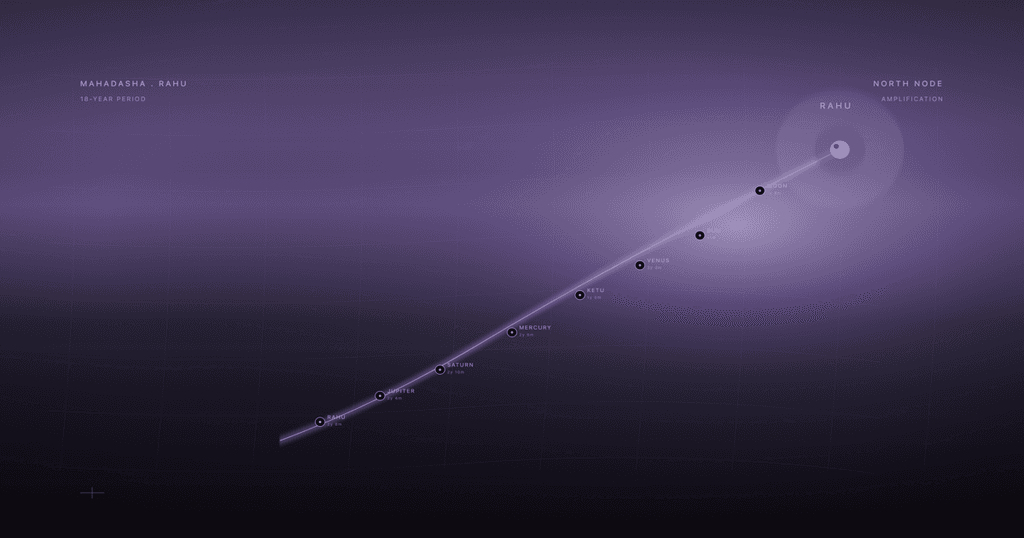
Nine antardashas fill the mahadasha in fixed order, the node first. Durations are universal; the third column belongs to Libra risings only.
| Antardasha | Runs for | What it owns from a Libra lagna |
|---|---|---|
| Rahu-Rahu | 2y 8m 12d | No lordship, pure occupancy. Natal Rahu's house sets the opening theme. |
| Rahu-Jupiter | 2y 4m 24d | 3rd and 6th: initiative, courage, service and health load. |
| Rahu-Saturn | 2y 10m 6d | 4th and 5th: home, education and children from the chart's yogakaraka. |
| Rahu-Mercury | 2y 6m 18d | 9th and 12th: fortune paired with loss and distance under one lord. |
| Rahu-Ketu | 1y 0m 18d | The counterweight. Whatever the first eight years amplified gets pruned. |
| Rahu-Venus | 3y 0m 0d | 1st and 8th: the native's own agenda, carrying the transformation load. |
| Rahu-Sun | 0y 10m 24d | 11th: gains and elder-network in a brief window. |
| Rahu-Moon | 1y 6m 0d | 10th: career and public position amplified for eighteen months. |
| Rahu-Mars | 1y 1m 18d | 2nd and 7th: money and partnership close the cycle under Mars energy. |
Four of these deserve prose.
Rahu-Saturn is the anchor. Saturn as yogakaraka owning the 4th and the 5th means the amplifier reaches home, property, education and children through one dignified lord at once. Where natal Saturn is well-placed, the Saturn sub-period is where the durable base of the eighteen years actually gets built. Where natal Saturn is compromised, the same houses take the strain and the yogakaraka fires as friction rather than fortune.
Rahu-Jupiter arrives before Saturn and sets a specific texture. Jupiter's houses here are the 3rd and the 6th, initiative and service, one upachaya and one dusthana. The Jupiter sub-period for this ascendant is where courage and workload accumulate together, and the tradition reads it as the period in which the native's routine reshapes to accommodate the amplified 3rd-house impulses.
Rahu-Mercury pairs fortune with expenditure. Mercury holds the 9th and the 12th from a Libra lagna, the classical fortune house alongside the classical loss-and-foreign house. This is the stretch that either delivers a genuine foreign or spiritual pivot or drains the fortune account through the same door.
Rahu-Mars closes the cycle. Mars owns the 2nd and 7th, so the last year of the mahadasha runs partnership and money together under a natural malefic. The tradition treats this as the settling-of-accounts stretch: partnerships and finances resolve into the configuration they will carry into the next mahadasha.
Placements that help and placements that fight
Reasoning from lordships, the friendliest homes for natal Rahu in a Libra-rising chart:
- 4th house (Capricorn). The node occupies home while Saturn, its dispositor, owns home and creativity. Property, base of operations and long-form projects become the constructive engine of the eighteen years.
- 5th house (Aquarius). The mirror: node in the trine of creativity, disposited by the yogakaraka. Speculation, teaching and children matter compound.
- 10th house (Cancer). The Moon as dispositor owns the 10th itself, so career and public visibility get a clean channel.
The placements that demand the most:
- 8th house (Taurus). Venus as dispositor owns the 1st and 8th, doubling the transformation channel with the native's own identity. Joint finances and rupture become the standing subject of the eighteen years.
- 12th house (Virgo). Mercury as dispositor owns the 9th and 12th; fortune and loss run together under one lord. Foreign relocation is the productive form of this signature.
- 7th house (Aries). Rahu in the marriage house with Mars as dispositor, and Mars ruling the 2nd and 7th, doubles the partnership-and-money exposure. Partnership matters carry the load.
Each line above is a structural prior. A strong aspect, a benefic conjunction or a contrary divisional chart can outvote any of them.
Late 2026: the node reaches the fourth
Transit Rahu enters Capricorn on 27 December 2026, which from a Libra lagna is the 4th house, Saturn's territory and the yogakaraka's own sign. For Libra risings inside Rahu dasha periods at that point, dasha and transit converge on the home-and-education axis for the roughly eighteen months that follow. The sign-specific walk for this ascendant is at Libra ascendant 2027; the broader map is 2027 by ascendant.
The limits of an ascendant-only reading
This page knows your rising sign and nothing else. It cannot see natal Rahu's house or sign, the dignity of its dispositor, its companions or the divisional charts that qualify all of them, and those unknowns are the majority of the reading. Nor can it see when the eighteen years run for you: that comes from the Moon's nakshatra at birth, which places some Libra risings in Rahu dasha as children and others never. A page like this describes the stage. It has not seen the play.
Vimshottari is one timing system among several that the tradition kept alive in parallel. Tempora's reasons for computing it first, and what the alternatives change, are set out in which dasha system.
Dates, tools and the scoreboard
To find where the Rahu years fall in a specific life, start from the Vimshottari reference table, which carries the nakshatra-to-lord lookup. The Kaal engine runs the full computation from birth details, Swiss Ephemeris under the True Pushya Paksha ayanamsa, down to sub-sub-periods. Tempora's dated public calls built on this machinery sit on the tracker with falsifiers attached, because a timing method that cannot be scored is a mood, not a method.
This mahadasha under the 2026 to 2028 sky for Libra rising
Rahu differs from every planetary period lord in one practical way: it moves slowly enough that its sign chapters carry dates. A Libra rising inside the eighteen years can therefore watch the period lord itself in motion. Until 27 December 2026 transit Rahu walks Aquarius, the 5th house from this lagna, amplifying speculation, students, children matters and creative output from a Saturn-ruled sign. On 27 December 2026 the node steps into Capricorn, the 4th house, and holds it until 15 July 2028: home, property, vehicles and the inner base become the amplified terrain. Both chapters keep the transiting dasha lord inside Saturn's signs, which for this chart means the period lord answers to the yogakaraka as transit dispositor for the whole window. Ketu mirrors the walk from Leo, the 11th, until 27 December 2026, then from Cancer, the 10th, so the south node's pruning register touches gains and networks first, public position after.
The slow benefic sets the second layer. Jupiter sits exalted in Cancer from 27 May 2026 to 19 June 2027, the 10th house from a Libra lagna: a dignified benefic crossing the career angle for roughly thirteen months. It tastes Leo, the 11th, from 23 October 2026 to 3 February 2027 and settles there from 19 June 2027, shifting the emphasis from position to gains. The 12 August 2026 solar eclipse falls on the Cancer-Leo cusp, the 10th-11th seam of this chart, and the classical election rule Tempora's corpus keeps is to finish work inside an eclipse shadow and start new work after it.
Saturn, the planet this whole page turns on, has its own calendar. It stays in Pisces, the 6th house, until 23 May 2027: service load, health maintenance and debt discipline, a workmanlike posting for the chart's most constructive lord. On 23 May 2027 it enters Aries, the 7th, placing the yogakaraka in the marriage house in the sign classical lists treat as its fall. It retreats into Pisces on 4 November 2027 and re-enters Aries to stay on 11 February 2028, so partnership questions opened in mid 2027 get a second pass before they settle. For a native inside the Rahu-Saturn antardasha these dates carry double weight, since the sub-period lord and the transiting planet are one and the same.
Every line above is a colouring, and the colouring is the smaller force. Which antardasha is running decides how much of this sky a given native actually meets: a Libra rising in Rahu-Venus reads the same dates differently from one in Rahu-Saturn. Sign-level houses also say nothing about degrees, and degree contact is the strength dial; the corpus example is a Jupiter contact computed to 0.05 of a degree. The nodal chapter itself, sign by sign, is mapped at Rahu in Capricorn, Ketu in Cancer 2027 to 2028.
Frequently asked
Why does the Saturn antardasha matter so much for Libra ascendant?
Because of what Saturn owns from this lagna. For Libra risings Saturn rules the 4th and the 5th, an angle and a trine from one planet, which the tradition calls yogakaraka. When Rahu hands 2 years 10 months and 6 days to that Saturn, the amplifier reaches home, property, education and children through one constructive lord. Whether the sub-period delivers depends on natal Saturn's dignity, but structurally no other stretch inside Rahu Mahadasha concentrates as much upside for this ascendant.
Is Rahu Mahadasha a wealth period for Libra ascendant?
Money is not the natural theme, transformation is. Venus rules the 1st and the 8th for Libra risings, so lagna-lord Venus sub-periods activate identity together with joint resources and rupture rather than earned income. The clearest money stretch is Rahu-Mars (1 year 1 month 18 days) which touches the 2nd, but it does so under Mars energy at the close of the eighteen years, so the tradition reads it as settlement rather than accumulation.
What does Rahu-Mars antardasha do for a Libra ascendant?
Mars is the 2nd and 7th lord from a Libra lagna, so its sub-period pairs the money house with the marriage house under a natural malefic. In practice the tradition reads this closing stretch as the resolution phase of the eighteen years: partnership status and financial position settle into what they will carry forward. Because Mars aspects heavily, this year is where accumulated tensions release, well or badly.
Is Rahu in Aries a problem for Libra risings?
Aries is the 7th house from a Libra ascendant, the marriage house. Placing the amplifier in the partnership house of the diplomat sign with Mars (the natural warrior) as dispositor is a demanding signature: it puts fire in the room designed for balance. The tradition reads it as partnership-heavy years, either through a spouse who catalyses radical change or through the native's own restless departures from partnership. It is also exactly the kind of claim that needs the full chart, because a strong Mars or a benefic aspect can revise it substantially.
When will a Libra ascendant person enter Rahu Mahadasha?
The ascendant has no say in it. The Vimshottari clock starts from the Moon's nakshatra at birth and runs the nine periods in fixed order, so the Rahu years can fall in childhood, midlife or not at all within a lifetime. The dates come from the birth time and the Moon, which is why this page discusses structure and leaves timing to computation.
Which classical sources define Vimshottari and the Rahu period?
Brihat Parashara Hora Shastra chapters 46 to 50 lay out the framework: the 120-year total, the nine planetary shares, the antardasha proportions and the nakshatra-to-starting-lord lookup. Phaladeepika by Mantreshwara adds per-planet interpretive depth. Jataka Parijata and Saravali provide cross-tradition validation. Tempora computes Vimshottari via Swiss Ephemeris under the True Pushya Paksha ayanamsa; the reasons are set out in the ayanamsa methodology page linked from the sidebar.
Where does transit Rahu sit for Libra risings between 2026 and 2028?
In Aquarius, the 5th house from a Libra lagna, until 27 December 2026, then in Capricorn, the 4th house, from 27 December 2026 to 15 July 2028. Both are Saturn-ruled signs, so a Libra rising running Rahu Mahadasha has the period lord transiting the yogakaraka's territory for the whole window: speculation, students and creative work first, home and property after. The houses name the terrain and the natal chart decides the scale, because an ascendant-only page cannot see which antardasha runs or where natal Rahu sits.
Read next
This article is a method reference for the Vimshottari Rahu Mahadasha applied to Libra ascendant. The house-rulership map follows the standard Parashari (Brihat Parashara Hora Shastra chapters 46-50) framework. Yogakaraka identification follows the kendra-trine connection rule with lagna-lord override. Kendradhipati Dosha applies only to natural benefics. Antardasha durations are the standard Vimshottari proportional decomposition. Engine: Swiss Ephemeris with True Pushya Paksha (PVRN Rao) ayanamsa. Internal audit log maintained. This article does not constitute medical, financial, legal or professional advice. First published 2026-05-21 by Tempora Research.