Rahu Mahadasha for Taurus Ascendant: the Saturn Sub-period Carries the Years
Taurus rising is the temperament least like Rahu in the zodiac: fixed, accumulative, loyal to what already works. The node deals in rupture and appetite. Yet this ascendant holds an asset none of the other earth signs can match, a single planet owning both the 9th and the 10th, and the eighteen years turn on whether the amplifier finds its way to that planet.
A fixed chart with one exceptional ally
Lay out the whole-sign lordships first. From a Taurus lagna: Venus rules the 1st and 6th, Mercury the 2nd and 5th, the Moon the 3rd, the Sun the 4th, Mars the 7th and 12th, Jupiter the 8th and 11th and Saturn the 9th and 10th. That last line is the headline. One planet holding an angle and a trine together is what older writers considered the best functional arrangement an ascendant can receive, and for Taurus risings that planet is Saturn.
Venus as lagna lord sets the temperament: sensory, patient, possession-oriented, slow to abandon anything it has built. Rahu's method is the opposite, discard and leap. When the node's period arrives in a Taurus-rising life, the usual shape is long resistance followed by one large, irreversible move rather than the continuous churn a mutable chart would produce. The fixity is not an obstacle to the mahadasha; it is what forces the mahadasha to concentrate its force into a few big events instead of many small ones.
Note also what Venus carries besides the 1st: the 6th, the house of service, debt, illness and daily grind. The ascendant lord doubling as 6th lord means even this chart's most personal periods keep a workload attached. Rahu amplifying Venus themes amplifies both sides of that ledger.
What the node borrows here
Rahu holds no lordship in the Parashari scheme, for Taurus risings or anyone else. Its eighteen years are furnished by three things it does not own: the house it occupies at birth, the planet ruling the sign it occupies and whoever shares that house with it. The practical consequence for this ascendant is simple to state: the luckiest borrowings are the Saturn-ruled ones. A natal Rahu in Capricorn or Aquarius hands the amplifier to the same planet that owns fortune and career, and the whole period inherits that orientation.
Everything else on this page describes the fixed scaffolding every Taurus rising shares. The furniture, which is what a person actually lives through, comes from the natal chart alone.
Walking the sub-periods
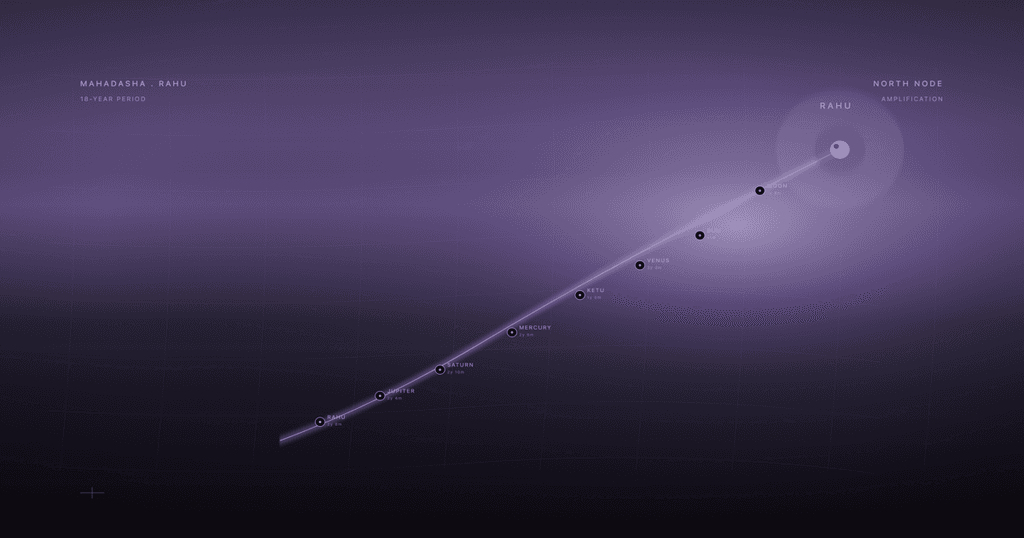
Nine antardashas fill the mahadasha in fixed order, the node first. Durations are universal; the third column belongs to Taurus risings only.
| Antardasha | Runs for | What it owns from a Taurus lagna |
|---|---|---|
| Rahu-Rahu | 2y 8m 12d | No lordship, pure occupancy. Natal Rahu's house becomes the opening theme. |
| Rahu-Jupiter | 2y 4m 24d | 8th and 11th: gains braided with joint assets, inheritance and exposure. |
| Rahu-Saturn | 2y 10m 6d | 9th and 10th: fortune and career from the chart's best functional planet. |
| Rahu-Mercury | 2y 6m 18d | 2nd and 5th: earned money, speech, speculation and creative intelligence. |
| Rahu-Ketu | 1y 0m 18d | The counterweight. Accumulations of the first eight years get pruned. |
| Rahu-Venus | 3y 0m 0d | 1st and 6th: the native's own agenda, carrying its service and health load. |
| Rahu-Sun | 0y 10m 24d | 4th: home, property and the private base in a brief window. |
| Rahu-Moon | 1y 6m 0d | 3rd: initiative, siblings, writing and short movement. |
| Rahu-Mars | 1y 1m 18d | 7th and 12th: partnership and distance close out the cycle. |
Four of these deserve prose.
Rahu-Saturn is the anchor. For most ascendants the node handing its longest working stretch to Saturn reads as grind; for Taurus risings it reads as the amplifier finally reaching the planet that owns the 9th and the 10th at once. Where natal Saturn is dignified, this is the window in which position, reputation and long-term direction get built to last. Where natal Saturn is afflicted, the same houses take the strain. Either way the Saturn sub-period is the axis the other eight rotate around.
Rahu-Jupiter arrives before it and sets a trap worth naming. Jupiter's houses here are the 11th and the 8th, gains and ruptures under one signature. The Jupiter sub-period for this ascendant is where windfalls, settlements, inheritances and partner capital show up, and also where exposure to other people's liabilities peaks. The tradition would counsel structure over momentum in precisely these months.
Rahu-Mercury is the cleanest money stretch: the 2nd and the 5th, earning and speculation, under a quick dispositor-friendly lord. For commercially minded Taurus risings this is often the most legible part of the whole period, income tracking effort with less of the 8th-house static.
Rahu-Venus gives the ascendant lord three full years. Self-definition, body, appearance and personal projects amplify, and so does the 6th-house freight Venus carries for this rising sign: workload, service obligations and health maintenance. The tradition reads lagna-lord sub-periods as the native's own chapters. Here the native's own chapter comes with a duty roster.
Placements that help and placements that fight
Reasoning from lordships, the friendliest homes for natal Rahu in a Taurus-rising chart:
- 9th house (Capricorn). The node occupies fortune while Saturn, its dispositor, owns fortune and career. Borrowing and occupancy reinforce each other. Long journeys, doctrine and mentors become engines rather than detours.
- 10th house (Aquarius). The mirror case: node in the career house, disposited by the career-and-fortune lord. Visibility compounds across the period.
- 5th house (Virgo). Mercury as dispositor owns the 2nd and 5th, so speculation, creative work and children-related themes are backed by the money axis.
The placements that demand the most:
- 8th house (Sagittarius). The dispositor Jupiter itself owns the 8th, doubling the house. Joint finances and upheaval become the standing subject of the eighteen years.
- 12th house (Aries). Mars as dispositor owns the 7th and 12th; loss and distance are amplified twice over. Emigration is the productive expression of this signature.
- 7th house (Scorpio). Several classical lists place the node's fall in Scorpio, and here that fall lands in the marriage house with a 12th-lord dispositor. Partnership matters carry the load.
Each line above is a structural prior. A strong aspect, a benefic conjunction or a contrary divisional chart can outvote any of them.
Late 2026: the node reaches the ninth
Transiting Rahu enters Capricorn on 27 December 2026, which from a Taurus lagna is the 9th house, Saturn's territory. For Taurus risings inside Rahu dasha periods at that point, dasha and transit converge on the fortune axis for the roughly eighteen months that follow. What that year weighs for each rising sign is mapped in 2027 by ascendant; the sign-specific walk is at Taurus ascendant 2027.
The limits of an ascendant-only reading
This page knows your rising sign and nothing else. It cannot see natal Rahu's house or sign, the dignity of its dispositor, its companions or the divisional charts that qualify all of them, and those unknowns are the majority of the reading. Nor can it see when the eighteen years run for you: that comes from the Moon's nakshatra at birth, which places some Taurus risings in Rahu dasha as children and others never. A page like this describes the stage. It has not seen the play.
Vimshottari is also one timing system among several that the tradition kept alive in parallel. Tempora's reasons for computing it first, and what the alternatives change, are set out in which dasha system.
Dates, tools and the scoreboard
To find where the Rahu years fall in a specific life, start from the Vimshottari reference table, which carries the nakshatra-to-lord lookup. The Kaal engine runs the full computation from birth details, Swiss Ephemeris under the True Pushya Paksha ayanamsa, down to sub-sub-periods. Tempora's dated public calls built on this machinery sit on the tracker with falsifiers attached, because a timing method that cannot be scored is a mood, not a method.
This mahadasha under the 2026 to 2028 sky for Taurus rising
Because the node crawls, its sign chapters carry dates, and a Taurus rising inside the eighteen years can watch the period lord move. Until 27 December 2026 transit Rahu occupies Aquarius, the 10th house from this lagna: career and public position take the amplification, from a sign owned by the very planet this page calls the chart's best functional lord. On 27 December 2026 the node enters Capricorn, the 9th house, and stays until 15 July 2028, shifting the amplified terrain to fortune, teachers, publishing and long journeys while keeping Saturn as transit dispositor. The whole window therefore keeps the dasha lord inside the 9th-and-10th lord's own signs, the same axis the Rahu-Saturn antardasha works for this ascendant. Ketu opposes from Leo, the 4th, until 27 December 2026, pruning at home and property, then from Cancer, the 3rd, where the tradition reads the south node as easier company.
Jupiter's calendar gives the window its precision benchmark. From 27 May 2026 to 19 June 2027 Jupiter sits exalted in Cancer, the 3rd house from a Taurus lagna: initiative, writing, siblings and self-driven effort under a dignified benefic. The corpus example of what degree-level work adds sits on this very lagna: on the India 1947 chart, itself Taurus rising, the engine logged transit Jupiter exact on natal Mercury on 5 August 2026 at an orb of 0.05 degrees, the kind of contact a sign-level page can only gesture at. Jupiter tastes Leo, the 4th, from 23 October 2026 to 3 February 2027 and settles there from 19 June 2027: home and property under the benefic's full attention. The 12 August 2026 solar eclipse falls on the Cancer-Leo cusp, the 3rd-4th seam of this chart.
Saturn itself, the planet whose sub-period anchors these eighteen years, sits in Pisces, the 11th house, until 23 May 2027: gains, networks and elder circles under the 9th-and-10th lord, a classically constructive posting. On 23 May 2027 it enters Aries, the 12th, moving the register to expenditure, distance and quiet consolidation; it retreats into Pisces on 4 November 2027, giving the gains house a second pass, and re-enters Aries to stay on 11 February 2028. A native running Rahu-Saturn reads all three dates twice, as sub-period and as transit.
The limits are the same as everywhere on this page. These are sign-level colourings; which antardasha runs, where natal Rahu sits and what the divisional charts say decide the actual weight, and the ascendant alone reveals none of it. The nodal chapter is mapped sign by sign at Rahu in Capricorn, Ketu in Cancer 2027 to 2028.
Frequently asked
Why does the Saturn antardasha matter so much for Taurus ascendant?
Because of what Saturn owns from this lagna. For Taurus risings Saturn rules the 9th and the 10th, a trine and an angle from one planet, which is the classical definition of the most constructive functional lord a chart can have. When Rahu hands 2 years 10 months and 6 days to that Saturn, the amplification is routed through fortune and career simultaneously. Whether it delivers depends on natal Saturn's condition, but structurally no other sub-period concentrates as much upside for this ascendant.
Is Rahu Mahadasha a wealth period for Taurus ascendant?
It can be, through two different doors. Mercury rules the 2nd and 5th for Taurus risings, so the Rahu-Mercury stretch (2 years 6 months 18 days) touches earned income and speculative or creative gains. Jupiter rules the 8th and 11th, so Rahu-Jupiter (2 years 4 months 24 days) mixes large gains with volatility, inheritance themes and other people's money. Neither door opens by default. Natal placement of Rahu, Mercury and Jupiter decides which door exists at all.
What does Rahu-Jupiter antardasha do for a Taurus ascendant?
Jupiter is the 8th and 11th lord from a Taurus lagna, so its sub-period pairs the gains house with the house of ruptures, joint assets and inheritance. In practice the tradition reads this stretch as financially eventful in both directions: money arriving through others (settlements, payouts, partners) and money exposed through others. It rewards conservative structuring more than momentum.
Is Rahu in Scorpio a problem for Taurus risings?
Scorpio is the 7th house from a Taurus ascendant, and several classical lists treat Scorpio as the node's sign of debilitation. That combination places a weakened amplifier in the marriage and partnership house, with a dispositor (Mars) that also owns the 12th. The tradition reads it as a demanding placement for partnership matters. It is also exactly the kind of claim that needs the full chart, since aspects, conjunctions and the navamsa can revise it substantially.
When will a Taurus ascendant person enter Rahu Mahadasha?
The ascendant has no say in it. The Vimshottari clock starts from the Moon's nakshatra at birth and runs the nine periods in fixed order, so the Rahu years can fall in childhood, midlife or not at all within a lifetime. The dates come from the birth time and the Moon, which is why this page discusses structure and leaves timing to computation.
What changes for Taurus risings when Rahu enters Capricorn in late 2026?
From 27 December 2026 the transiting node occupies Capricorn, the 9th house from a Taurus lagna and one of the two houses owned by this chart's best functional planet. Natives running Rahu dasha periods get a transit echo on the fortune axis: teachers, long journeys, publishing and belief systems. It is a weighting, not a promise, and Tempora logs such calls where they can be scored.
How does Saturn's 2027 sign change land for Taurus risings in Rahu Mahadasha?
Saturn holds Pisces, the 11th house of gains from a Taurus lagna, until 23 May 2027, then enters Aries, the 12th house of expenditure and distance. It retreats into Pisces from 4 November 2027 to 11 February 2028 before settling in Aries until 2030, so the gains house gets a second Saturn pass before the 12th-house chapter hardens. For a native inside the Rahu-Saturn antardasha the dates carry double weight, since the sub-period lord and the transiting planet are the same body. The size of the effect is a natal-chart question this page cannot answer from the ascendant alone.
Read next
Structural reference for the Vimshottari Rahu period read against the whole-sign lordships of one rising sign. The angle-plus-trine rule used to describe Saturn's role follows the standard functional-benefic convention of the Parashari corpus. Sub-period lengths are the classical proportional shares of the 120-year cycle. Engine: Swiss Ephemeris, True Pushya Paksha (PVRN Rao) ayanamsa. Statements attributed to the tradition are reported positions, not measured findings. This article does not constitute medical, financial, legal or professional advice. First published 2026-05-21 by Tempora Research.