Rahu Mahadasha for Cancer Ascendant: Appetite in a Moon Chart
A Cancer rising chart answers to the Moon, the most protective of the nine grahas. Rahu is the opposite instinct: slow, hungry and indifferent to safety. When the 18-year Rahu mahadasha opens here, an amplifier with no kingdom of its own starts broadcasting through a structure built for shelter.
An amplifier inside a security-first chart
Most mahadasha readings start from lordship: the houses a period lord owns for a given rising sign define what its years are about. Rahu breaks the method. The north node owns nothing in the Parashari scheme, so there is no entry to look up under its name. It borrows instead, taking the agenda of its dispositor, the planet ruling the sign it occupies, and the domain of whatever house holds it, then returning both with the gain turned up.
For Cancer risings that borrowed signal lands in a distinctive environment. The Moon rules the lagna and only the lagna, and its entire portfolio is the self: body, temperament, the felt sense of safety. Lunar charts consolidate. They secure the home, keep people close and price every decision in emotional cost. Rahu prices nothing in emotional cost. Over 18 years it asks this chart to want what the Moon never budgeted for: unfamiliar ground, visibility, scale. The period is not automatically destabilising, but many Cancer risings experience it as appetite and security taking turns at the wheel.
What Rahu borrows, house by house
Since the node can only speak through the seven planetary lords, the whole-sign assignments for Cancer risings are the actual vocabulary of these 18 years.
- The Moon holds the 1st house alone.
- The Sun holds the 2nd: family wealth, food and speech.
- Mercury holds the 3rd and the 12th: effort and expenditure in one portfolio.
- Venus holds the 4th and the 11th: home, vehicles and comfort tied to gains and networks.
- Mars holds the 5th and the 10th. A trine and an angle from one planet make Mars the classical yogakaraka for Cancer risings, the most constructive lord this chart has.
- Jupiter holds the 6th and the 9th: fortune and teachers sharing a desk with debt, disease and disputes.
- Saturn holds the 7th and the 8th: partnership joined to the house of shocks and shared assets.
Run a natal Rahu through that table and the generic label disappears. In Scorpio or Aries the node answers to Mars, and the period takes on yogakaraka colouring, career and creative ambition amplified. In Taurus or Libra it answers to Venus and pulls the home-and-gains axis forward. In Capricorn or Aquarius it answers to Saturn and drags the 7th-8th portfolio to the centre. One mahadasha name, three unrecognisably different lives.
Where the node sits well, and where it grinds
Cooperative seats
- The 11th, Taurus. The dispositor is Venus, itself lord of the 4th and 11th, so occupant and dispositor point at the same target: gains. An upachaya house also suits a node, since these houses reward accumulation over time.
- The 10th, Aries. Mars the yogakaraka disposits, and the node's appetite for visibility gets a legitimate stage.
- The 3rd, Virgo. The house of self-made effort is comfortable terrain for a graha that improvises, though dispositor Mercury drags a thread of the 12th along with it.
Abrasive seats
- The 8th, Aquarius. Saturn disposits from its 7th-8th portfolio, stacking the amplifier onto the most volatile houses this lagna has.
- The 12th, Gemini. The node's foreign-lands signification often reads literally here, with expenditure attached.
- The 1st, Cancer itself. The Moon disposits its own tenant. Appetite occupies the security seat directly, and the mahadasha becomes an identity question rather than an achievement question.
Five antardashas do the heavy lifting
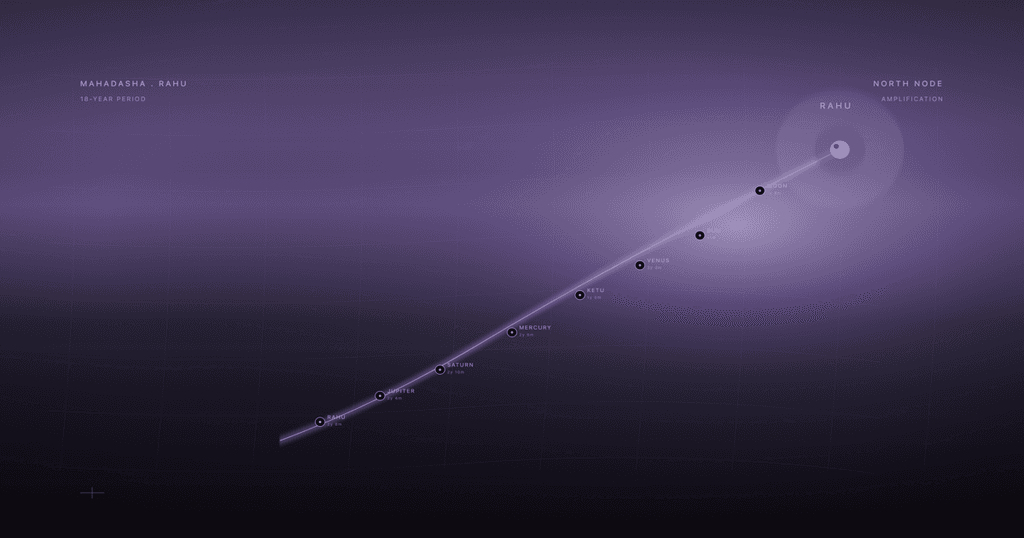
All nine sub-periods run in fixed order and fixed proportion; the complete sequence sits in the Vimshottari calculator and reference table. Five of them carry most of the structural weight for this lagna.
Rahu-Saturn, 2 years 10 months 6 days
The longest sub-period of the eighteen years. Saturn answers for the 7th and 8th here, so the amplifier presses on marriage, business partnership, joint finances and inheritance-class events. Classical authors treat node-plus-Saturn combinations as heavy, and for this lagna the house portfolio agrees with them. Charts with a sound natal Saturn tend to experience restructuring; afflicted ones, attrition.
Rahu-Venus, 3 years
The longest antardasha in absolute terms and, for Cancer risings, usually the most generous, since Venus owns both the 11th of gains and the 4th of home. Property acquired far from the birthplace, income through networks and domestic upgrades all belong to this window's typical register.
Rahu-Jupiter, 2 years 4 months 24 days
Jupiter's 9th-house lordship supplies the traditional benefic window: mentors, journeys, doctrine. Its 6th-house lordship rides along, so litigation and health-service themes belong to the same sub-period. The two faces frequently arrive together, a promotion and a dispute in the same year.
Rahu-Moon, 1 year 6 months
The lagna lord under the node's grip. Eighteen months in which the security question turns personal: residence, mother, emotional load. Cancer risings often report this as the most subjectively intense stretch even though it is far from the longest.
Rahu-Mars, 1 year 1 month 18 days
The yogakaraka closes the mahadasha. A short, kinetic window in which the 5th and 10th houses fire, often delivering the career consolidation the earlier years only promised, before the handover to the Jupiter mahadasha that follows.
The remaining four run Rahu-Rahu (2 years 8 months 12 days) at the opening, then Rahu-Mercury (2 years 6 months 18 days), Rahu-Ketu (1 year 0 months 18 days) and Rahu-Sun (10 months 24 days). None is trivial; they are simply less structurally loaded for this particular rising sign.
What this page cannot claim
Sign-level dasha writing has hard limits, and it is better to state them than bury them. First, nothing above is a statistical result. It is standard Parashari lordship logic applied to one rising sign, and classical inference is not the same thing as measured frequency. Second, Vimshottari is one of several dasha frameworks; which dasha system to use covers how they disagree and why. Third, natal placement outranks everything here: a Cancer rising with Rahu in the 8th and one with Rahu in the 11th share almost nothing except a headline. Fourth, dasha dates inherit birth-time error, so a lagna can be right while antardasha boundaries drift by months. Where Tempora publishes dated, falsifiable calls, they live on the Tracker with their conditions attached. This page is background, not a forecast.
Finding your own window
Whether the Rahu mahadasha is behind you, running now or decades away depends on the Moon's nakshatra at birth and nothing else. The reference table linked above shows the lookup. For an engine-computed sequence against your own birth data, Kaal generates the full mahadasha and antardasha timeline, and the imprint box below this article reaches the same engine. The instructive contrast is one sign over: the same node produces an entirely different period for Leo risings, where it faces the Sun's lagna instead of the Moon's.
Frequently asked
Is Rahu mahadasha good or bad for Cancer ascendant?
Neither by default. Rahu owns no houses for any rising sign, so it carries no fixed benefic or malefic charge for Cancer risings. The period takes its quality from natal Rahu's house, its dispositor and its conjunctions. A Rahu answering to Mars or Venus, the two most constructive lords for this lagna, tends toward a productive period. A Rahu tied to Saturn's 7th-8th portfolio, or seated in the 8th or 12th, tends toward a demanding one.
Does Rahu act like a yogakaraka for Cancer risings?
Not on its own. The classical yogakaraka for Cancer risings is Mars, which owns the 5th and 10th houses. Rahu can borrow that quality when it occupies a Mars-ruled sign, Aries or Scorpio, or sits conjunct Mars, because the node amplifies its dispositor's agenda. That is conditional borrowed strength, not a standing status.
What does the Rahu-Saturn antardasha bring for Cancer ascendant?
It is the longest sub-period of the mahadasha at 2 years 10 months 6 days, and for this lagna Saturn rules the 7th and 8th houses. Typical themes are pressure on marriage or business partnership, restructuring of joint finances and events in the inheritance and shared-asset class. Natal Saturn's condition decides whether it lands as consolidation or attrition.
Which is the best antardasha of Rahu mahadasha for Cancer risings?
On lordship logic, Rahu-Venus at 3 years has the strongest material case, since Venus rules the 4th and 11th, and Rahu-Mars at 1 year 1 month 18 days has the strongest career case, since Mars is the yogakaraka. Rahu-Jupiter is traditionally favoured but carries Jupiter's 6th-house lordship for this lagna alongside its 9th. All three rankings bend to the natal chart.
How does Rahu mahadasha differ from Ketu mahadasha for Cancer ascendant?
The nodes run opposite programs. Rahu's 18 years amplify worldly appetite through whichever house and dispositor hold it. Ketu's 7 years withdraw energy from its own seat and push the chart toward release and interiority. For a Moon-ruled lagna, Rahu typically stresses the security instinct through expansion and Ketu stresses it through detachment.
When do the heaviest years of the 18 usually fall for Cancer risings?
On the house logic of this lagna, the Rahu-Saturn stretch is the structural test, and the neighbouring Rahu-Jupiter window can run dispute themes through Jupiter's 6th lordship at the same time as its 9th-house gifts. That places the demanding band roughly in the middle third of the mahadasha for most charts, subject always to natal placement and to eclipses striking the natal nodal axis.
Read next
This page is a method reference: the standard whole-sign lordship assignment for a Cancer lagna, read against the node's dispositor logic. Mars holds yogakaraka status for this rising sign under the usual trine-and-angle rule. Antardasha durations are the fixed Vimshottari proportions of the 18-year span. Interpretive claims are classical, drawn from the BPHS lineage, and are not event statistics. Computation: Swiss Ephemeris with True Pushya Paksha (PVRN Rao) ayanamsa. Not medical, financial, legal or personal advice. First published 2026-05-21, revised 2026-07-11 by Tempora Research.