Rahu Mahadasha for Leo Ascendant: The Shadow Opposite the Sun
In the sky Rahu is not a body but a crossing point, the place where eclipses happen and the Sun is periodically swallowed. A Leo rising chart is ruled by that same Sun. No other lagna hands the 18-year Rahu period this particular charge: the graha keeping time for nearly two decades is the point that darkens the chart's own ruler.
What changes when the eclipser keeps the clock
The Vimshottari sequence hands each of nine grahas a fixed stretch of the life, and Rahu's stretch is the second longest at 18 years. For most rising signs the node is simply a loud tenant. For Leo risings there is an extra layer of astronomy in the room. Rahu marks the ascending intersection of the lunar and solar paths, one of the two points where eclipses occur, and the classical texts dramatise exactly that: the shadow that swallows the Sun. When the Sun is also the ascendant lord, period lord and chart ruler face each other for the entire window.
The Sun rules exactly one house here, the lagna itself. Solar charts organise around a centre: personal authority, being seen accurately, work that carries the owner's name. Rahu trades in the opposite currency. It approximates, impersonates and scales faster than legitimacy can follow. Eighteen years of that inside a solar chart typically produce real elevation alongside a running audit: is the elevation authored or borrowed. The natal chart casts the deciding vote, which is why the placement section below matters more than any general verdict.
The seven lords the node can speak through
Rahu delivers results only through the planets that actually hold lordship, so the whole-sign map for Leo risings is the working vocabulary of the period.
- The Sun: the 1st house alone.
- Mercury: the 2nd and the 11th, savings and gains under a single lord, an unusually clean money circuit.
- Venus: the 3rd and the 10th, self-made effort wired directly into career.
- Mars: the 4th and the 9th. Holding an angle and a trine together makes Mars the classical yogakaraka for Leo risings.
- Jupiter: the 5th and the 8th, creativity and children sharing a lord with shocks and joint assets.
- Saturn: the 6th and the 7th, service and rivals joined to marriage and partnership.
- The Moon: the 12th alone, expenditure, retreat and foreign residence.
Apply the map to any natal Rahu and the forecast sharpens. Rahu in Taurus or Libra answers to Venus and speaks career. Rahu in Aries or Scorpio answers to the yogakaraka and speaks property plus fortune. Rahu in Cancer answers to the Moon and pulls the 12th-house register of distance and expense across the whole period.
Natal seats, ranked by friction
Low-friction seats
- The 10th, Taurus. Venus disposits from its own career lordship, so occupant and dispositor converge on profession. This is the placement classical writers reward with public rise.
- The 9th, Aries. The yogakaraka disposits. Fortune, mentors and long journeys take the amplification.
- The 11th, Gemini. Mercury links the seat of gains to the 2nd of savings; the node's accumulative streak gets a legitimate channel.
High-friction seats
- The 1st, Leo itself. The node occupies the Sun's own sign: the eclipse image made natal. Identity inflates ahead of its evidence and the mahadasha keeps testing the gap.
- The 12th, Cancer. Occupant and dispositor both point at expenditure and distance, and the node's foreign signification often turns literal here.
- The 8th, Pisces. Jupiter's 8th lordship receives the amplifier; the sudden-event register runs louder than this lagna enjoys.
Conjunctions modify every seat above. A node joined to Venus takes the career channel with it wherever it sits; joined to Saturn it hardens into the 6th-7th register of rivalry and contract; joined to the Moon it deepens the 12th signature of distance from home. Classical sources flag the Sun-Rahu conjunction with particular care for this lagna, since the eclipse pairing then exists inside the natal chart itself, and the mahadasha years replay it at full scale. No single combination decides the outcome alone. Dignity, aspect and house all weigh in, which is ordinary Parashari procedure rather than a special rule invented for Leo.
Five sub-periods carry most of the weight
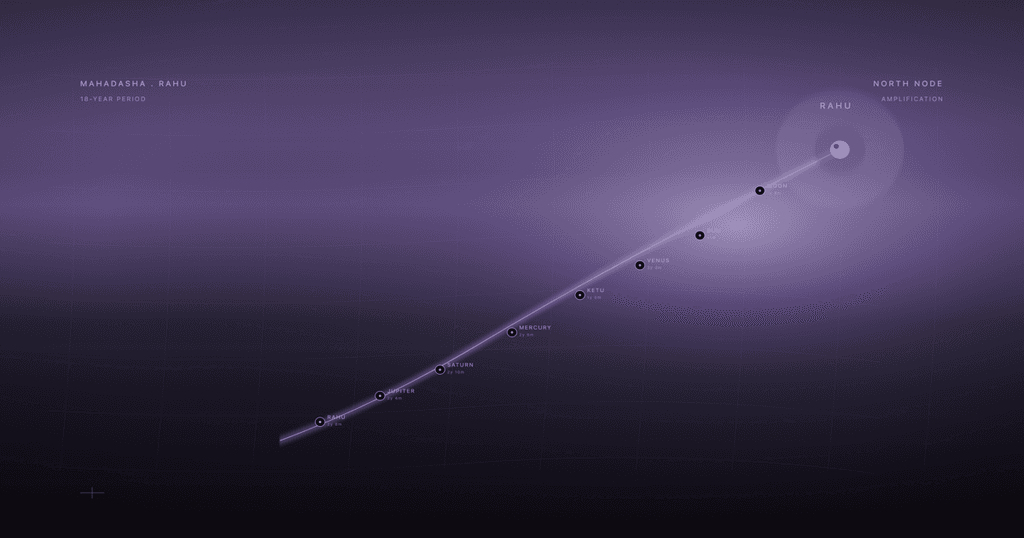
All nine antardashas arrive in fixed order at fixed proportions; the complete table lives in the Vimshottari calculator and reference table. These five do the most structural work in a Leo chart.
| Sub-period | Length | Houses activated | Working note |
|---|---|---|---|
| Rahu-Rahu | 2y 8m 12d | Natal Rahu's seat | The opening statement. Whatever house holds the node fires first and names the period's theme. |
| Rahu-Saturn | 2y 10m 6d | 6th and 7th | The longest slice. Partnership, opposition and service load arrive together; contracts signed here deserve slow reading. |
| Rahu-Venus | 3y 0m 0d | 3rd and 10th | The strongest professional window on paper. Effort converts to position, often by a foreign or unconventional route. |
| Rahu-Sun | 0y 10m 24d | 1st | The shortest of the nine. The ruler meets its eclipser; recognition and exposure both peak. |
| Rahu-Mars | 1y 1m 18d | 4th and 9th | The yogakaraka closes the period. Property and fortune consolidate before the handover to Jupiter's mahadasha. |
Of the remaining four, Rahu-Jupiter (2y 4m 24d) runs the 5th against the 8th, speculative gains next to volatility. Rahu-Mercury (2y 6m 18d) is the earning window through the 2nd and 11th. Rahu-Ketu (1y 0m 18d) strips the agenda back to essentials, and Rahu-Moon (1y 6m) routes through the 12th, frequently a relocation or withdrawal phase.
Limits, stated plainly
Nothing on this page is a measured event rate. It is Parashari lordship logic applied to one rising sign, and the classical corpus makes structural claims, not statistical ones. Vimshottari itself is one of several dasha frameworks in use; which dasha system sets out where they diverge. A sign-level page also cannot see the natal chart: two Leo risings with Rahu in the 10th and the 8th share a headline and little else. Antardasha boundaries inherit birth-time error, sometimes by months. Eclipse seasons striking the natal nodal axis modulate any of the windows above. Tempora's dated, falsifiable calls carry their conditions on the Tracker; treat this page as background.
Placing the period in your own timeline
Which mahadasha you are in depends only on the Moon's nakshatra at birth and the elapsed sequence since. Kaal computes the full mahadasha and antardasha ladder from your birth data, and the imprint box below this article reaches the same engine. For the transit stack overlaying these years in 2027, the read-next list carries the Leo-specific page. The contrast case is also worth a look: one sign later the same node reports to a Mercury-audited chart, and the period changes character completely.
This mahadasha under the 2026 to 2028 sky for Leo rising
A Rahu-period native holds a privilege no planet-lord dasha offers: the period lord is a transiting point with exact dates, so its current position can simply be looked up. For Leo rising the lookup reads: transit Rahu in Aquarius, the 7th house, until 27 December 2026, then in Capricorn, the 6th, from 27 December 2026 to 15 July 2028. The amplifier spends 2026 on the partnership angle, opposite the lagna, and the following eighteen months in the house of service, rivals and daily load. During those same stretches Ketu holds the mirror seats: the Leo lagna itself until 27 December 2026, then Cancer, the 12th. A south node on the ascendant sign while the north node's mahadasha runs is a dated version of this page's central image, the self quietly thinned while the outward reach amplifies. It stays a sign-level fact, and natal Rahu's seat continues to outrank any transit of it. The full dated wheel is at Rahu-Ketu transit.
The eclipse this page's FAQ says is worth dating precisely now has a date. The solar eclipse of 12 August 2026 falls on the Cancer-Leo cusp, which from this lagna is the 12th-1st boundary, the edge of the ascendant itself. For a Sun-ruled chart inside the eclipser's own mahadasha, classical practice treats that window as one to observe with unusual care, which is an instruction about attention rather than a prediction of events.
Jupiter's path through the window runs closer to this lagna than to most. It transits exalted in Cancer, the Leo 12th, from 27 May 2026 to 19 June 2027, dignity spent in the house of retreat and expenditure. It tastes Leo itself from 23 October 2026 to 3 February 2027, then returns to hold the lagna from 19 June 2027, with a Virgo taste, the 2nd, from 18 November 2027 to 9 March 2028. Jupiter standing on the ascendant sign for the second half of the window is the classical counterweight to the node's borrowing: the 5th-and-8th lord lending weight to the self the period keeps testing. A benefic transit of the lagna colours a year; it settles no authorship question, and this dasha's authorship question is settled in the natal chart.
Saturn, holder of the Leo 6th and 7th, sits in Pisces, the 8th house, until 23 May 2027, then crosses into Aries, the 9th, retreating to Pisces from 4 November 2027 before re-entering Aries on 11 February 2028 to stay until 2030. The 6th-7th lord moving from the depth house to the fortune house is a slow shift from contract friction toward doctrine and mentors, read classically. The retreat months return the 8th-house register for one more pass, which is the calendar's own reminder that these chapters overlap before they close.
What the shared sky cannot say is where these dates fall inside your antardasha ladder, Rahu-Saturn and Rahu-Venus alone covering nearly six years of the eighteen. That is birth-data work. The measured record behind this corpus stands at 9 graded flagship calls, 50 percent met, misses published.
Frequently asked
Why does Rahu mahadasha carry an identity theme for Leo ascendant?
Because the ascendant lord is the Sun, which rules only the lagna, and Rahu is the eclipse point that periodically darkens the Sun. The period lord and the chart ruler sit in structural opposition, so questions of authorship, recognition and legitimacy recur across the 18 years in a way no other lagna reproduces.
What does Rahu-Sun antardasha do for Leo risings?
It is the shortest sub-period at 10 months 24 days and the most concentrated. The lagna lord runs under the node that eclipses it, so visibility, promotion, exposure and authority disputes compress into a brief window. Charts with a dignified natal Sun typically convert it into recognition; afflicted Suns meet scrutiny instead.
Which antardasha is best for career for a Leo ascendant?
Rahu-Venus, on lordship logic. Venus rules the 3rd and 10th for this lagna, joining effort to profession, and at 3 years it is the longest sub-period of the mahadasha. Rahu-Mars follows, since Mars is the classical yogakaraka ruling the 4th and 9th. Both rankings defer to the natal chart.
Where is natal Rahu most comfortable for Leo risings?
The 10th in Taurus, where dispositor Venus also rules the 10th; the 9th in Aries under the yogakaraka; and the 11th in Gemini, where Mercury connects the house of gains to the 2nd of savings. Placements in the 1st, 8th or 12th give the period its most demanding texture.
Is Rahu in Leo lagna especially difficult during its own mahadasha?
It is the most double-edged seat for this rising sign. The node sits in the Sun's own sign and is disposited by the lagna lord, so self-projection amplifies faster than its supporting evidence, and the mahadasha spends years testing the gap. Outcomes depend on the natal Sun's strength and on aspects to the node.
Do eclipses matter more during Rahu mahadasha for Leo ascendant?
Eclipses always occur on the Rahu-Ketu axis, and during the node's own mahadasha classical practice watches them closely for every lagna. For Leo risings a solar eclipse carries extra weight because the eclipsed body is the ascendant lord itself. An eclipse falling on the natal nodal axis or the lagna during this period marks a window worth dating precisely.
Where is transit Rahu for a Leo ascendant during 2026 to 2028?
In Aquarius, the Leo 7th house, until 27 December 2026, then in Capricorn, the Leo 6th, until 15 July 2028. For a native running Rahu mahadasha this is the period lord's live position: the partnership angle first, the service-and-rivals house after, with Ketu opposite on the Leo lagna itself until 27 December 2026 and then in the 12th. The 12 August 2026 solar eclipse falls on the Cancer-Leo cusp, the very edge of this ascendant. These positions are sign-level colourings; natal Rahu's seat, its dispositor and the running antardasha carry the real weight, and no event is claimed from the dates alone.
Read next
A method page applying whole-sign Parashari lordships to the Leo lagna. Mars carries yogakaraka status here by the standard angle-plus-trine rule. Sub-period lengths follow the fixed Vimshottari proportions of an 18-year mahadasha. Statements of effect are classical inferences from the BPHS lineage and carry no claim of measured frequency. Engine: Swiss Ephemeris, True Pushya Paksha (PVRN Rao) ayanamsa. Nothing here is medical, financial, legal or personal advice. First published 2026-05-21; this edition 2026-07-11. Tempora Research.