Mars in the 7th House: Manglik Position and Partnership Friction
Mars in the 7th places the planet of conflict and decisive action directly on Kalatra Bhava (the spouse house). The placement is the central position of the five classical Manglik configurations and the most pronounced surface marker for partnership friction in the Vedic tradition. This piece reads the placement structurally, applies the cancellation rules and walks the per-ascendant variation including the Libra-ascendant own-sign Mars and the Capricorn-ascendant exalted Mars that forms Ruchaka yoga at the 7th.
What Mars in the 7th house means structurally
The 7th house in Vedic astrology is Kalatra Bhava, the spouse house. The wider portfolio covers marriage, business partnerships, contracts, public dealings and open enemies (the 7th is opposite the 1st, so the planets sitting on it directly face the lagna and represent who the chart owner meets in adversarial or partnership configurations). The 7th is a kendra (angular house), one of the four houses of strength alongside the 1st, 4th and 10th. Planets at the 7th gain digbala (directional strength) in some calculations and are structurally visible across the life.
Mars is the karaka for direct action, conflict, courage, the warrior register, surgery and the assertive principle. The intersection of Mars's natural significations with Kalatra Bhava produces the central Manglik signature: the chart owner's partnership register carries an action-and-conflict pattern. The classical reading is faster arguments, sharper escalation, higher tolerance for confrontation in close relationships and the appearance of adversarial figures in business and public dealings.
Tempora's detailed reading of Manglik dosha is set out in the manglik dosha piece, which walks the structural reading and the five Manglik positions in full. The cancellation rules are covered in manglik cancellation rules. The reading in this piece focuses specifically on the 7th-house placement as the central position of the dosha.
The classical Manglik configuration at the 7th
The classical Manglik dosha (also called Mangal dosha or Kuja dosha) is Mars positioned in the 1st, 4th, 7th, 8th or 12th house counted from the Lagna (the ascendant) or from the Moon. The 7th-house placement is the central position because Mars sits directly on Kalatra Bhava itself. The classical reasoning in the Brihat Parashara Hora Shastra is that Mars at the 7th casts its natural aspects (Mars aspects the 4th and 8th from itself plus the standard 7th-house opposition) onto the 10th house (career and public reputation), the 2nd house (wealth and family) and the 1st house (the chart owner directly). The composite effect is to introduce a conflict register into multiple life-domains simultaneously through the partnership axis.
The surface signature reads as marriage friction. The chart owner carries a partnership disposition that surfaces commercial and domestic disagreements that less direct charts would tolerate. Arguments escalate quickly, words are direct and the willingness to confront is high. In a marriage between two partners where one carries Mars in the 7th and the other does not, the dosha-carrying partner's conflict register often dominates the household. In a marriage between two partners who both carry the dosha, the conflict register meets a matching register and the household achieves a stable conflict-and-resolution equilibrium that the bhanga rules formally recognise as cancellation.
The classical literature is consistent that Mars-in-7th does not predict divorce as a deterministic outcome. The dosha is information about how arguments play in the relationship, not a verdict on the relationship's durability. Conflict pattern and divorce outcome are different variables: many durable marriages carry the conflict pattern and absorb it constructively; many marriages without the conflict pattern end for other reasons. Reading Mars-in-7th as a divorce predictor is the most common misuse of the dosha in popular practice.
The cancellation rules (Manglik bhanga) for the 7th-house placement
The Brihat Parashara Hora Shastra lists explicit conditions under which the Manglik dosha at the 7th is cancelled. Five conditions are the most commonly cited in living practice:
- Mars in own-sign at the 7th. Mars in own-sign Aries (for Libra ascendant) or Scorpio (for Taurus ascendant) at the 7th cancels the surface dosha through dignity. The chart owner carries a commanding partnership presence rather than a conflict-axis register.
- Mars exalted at the 7th. Mars exalted in Capricorn at the 7th (for Cancer ascendant) cancels the dosha and forms Ruchaka yoga (Mars at a kendra in exaltation). The placement reads as institutional partnership brilliance.
- Mars aspected by or conjoined with Jupiter. Jupiter's grace (the benefic-of-benefics) absorbs the Mars conflict register. The chart owner's marriage carries the conflict pattern but with structural cushioning from Jupiter's principled register.
- Both partners Manglik in the same way. The most commonly cited bhanga in living practice. When the boy and girl both carry the dosha, the conflict signature is symmetric and the household reaches stable equilibrium. Traditional matchmakers in India have used this rule for centuries.
- Dosha from one reference point only. The dosha is read from both the Lagna and the Moon. If Mars sits at the 7th from Lagna but not from Moon (or vice versa), the dosha is considered partially cancelled. Full dosha requires Mars at the 7th from both reference points.
The structural significance of the bhanga rules is that most charts that carry the surface Mars-in-7th also carry one or more cancellation conditions. The population rate of severe Manglik consequences in real marriages is far lower than the population rate of the surface placement, which is the strongest single argument that Mars-in-7th is not a deterministic marriage-killer.
The business-partner separation pattern
The 7th house rules business partnerships in addition to marriage. Mars in the 7th carries a distinctive business-partnership signature: founding-and-dissolution sequences. The chart owner often enters early-career partnerships with high enthusiasm, encounters commercial disagreements that the conflict register surfaces faster than equivalent charts would and exits the partnership through structural separation. The pattern repeats across two or three partnership cycles before the chart owner settles into a stable structure.
The stable structure typically takes one of three forms. The chart owner becomes the sole principal of the operation with hired senior staff rather than equity partners. The chart owner accepts a much smaller equity-sharing structure (5-10% partners rather than 33-50% co-founders) where the conflict-register pressure has limited room to surface. Or the chart owner finds a single long-arc partner whose own chart absorbs the Mars register, typically a partner with their own Manglik configuration or with a dignified Saturn that provides structural counterweight. The classical practice reads the 7th lord and Venus simultaneously with the Mars placement to predict which of the three stable structures the chart owner reaches.
Defining business-partnership events tend to cluster in Mars sub-periods within the running mahadasha. Mars-Mars at the start of any Mars-related dasha is the classical partnership-axis activation window: foundings, exits, contract renegotiations, equity restructures. The Mars mahadasha itself (the 7-year Vimshottari period) often coincides with the consolidation phase: the chart owner reaches the stable structure during this window and the partnership configuration that emerges typically lasts beyond the mahadasha.
Defining adversary-encounters and the open-enemies register
The 7th house also rules open enemies (as distinct from the 6th house, which rules hidden enemies and routine adversaries). Open enemies are the public figures the chart owner faces in identifiable adversarial configurations: the litigant on the other side, the competing executive in the market, the political opponent, the publicly named rival. Mars in the 7th produces defining adversary-encounter events across the life: a major public dispute that defines the chart owner's reputation, a competitive market battle that produces lasting industry standing or a political contest that establishes the chart owner's public position.
The adversary-encounter signature is most visible in careers that involve direct competition: politics, litigation, competitive sports, market-facing business roles and the executive layer of any large organisation. Charts with Mars in the 7th often produce the senior figures who define their organisation through the adversaries they defeat. The classical reading rates this as a high-visibility career-axis signature: the chart owner becomes known through conflict rather than collaboration.
The dignity of Mars sets the quality of the adversary encounter. A high-dignity Mars at the 7th (own-sign Aries, own-sign Scorpio or exalted Capricorn) produces clean adversary-encounter outcomes where the chart owner prevails with credit and lasting standing. A debilitated Mars (Cancer at the 7th, for Capricorn-Moon-sign-counting in some Manglik calculations) produces messier outcomes: prolonged disputes, ambiguous resolutions and reputation costs even in nominal victories. The Saturn aspect on Mars in the 7th extends the timeline of any adversary encounter and adds the structural-pressure register: disputes that play across years rather than months.
Per-ascendant variation
The reading varies by lagna because Mars rules different houses from each ascendant and sits in different signs at the 7th. The sign Mars occupies at the 7th sets the dignity, which is the structural filter for the strength and quality of the placement.
- Aries ascendant. Mars rules the 1st and 8th, sits in the 7th in Libra (an enemy sign for Mars). Full Manglik signature with partnership-axis pressure. The 8th-rulership adds the transformation-axis register: defining marriage events with longevity or inheritance content. The conflict-register is sharp and the bhanga rules need to be applied carefully for a clean reading.
- Cancer ascendant. Mars rules the 5th and 10th, sits exalted in the 7th in Capricorn. Ruchaka yoga formation (Mars at kendra in exaltation) and the strongest cancellation of the surface Manglik dosha. The chart owner reads as institutional partnership brilliance: marriage to a senior professional, business partnership with structural authority and adversary-encounter outcomes that produce lasting public standing.
- Capricorn ascendant. Mars rules the 4th and 11th, sits exalted in the 7th in Cancer. Ruchaka yoga formation in own-sign for the 7th-house dispositor. The chart owner reads as commanding partnership presence with wealth-axis support. Marriage typically arrives to a partner with strong material backing or institutional authority and business partnerships produce durable gains.
- Libra ascendant. Mars rules the 2nd and 7th, sits in own-sign Aries at the 7th. The strongest classical Mars-in-7th yoga: own-house and own-sign for the placement and the 7th-lord-in-7th configuration. The chart owner reads as a commanding partnership figure with strong Mars-axis partner profile. The marriage carries the conflict register but with high mutual dignity: arguments are direct and resolutions are clean.
- Pisces ascendant. Mars rules the 2nd and 9th, sits in the 7th in Virgo (a neutral sign). Partnership-axis with dharma-and-wealth register: partner often from a different cultural background or with a strong educational or principle-axis profile. The 9th-rulership adds the foreign-axis or higher-education register to the partnership signature.
- Taurus ascendant. Mars rules the 7th and 12th, sits in own-sign Scorpio at the 7th. Own-sign placement cancels the surface dosha. The chart owner reads as a partnership-axis figure with strong transformation-and-investigation register in the relationship. Marriage often carries depth-axis content: shared secrets, intelligence-axis or investigative pursuits or significant joint inheritance events.
Dated windows that activate a natal Mars in the 7th
A natal Mars in the 7th is brought forward when a slow transit crosses the sign of the 7th house or the degree Mars occupies. A Capricorn ascendant has the 7th in Cancer, so exalted Jupiter from 27 May 2026 and the 12 August 2026 eclipse fall across the partnership axis that carries Mars. A Libra ascendant has the 7th in Aries, which Saturn enters on 23 May 2027, leaves on 4 November 2027 and re-enters on 11 February 2028. A Cancer ascendant has the 7th in Capricorn, where Rahu sits from 27 December 2026 to 15 July 2028. Since the 7th placement carries the Manglik reading, these dated windows are when that register comes forward, yet each is an activation rather than a fixed outcome, with the natal Mars as the standing condition.
Mars also returns to its own placement on a regular cycle. Transit Mars comes back to any given sign about every two years, and when it re-enters the sign of your natal Mars it forms a same-planet return, the classical trigger for the 7th-house partnership signature. The return marks the timing, and the birth placement stays the condition it activates.
Defining marriage events during Mars mahadasha
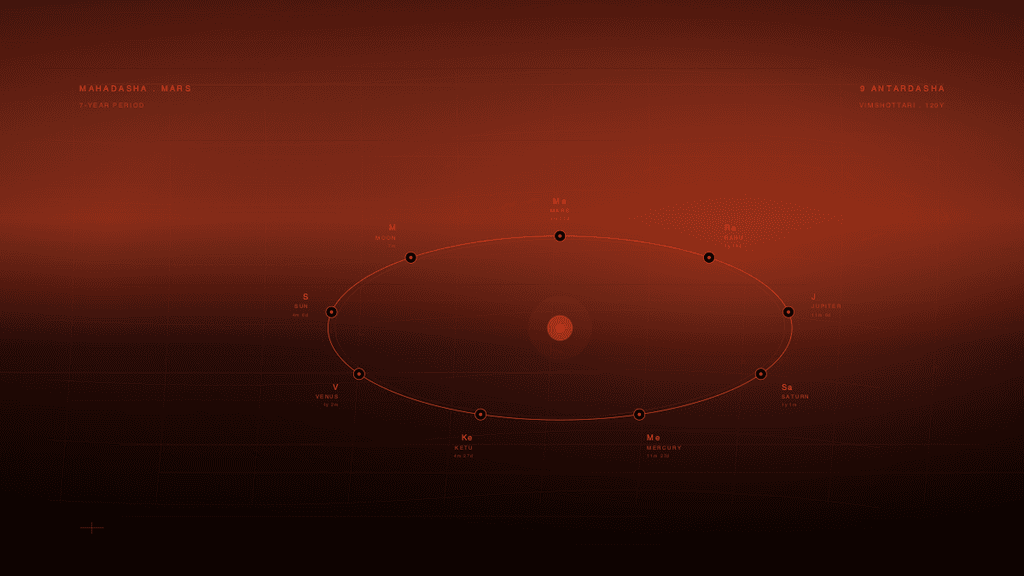
The Mars mahadasha is the 7-year Vimshottari window where the action register is foregrounded. For charts with Mars in the 7th, the mahadasha typically activates defining marriage-axis events: the marriage itself (if the chart owner is unmarried at the dasha entry), the major-conflict-and-resolution phase of an existing marriage, the founding or dissolution of major business partnerships or a defining open-enemies encounter that shapes the chart owner's public reputation. The pattern is recurring: the partnership-axis intensifies during this window in both direction and magnitude.
The classical sub-periods carrying the highest partnership-event density are Mars-Mars (the opening activation), Mars-Venus (Venus is the partnership karaka), Mars-Jupiter (principled marriage axis for female charts where Jupiter is the karaka) and Mars-Saturn (the structural-pressure phase that often produces the consolidation event). Mars-Mercury produces contract and legal partnership events. The classical practice walks the Mars dasha sequence and marks these sub-periods as the chart's high-confidence partnership-event windows.
For the broader Mars mahadasha reading and its 7-year sub-period structure, see Tempora's Mars mahadasha piece. For the marriage-timing rules in general, see Tempora's marriage delay diagnosis.
Calibration status
The article documents the classical Mars-in-7th-house reading as set out in Brihat Parashara Hora Shastra Chapters 11 and 24, Phaladeepika Chapter 7 and Jataka Parijata. The bhanga rules follow the Brihat Parashara Hora Shastra Chapter on Manglik dosha. The per-ascendant variation rules follow the lord-rulership analysis standard in classical practice. Tempora's calibration runs on the Swiss Ephemeris with the True Pushya Paksha ayanamsa by PVRN Rao. The signature library for house-specific Mars placements is under construction; calibrating Mars-in-7th lift figures against marriage outcomes in a labelled chart corpus is open work. The reading framework above is presented as the tradition's own structural reading with Tempora's per-ascendant overlay.
Frequently asked questions
What does Mars in the 7th house mean in Vedic astrology?
Mars in the 7th house places the planet of conflict and action in Kalatra Bhava (the spouse house, the partnership house). The 7th house rules marriage, business partnerships, contracts and open enemies. Mars there is the classical Manglik position (also called Mangal dosha or Kuja dosha) and produces partnership friction as its surface signature: arguments with the spouse, business partner separations, conflict in contractual relationships and defining adversary encounters. The reading is not deterministic. The bhanga (cancellation) rules in the classical literature cancel the dosha in most charts that carry it and the chart owner's overall partnership outcome depends on the broader 7th house condition.
Is Mars in the 7th house Manglik?
Yes. Mars in the 7th house is the central placement of the five Manglik positions (1st, 4th, 7th, 8th, 12th counted from the Lagna or the Moon). The 7th placement is the classical core of the dosha because Mars sits directly on Kalatra Bhava itself. The classical literature gives the 7th as the most pronounced Manglik position with the strongest surface marriage-friction signature. However, the bhanga rules apply to all five positions and roughly half of all charts carry one or more Manglik positions when both Lagna and Moon are counted, which is the strongest single argument that the dosha is not a deterministic marriage-killer.
How does Mars in the 7th house affect marriage?
Mars in the 7th biases the marriage register toward conflict-pattern: faster arguments, sharper escalation, higher tolerance for confrontation. The reading is structural and not predictive of divorce. The chart owner's eventual marriage outcome depends on the 7th lord placement, the dignity of Venus (the karaka in male charts) and Jupiter (the karaka in female charts), the cancellation conditions and the marriage partner's chart. A well-placed 7th lord, a strong Venus or Jupiter and a partner whose own chart absorbs the Mars register (often a Manglik partner) produce a durable marriage with conflict as a feature rather than a failure. The classical literature is consistent that marriage outcome cannot be read from Mars-in-7th alone.
What is Manglik bhanga (cancellation) for Mars in the 7th house?
The bhanga rules cancel the surface Manglik signature. Five classical conditions cancel Mars in the 7th: Mars in own-sign Aries or Scorpio at the 7th, Mars exalted in Capricorn at the 7th, Mars aspected by or conjoined with Jupiter or a strong benefic, both partners carrying Manglik dosha in the same way (the most commonly cited bhanga in living practice) and the dosha appearing only from one reference point (Lagna only or Moon only rather than from both). The Brihat Parashara Hora Shastra lists these conditions explicitly. Most charts that carry surface Mars-in-7th also carry one or more bhanga conditions, which is the structural reason the population rate of severe Manglik consequences is far lower than the population rate of the placement itself.
Does Mars in the 7th house cause business partner separations?
The 7th house rules business partnerships and Mars there does carry a separation-axis signature in the commercial register. Charts with Mars in the 7th often produce founding-and-dissolution sequences in business partnerships: a first partnership that ends in conflict, a second partnership with adjusted terms, a third that holds. The chart owner often ends up as the sole principal or with a much smaller equity-sharing structure than initial partners propose. The signature operates through three mechanisms: the chart owner's higher tolerance for direct confrontation pushes partners away in early career, the conflict register surfaces commercial disagreements that less direct charts would tolerate and the action-axis disposition tends to prefer solo decision-making over committee-style governance.
How does Mars in the 7th house change by ascendant?
The reading varies by lagna because Mars rules different houses from each ascendant and sits in different signs at the 7th. For Aries ascendant, Mars rules the 1st and 8th and sits in the 7th in Libra (an enemy sign for Mars): full Manglik signature, partnership-axis pressure. For Capricorn ascendant, Mars rules the 4th and 11th and sits exalted at the 7th in Cancer: Ruchaka yoga formation, partnership-axis brilliance with conflict-register modulator. For Pisces ascendant, Mars rules the 2nd and 9th and sits in the 7th in Virgo: partnership-axis with dharma-and-wealth register, often a partner from a different cultural background. For Libra ascendant, Mars rules the 2nd and 7th and sits in own-sign Aries at the 7th (the strongest classical Mars-in-7th yoga: own-house, own-sign): commanding partnership presence, durable marriage with strong Mars partner profile.
When is a natal Mars in the 7th house activated in 2026 to 2028?
The placement activates when a slow transit crosses the sign of the 7th house or the natal Mars degree. A Capricorn ascendant has the 7th in Cancer, reached by exalted Jupiter from 27 May 2026 and the 12 August 2026 eclipse. A Libra ascendant has it in Aries, entered by Saturn on 23 May 2027 with a retreat and a return by 11 February 2028. A Cancer ascendant has it in Capricorn, where Rahu sits from 27 December 2026 to 15 July 2028. Transit Mars also returns to any given sign about every two years, forming a same-planet return at the natal sign. The dates are activation windows, while the natal placement is the standing condition.
- The 7th house · the deep-dive on Kalatra Bhava and the partnership-axis reading
- Manglik dosha: what it actually means · the structural reading of Mangal dosha
- Manglik cancellation rules · the bhanga rules in full
- Mars mahadasha · the 7-year action-period in the Vimshottari sequence
- Why is my marriage delayed · the marriage delay diagnosis
- Mars in the 5th house · children, speculation and creative action
- Mars in the 6th house · victory in conflict and service-career
- Mars in the 8th house · surgery, transformation and the hidden warrior
This article was prepared by Tempora Research as an informational piece in the Planet-in-House cluster. Methodology is documented in Tempora's research-publishing standards and reproducible against the public engine. Calibration runs on the Swiss Ephemeris with the True Pushya Paksha ayanamsa. Internal audit log maintained. This article does not constitute medical, financial, legal or professional advice. First published 2026-06-05 by Tempora Research.