Mars in the 8th House: Surgery, Transformation and the Hidden Warrior
Mars in the 8th places the planet of decisive action in Ayur Bhava (the longevity house). The 8th is the chart's most intense register: longevity, transformation, occult research, hidden matters, joint resources and the mortality axis. Mars there is one of the classical Manglik positions and carries a distinctive twist for the natural zodiac, where the 8th house corresponds to Scorpio (Mars's own sign). The placement produces the hidden-warrior signature: defining surgical events, deep-research capacity, inheritance with conflict and longevity-axis turning points. This piece reads the placement structurally, per-ascendant, with the Mars mahadasha overlay.
What Mars in the 8th house means structurally
The 8th house in Vedic astrology is Ayur Bhava, the longevity house. The wider portfolio covers transformation, occult and esoteric research, hidden matters, joint resources, inheritance, the spouse's wealth (since the 8th is the 2nd from the 7th), sudden gains and losses, accidents and the mortality axis. The 8th is a dusthana (difficult house) in the classical four-house classification, but it is also the seat of moksha-axis themes and the transformation register that the warrior planet can occupy with structural significance. The classical karaka for the 8th is Saturn (longevity) and the secondary karaka is Mars (acute events).
Mars is the karaka for direct action, conflict, courage, the warrior register, surgery and the assertive principle in life. The intersection of Mars's natural significations with Ayur Bhava produces the hidden-warrior signature: the chart owner carries the action register into territory that other placements cannot. Surgery, investigation, forensic work, intelligence-axis professions, depth psychology and the kind of research that requires sustained engagement with intense material all become career-axis registers. The 8th-house Mars converts intensity into instrument.
The distinctive structural feature of Mars in the 8th is the natural-zodiac own-house effect. The 8th house corresponds to Scorpio in the natural zodiac (the zodiac taken from Aries-as-1st), which is Mars's own sign. The placement therefore carries own-house dignity for the natural-zodiac reading even when the ascendant's own 8th-house sign is different. The classical reading rates this dignity as a cushion: it absorbs some of the dusthana register and routes the Mars action into constructive depth-axis output rather than purely destructive intensity.
The hidden-warrior register and depth-axis professions
The classical reading of Mars in the 8th is the hidden warrior: the action-axis figure whose work happens in conditions that the wider world does not see directly. The signature is most visible in five career-axis registers: surgical specialties (the literal cutting and rejoining of the body), forensic investigation and intelligence-axis work, depth psychology and psychiatry (the engagement with hidden mental conditions), occult-axis scholarship and esoteric practice (tantric, kabbalistic, hermetic and other depth-research traditions) and the deep-research roles of any technical field where the work requires sustained engagement with intense material.
The surgeon profile is the most accessible classical reading. Charts with Mars in the 8th in dignity (own-sign Scorpio for Aries ascendant, exalted Capricorn for Gemini ascendant) often produce successful surgeons with specialty interests in the more demanding subdisciplines: cardiothoracic surgery, neurosurgery, transplant surgery, oncological surgery and the trauma-axis specialties. The 8th-house Mars provides the comfort with intense conditions, the action register provides the decisive intraoperative judgement and the 8th-house Mars in own-sign Scorpio adds the patience for long-arc procedures and post-operative complications.
The investigator profile applies to forensic work, intelligence services, investigative journalism and the kind of regulatory or law-enforcement roles that require sustained engagement with hidden material. The chart owner reads as comfortable with operating in conditions of partial information, capable of sustained pursuit and willing to confront content that other charts find too intense to engage. The classical reading rates the 8th-house Mars in Scorpio as one of the strongest single placements for intelligence-axis professions.
Defining surgical events
Mars in the 8th carries a distinctive medical reading. The 8th house rules acute physical events, accidents, surgical interventions and the kind of medical conditions that require decisive action rather than long-arc management. Charts with the placement often experience defining surgical events across the life: a major operation in early adulthood, a corrective surgical procedure during the Mars mahadasha or a series of medical interventions that the chart owner navigates through structural resilience. The reading runs both ways: the chart owner who undergoes surgical events also tends, in many charts, to deliver them.
The structural filter that separates a defining event from a chart-threatening crisis is the dignity of Mars and the placement of the 8th lord. A chart with Mars in the 8th in own-sign Scorpio or exalted Capricorn carries the surgical event as a turning point: the chart owner emerges stronger, the medical conditions resolve and the experience often initiates a depth-axis career interest. A chart with Mars debilitated in Cancer at the 8th or aspected by malefics requires careful reading: the accident-axis pressure is higher and the support layer (Jupiter aspect, dignified 8th lord, Saturn at a kendra) matters more.
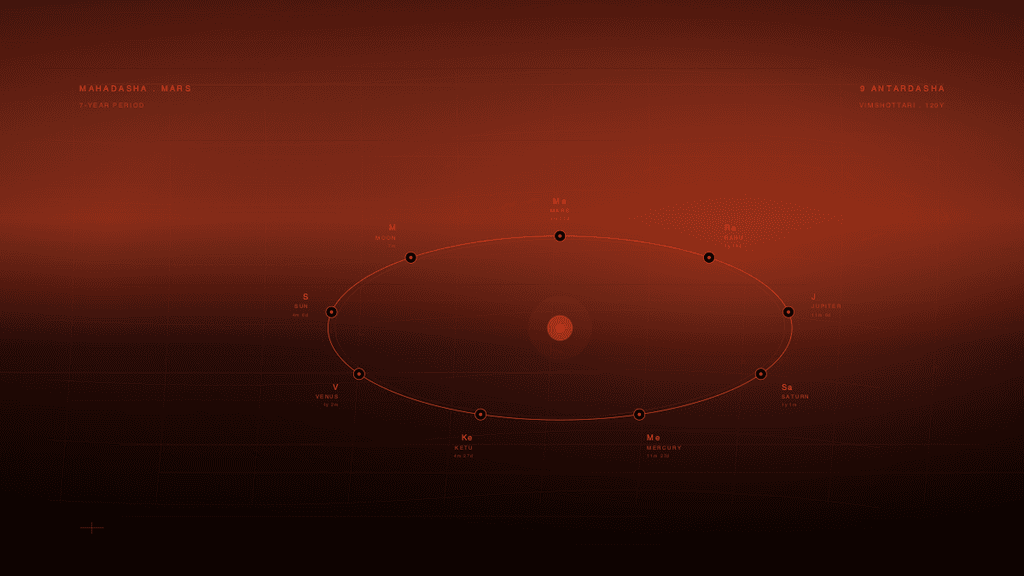
The timing layer is the running dasha. Mars-period sub-periods within any major dasha are the candidate windows for surgical events. The Mars mahadasha itself (the 7-year Vimshottari period) often coincides with the defining surgical or major medical event of the chart owner's life. Mars-Saturn within Mars mahadasha is the classical extended-recovery window. Mars-Sun produces the acute event itself. The classical practice walks the Mars dasha sequence and marks these sub-periods as the high-confidence medical-event windows.
Occult-research arcs and the depth-axis register
The 8th house is the classical occult-research house in Vedic astrology. The portfolio includes esoteric scholarship, tantric and shamanic practice, mediumship-axis work, the kind of depth psychology that engages unconscious material directly and the research roles that require sustained engagement with content that the conventional culture treats as off-limits. Mars in the 8th carries one of the cleanest occult-research-capacity signatures because the action register provides the willingness to confront and the 8th-house Mars in own-sign provides the structural stamina for sustained depth work.
The career applications include practising psychotherapists with depth-axis methods (Jungian analysis, transpersonal psychology, somatic experiencing of trauma), academic researchers of esoteric and religious traditions, practitioners and teachers of tantric and yogic depth practices, regulatory and forensic specialists who engage with criminal psychology and the depth-research roles of intelligence services. The chart owner's contribution to the field often arrives through engagement with material that less direct placements avoid: the work that nobody else will do.
The classical Brihat Parashara Hora Shastra rates the 8th house and Mars together as a strong configuration for what the tradition calls vidya gurus of esoteric subjects: teachers whose authority comes from direct engagement with practice rather than from textual mastery alone. The yogi profile (in the technical sense, the long-arc practitioner of depth disciplines) often shows Mars in the 8th in dignity, supported by a strong 9th house and a dignified 12th lord. The Mars mahadasha often coincides with the initiation phase, the major retreat phase or the public teaching phase of the depth-axis career.
Inheritance with conflict
The 8th house rules inheritance, joint resources and the wealth that arrives through other people's resources. Mars in the 8th biases the inheritance register toward conflict: defining inheritance events often involve disputes that the action register resolves. The classical pattern is the contested will, the partnership-asset division that requires aggressive negotiation, the insurance or compensation claim that the chart owner pursues against institutional resistance and the joint-property division that becomes a long-arc legal contest.
The chart owner typically prevails in these inheritance-axis disputes through persistence and direct engagement. The action register provides the willingness to pursue claims that less direct charts would abandon. The depth-axis register provides the capacity to navigate the complex documentation and legal-procedural conditions that these disputes require. The 8th-house Mars often produces the family member who ends up handling the estate, the executor of the contested will and the principal-axis figure of the inheritance-distribution process.
The dasha-timing layer is essential. Inheritance events tend to cluster in dashas of the 8th lord, the 2nd lord (the 2nd house also rules family wealth) and Mars-period sub-periods within any major dasha. Disputes that begin in Mars sub-periods tend to resolve in the chart owner's favour. Disputes that begin in dashas of debilitated planets aspecting the 8th require careful reading. The classical practice reads the 8th lord placement and the 2nd lord placement together when assessing inheritance-axis event windows.
Longevity-axis events and the turning-point pattern
The 8th house is Ayur Bhava, the longevity house and Mars there carries a distinctive longevity reading. Classical practice does not read Mars-in-8th as a shortened-longevity verdict in itself: the longevity calculation requires the full Ayur Bhava analysis (the lagna, the lagna lord, the 8th house, the 8th lord, the Moon and the operation of the dasamamsa or the Jaimini longevity scheme). What Mars-in-8th does carry is the turning-point signature: the chart owner experiences one or more defining transformation events across the life that mark structural pivots in identity, career or life direction. These events arrive with intensity and the chart owner emerges with a substantively altered structure.
The classical turning-point pattern shows up in three phases. The first phase typically arrives in early adulthood: a defining surgical event, a major accident, a profound career-redirection moment or an inheritance event that sets the chart owner's adult trajectory. The second phase often arrives in the running Mars mahadasha or a major Saturn transit through the 8th: the consolidation event that defines the chart owner's mature work. The third phase may arrive in the later life as the longevity-axis event itself: the recovery from a serious medical condition or the conscious engagement with the mortality axis that depth-axis figures often undertake as part of their tradition.
Per-ascendant variation
The reading varies by lagna because Mars rules different houses from each ascendant and sits in different signs at the 8th. The sign at the 8th sets the dignity and the lord-rulership rule sets the structural significance of the placement.
- Aries ascendant. Mars rules the 1st and 8th, sits in the 8th in own-sign Scorpio. The strongest classical Mars-in-8th placement: lagna lord in own sign in the longevity house. The chart owner reads as a surgeon, investigator, intelligence-axis professional or depth-research scholar with strong identity-axis commitment to the depth-work. Manglik signature is cancelled by own-sign dignity.
- Gemini ascendant. Mars rules the 6th and 11th, sits exalted in the 8th in Capricorn. Institutional-leadership through transformation-axis register. The 6th-and-11th rulership adds the conflict-and-gains register to the depth-axis work: the chart owner reads as a successful institutional figure in surgical, forensic or intelligence-axis professions with strong material gains. Exaltation cancels the surface Manglik signature.
- Pisces ascendant. Mars rules the 2nd and 9th, sits in the 8th in Libra (an enemy sign for Mars). Wealth-and-dharma axis pressure through inheritance and joint-resources conflict. The chart owner reads as a figure engaged in inheritance disputes and family-wealth restructuring. The 9th-rulership adds the dharma-axis or higher-education register: depth-research engagement with religious, philosophical or scholarly material.
- Sagittarius ascendant. Mars rules the 5th and 12th, sits in debilitated Cancer at the 8th. Requires careful reading. The placement produces creative-axis intensity (5th-rulership) with foreign-axis or institutional-confinement themes (12th-rulership) but with the debilitation-axis health pressure. Saturn aspect on the placement is the structural cushion if it is present; otherwise the chart needs strong benefic relief from Jupiter or Venus.
- Cancer ascendant. Mars rules the 5th and 10th, sits in the 8th in Aquarius (a neutral sign). The yogakaraka rulership (5th and 10th) is partially compromised by the dusthana placement. The chart owner reads as a creative-axis or career-axis figure with a defining transformation event that redirects the career arc. Mars mahadasha is the activation window.
- Leo ascendant. Mars rules the 4th and 9th, sits in the 8th in Pisces (a friendly sign). The 4th-and-9th rulership adds the home-axis and dharma-axis register to the depth-axis work. The chart owner reads as a depth-research figure with strong principle-axis register, often engaging with religious or scholarly traditions through hands-on practice rather than purely textual study.
When the current sky crosses this placement
A natal Mars in the 8th is activated when a slow transit crosses the sign of the 8th house or the degree of Mars. A Sagittarius ascendant carries the 8th in Cancer, so exalted Jupiter from 27 May 2026 and the 12 August 2026 eclipse move across the depth-and-transformation axis where Mars sits. A Virgo ascendant carries the 8th in Aries, which Saturn enters on 23 May 2027, steps back from on 4 November 2027 and reoccupies on 11 February 2028. A Cancer ascendant carries the 8th in Aquarius, where Rahu sits until 27 December 2026. These transits date when the placement's register surfaces, and each remains an activation window rather than a determined event, because the natal Mars is the standing condition.
The 8th placement also answers to Mars on its own cycle. Transit Mars returns to any given sign about every two years, and its re-entry into the sign of your natal Mars forms a same-planet return, the classical trigger for the 8th-house turning-point signature. The return sets the date, and the birth chart sets the condition it meets.
Defining transformation events during Mars mahadasha
The Mars mahadasha is the 7-year Vimshottari window where the action register is foregrounded. For charts with Mars in the 8th, the mahadasha typically activates one or more defining transformation events: a major surgical or medical event, a significant inheritance or joint-resources event, a deep-research transformation that defines the chart owner's professional contribution or a pivot in life direction that the chart owner navigates through structural resilience. The pattern is recurring: the intensity-axis themes of the 8th house find their concentrated expression in this window.
The classical sub-periods that carry the highest transformation-event density are Mars-Mars (the opening activation), Mars-Saturn (the longest sub-period and the structural-consolidation window), Mars-Rahu (the unconventional or boundary-crossing transformation), Mars-Jupiter (the principled depth-research transformation) and Mars-Sun (the public-recognition event for the depth-axis work). The classical practice walks the Mars dasha sequence and marks these sub-periods as the high-confidence transformation-event windows.
For the broader Mars mahadasha reading and its 7-year sub-period structure, see Tempora's Mars mahadasha piece. The 8th-house reading in full is set out in the 8th house piece. The Manglik reading and cancellation rules are at manglik dosha and manglik cancellation rules.
Calibration status
The article documents the classical Mars-in-8th-house reading as set out in Brihat Parashara Hora Shastra Chapters 11 and 24, Phaladeepika Chapter 7 and Jataka Parijata. The per-ascendant variation rules follow the lord-rulership analysis standard in classical practice. The natural-zodiac own-house dignity rule for the 8th-house Mars is a Tempora reading overlay grounded in the Phaladeepika treatment of Scorpio-Mars symmetry. Tempora's calibration runs on the Swiss Ephemeris with the True Pushya Paksha ayanamsa by PVRN Rao. The signature library for house-specific Mars placements is under construction; calibrating Mars-in-8th lift figures against surgical-event and transformation-event windows in a labelled chart corpus is open work. The reading framework above is presented as the tradition's own structural reading with Tempora's per-ascendant overlay.
Frequently asked questions
What does Mars in the 8th house mean in Vedic astrology?
Mars in the 8th house places the planet of decisive action in Ayur Bhava (the longevity house). The 8th house rules longevity, transformation, occult research, hidden matters, inheritance, joint resources and the chart owner's mortality axis. Mars there is the classical Manglik position with a distinctive twist: the 8th house corresponds to Scorpio in the natural zodiac, which is Mars's own sign. The placement carries own-house dignity for the natural zodiac reading and produces the hidden-warrior register: defining surgical events, occult-research capacity, inheritance with conflict and longevity-axis events that arrive as turning points.
Is Mars in the 8th house dangerous?
Mars in the 8th carries surface intensity but is not deterministically dangerous. The classical reading flags defining surgical events, accidents with potential medical significance and the kind of acute physical conditions that the 8th house carries. However, the same placement produces the surgeon, the investigator, the intelligence-axis professional and the deep researcher who navigates the conditions that less direct placements cannot. The reading is structural: the chart owner encounters intensity-axis conditions that other charts avoid and either delivers transformation through the encounter or experiences transformation as a consequence. The dignity of Mars and the support of the 8th lord are the structural filters.
Does Mars in the 8th house cause accidents?
The 8th house rules acute physical events and Mars there does carry an accident-axis signature. The classical reading is significant medical events: surgeries, accidents with hospitalisation, conditions that require decisive medical intervention. The signature is not unique to Mars-in-8th. Any malefic in the 8th can produce the pattern and the running dasha is the timing filter. Charts with Mars in the 8th in dignity (own-sign Scorpio for Aries ascendant, exalted Capricorn for Gemini ascendant) absorb the accident-axis signature into the surgeon-and-warrior register and experience the events as defining career moments rather than chart-threatening crises. Charts with debilitated Mars in the 8th (Cancer for Sagittarius ascendant) require careful reading and the Saturn or Rahu aspect on Mars-in-8th amplifies the accident-axis pressure.
Does Mars in the 8th house produce occult research capacity?
Yes. The 8th house is the classical occult-research house in Vedic astrology and Mars there carries one of the cleanest occult-research-capacity signatures. The chart owner reads as a deep investigator: comfort with material that other charts find too intense, capacity for sustained research into hidden conditions and the willingness to confront content that requires direct engagement. The career applications include forensic investigation, intelligence work, depth psychology and psychiatry, surgical specialties (the literal surgical investigation of the body), occult-axis scholarship, tantric and esoteric practice and the deep-research roles of any technical field. The classical example is the investigator who succeeds where the conventional approach fails.
Is Mars in the 8th house Manglik?
Yes. Mars in the 8th house is one of the five classical Manglik positions (1st, 4th, 7th, 8th, 12th counted from the Lagna or the Moon). The 8th-house placement carries the marriage-friction register through the 8th house's aspect-and-rulership relationships: Mars at the 8th aspects the 2nd house (family and wealth), the 11th house (gains and partnerships of the elder kind) and the 3rd house (siblings and courage). The dosha applies but the same cancellation rules apply: own-sign or exalted Mars, Jupiter aspect, both partners Manglik, dosha from one reference point only. For Aries ascendant the 8th-house Mars is in own-sign Scorpio, which is a strong dignity-based cancellation and the strongest classical Mars-in-8th placement.
How does Mars in the 8th house change by ascendant?
The reading varies by lagna. For Aries ascendant, Mars rules the 1st and 8th and sits in the 8th in own-sign Scorpio: the strongest Mars-in-8th placement with double-dignity (lagna lord in own sign in the longevity house), producing surgeon, investigator or institutional-axis intensity professional. For Gemini ascendant, Mars rules the 6th and 11th and sits in the 8th exalted in Capricorn: institutional-leadership through transformation-axis register. For Sagittarius ascendant, Mars rules the 5th and 12th and sits in the 8th in debilitated Cancer: requires careful reading, the placement produces creative-axis intensity but with health-axis pressure. For Pisces ascendant, Mars rules the 2nd and 9th and sits in the 8th in Libra (enemy sign): wealth-and-dharma axis pressure through inheritance and joint-resources conflict.
When is a natal Mars in the 8th house activated in 2026 to 2028?
A slow transit across the sign of the 8th house or the natal Mars degree activates the placement. A Sagittarius ascendant holds the 8th in Cancer, reached by exalted Jupiter from 27 May 2026 and the 12 August 2026 eclipse. A Virgo ascendant holds it in Aries, entered by Saturn on 23 May 2027 with a retreat on 4 November 2027 and a return on 11 February 2028. A Cancer ascendant holds it in Aquarius, where Rahu sits until 27 December 2026. Transit Mars also returns to any given sign about every two years, forming a same-planet return at the natal sign. The dates are activation windows, while the natal placement is the standing condition.
- The 8th house · the deep-dive on Ayur Bhava and the transformation-axis reading
- Mars mahadasha · the 7-year action-period in the Vimshottari sequence
- Manglik dosha: what it actually means · the structural reading of Mangal dosha
- Manglik cancellation rules · the bhanga rules in full
- Mars in the 5th house · children, speculation and creative action
- Mars in the 6th house · victory in conflict and service-career
- Mars in the 7th house · Manglik position and partnership friction
- Stellium in the 8th house · 3+ planet concentration on Ayur Bhava
This article was prepared by Tempora Research as an informational piece in the Planet-in-House cluster. Methodology is documented in Tempora's research-publishing standards and reproducible against the public engine. Calibration runs on the Swiss Ephemeris with the True Pushya Paksha ayanamsa. Internal audit log maintained. This article does not constitute medical, financial, legal or professional advice. First published 2026-06-05 by Tempora Research.