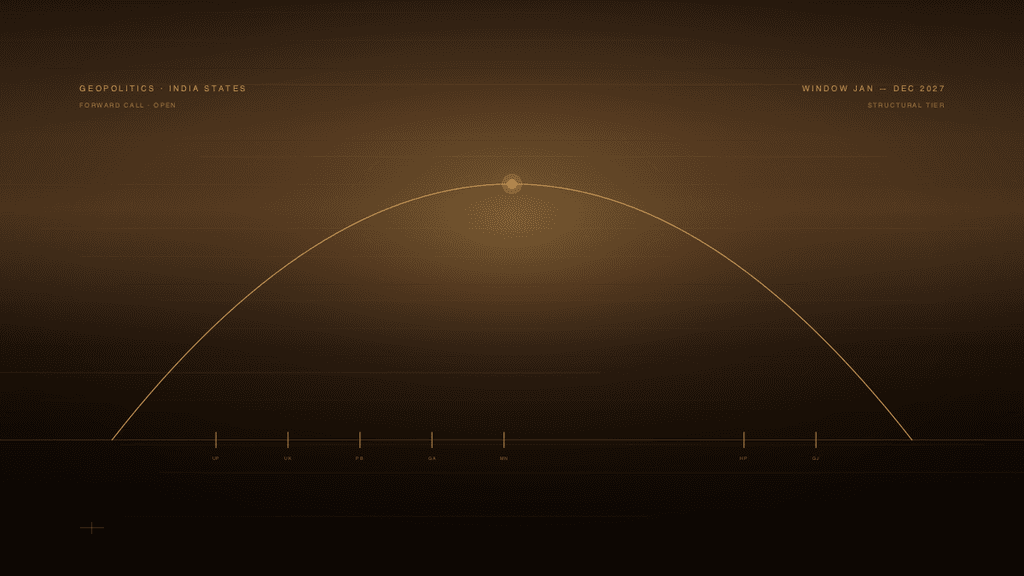
India 2027 State Elections Cohort: Saturn Pisces-to-Aries on the 1947 Chart
A structural forward call on the seven Indian state assembly elections scheduled in 2027. Cohort-level test condition anchored on Saturn's transit from sidereal Pisces (11th house from Taurus lagna) into sidereal Aries (12th house) across the India 1947 founding chart.
What this window typically looks like
Seven state assemblies elected in 2022 reach end-of-term in 2027. Five (Uttar Pradesh, Uttarakhand, Punjab, Goa, Manipur) go to the polls in February to March 2027 ahead of Saturn's Aries ingress on 23 May. Two (Himachal Pradesh in November, Gujarat in December) go to the polls after the ingress. The seven state polls form a single calendar-year cohort. The structural reading is at cohort level rather than at any single state.
2027 state poll cohort, election timing
| State | Expected poll window | Saturn position | Term ends |
|---|---|---|---|
| Uttar Pradesh | Feb-Mar 2027 | Late Pisces (11th house) | May 2027 |
| Uttarakhand | Feb-Mar 2027 | Late Pisces (11th house) | Mar 2027 |
| Punjab | Feb-Mar 2027 | Late Pisces (11th house) | Mar 2027 |
| Goa | Feb-Mar 2027 | Late Pisces (11th house) | Mar 2027 |
| Manipur | Feb-Mar 2027 | Late Pisces (11th house) | Mar 2027 |
| Himachal Pradesh | Nov 2027 | Aries (12th house) | Jan 2028 |
| Gujarat | Dec 2027 | Aries (12th house) | Feb 2028 |
Section 1. The call
This article makes a cohort-level testable prediction about the seven Indian state assembly elections scheduled for 2027. Tempora's reading of the India 1947 founding chart says structural-pressure events on state-level political outcomes rise inside the 11th-to-12th-house transit by Saturn across the calendar year. The window opens 1 January 2027 and closes 31 December 2027. The reconciliation date targets 28 February 2028, sixty days after the last expected poll declaration (Gujarat in December 2027).
The discipline Tempora applies here is the same as on the India 2029 general election forward call (window 1 April to 30 June 2029, dasha-lord-in-stress-house signature), the India macro-stress window 2027-2028 and the broader Saturn-in-Aries cohort piece. We are not predicting which party wins which state. We are not picking vote-share numbers state by state. What we are doing is naming a cohort threshold (3 of 7) and a set of observable transition events that resolve as a binary verdict by reconciliation.
Section 2. The mechanism, walked through
2.1 The India 1947 chart and the 11th-to-12th-house transit
The India 1947 founding chart, computed for 15 August 1947 at 00:00 IST in Delhi under True Pushya Paksha ayanamsa via Swiss Ephemeris, has Taurus rising. The chart sits in Tempora's calibrated six-chart library. Saturn ingressed sidereal Pisces in approximately March 2025 and stays there through May 2027. Pisces is the 11th house from Taurus lagna, traditionally read as labha bhava (gains, alliances, public-affairs networking). Saturn ingresses sidereal Aries on 23 May 2027 (Swiss Ephemeris, True Pushya Paksha). Aries is the 12th house from Taurus, traditionally read as vyaya bhava (dispersion, dissolution, expenditure).
The 11th-to-12th-house transition by a slow planet like Saturn is read structurally as a transition from alliance-formation and public-network building (11th house themes) into dispersion and re-shuffling (12th house themes). For a national chart this is a structural backdrop, not a per-event prediction. The cohort of seven state polls in 2027 sits across the calendar year in which the transition lands.
2.2 Why structural-tier and not calibrated
The India 1947 chart carries one calibrated signature documented in the corpus: dasha-lord-in-stress-house, one of the chart's strongest historical pressure signatures. That signature is the basis for the India 2029 general election forward call. The Saturn 11th-to-12th-house transit during 2027 is not the dasha-lord-dusthana signature and is not independently calibrated. The 2027 state-elections cohort call is therefore structural-tier: same chart, different transit configuration, no independent lift figure.
Per-state founding charts are not part of Tempora's audit corpus and are not used here. The reading is at the cohort level on the India 1947 chart, with per-state outcomes aggregated into the cohort test. The audit log distinction is internal.
Section 3. The test condition, what would invalidate this call
Every Tempora forward call carries a binary test condition with a stated threshold and a window close date. The call is wrong if 2 or fewer of the 7 state polls produce a cohort-level transition event within 60 days of result declaration.
Transition event A: coalition negotiation duration. Coalition-formation negotiation from result declaration to government formation lasts more than 30 days. The 30-day threshold is above the historical baseline for Indian state government formation (most state results produce a government within 14 days; 30 days is materially above baseline).
Transition event B: incumbent vote-share collapse. The 2022 incumbent ruling party records a 2027 vote-share drop of 10 percentage points or more from the 2022 baseline (in a head-to-head comparison or across the aggregate state-wide tally if multi-party).
Transition event C: defection or alliance breakup. A formal defection or alliance breakup is registered with the Election Commission within 60 days of result declaration. This includes Anti-Defection-Law actions, alliance dissolution announcements or merger of a state party into a national party.
Transition event D: sovereign rating watch action. Moody's, S&P or Fitch places India sovereign or any single Indian state on negative watch or downgrades, within 60 days of any 2027 state result declaration.
A state poll counts as having "produced a transition event" if at least one of A through D fires inside the 60-day post-result window for that state. Aggregation across the seven states: 3 or 4 of 7 firing resolves MET. 5 or more firing resolves stronger MET. 2 or fewer firing resolves FAILED. There is no middle ground.
Section 3.5. Additional chart-side overlays
Two configurational overlays sit alongside the Saturn 11th-to-12th transit and modify how the cohort window reads phase-by-phase. The original draft anchored on the Saturn transition alone; an 11 June 2026 re-audit adds these two findings to the chart-side narrative.
Jupiter's second exaltation pass through Cancer (3 February to 19 June 2027) overlaps the Big Five state-poll window precisely. Under True Pushya Paksha computation, Jupiter completes a first pass through sidereal Cancer from 27 May to 23 October 2026, retrogrades into Leo, then re-enters Cancer on 3 February 2027 for a second pass that runs through 19 June 2027. The second pass covers the Uttar Pradesh, Uttarakhand, Punjab, Goa and Manipur poll dates (February to March 2027) and the result-declaration windows that follow. Jupiter in Cancer is the chart's exaltation transit walking the natal Cancer stellium (Moon at Cancer 5.12 degrees, Mercury at 14.82 degrees, Saturn at 21.61 degrees, Venus at 23.70 degrees, Sun at 29.13 degrees, with the Sun and Venus contacts both falling inside the poll-cohort window). On 23 May 2027 (the date Saturn ingresses Aries), transit Jupiter at Cancer 26.28 degrees is within 2.9 degrees of orb of natal Sun and 2.6 degrees of natal Venus. The Jupiter walk reads classically as institutional-support overlay: even where the Saturn 12th-house transit applies dispersion-and-dissolution pressure, Jupiter's exaltation transit over the chart's mass cluster provides a counterweight that historically constrains the magnitude of cohort-level discontinuity events.
Saturn's 60-degree forward aspect to natal Mars tightens after Saturn ingresses Aries. From early Aries, transit Saturn casts its classical 60-degree forward aspect (the Vedic 3rd aspect) onto early Gemini, where natal Mars sits at 1.79 degrees. The aspect is loose at Saturn ingress (5 degrees on 23 May 2027), tightens through mid-2027 as Saturn moves deeper into Aries, and reaches under 4 degrees of orb across the Himachal Pradesh November and Gujarat December polls. Mars is the lagna lord in classical Parashari reading for an Aries lagna chart; for the Taurus lagna India 1947 chart Mars is the lord of the 7th and 12th houses, the houses of contested alliance partners and of dispersion-and-dissolution. Saturn aspecting natal Mars from the 12th house places structural pressure on the lord of the 7th (the partner-alliance domain), which is consistent with the cohort-level alliance-breakup and coalition-negotiation transition events the test condition tracks.
Window-close phase: by 31 December 2027 (Gujarat polls), transit Jupiter has moved to Virgo 4.17 degrees. From that position Jupiter casts its 240-degree forward aspect (the Vedic 9th aspect of Jupiter) onto early Taurus, within 4.7 degrees of orb of the natal Lagna and within 2.0 degrees of natal Rahu. Jupiter's 9th-aspect into the lagna axis is a supportive late-window overlay that historically modulates the late-cohort state polls toward the lower end of the cohort-transition spectrum.
Three additional chart-side layers the engine surfaces
Annual classical signature for Vedic year 2027 reads as conflict-and-mobilisation. The Vedic year that begins in April 2027 carries a Mars-lord classical signature whose description is fires consuming villages, robber-and-conflict mobilisation and disease pressure. The signature runs across all the major-cohort state polls inside the window (Himachal Pradesh November and Gujarat December 2027, after the Saturn ingress to Aries). For a cohort-transition test where the threshold is 3 of 7 polls registering transition events, a Mars-year backdrop reads as a structural tone that elevates the probability of late-cohort polls registering above the lower-end transition spectrum the Section 3.5 Jupiter-overlay reads.
Annual progression marker sits in the transformation house through 2027. The India 1947 chart's annual progression marker sits in the eighth house of transformation across the entire test window. The eighth-house placement is the classical signature for a year of structural-transition tone on the chart, which sits in parallel with the Saturn 11th-to-12th transit the article already discusses. The combined reading is that the cohort-level transition events are most likely to register in the calendar months when both the Saturn 12th-house transit (post 23 May 2027) and the eighth-house annual marker overlap, which is the Himachal Pradesh-Gujarat back half of the window.
Mercury-Moon near-exact contact in early July 2027 lands inside the window. Mercury reached a near-exact contact with Moon on 3 July 2027 carrying a drought-and-famine classical signature in the classical tables. For a cohort-test whose markers include agrarian-distress-driven transition events specifically, a Mercury-Moon contact carrying that classical signature inside the window is a chart-side reading the engine adds beyond the Section 3.5 Jupiter and Saturn-Mars overlays.
Section 4. Reconciliation commitment
Window closes 31 December 2027. The reconciliation targets publication 28 February 2028, sixty days after the last 2027 state poll (Gujarat) is expected to declare results. Reconciliation lands in a Section 2 reconciliation block on this article with a per-state table (poll date, result declaration date, transition events A-D fired or not fired, pass-or-fail per state) and the verdict (MET or stronger MET or FAILED).
The same dual-loop reconciliation applies as on every Tempora forward call. The first loop is the outcome: did at least 3 of 7 state polls produce a transition event? The second loop is the mechanism: when we re-run the engine after window close, does the chart-side reading we published before the window match the chart-side reading the engine produces with hindsight? Both loops get a public verdict. Misses stay on the tracker indefinitely at tempora.ltd/tracker.
Withdrawal notice
Withdrawn from scoring on 9 July 2026, before this call's window closed on 2027-12-31. Tempora adopted a calibrated-only publication standard in July 2026: the flagship Tracker carries signatures that cleared a cohort backtest and everything experimental proves itself in the Lab first. This call predates that standard.
Reason on the record. Published before the calibration standard; structural signature does not meet the current Tracker bar. Record retained.
What stays. The dated call, its window, its test condition and its receipt remain on this page unchanged. Withdrawn calls are never graded and never counted in any Tempora hit rate. The full withdrawn register is public on the Lab; the live scoreboard is at the Tracker. Tempora retires calls in the open and never edits the scoreboard.
Frequently asked
Which states go to the polls in 2027?
Seven state assemblies elected in early 2022 or late 2022 reach end-of-term in 2027 and require fresh elections. Uttar Pradesh, Uttarakhand, Punjab, Goa and Manipur (all elected February to March 2022) go to the polls in February to March 2027. Himachal Pradesh (elected November 2022) goes to the polls in November 2027. Gujarat (elected December 2022) goes to the polls in December 2027. Election Commission of India schedules will fix exact dates closer to the windows.
What is the Tempora forward call?
Tempora's structural forward call says at least 3 of the 7 state assembly polls in 2027 produce a cohort-level transition event within 60 days of result declaration. Transition events are coalition negotiation lasting longer than 30 days from result to government formation, incumbent vote-share dropping by 10 percentage points or more from the 2022 baseline, defection or alliance breakup formally registered with the Election Commission within 60 days of result or a sovereign or sub-sovereign rating watch action by Moody's, S&P or Fitch on India or any single state inside the same 60-day post-result window.
Why Saturn-Pisces-to-Aries on the India 1947 chart?
The India 1947 founding chart (15 August 1947, 00:00 IST, Delhi) is the canonical India natal chart used in Tempora's calibrated six-chart library, with Taurus rising under True Pushya Paksha ayanamsa. Saturn transits Pisces from approximately March 2025 through May 2027 (the chart's 11th house from Taurus lagna), then ingresses sidereal Aries on 23 May 2027 (the chart's 12th house). The 11th-to-12th house transition is read as a transit from public-affairs and alliance themes (11th house labha bhava) into themes of dispersion and dissolution (12th house vyaya bhava). The 2027 state-poll cohort sits in the calendar window where the transition lands.
What is the test condition?
The call is wrong if 2 or fewer of the 7 state polls produce a cohort-level transition event within 60 days of result declaration. 3 to 4 of 7 firing resolves MET. 5 or more firing resolves stronger MET. 2 or fewer firing resolves FAILED. Transition events are defined narrowly: coalition negotiation longer than 30 days from result to government formation, incumbent vote-share drop of 10pp or more from 2022 baseline, defection or alliance breakup or sovereign or sub-sovereign rating watch action on India or any single state.
Is this calibrated?
No. The India 1947 chart is part of Tempora's audit corpus (the dasha-lord-in-stress-house signature on this chart is one of the chart's strongest historical pressure signatures as documented in the India 2029 general election article). The Saturn-Pisces-to-Aries 11th-to-12th-house transit, however, is a structural-tier reading not independently audited for state-election outcomes. Lower-confidence structural extension of the audit-corpus India chart reading.
When does Tempora reconcile?
Within 60 days of the final 2027 state poll result declaration (Gujarat is expected in December 2027). Tempora targets a reconciliation publication date of 28 February 2028. Section 2 of this article will carry the per-state table (election dates, result declaration dates, cohort transition events, pass or fail per state) and the verdict (MET or stronger MET or FAILED).
Read next
This article was prepared by Tempora Research as a structural-tier extension of the audit-corpus India 1947 chart reading. The dasha-lord-in-stress-house signature is the only chart-side signature on this chart with an independent historical pressure track record; the Saturn 11th-to-12th-house transit during 2027 is a structural-tier reading. Chart positions and transit dates are reproducible against the public engine using True Pushya Paksha (PVRN Rao) ayanamsa via Swiss Ephemeris. State election scheduling is approximate and subject to Election Commission of India confirmation closer to actual poll windows. Internal audit log maintained. This article does not constitute medical, financial, legal or professional advice. First published 2026-05-20 by Tempora Research.