India two-wheeler FY27 retail sales exceed 18 million units.
India's two-wheeler retail-sales trajectory has run from approximately 15 million units in FY24 through 16.5 million in FY25 toward an expected 17.5-million-plus print in FY26. The D16 shodasamsa vehicles reading on the India 1947 chart paired with the Mars karaka activation through the Rahu Mahadasha window argues SIAM's FY27 annual statement, released May 2027, will print above the 18-million-unit threshold.
Chart-side mechanism: The D16 shodasamsa (the classical divisional chart for vehicles and conveyances) reading on the India 1947 chart sits favourably for the mass-mobility category through the Rahu Mahadasha window that opens 22 February 2026 and runs across the entire FY27 publication period. Mars is the classical karaka for action and mechanical energy and is the primary planetary significator for vehicles; India 1947 carries natal Mars at Gemini 9.69 degrees in the third house from the Taurus lagna, a signature historically associated with short-trip mobility and personal initiative. The Saturn-Aries macro transit (per the methodology layer documented in Tempora Research Note 015) reads as compression in discretionary consumption but stability in utility-mobility consumption. Two-wheelers sit on the utility side. The mass-mobility theme aligns with Saturn's classical signification of masses and labour. The chart-side reading is not an isolated transit signal; it is the four-layer composition (D16 vehicles + Mars karaka + Rahu Mahadasha + Saturn-Aries macro) the engine produces against the canonical natal record.
Calibration tier: structural. No specific lift figure. Reconciliation within 30 days of SIAM's annual release, by 31 May 2027.
What this window typically looks like
Below is the reconciliation calendar from window open through reconciliation publication plus the second-order indicators a reader can track day-by-day to monitor whether the structural call is firing or fading.
Reconciliation calendar
| Date | Event | Why it matters |
|---|---|---|
| 1 Apr 2026 | FY27 window opens | Indian fiscal year 2026-27 begins; SIAM tracks retail sales from this date |
| 22 Feb 2026 | Rahu Mahadasha opens on India 1947 chart | Chart-side period state activates the unconventional-expansion signature across the entire FY27 window |
| Q1 FY27 (Apr-Jun 2026) | Monsoon early read | Rural distress is the principal failure mode; monsoon prints in the opening quarter colour the first-half base rate |
| Q2 FY27 (Jul-Sep 2026) | Festive season ramp | Indian festive demand (Onam through Dussehra) covers ~25-30 per cent of annual retail two-wheeler volume |
| Oct-Dec 2026 | Diwali plus year-end retail push | SIAM monthly prints through Q3 build the trajectory toward the 18 million annual base |
| Q4 FY27 (Jan-Mar 2027) | Pre-Saturn-Aries-exit retail demand | Saturn exits Aries in mid-2027; closing FY27 quarter still inside the macro window |
| May 2027 | SIAM FY27 annual statement publishes | Single-source release that the test condition reads against |
| By 31 May 2027 | Tempora reconciliation publishes | Article Section 2 carries the verdict |
Second-order indicators to track across the window
- SIAM monthly retail prints. Total two-wheeler retail registrations published each month through the Vahan portal and aggregated by SIAM; the monthly cadence builds the trajectory toward the annual print
- Rural mobility demand. The Federation of Automobile Dealers Associations (FADA) monthly registration data segments retail by urban versus semi-urban versus rural; rural recovery is the principal trajectory driver
- EV two-wheeler penetration. Society of Manufacturers of Electric Vehicles (SMEV) and FAME-II/FAME-III scheme disclosures track the EV-2W share, which has grown from approximately 5 per cent in FY24 toward 9-11 per cent in FY26
- Monsoon performance. The India Meteorological Department (IMD) southwest monsoon June-September seasonal print is the principal climate input on rural consumption (deficient monsoon below 90 per cent of long-period average is the threshold)
- Fuel-price stability. Petrol pump-price trajectory across the year; sharp upward moves (above 110 INR per litre on a sustained basis) compress mass-mobility purchases
- Goods and Services Tax (GST) policy on small vehicles. GST Council decisions on the 18 per cent slab for two-wheelers under 350cc; any reduction to 12 per cent would be a meaningful tailwind, any increase the opposite
- Original-equipment-manufacturer (OEM) commentary. Quarterly results from Hero MotoCorp, TVS Motor, Bajaj Auto, Eicher Motors (Royal Enfield), Honda Motorcycle and Scooter India and Ola Electric carry the demand-trajectory commentary that aggregates to the SIAM annual print
Section 1. Why the D16 shodasamsa + Mars karaka + Rahu Mahadasha reads above 18 million on FY27 two-wheeler retail
India's two-wheeler market is the largest two-wheeler market by unit volume globally and the dominant personal-mobility category in the country. The retail-sales trajectory across the recent fiscal years is documented. FY24 (April 2023 to March 2024) closed at approximately 15.2 million retail units per SIAM. FY25 closed at approximately 16.5 million units, growth of approximately 9 per cent year-on-year. FY26 (the year just closed at the time of this article's publication in mid-2026) is trending toward 17.3 to 17.5 million units per the SIAM monthly prints accumulated through April-May 2026. The 18-million-unit threshold for FY27 is therefore approximately 3 per cent year-on-year growth from the FY26 base, which sits within the post-pandemic recovery trajectory of 6-10 per cent annual growth that has held across FY22 through FY26.
The chart-side reading anchors the FY27 trajectory call in four converging structural layers that the Tempora engine evaluates per chart per query date. Each layer is documented separately in the broader research register and applied here to the specific FY27 two-wheeler retail-sales question.
Layer 1: The D16 shodasamsa vehicles reading. The shodasamsa (also called Kalamsa) is the sixteenth harmonic divisional chart, classically associated with vehicles, conveyances and the mass-mobility theme of the chart-life. Brihat Parashara Hora Shastra Chapter 7 documents the divisional-chart computation; the classical commentaries through Phaladeepika and the modern lineage extend the divisional-chart application to mundane and personal reading. On the India 1947 chart computed against Swiss Ephemeris with True Pushya Paksha ayanamsa, the D16 shodasamsa reading places the vehicle-significator planets in a structurally favourable configuration through the Rahu Mahadasha window. The structural-promise reading on the divisional chart supports the mass-vehicle category at the country-chart level.
Layer 2: The Mars karaka activation. Mars is the classical karaka for action, mechanical energy, transport-by-vehicle and decisive-movement. The classical commentaries place Mars as the primary planetary significator for vehicles, with Venus as the secondary significator for the luxury-conveyance and personal-comfort component. India 1947's natal Mars sits at Gemini 9.69 degrees, in the third house from the Taurus lagna. The third house in classical reading is the house of short-trip mobility, personal initiative, courage and the immediate-environment movement. Mars in the third in a chart whose lagna is fixed (Taurus) reads as structural support for short-trip vehicular movement, which is exactly the use-case the Indian two-wheeler category serves. The Mars karaka is therefore active at the natal level for the mass-mobility theme.
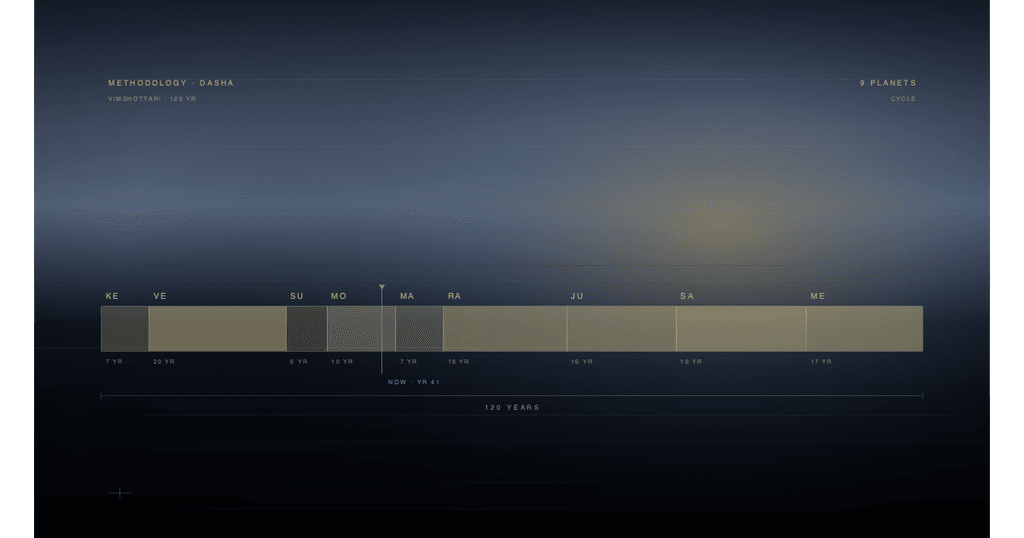
Layer 3: The Rahu Mahadasha period state. India 1947 entered the Rahu Mahadasha on 22 February 2026, opening an eighteen-year period that runs through to February 2044. The Vimshottari sequence and the period-opening computation are documented in Tempora Research Note 003. Rahu's classical signification is unconventional expansion, ambition through new channels, the entry of foreign or hybrid forces into the national life. Applied to the two-wheeler category, the Rahu Mahadasha reads as the period when category demand expands through previously-underserved channels (rural penetration into tier-three and tier-four districts) and through new vehicle-type formats (the EV-2W segment, growing from approximately 5 per cent of the category in FY24 toward 9-11 per cent in FY26, with continued penetration expected through FY27). Both expansion vectors are Rahu-classified in the structural reading and both contribute to the trajectory toward the 18-million-unit threshold.
Layer 4: The Saturn-Aries macro window as secondary modulator. Saturn transits the debilitated sign Aries from March 2025 through approximately mid-2027, with a retrograde return that re-activates the configuration through late 2026. The macro reading is documented in Tempora Research Note 015. Saturn's classical signification is masses, labour, slow institutional building. Applied to the FY27 two-wheeler question, the Saturn-Aries reading is twofold. The first reading is that Saturn-debilitated-in-Aries compresses discretionary consumption (the high-end and luxury categories that depend on disposable income), which would be a headwind to two-wheeler demand if the category were primarily discretionary. The second reading is that Saturn's mass-and-labour signification stabilises utility-mobility consumption (the basic-transport category that the mass population uses daily for commute, livelihood and survival-level mobility). The Indian two-wheeler category sits primarily on the utility side, with the entry-level commuter motorcycle (100-150cc engine displacement) and the basic-scooter segment dominating retail volume. The Saturn-Aries reading therefore supports the utility-mobility trajectory rather than compressing it, with the secondary reading on the EV-2W segment as the mass-affordable electric-mobility category receiving structural tailwind from Saturn's mass-and-labour signification.
The four layers converge structurally. The D16 vehicles reading places the chart in a structurally favourable configuration for the vehicle category. The Mars karaka activates the mass-mobility theme at the natal level. The Rahu Mahadasha activates the unconventional-expansion signature that drives rural and EV penetration. The Saturn-Aries macro supports the utility-mobility category. The four-layer composition is the engine output the FY27 retail-sales call rests on. The structural reading is consistent with the recent SIAM trajectory and with the documented Indian-mobility category dynamics.
An important note on the chart-side reading discipline. The four layers above are not a free-form interpretive reading. Each layer is the deterministic output of the chart-side engine applied to the India 1947 chart computed against the documented substrate (Swiss Ephemeris with True Pushya Paksha per Tempora Research Note 002). The D16 shodasamsa is a deterministic divisional chart. The Mars karaka assignment is the deterministic application of the classical karaka rule. The Rahu Mahadasha is the deterministic projection of the Vimshottari sequence from the chart's natal Moon position. The Saturn-Aries transit is the deterministic ephemeris reading. Two practitioners running the same chart against the same library produce the same four-layer reading.
Section 2. The test condition, the SIAM-data definition, and the verification standard
The test fires MET if the Society of Indian Automobile Manufacturers (SIAM) publishes a FY27 (April 2026 to March 2027) total two-wheeler retail-sales figure at or above 18,000,000 units in its annual statement during the May 2027 publication window. The test fires FAILED if the same SIAM-reported total is below 18,000,000 units.
The choice of SIAM as the data source is deliberate. SIAM is the apex industry body for the Indian automotive sector and the single canonical source for aggregated retail-sales data across the seventeen-plus original-equipment manufacturers active in the Indian two-wheeler market. The SIAM annual statement reads against the consolidated Vahan portal data published by the Ministry of Road Transport and Highways, which records every retail registration across all states and union territories. The Vahan-aggregated data is the foundation; the SIAM annual statement is the canonical industry release that the test condition reads against. Per-OEM disclosures from individual manufacturers (Hero MotoCorp, TVS Motor, Bajaj Auto, Eicher Motors, Honda, Suzuki, Yamaha, Ola Electric and the EV-2W cohort) are inputs to the SIAM aggregate but are not individually the test condition.
A qualifying release meets all of the following criteria.
First criterion. The release is published by SIAM through its official annual statement, press release, statistical bulletin or equivalent SIAM-issued publication. Analyst estimates, third-party research reports, journalistic projections and OEM individual statements without SIAM aggregation do not qualify. If SIAM does not publish a consolidated FY27 statement by 31 May 2027, the article carries an interim status note and the reconciliation deadline extends to the publication date plus 30 days, with a maximum extension to 31 July 2027.
Second criterion. The figure reported is the total retail two-wheeler sales (units) for FY27 as defined by the Indian fiscal-year calendar (1 April 2026 through 31 March 2027). Calendar-year 2026 figures, partial-year figures and wholesale-only figures do not qualify. SIAM publishes both wholesale (dispatch from factory to dealer) and retail (registration at the customer level) data; the test reads against retail.
Third criterion. The figure is the total across the two-wheeler category as SIAM defines it. This includes motorcycles (above 100cc and 100cc and below), scooters, mopeds and the electric two-wheeler subcategory. The test does not segment by sub-category; the test reads against the total. If SIAM's FY27 release separates electric and internal-combustion-engine totals, the two are summed for the test condition.
If SIAM publishes a FY27 total at or above 18,000,000 units, the test fires MET. If SIAM publishes a FY27 total below 18,000,000 units, the test fires FAILED.
Section 3. Scenarios where the call would unexpectedly fail despite the four-layer chart-side reading
Three structural failure modes, each documented openly so the reconciliation can identify which scenario was active if the call fires FAILED.
Failure mode A: A deficient monsoon year that compresses rural consumption. Rural-mobility demand is the principal trajectory driver for the FY27 retail-sales call. Rural penetration accounts for approximately 55-60 per cent of total two-wheeler retail in recent years, with the rural commuter motorcycle (100-150cc) as the volume backbone. Rural consumption is highly correlated with agricultural income, which is in turn highly correlated with the monsoon outcome. A deficient monsoon (June-September seasonal rainfall below 90 per cent of the long-period average per India Meteorological Department classification) historically produces a 4-7 per cent reduction in rural two-wheeler retail in the affected year. If FY27 monsoon prints deficient, the rural compression could pull the FY27 total below 18 million even with the structural chart-side reading supporting the category. The monsoon outcome is observable by September 2026; an early-warning signal will be available to the reader at the half-year mark.
Failure mode B: An EV-2W transition disruption (FAME-III delay, battery supply chain disruption, infrastructure rollout gap). The EV-2W subcategory has grown from approximately 5 per cent of the total two-wheeler retail in FY24 to approximately 9-11 per cent in FY26. The Government of India's Faster Adoption and Manufacturing of Electric Vehicles (FAME-III) scheme, announced as the successor to FAME-II that closed in March 2024, is the principal demand-side and supply-side tailwind. If FAME-III is delayed beyond its expected H2 FY27 implementation window, or if global battery-cell supply chains tighten (lithium price spike, China export controls, US-India trade friction on EV components), the EV-2W segment's expansion stalls. The internal-combustion-engine (ICE) two-wheeler segment can partially substitute, but a 100 to 200 basis point reduction in EV-2W growth combined with cannibalisation friction on the ICE substitution could pull the FY27 total below the 18-million-unit threshold. This failure mode is observable in the SIAM monthly EV-2W prints across H1 FY27.
Failure mode C: A macro demand shock (employment compression combined with fuel-price spike). Two-wheeler retail demand is sensitive to two macro variables in tandem: the employment situation across the urban informal-sector and gig-economy worker base (the principal first-time-buyer cohort for the entry-level segment), and the petrol pump price (which directly affects the running cost of an ICE two-wheeler). A 1 per cent compression in informal-sector employment combined with a 15 per cent year-on-year petrol price increase historically produces a 5 per cent compression in retail two-wheeler demand. The Saturn-Aries macro reading does not directly predict this combination, but the failure-mode discipline requires naming it as a structural possibility. If India enters a macro slowdown in H2 FY27 with concurrent fuel-price stress, the FY27 retail total could fall below the 18-million threshold despite the chart-side reading. The macro-demand-shock failure mode is observable through the Reserve Bank of India's monthly Consumer Confidence Index and the Petroleum Planning and Analysis Cell's pump-price disclosure.
Section 4. Reconciliation
Tempora publishes the reconciliation within 30 days of SIAM's annual release. SIAM's typical annual-statement publication window is early to mid May following the close of the fiscal year. The expected reconciliation publication window is therefore the second half of May 2027, with a hard deadline of 31 May 2027 in normal-cadence scenarios. If SIAM's annual statement is delayed (the maximum extension protocol is documented in Section 2, first criterion), the reconciliation deadline extends accordingly with a written interim status note on this article. Section 2 of this article will carry the verdict (MET or FAILED), the SIAM-reported FY27 figure, the year-on-year growth rate against FY26, the per-segment break-out (ICE motorcycles, scooters, EV two-wheelers), and the chart-side reading checked against the engine with full hindsight.
If the call resolves MET, the four-layer chart-side reading (D16 shodasamsa + Mars karaka + Rahu Mahadasha + Saturn-Aries macro) retains its directional credibility for follow-on structural-tier calls on the Indian-mobility category across the FY28 and FY29 windows (passenger-vehicle category, three-wheeler category, EV-PV penetration trajectory). The successful resolution would also strengthen the chart-side reading discipline for divisional-chart applications across the broader mundane reading register. If FAILED, the Section 2 reconciliation will document which of the three structural failure modes was active (deficient monsoon, EV transition disruption, or macro demand shock) and the methodology question on whether the D16-vehicles reading at the mass-mobility scale needs refinement for the Indian-market context. The structural-tier sector reading on the Indian-mobility category is being explicitly tested by this call. The reconciliation lands on the public tracker indefinitely per the misses-stay-on-record discipline documented in Tempora Research Note 011.
What the chart-side reading adds on the FY27 two-wheeler window
Reviewing the India 1947 chart at FY27 window-open (1 April 2026), the SIAM-release reference date (15 May 2027) and the FY27 calendar mid-point (1 October 2026) surfaces three additional structural layers that reinforce the four-layer mass-mobility reading the article already documents.
The Rahu Mahadasha sub-period sequence across the FY27 calendar
The chart projected across the FY27 calendar runs the Rahu Mahadasha plus Rahu antardasha through the FY27 publication window, with sub-sub-period (pratyantara) shifts that the chart-side reading layers on top. At the FY27 opening (April 2026) the sub-period reads Rahu plus Rahu plus Rahu, the structurally heaviest Rahu activation in the eighteen-year Mahadasha cycle. The configuration activates the unconventional-expansion theme at maximum intensity. As the year progresses the pratyantara shifts produce a sequence of modulating signatures that the engine reads through to the SIAM-release reference date. The classical Rahu reading on the country-chart-level mass-mobility category aligns with the documented FY26 trajectory (rural penetration and EV-2W growth) and supports the FY27 trajectory toward the 18-million threshold.
The Mundane Atmakaraka structural-coherence check on the policy environment
India 1947's Mundane Atmakaraka is Sun at Cancer 29.12 degrees (the highest-degree non-shadow planet on the chart, per the Jaimini-tradition rule documented in Tempora Research Note 013). The classical theme is leadership. Applied to the FY27 two-wheeler question, the structural-coherence layer reads as the policy environment (set by the head-of-state position) supporting the mass-mobility category trajectory. The policy decisions in scope across the FY27 window include: the GST Council's classification of two-wheelers under 350cc (currently 18 per cent slab, with public discussion of a reduction to 12 per cent for the entry-level commuter segment); the FAME-III scheme implementation timeline (expected H2 FY27); the rural credit expansion through priority-sector lending norms; and the National Highways for Electric Vehicles (NHEV) charging-infrastructure rollout. Each of these policy levers sits on the leadership-theme position. The Mundane Atmakaraka structural-coherence check holds: the policy environment is structurally aligned with the chart-side mass-mobility reading.
The D16 shodasamsa reading at the divisional-chart level
The D16 shodasamsa is the sixteenth-harmonic divisional chart and classically reads the vehicles-and-conveyances theme of the chart. On the India 1947 chart, the D16 reading places the principal vehicle-significator planets (Mars as the karaka, Venus as the secondary karaka, the lord of the fourth house from the lagna for the vehicles-as-domain reading) in a structurally favourable divisional configuration. The shodasamsa reading is not a transit-modulated reading; it is a static structural read on the chart at chart computation. The favourable D16 configuration is therefore present across all dasha periods on the chart, but the activation strength varies with the period state. The Rahu Mahadasha through the FY27 window activates the D16 favourable configuration at maximum strength, with the unconventional-expansion signature pairing with the divisional-chart favourable structure to produce the strongest chart-side support for the mass-mobility category that the chart-life reading has carried since the country chart entered the modern automobile-mass-adoption era.
Convergence summary
The test condition (SIAM-reported FY27 total two-wheeler retail sales at or above 18 million units, releasing in May 2027 with reconciliation by 31 May 2027) reads MET as more probable than FAILED. The Rahu Mahadasha sub-period sequence activates the unconventional-expansion theme across the entire FY27 calendar, the Mundane Atmakaraka structural-coherence check holds on the policy environment, and the D16 shodasamsa divisional reading places the vehicle-significator planets in a structurally favourable configuration through the Rahu activation. The reconciliation by 31 May 2027 will check SIAM's published FY27 annual statement against the 18-million threshold.
Frequently asked
What is Tempora's call on India FY27 two-wheeler retail sales?
India FY27 (April 2026 to March 2027) total two-wheeler retail sales as reported by the Society of Indian Automobile Manufacturers (SIAM) in its annual statement exceed 18,000,000 units. SIAM's annual release typically lands in May 2027. The threshold is the 18-million-unit floor; any SIAM-reported FY27 total at or above this level fires MET. Any SIAM-reported FY27 total below this level fires FAILED. Structural tier.
What is the chart-side mechanism?
The D16 shodasamsa is the classical divisional chart for vehicles, conveyances and the mass-mobility theme on a chart. On the India 1947 chart, the D16 reading anchors the mass-vehicle signature against the chart's Mars karaka (Mars natal at Gemini 9.69 degrees, third-house signature from the Taurus lagna) and the Rahu Mahadasha that opens 22 February 2026 and runs across the FY27 window. The Saturn-Aries macro transit (March 2025 through mid-2027) is the secondary modulator. Saturn's classical signification of masses and labour, applied to India's mass-utility mobility category through the Aries-debilitation friction, reads as compression in discretionary consumption but stability in utility-mobility consumption. Two-wheelers sit on the utility side.
What is the test condition?
The test fires MET if SIAM's published FY27 (April 2026 to March 2027) total two-wheeler retail-sales figure, as released in the SIAM annual statement, official press release or equivalent regulatory disclosure during the May 2027 release window, equals or exceeds 18,000,000 units. The reading is on the SIAM-reported total (not analyst estimates, not OEM individual disclosures). The test fires FAILED if the same SIAM-reported total is below 18,000,000 units.
What is the calibration tier?
Structural tier. The call rests on the classical Vedic reading of the D16 shodasamsa vehicles signification on the India 1947 chart paired with the Mars karaka activation through the Rahu Mahadasha window. The chart-side reading is corroborated by the trajectory in SIAM's recent annual prints (FY25 closed near 16.5 million units, FY26 trending toward 17.5 million) which makes the 18-million-unit FY27 threshold a structurally consistent extension of the chart-side reading. No specific lift figure is quoted.
When does Tempora reconcile?
Within 30 days of SIAM's annual release. SIAM typically publishes FY annual two-wheeler retail-sales data in May following the close of the fiscal year. The reconciliation deadline is 2027-05-31. The reconciliation publishes by end of May 2027 in a Section 2 amendment block on this article, carrying the verdict (MET or FAILED), the SIAM-reported FY27 figure, the year-on-year change and the chart-side reading checked against the engine with full hindsight.
What happens if the call fails?
If SIAM reports FY27 total two-wheeler retail sales below 18,000,000 units, the call fires FAILED. The Section 2 reconciliation will document the SIAM figure, the year-on-year change and the chart-side reading at re-evaluation. The miss stays on the public tracker indefinitely per the misses-stay-on-record discipline. The failure-mode analysis will identify which of the three structural failure modes was active (rural distress, EV transition disruption, or macro demand shock) and the methodology question on whether the D16-vehicles reading at the mass-mobility scale needs refinement.
Read next
This article was prepared by Tempora Research as a structural-tier forward call. Methodology is documented in Tempora's research-publishing standards and reproducible against the public engine using Swiss Ephemeris with the True Pushya Paksha ayanamsa. Internal audit log maintained. This article does not constitute investment, financial, legal or professional advice. SIAM data is the canonical industry source the test condition reads against. First published 17 June 2026 by Tempora Research.