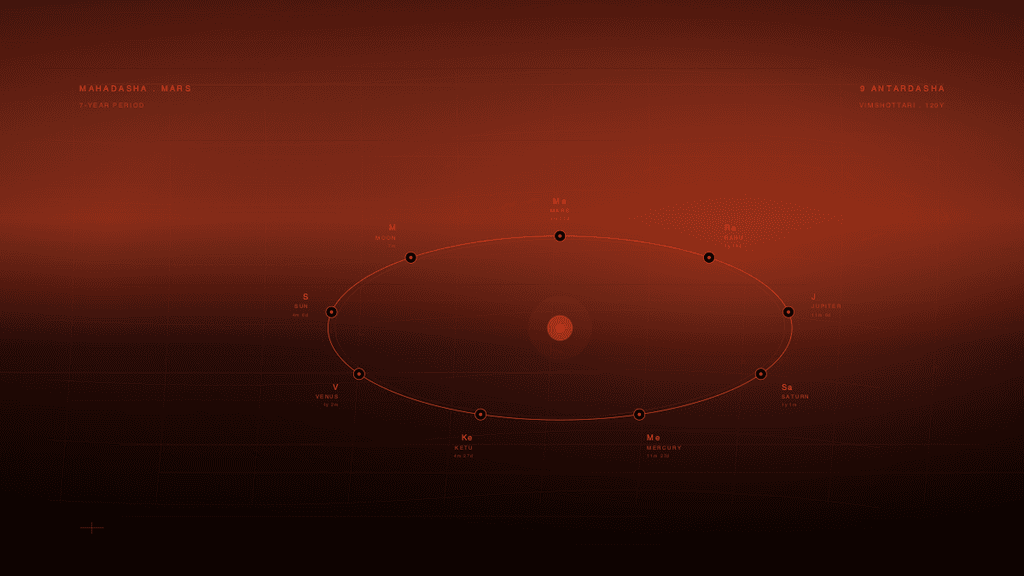
Mars in the 12th House: Foreign Action, Hospitals and the Hidden Warrior
Mars in the 12th house places the warrior in the Vyaya Bhava (expense house in Sanskrit). The classical reading is mixed: the 12th is a dusthana, so Mars there carries the classical expense-of-action and foreign-action-loss caution. The modern reading extends the classical framework into constructive applications: foreign-military service, hospital and surgical work, intelligence and covert-action professions and significant foreign-residency during the Mars mahadasha. The placement is also one of the four classical Mangal Dosha (Manglik) positions affecting marriage-axis intimacy. This article walks the placement through its classical signature, the dusthana register, the constructive modern applications, the per-ascendant variation across the 12 lagnas, the Mars mahadasha activation window and the reconciliation conditions.
The 12th house and Mars's action register
The 12th house (Vyaya Bhava the expense house, Moksha Bhava the liberation house in Sanskrit) is the chart's dissolution register. It carries loss and expense, foreign residence and far-distant places, spiritual liberation (moksha), bed-pleasures and intimacy (Shayya Sukha in Sanskrit), hospitals and places of confinement, hidden enemies, sleep and contemplative practice, the left eye and the feet as body parts. The classical karakas are dual: Saturn for loss and Ketu for liberation. The 12th is dusthana (with 6th and 8th) and the final moksha-axis house (with 4th and 8th).
Mars carries the warrior register. The classical Sanskrit names are Mangal (the auspicious) and Kuja (son of earth). Mars rules Aries and Scorpio and signifies surgery, real estate, military and police professions, sports and entrepreneurial drive.
When Mars enters the 12th, the warrior occupies the dissolution-and-foreign-and-hidden register. The classical reading is more mixed than for any other house placement. Mars's action register encounters the 12th's dissolution register and the combination can read either as constructive (action in hidden or foreign domains) or as classically cautioned (expense-of-action, action that dissipates into loss). The specific direction depends on Mars dignity, dispositor strength and the broader chart configuration more than for any other Mars-in-house placement.
Dusthana register: the classical caution
The 12th is dusthana, one of the three difficult houses (6th, 8th, 12th). The classical reading is that the 12th register activates as structural pressure: difficult themes (loss, expense, hidden enemies, foreign displacement, dissipation) activate when the 12th is occupied or aspected. Mars as a natural malefic in dusthana doubles the friction-axis signature at the structural level.
The specific classical cautions for Mars-in-12th:
- Expense-of-action. The classical reading that Mars's action register dissipates into expense rather than building durable structure. Action without result, force expended without proportional outcome, energy lost to friction rather than converted into accomplishment. The classical caution applies particularly when Mars is debilitated or afflicted.
- Foreign-action-loss. Action taken in foreign-or-distant contexts that produces loss rather than gain. Business ventures in foreign markets that fail, foreign deployment that ends in injury, foreign relocation that produces dissipation rather than accumulation. The classical reading is configuration-dependent and applies particularly when the 4th-house counter-pull is weak.
- Hidden conflicts. Friction with adversaries operating covertly (distinct from the 6th's open adversary register). Hidden enemies, behind-the-scenes opposition, conflicts not openly visible that consume the chart owner's energy. The classical caution applies when Saturn or Rahu aspects Mars in the 12th.
- Bed-pleasures and intimacy friction (Mangal Dosha). The Sanskrit Shayya Sukha (bed-pleasures) signification of the 12th combined with Mars's friction register produces the classical Mangal Dosha (Kuja Dosha, Manglik) placement. This is the marriage-axis caution specific to bed-pleasures rather than to the partnership register itself.
- Sleep disturbance and rest-axis friction. The 12th's sleep signification combined with Mars's energy register can produce restless sleep, insomnia patterns and broader rest-axis friction. The classical reading applies particularly when Mars is well-aspected by Saturn or Mars sits in a fire sign in the 12th.
The Mangal Dosha angle: bed-pleasures and marriage
Mars in the 12th house is one of the four classical Mangal Dosha (Manglik) placements. The classical four-position list is Mars in the 1st, 4th, 7th and 12th. Some traditions expand the list to include the 2nd and 8th, producing the six-position Manglik framework. The specific 12th-house Mangal Dosha activates the bed-pleasures-and-intimacy register (Shayya Sukha in Sanskrit) rather than the partnership-as-public-relationship register (which is the 7th-house Mangal Dosha).
The Mangal Dosha classical caution applies to both nativities in a partnership. The reading is configuration-dependent. Manglik-Manglik matching (both partners carrying Manglik signature on their charts) classically cancels much of the dosha. Strong benefic aspect on Mars softens the friction. The Manglik framework is one of the older marriage-compatibility filters in classical Vedic practice and remains in active use in contemporary matchmaking. The full cancellation framework is documented in Tempora's Manglik cancellation rules article.
The specific 12th-house Manglik reading focuses on intimacy-axis friction within marriage rather than on public partnership-axis conflict. The classical practice reads this as a register-specific caution: the marriage itself can be durable and constructive while the bed-pleasures register carries some friction-component. The reading is particularly susceptible to benefic modulation: Venus aspect on Mars in 12th softens the intimacy-axis friction substantially, Jupiter aspect provides structural-dharmic-modulation and Moon-axis support adds emotional-fluidity to the intimacy register.
Constructive modern applications: where Mars in 12 reads strongly
The modern reading of Mars in 12th extends the classical framework into constructive contemporary applications. The placement supports specific professional categories where the action-in-hidden-or-foreign register operates as career advantage rather than as classical caution.
- Foreign-military service. The 12th is the classical foreign-residence house. Mars is the warrior. The combination is one of the strongest single placements for foreign-deployment military careers. Officer corps with overseas postings, peacekeeping missions, defence-attaché roles in foreign embassies and the broader register of military service abroad. The Mars mahadasha often coincides with the defining foreign-deployment cycle of the chart owner's military career.
- Surgery and surgical specialties. The 12th carries hospitals; Mars carries surgery. The combination is one of the strongest single placements for surgical careers, particularly hospital-axis surgery rather than private-practice surgery. Trauma surgery, surgical residency at major institutions, hospital-administration roles in surgical departments and the broader register of action-within-hospital-institutions.
- Intelligence and covert-action work. The 12th's hidden-register significations combined with Mars's action register produce classical strong placement for intelligence services field operations, special forces with classified deployment, investigative journalism on hidden subjects, security consulting in confidential environments and the broader register of action-in-hidden-domains.
- Foreign trade and international logistics. Business careers involving cross-border execution. Foreign-trade specialists, international logistics managers, foreign-market business development with operational-execution focus. Mars-in-12th supports the action-and-execution side of foreign-trade better than the strategy-and-advisory side.
- Foreign-aid and conflict-zone work. Humanitarian work in conflict zones, disaster-response coordination abroad, war-correspondent journalism and the broader register of action-in-difficult-foreign-contexts. The 12th's expansion-into-difficult-places signification activates the Mars action-register in service contexts.
- Renunciation-axis work with action component. Monastic discipline at the more action-oriented end of the contemplative spectrum. Martial-arts-discipline traditions, security-roles in monastic institutions and the broader register of renunciation-with-action-component. The placement classically supports the warrior-monk archetype better than the soft-contemplative-monk archetype.
Hospital and surgical events: the patient-side reading
The classical caution-side of the 12th-house hospital signification reads from the patient perspective: Mars in 12 reads as significant hospital events during the Mars mahadasha. The reading covers a spectrum:
- Mild: surgical procedures. Planned surgical procedures during Mars mahadasha. Orthopaedic surgery, abdominal surgery, surgical interventions where the chart owner is on the receiving end of the surgical knife. The classical reading is configuration-dependent but applies particularly during Mars mahadasha activations.
- Moderate: hospitalisation periods. Extended hospitalisation events during Mars mahadasha. Periods of confinement to hospital for treatment, recovery cycles requiring sustained hospital stays and the broader register of being in hospital as a significant life-event.
- Severe: significant accident-axis events. Mars in 12 with malefic aspect and weak dispositor carries the classical accident-axis caution. Vehicular accidents, falls and physical-injury events that require hospital intervention. The classical reading applies particularly during Mars mahadasha and the Mars-Rahu antardasha or Mars-Saturn antardasha sub-periods.
The reading is not deterministic. Many Mars-in-12 chart owners pass through Mars mahadasha without significant hospital events. The classical signature points in a direction; the specific outcome depends on Mars dignity, dispositor strength, broader chart configuration and the chart owner's behavioural context (driving habits, risk-taking, occupational hazard exposure). The classical caution is a probabilistic structural reading, not a deterministic prediction.
Foreign residency: the most common biographical signature
The most consistent biographical signature for Mars-in-12th charts is significant foreign-residency during the Mars mahadasha. The 12th is the classical foreign-residence house and Mars activates the placement through the action-axis route into foreign residence. The mechanisms vary across the spectrum of constructive modern applications:
Foreign-military deployment is the most direct route. The chart owner's military career produces overseas postings during the Mars mahadasha and the foreign-residency cycle directly coincides with Mars-mahadasha activation. Surgical or medical careers abroad form a second common pattern: surgical training or hospital-axis professional life produces foreign-residency through career advancement rather than through deployment. Intelligence and covert-action careers produce a third pattern with often the longest foreign-residency cycles. Entrepreneurial relocation driven by competitive opportunity is a fourth pattern, common in contemporary business contexts.
The 4th-house counter-pull determines permanence. The Mars-in-12 foreign-residency reading combines with the 4th-house reading from Tempora's will I settle abroad article. Strong 4th house produces foreign-residency followed by return to homeland; weak 4th house produces permanent foreign settlement. The classical practice reads the 4th-12th axis together for foreign-permanence assessment.
Per-ascendant variation: how the 12 lagnas read Mars in 12th differently
Each ascendant assigns Mars a different functional role.
| Ascendant | 12th sign | Mars rules | Classical reading |
|---|---|---|---|
| Aries | Pisces | 1st & 8th | Lagna-and-transformation lord in dusthana. Classical caution: self dissipates into hidden domains. Strong placement for intelligence and covert-action lives. |
| Taurus | Aries | 7th & 12th | 12th lord at own sign in 12th house. Partnership and loss significations at home. Constructive long-arc placement despite dusthana register. |
| Gemini | Taurus | 6th & 11th | Service-and-gains lord in dusthana. Foreign-service and foreign-gains-axis lives with friction-component. |
| Cancer | Gemini | 5th & 10th | Yoga-karaka (5th and 10th lord) in dusthana. Classical mixed: creative-career significations in dissolution register. Strong for foreign-military and foreign-creative careers. |
| Leo | Cancer | 4th & 9th | Mars debilitated in Cancer in 12th. Classical weakest dignified placement. Home-and-dharma lord in dusthana with debilitation: maximum caution. |
| Virgo | Leo | 3rd & 8th | Effort-and-transformation lord in dusthana. Foreign-effort and hidden-transformation lives, often producing intelligence and investigative careers. |
| Libra | Virgo | 2nd & 7th | Wealth-and-partnership lord in dusthana. Foreign-wealth or foreign-partnership lives with classical loss-axis caution. |
| Scorpio | Libra | 1st & 6th | Lagna-and-service lord in dusthana. Mars in enemy's air-sign Libra. Self-axis dissolution and service-axis friction. Strong for foreign-aid and conflict-zone careers. |
| Sagittarius | Scorpio | 5th & 12th | 12th lord at own sign Scorpio in 12th house. Strongest single configuration: dusthana-lord at own house, constructive long-arc placement. Strong for foreign-creative and foreign-spiritual careers. |
| Capricorn | Sagittarius | 4th & 11th | Home-and-gains lord in dusthana. Foreign-home and foreign-gains lives. Strong for international-business operational careers. |
| Aquarius | Capricorn | 3rd & 10th | Mars exalted in Capricorn in 12th. Classical strongest dignified placement. Effort-and-career lord at exaltation: foreign-career excellence with structural-strength register. |
| Pisces | Aquarius | 2nd & 9th | Wealth-and-dharma lord in dusthana. Foreign-wealth and foreign-dharma lives, often producing dharmic-axis foreign careers. |
The classical strongest configurations are Aquarius ascendant (Mars exalted in Capricorn in 12th) and Sagittarius ascendant (Mars as 12th-lord at own house in own sign Scorpio). Both produce constructive long-arc foreign-axis careers when supported by the broader configuration. The classical caution is strongest for Leo ascendant (Mars debilitated in Cancer in 12th), where the home-and-dharma lord in dusthana with debilitation produces multiple friction-axis registers activating together.
How the current sky reaches a natal Mars in the 12th
A natal Mars in the 12th is activated when a slow transit crosses the sign of the 12th house or the degree of Mars. A Leo ascendant carries the 12th in Cancer, so exalted Jupiter from 27 May 2026 and the 12 August 2026 eclipse pass across the expenditure-and-foreign axis where Mars sits. A Taurus ascendant carries the 12th in Aries, which Saturn enters on 23 May 2027, steps back from on 4 November 2027 and reoccupies on 11 February 2028. An Aquarius ascendant carries the 12th in Capricorn, where Rahu sits from 27 December 2026 to 15 July 2028. These transits date when the placement's register comes forward, and each is an activation window rather than a fixed event, since the natal Mars is the standing condition beneath it.
Mars also returns to trigger its own placement. Transit Mars returns to any given sign about every two years, and its re-entry into the sign of your natal Mars forms a same-planet return, the classical activation of the 12th-house foreign-and-withdrawal signature. The return dates the trigger, and the birth chart holds the condition.
The Mars mahadasha foreign-action window
The 7-year Mars mahadasha is the primary activation window for Mars-in-12th events. The mahadasha activates the placement at maximum alignment: the dasha lord (Mars) is also placed in the foreign-and-hidden house (12th). The classical reading is that this is one of the structurally strongest single-placement-and-dasha alignments for foreign-residency and hospital-axis events.
The most active sub-periods within Mars mahadasha for Mars-in-12th charts:
- Mars-Mars (first 4.5 months). Mahadasha-and-antardasha alignment activates the placement at its most direct. Defining foreign-deployment, surgical-residency-launch or intelligence-career-launch events concentrate.
- Mars-Saturn (around year 5). Saturn provides structural-completion and is the 12th-loss karaka. Long-arc foreign-residency consolidation, hospital-axis career stabilisation. Also the sub-period where significant accident-axis events have higher base-rate when classical caution applies.
- Mars-Rahu (around year 4). Rahu adds the foreign-amplification register. The classical strongest sub-period for foreign-residency starts. Major foreign-relocation events often fall here.
- Mars-Ketu (first sub-period after Mars-Mars). Ketu adds the contemplative-dissolution register. Often produces the surgical-event sub-period for medical-axis Mars-in-12 charts or the renunciation-axis events for spiritual-axis Mars-in-12 charts.
The transit-confirmation layer adds Saturn transits over the natal 12th house (consolidation windows), Jupiter transits over the natal Mars (dharmic-axis activation) and Rahu transits in the candidate years. Three-layer convergence (mahadasha, antardasha, transit) produces the most reliable timing signal.
A worked example: Aquarius ascendant Mars exalted Capricorn 12th
Consider the strongest single Mars-in-12th configuration. Aquarius ascendant. Mars exalted in Capricorn in the 12th house. Saturn (the lagna lord and the Capricorn-ruler dispositor of Mars) well-placed. Jupiter aspecting the 12th from the 4th or the 8th.
The reading. Mars at exaltation in Capricorn carries maximum sign-dignity. Mars is also the 3rd-and-10th lord for Aquarius ascendant, linking effort-and-career significations to the foreign-and-hidden house. The exalted-Mars-in-12th configuration converts the dusthana register from classical caution into constructive long-arc foreign-axis career. The placement reads as a foreign-career-excellence chart: major foreign-military officer, surgical practice in international hospitals, intelligence-service senior roles or international-business operational executive careers.
The Mars mahadasha activation. For this configuration, Mars mahadasha (7 years) often produces the defining foreign-residency cycle of the chart owner's life. Military command rank in foreign deployment, surgical specialist credentialling and practice abroad, intelligence-service senior-role appointment with foreign-posting or international-business executive role with primary residence abroad all concentrate. The Mangal Dosha bed-pleasures-and-intimacy caution is substantially softened by Mars's exaltation; intimacy-axis register reads as competitive-but-respectful rather than as significant friction.
Cross-confirmation in the Navamsa (the D-9 chart) is the second-pass test. If natal Mars retains strength in the D-9 (own sign Aries or Scorpio, exalted Capricorn or in a D-9 kendra), the foreign-career-excellence reading carries soul-chart endorsement and is at its most reliable.
What this reading does not predict
The framework predicts structural disposition and the windows where the disposition activates. It does not predict specific hospital events or specific surgical procedures. It does not predict specific foreign-deployment dates or specific career postings. It does not predict whether the chart owner will marry, whether the Mangal Dosha will affect a specific partnership or specific marriage-axis dates. The classical accident-axis caution is a probabilistic structural reading, not a deterministic event forecast.
The classical caution registers (expense-of-action, foreign-action-loss, Mangal Dosha intimacy friction) are similarly directional rather than deterministic. Mars-in-12 does not guarantee any of these outcomes. It predicts a structural disposition toward these registers, which can be channelled constructively (as foreign-action career excellence, surgical-axis professional achievement, covert-action competence) or which can manifest as classical caution depending on Mars dignity, dispositor strength and broader chart configuration.
Calibration status
The article documents the classical Mars-in-12th reading as set out in BPHS Chapter 11 (the 12th house), the Mangal Dosha framework, Phaladeepika Chapter 7 and Sarvartha Chintamani. The Tempora calibrated signature library (Note 005) does not currently include Mars-in-12th-specific event signatures. Chart computation uses the Swiss Ephemeris with the True Pushya Paksha ayanamsa by PVRN Rao for sidereal positions. The classical readings (dusthana logic, per-ascendant variation, Mangal Dosha, foreign-residency pattern, Mars mahadasha activation) are presented as the tradition's own framework rather than as Tempora calibrated output. Calibrating Mars-in-12th signatures against a labelled chart-corpus of verified foreign-military and surgical-career biographies is open work scheduled after the existing signature library is stable.
Frequently asked questions
What does Mars in the 12th house mean in Vedic astrology?
Mars in the 12th house places the warrior in the Vyaya Bhava (expense house, Sanskrit). The classical reading is mixed: the 12th is dusthana (with 6th and 8th), so Mars there carries the classical expense-of-action and foreign-action-loss reading. The modern reading extends this to constructive applications: foreign-military service, hospital and surgical work, covert-action and intelligence professions and significant foreign-residency during the Mars mahadasha. The placement is one of the four classical Mangal Dosha positions affecting marriage timing. Sources: BPHS Chapter 11, Phaladeepika Chapter 7.
Is Mars in the 12th house a Mangal Dosha placement?
Yes. Mars in the 12th house is one of the four classical Mangal Dosha (Kuja Dosha, Manglik) positions, alongside Mars in the 1st, 4th and 7th. The doshic count expands in some traditions to include the 2nd and 8th. The classical reading is that Mars in 12 carries the bed-pleasures-and-intimacy affliction register: the 12th carries the Sanskrit Shayya Sukha (bed-pleasures) signification and Mars's conflict register applied here produces classical caution around marriage-axis intimacy and partnership-bed-register harmony. Manglik-Manglik matching (both partners carrying Manglik signature) cancels much of the dosha. The full Manglik cancellation framework is documented in the Manglik cancellation rules article.
Can Mars in the 12th house indicate foreign settlement?
Yes. The 12th is the classical foreign-residence house and Mars in the 12th adds the action register to the foreign-axis. The placement frequently produces significant foreign-residency during the Mars mahadasha. The mechanism varies: foreign-military deployment (the action-axis route into foreign residence), surgical or medical career abroad (the 12th carries hospitals, Mars carries surgery), intelligence and covert-action work in foreign locations and entrepreneurial venture relocations driven by competitive opportunity. The 4th-house counter-pull determines whether the foreign-residency becomes permanent or returns. Strong 4th house produces eventual return; weak 4th house produces permanent settlement.
What hospital and surgical readings does Mars in the 12th house carry?
The 12th house signifies hospitals and places of confinement classically. Mars signifies surgery and physical-intervention as karaka. The combination reads two ways: from the patient side as significant hospital events including surgical procedures, hospitalisation periods and the broader register of being in hospital during Mars mahadasha; from the professional side as careers in surgical medicine, hospital administration, hospital-axis professions and the broader register of working within hospital institutions. Both readings activate during Mars mahadasha. The professional reading is the constructive expression of the placement; the patient reading is the classical caution. The specific outcome depends on Mars dignity, dispositor strength and broader chart configuration.
Does Mars in the 12th house support covert-action and intelligence careers?
Yes. The 12th carries hidden register signfications (hidden enemies, contemplative practice, withdrawal from public view). Mars adds the action register. The combination produces classical strong placement for covert-action work: intelligence services field operations, special forces with classified deployment, investigative journalism on hidden subjects, security consulting in confidential environments and the broader register of action-in-hidden-domains. The placement is also strong for backstage roles in major institutions where decisive action happens outside public view. The professional success in these domains depends on Mars dignity and the broader chart configuration; the placement provides the structural disposition.
How does the ascendant change Mars in 12th reading?
Each ascendant assigns Mars a different functional role. Aries ascendant: Mars rules 1st and 8th, in 12th the lagna-lord is in dusthana, classical caution but produces intelligence and covert-action lives. Cancer ascendant: Mars is yogakaraka (5th and 10th lord), in 12th it links creativity and career to foreign-axis and hidden domains. Sagittarius ascendant: Mars rules 5th and 12th, in 12th it is at own house (12th lord at own house), constructive long-arc placement. Pisces ascendant: Mars rules 2nd and 9th, in 12th it links wealth-and-dharma to foreign-axis. Mars debilitated in Cancer in 12th is classical weakest dignified placement and occurs for Leo ascendant. The full table covers all 12 lagnas.
When is a natal Mars in the 12th house activated in 2026 to 2028?
A slow transit across the sign of the 12th house or the natal Mars degree activates the placement. A Leo ascendant holds the 12th in Cancer, reached by exalted Jupiter from 27 May 2026 and the 12 August 2026 eclipse. A Taurus ascendant holds it in Aries, entered by Saturn on 23 May 2027 with a retreat on 4 November 2027 and a return on 11 February 2028. An Aquarius ascendant holds it in Capricorn, where Rahu sits from 27 December 2026 to 15 July 2028. Transit Mars also returns to any given sign about every two years, forming a same-planet return at the natal sign. The dates are activation windows, while the natal placement is the standing condition.
- 12th house (Vyaya Bhava) · full house article covering all six signification registers
- Mars mahadasha · the 7-year activation window for Mars placements
- Will I settle abroad · the 4th-house counter-pull for foreign-residency permanence
- Manglik cancellation rules · the Mangal Dosha framework and cancellation conditions
- Mars in the 11th house · the previous house in sequence, the gains house
- The 12 houses cluster hub · all 12 individual houses plus classification groups
This article was prepared by Tempora Research as a planet-in-house reading article in the Houses cluster. The classical Mars-in-12th framework, dusthana logic, Mangal Dosha framework, per-ascendant variation table and Mars mahadasha activation rule are documented in Brihat Parashara Hora Shastra Chapter 11, Phaladeepika Chapter 7 and Sarvartha Chintamani and are presented as classical methodology rather than Tempora calibrated output. Chart computation uses the Swiss Ephemeris with the True Pushya Paksha ayanamsa. Methodology is documented in Tempora's research-publishing standards and reproducible against the public engine. Internal audit log maintained. This article does not constitute medical, financial, legal or professional advice. First published 2026-06-05 by Tempora Research.