What Separates Research-Grade from Commercial Vedic Astrology, six structural differences that define the posture.
Vedic astrology is practised across a wide quality spectrum. At one end sits the research-grade posture: predictions published in advance with dated windows and reconciliation conditions, calibration figures derived from Monte Carlo backtest against labelled event sets, engine and ayanamsa named explicitly, source-citation discipline tying every interpretive claim to classical text and reconciliation of every call regardless of outcome. At the other end sits the commercial posture: practitioner-dependent reading, post-hoc interpretation, selective publication of hits, unnamed engine and tradition cited without text reference. Six structural differences separate the two. The framework is not anti-tradition. Every classical method (Parashari houses, Vimshottari dasha, Navamsa, ashtakavarga, the yogas) carries over into research-grade work. What changes is the evidentiary discipline around the methods. Tempora occupies the research-grade position because every dimension of the published surface is built to that standard.
Difference 1: Open data versus practitioner-dependent
Research-grade Vedic astrology publishes its data. The natal chart, the event set against which configurations were tested, the calibration code that computed the lift and the configuration test itself are all on the open surface. Anyone with the same engine and the same data can recompute the same numbers. The published lift figure is a derivative claim that any researcher can independently verify.
Commercial Vedic astrology runs on practitioner-private knowledge. The chart is computed inside the practitioner's app or by the practitioner's reading. The interpretive judgement sits in the practitioner's experience. The basis for any specific reading (which classical configuration was matched, which sources were drawn on, which similar charts were compared against) is not externally visible. The reading is meaningful only inside the practitioner-to-client relationship. There is nothing to recompute and nothing to verify.
The structural difference is not about practitioner quality. A practitioner working from deep classical training can produce excellent reading. The difference is about externally testable claims. Research-grade work survives the practitioner because the data and code are public. Commercial work does not because the data and judgement are private.
Difference 2: Dated forward calls versus post-hoc reading
Research-grade Vedic astrology publishes predictions in advance with three required fields: a named entity (the chart the prediction is on), a dated window (the period during which the predicted event would occur) and a named reconciliation condition (the condition that would make the call wrong). The prediction is committed to the public record before the window opens. After the window closes, the actual outcome is matched against the prediction.
Commercial Vedic astrology reads after the event. A market crash happens; the practitioner identifies which dasha and transit configuration was active and reads the configuration as having caused the crash. The reading is internally coherent (the configuration genuinely was active) but it has zero predictive content. The same configuration appears at many other dates when no crash occurred and the post-hoc reading does not address those dates. The selection of which configuration to read is itself determined by the event.
The discipline that separates the two is the Popperian criterion: a claim is testable only if it specifies what would refute it. Dated forward calls with named reconciliation conditions are testable. Post-hoc readings are not. Tempora's reproducible astrology piece walks the criterion in detail.
Difference 3: Public reconciliation versus selective hits
Research-grade Vedic astrology publishes verdicts on every dated forward call after the window closes, regardless of whether the call hit or missed. Tempora's reconciliation lag is 30 days. The reconciliation states the original call, the actual outcome, the verdict (HIT, NEAR-HIT, MISS or NULL) and the methodology lesson learned. The reconciliation entries sit publicly across the Research notes and Tracker.
Commercial Vedic astrology publishes hits and quietly drops misses. The selection effect is structural: hits are publishable (they validate the practitioner's authority) and misses are not (they would undermine it). The surface reader sees only the favourable subset of predictions. The actual track record across all predictions made is not externally visible.
The asymmetry compounds across time. A practitioner who issues 100 predictions and quietly publishes only the 30 that hit appears to have a 100 percent hit rate. The 70 misses are invisible. Research-grade work rules this out by publishing every prediction at issue and every reconciliation at close, regardless of outcome. Tempora's MISS reconciliations are visible on the Tracker alongside the HIT reconciliations.
Difference 4: Calibration-derived lift versus classical-text-only
Research-grade Vedic astrology weights its interpretive claims by calibration. The classical text says a configuration matters (Saturn in the 7th delays marriage; 9L-10L conjunction produces Raja yoga; Saturn return at age 29 changes life direction). The calibration asks how much the configuration matters: how much more often does it appear on event dates than random dates? The lift figure is the answer. Tempora's published lift figures across national-chart configurations sit in the 1.12x to 5.46x range, with the strongest signatures on leadership transitions.
Commercial Vedic astrology reads classical text without empirical weighting. The configuration matters because classical text says so. No measurement is performed to test whether the configuration recurs against historical evidence. The practitioner cites the classical reading as if the citation alone settled the empirical question.
The position research-grade takes is not that classical text is wrong. Tradition supplies the hypotheses. Calibration weights them. A configuration that classical text emphasises but that calibration shows lifts at 1.05x against random chance is downweighted in practical reading. A configuration that classical text mentions in passing but that calibration shows lifts at 4.5x is upweighted. The empirical measurement modulates the inherited authority of the text.
Difference 5: Swiss Ephemeris with named ayanamsa versus phone-app shortcuts
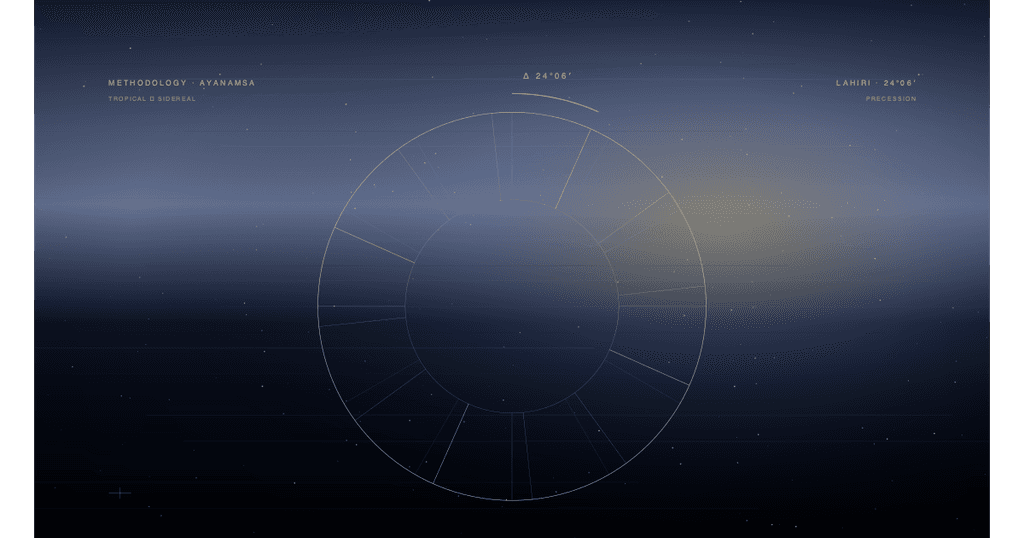
The engine choice determines what the chart actually computes. Vedic astrology requires an ephemeris (planetary position table) and an ayanamsa (sidereal zodiac offset). Research-grade work names both. Tempora uses Swiss Ephemeris, the academic-standard ephemeris developed by Astrodienst and used in academic astronomy research. Tempora's ayanamsa is True Pushya Paksha, which anchors the sidereal zodiac to the Pushya nakshatra principle in the classical convention.
Commercial Vedic astrology often runs on phone-app shortcuts. The app computes positions from an unnamed ephemeris (sometimes an internal approximation, sometimes an outdated table) and applies an unnamed ayanamsa (default is usually Lahiri without saying so). Two apps fed the same birth data can produce different ascendant signs because their ayanamsa differs by a degree. The chart that the user sees is not externally verifiable.
Why this matters in practice: the mahadasha sequence is computed from the Moon's nakshatra at birth. A 30-arcminute difference in the Moon's sidereal position (the typical drift between two unnamed ayanamsa choices) can place the Moon in a different nakshatra, which changes the mahadasha sequence by years and changes every period reading in the chart. The engine choice cascades into every downstream prediction.
Difference 6: Source-citation versus tradition-without-text-reference
Research-grade Vedic astrology cites the classical text on every interpretive claim. A claim that "9L-10L conjunction produces Raja yoga" carries the BPHS Chapter 34 reference. A claim that "Saturn delivers marriage late on Capricorn ascendant" carries the Phaladeepika Chapter 9 reference. A claim about ashtakavarga reading carries the BPHS Chapter 65 reference. The reader can verify the claim against the source. Translation quality, manuscript variants and competing readings are noted where they exist.
Commercial Vedic astrology cites tradition without text reference. The phrase "classical Vedic astrology says" introduces the claim and the source is not specified. Several configurations in widespread commercial use turn out, on close inspection, to be modern attributions to classical text where the actual text either says something different or does not address the question at all. Without text reference, the reader has no way to check.
The discipline matters because the Vedic corpus is large and internally varied. Brihat Parashara Hora Shastra is foundational but not exhaustive. Phaladeepika, Sarvartha Chintamani and Jaimini Sutra carry their own readings, sometimes complementary and sometimes in tension with BPHS. Source-citation discipline forces the practitioner to identify which classical tradition the specific reading sits inside, which is itself a methodological clarification.
Why the posture is pro-rigour, not anti-tradition
The research-grade posture is sometimes misread as anti-tradition. The misreading is structural. Research-grade work uses classical methods extensively: Parashari houses, Vimshottari dasha, the divisional charts (Navamsa for marriage, Dasamsa for career, Saptamsa for children), the ashtakavarga system, the named yogas (Raja yoga, Dhana yoga, Pancha Mahapurusha, Gajakesari, Lakshmi). The methods are unchanged from classical sources.
What research-grade adds is empirical measurement on top of classical reading. The classical text supplies the hypothesis: a specific configuration registers in specific event categories. The calibration measures the hypothesis: does the configuration actually recur in the labelled event set at meaningful lift over random chance? Hypothesis from tradition. Measurement from data. The two layers compose, they do not compete.
Tempora's choice has been to make the empirical layer transparent. The labelled event sets are published in JSON. The Monte Carlo baselines are reproducible from seed. The lift figures are derivative claims that any researcher can verify or contest. The interpretive readings cite the classical text the hypothesis came from. The full pipeline is open. Anyone who disagrees with a specific reading can recompute against the same data and either confirm the figure or produce an alternative.
Framework limits
The research-grade posture does not solve every problem in Vedic astrology. The corpus contains genuine internal disagreements where different classical texts give different readings; calibration can resolve some of these (which reading registers in event data) but not all (some readings concern outcomes that resist measurement). The chart-foundation problem (which moment to use for a national chart, which time to use for an undocumented birth) remains a research question regardless of methodology. The framework does not claim to remove these residuals; it claims to address the parts of the problem that admit measurement.
The posture also does not promise specific event prediction. Calibration produces lift figures: how much more often a configuration recurs in event dates than random dates. The lift figure tells you which configurations are signal-bearing. It does not tell you that the next instance of the configuration will produce the event. The framework predicts windows of elevated probability, not specific events.
Frequently asked questions
What is research-grade Vedic astrology?
Research-grade Vedic astrology is Vedic astrology practised under the same evidentiary standards a research lab would apply to any empirical claim: open data (natal charts, event sets and calibration code published), dated forward calls (predictions committed before the window opens), public reconciliation (verdicts published on all calls regardless of hit or miss), calibration-derived lift figures (Monte Carlo backtest against labelled event sets), documented engine (Swiss Ephemeris with named ayanamsa) and full source-citation (BPHS chapters and classical text references on every interpretive claim). The posture is not anti-tradition. It uses classical methods (Parashari houses, Vimshottari dasha, Navamsa, ashtakavarga) and applies modern measurement to them.
What are the six structural differences from commercial astrology?
Six differences: (1) Open data versus practitioner-dependent reading. Research-grade publishes the natal chart, event set and calibration code so anyone can recompute. Commercial keeps the chart and interpretation behind the practitioner. (2) Dated forward calls versus post-hoc reading. Research-grade commits to a window plus a reconciliation condition. Commercial reads after the fact. (3) Public reconciliation versus selective hits. Research-grade publishes verdicts on all calls including misses. Commercial selects favourable hits. (4) Calibration-derived lift versus classical-text-only reading. Research-grade derives lift figures from Monte Carlo backtest against labelled events. Commercial uses classical readings without empirical weighting. (5) Documented engine versus phone-app shortcuts. Research-grade uses Swiss Ephemeris with named ayanamsa. Commercial uses opaque app calculations. (6) Source transparency versus tradition without text reference. Research-grade cites BPHS chapter and verse. Commercial cites tradition without text reference.
Is research-grade Vedic astrology anti-tradition?
No. The research-grade posture is pro-rigour, not anti-tradition. Every interpretive claim in research-grade Vedic astrology rests on classical sources: Brihat Parashara Hora Shastra (the foundational Parashari text), Phaladeepika, Sarvartha Chintamani, Jaimini Sutra, Saravali. The houses, the dashas, the divisional charts, the yogas, the ashtakavarga system all come from this corpus. What research-grade adds is empirical weighting on top of the classical readings. The classical text says a configuration matters; the calibration measures how much it matters against a labelled event set. Tradition supplies the hypotheses. Measurement weights them.
Why does the engine choice matter?
The engine choice determines what the chart actually computes. Vedic astrology requires an ephemeris (planetary position table) and an ayanamsa (sidereal zodiac offset). Swiss Ephemeris is the academic-standard planetary position engine, accurate to arcsecond precision across thousands of years. Ayanamsa choice (Lahiri, True Pushya Paksha, Krishnamurti, Raman) determines exactly where the sidereal zodiac is anchored. Two charts computed from the same birth data with different ayanamsa can produce different ascendant signs, different nakshatra placements and different mahadasha sequences. Research-grade names the engine (Swiss Ephemeris) and the ayanamsa (Tempora uses True Pushya Paksha) so the chart is reproducible. Commercial phone-app shortcuts often use unnamed ayanamsa and unverifiable position calculations.
How does public reconciliation work?
Public reconciliation is the practice of publishing verdicts on every dated forward call after the window closes, regardless of whether the call hit or missed. Tempora publishes reconciliations within 30 days of window close in the Research notes. The reconciliation states the original call, the actual outcome, the verdict (HIT, NEAR-HIT, MISS or NULL) and the methodology lesson if any. Selective publication of hits while quietly dropping misses is the most common evidence pattern in commercial astrology and the central thing public reconciliation rules out. Tempora's full reconciliation log is publicly readable across the Research notes and on the Tracker.
Why is Tempora positioned as research-grade?
Tempora occupies the research-grade position because every dimension of the surface is built to research standards. Charts are computed via Swiss Ephemeris with True Pushya Paksha ayanamsa. The eight labelled national-chart event sets are published in JSON. Forward calls are dated with explicit windows and reconciliation conditions. Reconciliations are published within 30 days of window close. Lift figures are derived from Monte Carlo backtest against 300 random-date baselines. Interpretive claims cite BPHS chapter or comparable classical reference. The full methodology is documented in Research Note 005 and the publishing standards. No part of the surface depends on practitioner-private knowledge. Anyone with the same engine, the same event set and the same configuration test can reproduce the calibrated lift figures.
- reproducible astrology · the Popperian framework for dated forward calls
- Reproducible Vedic backtesting · the backtest pipeline behind the lift figures
- Calibrated lift · the lift figure explained
- Labelled event sets · the ground-truth list calibration measures against
- Research notes · the full set of dated forward calls and reconciliations
This article was prepared by Tempora Research as a methodology piece in the Method cluster. Calibrated lift figures and labelled event sets are documented in Research Note 005 and reproducible against the public engine. Internal audit log maintained. This article does not constitute medical, financial, legal or professional advice. First published 2026-06-04 by Tempora Research.