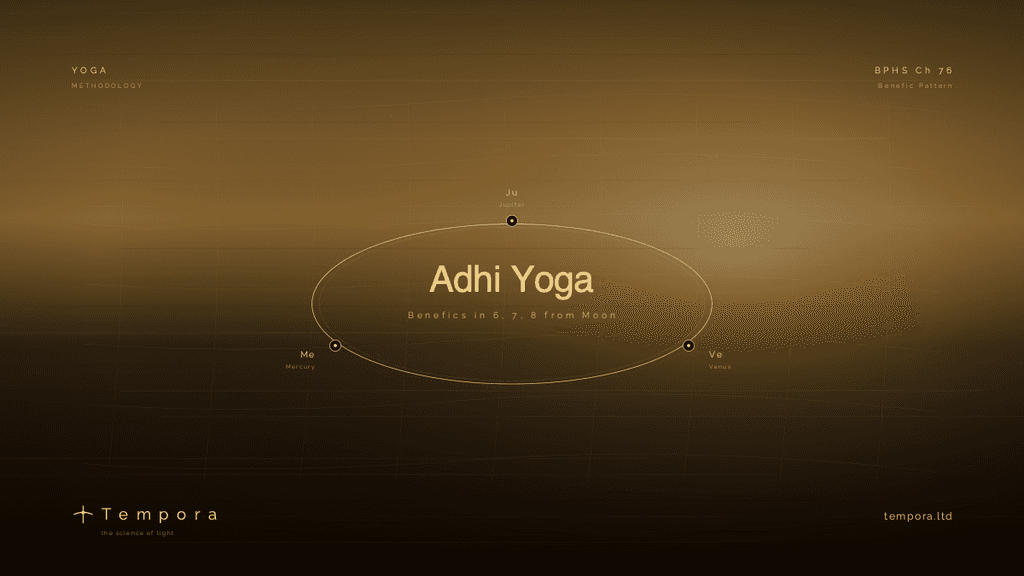
Adhi Yoga: Benefics in 6, 7, 8 from Moon
Adhi yoga forms when Jupiter, Venus and Mercury (the three natural benefics) occupy the 6th, 7th and 8th houses counted from the natal Moon. The classical reading is dignified recognition, leadership, financial stability and a benefic shield around the natal mind. Strength scales with how many of the three benefics are present. Activation runs through the Vimshottari mahadasha of any participating benefic. Distinct from the Anapha-Sunapha-Durudhara Moon yogas which count from the 2nd and 12th.
Adhi yoga forms when Jupiter, Venus and Mercury (the three natural benefics) occupy the 6th, 7th and 8th houses counted from the natal Moon. The classical reading is dignified-recognition, leadership, financial-stability and a benefic shield around the natal mind. Strength scales with how many of the three benefics are present. Activates during the mahadasha of any participating benefic. Source: BPHS Chapter 76.
The classical formation condition
Brihat Parashara Hora Shastra Chapter 76 (the chapter on Moon-based yogas) documents Adhi yoga as a configuration counted from the natal Moon rather than from the ascendant. The condition is precise: the three natural benefics (Jupiter, Venus and Mercury) must occupy the 6th, 7th and 8th houses counted from the natal Moon. The classical reading is dignified recognition and leadership.
The Sanskrit word adhi in this context carries the sense of supreme or chief. The yoga names a configuration where the chart owner reads as carrying chief-position recognition through the structural support the three benefics provide around the natal mind. The 6th, 7th and 8th houses from the Moon form an arc on the right-side of the lunar disposition: the houses where benefic protection has the most direct effect on the chart owner's mental and emotional axis.
Adhi yoga is part of the cluster of Moon-based yogas the classical tradition treats together. These include the Anapha (benefics in the 12th from the Moon), Sunapha (benefics in the 2nd from the Moon), Durudhara (benefics in both 2nd and 12th from the Moon), Kemadruma (no planets in the 2nd or 12th from the Moon) and Adhi itself. The full set is documented in BPHS Chapter 76 and elaborated across Phaladeepika and Sarvartha Chintamani.
Why the 6th, 7th and 8th from the Moon
The classical reasoning is rooted in the lunar disposition. The Moon in Vedic astrology governs the mind, emotional axis and the chart owner's daily mental texture. Houses counted from the Moon describe the registers that flow into and out of the Moon's natural functioning. The 6th from the Moon is the contention axis the mind must navigate (enemies, illness, daily struggle). The 7th from the Moon is the relational axis. The 8th from the Moon is the transformation axis.
When benefics occupy these three houses, the chart owner reads as carrying built-in protection against the difficulties the mind would otherwise have to navigate alone. Jupiter in the 6th from the Moon shields the chart owner against enemies and chronic illness. Venus in the 7th from the Moon stabilises relational life and partnership. Mercury in the 8th from the Moon supports transformation through clear thinking and analytical capacity.
The configuration produces what the classical literature calls the benefic shield around the natal mind. The chart owner reads as recognised in public-facing work because the mental axis is protected against the dusthana-axis disturbances that would otherwise leak into the daily functioning of the Moon. The recognition is not theatrical: it is the steady recognition that accrues to chart owners whose mental and emotional foundation is structurally protected.
Strength scaling with benefic count
The classical practice scales the Adhi yoga reading by how many of the three natural benefics participate.
One benefic in any of the 6th, 7th or 8th from the Moon. Mild Adhi expression. The chart owner reads as carrying one strand of the benefic shield: Jupiter alone gives wisdom-axis protection; Venus alone gives relational-axis protection; Mercury alone gives intellect-axis protection. The yoga is present but operates at single-axis strength.
Two benefics in any of the 6th, 7th or 8th from the Moon. Moderate Adhi expression. The chart owner reads as carrying two strands of the shield, with the third axis operating at default strength. The classical practice notes the two-benefic Adhi as common in chart owners with notable but not dominant recognition in their chosen field.
All three benefics in the 6th, 7th and 8th from the Moon. Full Adhi expression. The chart owner reads as carrying complete benefic-shield support around the natal Moon. This configuration is rare because it requires Jupiter, Venus and Mercury to spread across three specific consecutive houses from the lunar position. When it occurs, the classical reading is dignified recognition at the highest level: leadership in domain, financial stability across phases of life and the benefic-protection reading that runs through all three contention, relational and transformation axes simultaneously.
Some classical sources additionally distinguish whether the three benefics each occupy one of the three houses (one benefic per house) versus multiple benefics sharing a house. The single-benefic-per-house spread produces the strongest classical reading.
Dignity modulation
The strength of Adhi yoga is further modulated by the dignity of the participating benefics.
Strongest expression. Participating benefics in own or exalted signs. Jupiter is exalted in Cancer and owns Sagittarius and Pisces. Venus is exalted in Pisces and owns Taurus and Libra. Mercury is exalted in Virgo and owns Gemini and Virgo. Adhi yoga where the 6th-7th-8th houses from the Moon happen to fall in benefic-friendly signs and the participating benefics sit in own or exaltation dignity delivers the yoga's strongest classical reading.
Moderate expression. Participating benefics in friendly signs. The reading is present but qualified by the slight dilution from non-own-non-exalted dignity.
Reduced expression. Participating benefics in enemy signs or debilitated. Jupiter is debilitated in Capricorn. Venus is debilitated in Virgo. Mercury is debilitated in Pisces. A debilitated benefic in the 6th, 7th or 8th from the Moon technically forms the yoga but the dignity-weakness reduces delivery substantially. Classical practice notes such configurations as nominal-Adhi rather than active-Adhi.
Combustion further reduces expression. A benefic within roughly 12 degrees of the Sun reads as combust and its natural-benefic register operates with reduced strength.
Dasha activation
Adhi yoga is structural. The yoga sits in the chart from birth but its recognition-and-leadership register becomes active during the Vimshottari mahadasha of the participating benefics.
Jupiter mahadasha (16 years). Activates the Adhi yoga from the Jupiter side. The chart owner experiences the wisdom-axis and dignified-recognition register most prominently. Common period for educational achievement, dharmic-axis recognition and the benefic-shield register at its widest activation.
Venus mahadasha (20 years). Activates from the Venus side. Relational-axis recognition, aesthetic-axis recognition, financial stability and partnership-axis benefits.
Mercury mahadasha (17 years). Activates from the Mercury side. Intellectual-axis recognition, communication-axis prominence, analytical-axis leadership.
Antardasha activation. Within other mahadashas, the antardasha of any participating benefic activates a shorter Adhi window. Double-activation (the participating benefic running as both dasha lord and antardasha lord or two participating benefics running as dasha plus antardasha in sequence) produces the most concentrated activation.
Transit Jupiter through the houses involved in the Adhi configuration provides additional constructive overlay. Transit Saturn through the same houses provides structural-pressure overlay. See Moon mahadasha for the broader Moon-period activation framework.
Distinguishing Adhi from Anapha, Sunapha and Durudhara
Adhi yoga is sometimes confused with the three Moon yogas that count from the 2nd and 12th from the natal Moon. The classical distinctions.
Sunapha yoga. Forms when any planet other than the Sun and Rahu and Ketu occupies the 2nd house from the natal Moon. Reads as wealth from self-effort, intelligence and capacity for sustained earnings. Different counting (2nd from Moon, not 6th to 8th).
Anapha yoga. Forms when any planet other than the Sun and Rahu and Ketu occupies the 12th house from the natal Moon. Reads as comfortable living, generous disposition and capacity for self-expression. Different counting (12th from Moon, not 6th to 8th).
Durudhara yoga. Forms when both the 2nd and 12th houses from the Moon are occupied by planets other than the Sun and Rahu and Ketu. Combines the Sunapha and Anapha readings. Reads as full lunar support across earnings and expression axes.
Kemadruma yoga. Forms when neither the 2nd nor the 12th house from the Moon contains any planet other than the Sun and Rahu and Ketu. Classical default reading is isolation of the lunar mind from supporting planetary context, with cancellation conditions documented separately. See Kemadruma yoga for the full calibrated treatment.
Adhi yoga is structurally distinct from all four. It counts from the 6th, 7th and 8th from the Moon and requires specifically the three natural benefics (Jupiter, Venus and Mercury) rather than any planet. A chart can carry Adhi yoga and one of the Anapha-Sunapha-Durudhara configurations simultaneously, with the readings compounding.
How to identify Adhi yoga in your own chart
- Compute your sidereal natal chart. Tempora uses the Swiss Ephemeris with the True Pushya Paksha ayanamsa by PVRN Rao.
- Locate the natal Moon. Note its sign and house position.
- Count houses from the Moon: identify the 6th, 7th and 8th houses counted from the Moon's position (not from the ascendant).
- Check Jupiter, Venus and Mercury. Are any of them sitting in the 6th, 7th or 8th from the Moon?
- If one benefic is present, you have mild Adhi. If two are present, moderate Adhi. If all three are present, full Adhi.
- Check the single-benefic-per-house distribution: full Adhi reads strongest when each of the three benefics occupies one of the three houses (rather than two benefics sharing a house).
- Check dignity: participating benefics in own or exalted signs deliver strongest. Debilitated or combust participating benefics reduce delivery.
- Walk the Vimshottari dasha sequence: the mahadasha periods of the participating benefics are the structural activation windows.
- Check for co-occurring Moon yogas: Sunapha, Anapha or Durudhara can compound with Adhi when both configurations are present.
What Adhi yoga does not predict
Adhi yoga is one component of the chart's structural reading. It does not by itself guarantee specific recognition outcomes or specific timing. The classical framework reads Adhi as a structural-capacity flag: the chart owner carries the benefic-shield register around the natal mind and the dignified-recognition disposition the configuration produces. Whether and how that capacity expresses depends on the dasha sequence, the transit overlay across the lifetime, the chart owner's response architecture and the broader chart context.
The yoga also does not specify the domain of recognition. Some chart owners with full Adhi achieve recognition in academic axes, others in commercial axes, others in public-service axes. The yoga supplies the benefic-shield and dignified-recognition register; the chart owner's specific application sits with the rest of the chart and the chart owner's chosen domain.
A chart with strong Adhi but with the 10th lord debilitated and the 11th house afflicted can produce the benefic-shield register and dignified-recognition disposition without the corresponding wealth or status outcomes. The full reading combines the Adhi capacity with the career-axis and wealth-axis conditions and the dasha-driven event timing.
Calibration status
The article documents the classical Adhi yoga framework as set out in BPHS Chapter 76, Phaladeepika Chapter 6 and Sarvartha Chintamani Chapter 12. The formation conditions (benefics in 6th, 7th and 8th from the Moon), the strength scaling with benefic count, the dignity modulation and the dasha activation framework are presented as the tradition's own framework. The Tempora calibrated signature library does not currently include Adhi-yoga-based event signatures at population level. Calibrating the yoga against a labelled chart corpus is open work. See Calibrated lift for the calibration methodology Tempora applies to other classical signatures.
Sources. Brihat Parashara Hora Shastra Chapter 76 (Chandra Yogas). Phaladeepika Chapter 6. Sarvartha Chintamani Chapter 12. Jataka Parijata Chapter 7.
Adhi yoga under the 2026 to 2028 sky
Adhi yoga forms when the three natural benefics Jupiter, Venus and Mercury occupy the 6th, 7th and 8th houses counted from the natal Moon. That arrangement is fixed at birth. The 2026 to 2028 sky cannot build it for a chart that does not already carry it. What the dated sky can do is echo one leg of the support cluster by transit, and the slow benefic that carries the echo is Jupiter.
Jupiter is exalted in Cancer from 27 May 2026 to 19 June 2027, with a first taste from 6 October to 18 December 2025. While Jupiter holds Cancer it sits in the 6th from an Aquarius Moon, the 7th from a Capricorn Moon and the 8th from a Sagittarius Moon. For those three lunar placements a benefic occupies one of the exact houses Adhi reads, so the support-cluster register is lit from the outside for that window. When Jupiter moves to Leo from 19 June 2027 the same arithmetic shifts the lit house one sign forward.
The two fast benefics complete the picture on a shorter clock. Venus and Mercury pass through Cancer and every other sign several times across 2026 to 2028, so each of them tenants the 6th, 7th or 8th from any given Moon for a few weeks at a stretch. Those passes are frequent and brief. They colour the texture of a month rather than a chapter.
Pair each signal with its limit. Adhi asks for all three benefics seated across the 6th, 7th and 8th from the Moon at once. A transit places one benefic in one of those houses for a dated stretch. The window echoes the yoga. The natal cluster is the standing form, and the transit relief closes when the planet leaves the sign. A chart that already carries Adhi reads the Jupiter-in-Cancer window as reinforcement of a structure it owns. A chart free of Adhi reads the same window as a passing benefic transit through the lunar 6th, 7th or 8th, weaker and time-boxed.
Tempora publishes dated forward calls and grades them on the public scoreboard. No Adhi-specific population signature has been graded there. The honest position is that the yoga is documented in the classical corpus and the transit windows above are computable, while the calibrated lift for Adhi itself stays open work. The Jupiter transit that lights these houses is the same exaltation examined in the Jupiter mahadasha note, which sets out how a Jupiter period and a Jupiter transit read together.
Frequently asked questions
Does the 2026 to 2028 sky create Adhi yoga in my chart?
No. Adhi yoga is a natal arrangement of the three benefics Jupiter, Venus and Mercury across the 6th, 7th and 8th from the natal Moon, fixed at birth. Transits cannot assemble the standing cluster. What the dated sky offers is an echo of one leg. Jupiter exalted in Cancer from 27 May 2026 to 19 June 2027 sits in the 6th from an Aquarius Moon, the 7th from a Capricorn Moon and the 8th from a Sagittarius Moon, so a benefic occupies one Adhi house for that window. Venus and Mercury pass the same houses several times a year on a much shorter clock. A chart that already carries Adhi reads the Jupiter window as reinforcement. A chart without it reads a passing transit that closes when Jupiter leaves the sign.
What is Adhi yoga in Vedic astrology?
Adhi yoga is the classical Moon-based recognition yoga documented in Brihat Parashara Hora Shastra Chapter 76. It forms when the three natural benefics (Jupiter, Venus and Mercury) occupy the 6th, 7th and 8th houses counted from the natal Moon. The Sanskrit word adhi means chief or supreme. The classical reading is dignified recognition, leadership capacity, financial stability and a benefic shield around the natal mind. Strength scales with how many of the three benefics participate: one gives mild Adhi, two gives moderate, three gives full Adhi. The yoga is counted from the natal Moon (not from the ascendant) which is the diagnostic distinguishing it from kendra-based yogas.
How does Adhi yoga differ from Anapha, Sunapha and Durudhara?
All four are Moon-based yogas but they count from different houses. Sunapha forms when planets occupy the 2nd from the Moon. Anapha forms when planets occupy the 12th from the Moon. Durudhara forms when both the 2nd and 12th from the Moon are occupied. Adhi forms when specifically Jupiter, Venus and Mercury occupy the 6th, 7th and 8th from the Moon. The participant set is different (Adhi requires the three natural benefics specifically; Sunapha and Anapha admit any planet other than the Sun and Rahu and Ketu) and the counting is different (6th-8th versus 2nd or 12th). A chart can carry Adhi together with Sunapha or Anapha or Durudhara when both configurations are present.
Why does Adhi yoga count from the Moon rather than the ascendant?
The Moon in Vedic astrology governs the mind, the emotional axis and the chart owner's daily mental texture. Houses counted from the Moon describe the registers that flow into and out of the Moon's natural functioning. The 6th, 7th and 8th from the Moon are the contention axis, the relational axis and the transformation axis the mind must navigate. When the three natural benefics occupy these specific houses from the lunar position, the chart owner reads as carrying built-in protection against the difficulties the mind would otherwise have to navigate alone. The classical literature calls this the benefic shield around the natal Moon. Counting from the ascendant would describe a different reading register (the visible-life axis rather than the mental-emotional axis).
How is Adhi yoga activated by dasha?
The yoga is structural and is present in the chart from birth. It becomes active during the Vimshottari mahadasha of any participating benefic. Jupiter mahadasha (16 years) activates the wisdom-axis and dignified-recognition register. Venus mahadasha (20 years) activates the relational-axis recognition and financial stability register. Mercury mahadasha (17 years) activates the intellectual-axis recognition and communication-axis prominence. Within other mahadashas, the antardasha of any participating benefic activates a shorter Adhi window. Double-activation, where the participating benefic runs as both dasha lord and antardasha lord, produces the most concentrated activation period for the yoga's full register.
Is Adhi yoga common or rare?
Mild Adhi (one of the three benefics in the 6th, 7th or 8th from the Moon) is moderately common because any of three planets can satisfy the condition. Full Adhi (all three benefics distributed across the 6th, 7th and 8th from the Moon, ideally one benefic per house) is rare because it requires Jupiter, Venus and Mercury to spread across three specific consecutive houses from the lunar position. The rarity is what gives full Adhi its classical strength: it indicates the chart owner's Moon happens to sit at a position where the three benefics surround the relevant mental-axis houses simultaneously. Statistical incidence depends on the natal sample but full Adhi is typically reported in the low-single-digit-percentage range across population samples.
What does Adhi yoga not predict?
Adhi yoga is one component of the chart's structural reading. It does not by itself guarantee specific recognition outcomes or specific timing. Whether and how the capacity expresses depends on the dasha sequence, the transit overlay across the lifetime, the chart owner's response architecture and the broader chart context. The yoga also does not specify the domain of recognition. Some chart owners with full Adhi achieve recognition in academic axes, others in commercial axes, others in public-service axes. A chart with strong Adhi but with the 10th lord debilitated and the 11th house afflicted can produce the benefic-shield register and dignified-recognition disposition without the corresponding wealth or status outcomes.
Read next
- Raja Yoga: status configurations
- Dhana Yoga: wealth-house lord combinations
- Neecha Bhanga Raja Yoga
- Calibrated lift: measuring whether a Vedic technique works
This article represents conventional Vedic teaching and Tempora Research method documentation. It does not constitute financial, legal, medical or professional advice. Yoga interpretation depends on the full natal chart; the conditions described here are necessary but not always sufficient. Internal audit log maintained.