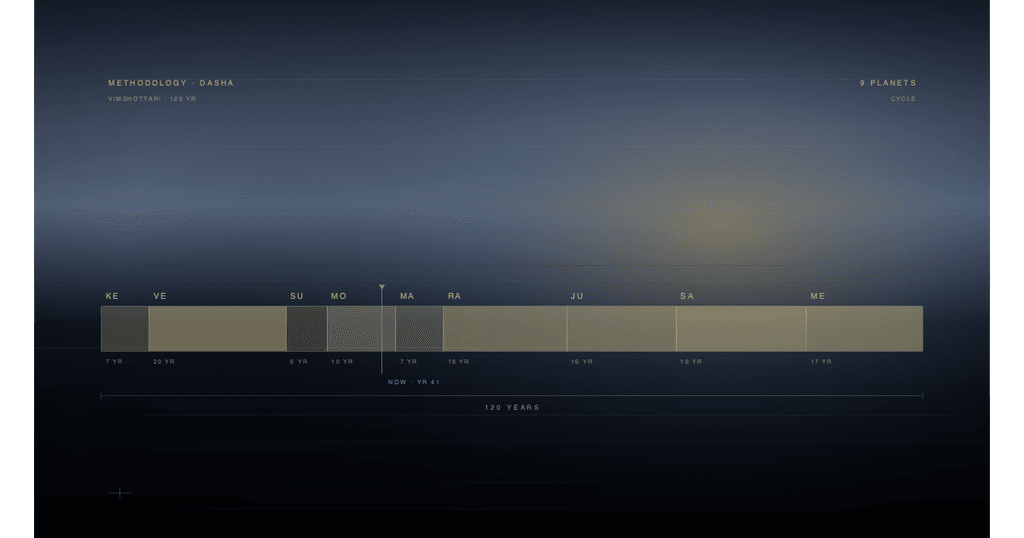
Dasha Chhidra, the closing-window stress band before a mahadasha changes.
Dasha chhidra (Sanskrit: chhidra, the gap or the leak) is the closing 1/9th or 1/8th of any Vimshottari mahadasha when the running antardasha is the same lord as the incoming or outgoing mahadasha. The classical reading is a structural stress band: the energy of the closing mahadasha leaks and the energy of the incoming mahadasha begins to assert, producing instability across the boundary. The chhidra is distinct from dasha sandhi (the broader 6-to-8-month junction zone between two mahadashas) which Tempora documents separately at dasha sandhi junction periods. Chhidra is narrower and refers specifically to sub-period leakage; sandhi is broader and covers the full transition zone. Worked examples, mitigating factors and the per-mahadasha chhidra positions are below. Tempora's calibration treats chhidra windows as filter-stress periods where event probability lifts moderately above background. Sources: BPHS Chapter 47, Phaladeepika Chapter 12.
What dasha chhidra means structurally
Dasha chhidra is one of the more technically specific concepts in Vimshottari practice. The Sanskrit word chhidra translates as the gap, the leak or the hole. The classical reading uses chhidra to describe sub-period windows inside a mahadasha where the structural integrity of the period weakens because the antardasha lord is the same planet as either the incoming or outgoing mahadasha. The same-planet condition creates a leakage: energy from the antardasha lord either drains into the next mahadasha (when the antardasha lord equals the next mahalord) or echoes the previous mahadasha that is already exhausted (when the antardasha lord equals the previous mahalord).
The strongest classical case is the same-planet antardasha at the very end of a mahadasha. In the Vimshottari nesting, every mahadasha ends with its own antardasha as the final sub-period: Mercury mahadasha ends with Mercury-Mercury antardasha, Saturn mahadasha ends with Saturn-Saturn antardasha, Venus mahadasha ends with Venus-Venus antardasha. This same-planet antardasha at exit reads as the structurally weakest moment in the mahadasha because the closing mahalord has no antardasha-level support from any other planet; it is operating purely on its own exhausted energy.
The related structural case is the same-planet antardasha at the beginning of an incoming mahadasha. The first antardasha of every mahadasha is the mahalord's own (Saturn mahadasha begins with Saturn-Saturn, Mercury mahadasha begins with Mercury-Mercury). The classical commentary treats this as pratham chhidra (the opening leak): the incoming mahalord has not yet established its full structural environment and is operating without sub-period diversification.
The classical citation is Brihat Parashara Hora Shastra Chapter 47, with elaborations in Phaladeepika Chapter 12 and the Vimshottari commentary literature.
The structural distinction: chhidra versus sandhi
Tempora's separate treatment of dasha sandhi (dasha sandhi junction periods) covers the broader transition zone between two mahadashas. The distinction between chhidra and sandhi is structural and matters for both reading and calibration.
Sandhi (Sanskrit: junction) is the broader transition zone. Classical practice flags sandhi as the final 3 to 4 months of the outgoing mahadasha plus the first 3 to 4 months of the incoming mahadasha. The total sandhi window runs 6 to 8 months across the transition boundary. Sandhi covers the full handover period.
Chhidra (Sanskrit: leak) is the narrower sub-period leakage band inside the sandhi. Chhidra refers specifically to the antardasha and pratyantara level windows where the sub-period lord is the same as the incoming or outgoing mahalord, which creates the leakage signature. The strongest chhidra point is the same-planet antardasha at the end of the mahadasha (Mercury-Mercury at close of Mercury), which runs for roughly the final 12 months of the 17-year Mercury period.
The two concepts overlap. The end-of-mahadasha chhidra sits inside the closing-side of the sandhi zone. But not all of the sandhi is chhidra (the broader 3-to-4-month band includes other antardashas too) and not all chhidra is at the exact junction (same-planet antardashas appear at other positions in the sequence as well). The practical reading: sandhi is the broader caution zone, chhidra is the narrower stress concentration within it.
| Concept | Sanskrit | Scope | Duration |
|---|---|---|---|
| Dasha sandhi | Junction | Broader transition zone between two mahadashas | 6 to 8 months total, 3 to 4 months on either side of exact junction |
| Dasha chhidra | Leak | Sub-period leakage windows where antardasha lord equals incoming or outgoing mahalord | Variable: from a few weeks (pratyantara-level) to several months (antardasha-level) |
| Same-planet antardasha at exit | Mahadasha-anta | Final antardasha of every mahadasha (Mercury-Mercury at close of Mercury) | Typically 9 to 14 months depending on mahalord |
| Pratham chhidra | Opening leak | Same-planet antardasha at start of incoming mahadasha | Typically 9 to 14 months at start of incoming mahadasha |
Worked example: Mercury mahadasha closing chhidra
Mercury mahadasha runs for 17 years in the Vimshottari sequence. In the conventional Vimshottari order, the mahadasha after Mercury is Ketu (7 years). Working through the antardasha sequence inside Mercury mahadasha, the antardashas follow the order: Mercury-Mercury (opening, roughly 2.4 years), Mercury-Ketu (roughly 11.9 months), Mercury-Venus (roughly 2.8 years), Mercury-Sun (roughly 10.2 months), Mercury-Moon (roughly 1.4 years), Mercury-Mars (roughly 11.9 months), Mercury-Rahu (roughly 2.5 years), Mercury-Jupiter (roughly 2.3 years), Mercury-Saturn (roughly 2.7 years).
The Mercury-Ketu antardasha sits second in the sequence (after the opening Mercury-Mercury), not at the end. The chhidra structural condition (antardasha lord = next mahalord, with Ketu being the next mahalord after Mercury) is met during this Mercury-Ketu period. The classical chhidra reading concentrates in the final 1/9th of this Mercury-Ketu antardasha: roughly the last 40 days, where the Ketu signature accumulates and prefigures the upcoming Ketu mahadasha.
The strongest closing chhidra in Mercury mahadasha is the final Mercury-Saturn antardasha (roughly the last 2.7 years of Mercury mahadasha) leading into the absolute end. Within Mercury-Saturn, the closing 1/9th (roughly the last 4 months) reads as the deepest closing-window chhidra. The exact junction itself transitions to Ketu mahadasha, which then opens with Ketu-Ketu antardasha (the pratham chhidra of the new period, lasting roughly 4.9 months).
The chhidra-then-sandhi-then-pratham-chhidra sequence creates a concentrated stress band of roughly 9 to 13 months centred on the Mercury-to-Ketu transition. Classical practice avoids irreversible commitments through this window: it advises against major financial deals, irreversible career moves, large medical decisions or relationship-defining steps that would be hard to unwind if the transition produces unexpected outcomes.
Mitigating factors
The chhidra signature is a structural stress band, not a deterministic verdict. The intensity scales with mitigating and aggravating factors that the broader chart context supplies. Four classical mitigating factors reduce chhidra stress.
- Strong closing mahalord. The outgoing mahadasha lord in own-sign, exaltation, kendra or trikona occupation softens the leak because the lord retains structural capacity through its exit. A Mercury in own-sign Virgo at the 10th house going into the chhidra exit window produces a markedly less stressful closing than a Mercury debilitated at the 6th house.
- Benefic transits during the window. Jupiter or Venus transiting the relevant houses (the 1st, the 10th, the 7th, the natal Moon's house) during the chhidra months reduces the leak intensity. Jupiter transit specifically over the natal Moon position or the lagna is a classical chhidra-softening signature.
- Auspicious antardasha sequence. When the chhidra sub-period antardasha lord is dignified and friendly to the mahadasha lord, the leak signature is muted. For Mercury mahadasha closing chhidra, a dignified friendly Ketu (Ketu in own-sign Scorpio or in the 12th house with no afflictions) produces a softer closing than an afflicted Ketu in dusthana.
- Mature dasha context. Charts that have already passed through the same mahadasha-handover pattern in previous Vimshottari cycles tend to register chhidra at lower intensity than charts experiencing the configuration for the first time. The classical phrasing is that the chart's environment has been pre-conditioned by the earlier pass through the same configuration.
The four factors do not eliminate the chhidra register but they downweight its intensity. A chart with all four mitigations passes through chhidra with minimal observable disruption. A chart with none of them registers the chhidra at full intensity and the closing-window stress shows up materially.
How Tempora's calibration treats chhidra
Tempora's calibration treats chhidra windows as filter-stress periods: windows in which the lift figure for event probability is elevated above background but the lift is moderate (roughly 1.3x to 1.8x on labelled personal-chart event sets) rather than dominant (3x or higher, which is the lift range that strong yoga activations produce). The chhidra register is used as a downweighting filter on forward calls.
The practical implication: a forward call that would otherwise land on the chhidra window is annotated with a lower confidence band because the structural environment is unstable through the leak. The dasha activation that the forward call relies on (a specific yoga, a specific transit-dasha overlap) may not fire with full strength because the underlying mahadasha is in handover. Forward calls during dasha sandhi (the broader junction) get a similar but milder annotation; sandhi is a wider zone of caution but the chhidra concentrates the structural stress.
The calibrated lift on chhidra-window event probability has been measured against the eight national-chart labelled event sets and is documented in Research Note 005. The measurement is not stable across national charts (some national charts show chhidra lift in the 1.5x range, others in the 1.2x range, with significant variance) which suggests chhidra is a real but moderate-strength signature rather than a dominant one.
The pratyantar-level chhidra (third-level leakage)
Classical practice also extends chhidra reading to the pratyantar level (third level of the Vimshottari nesting, below antardasha). The pratyantar of a same-planet antardasha further concentrates the leak. Tempora's longer treatment of pratyantar dasha covers the third-level mechanics in detail.
The structural rule for pratyantar-level chhidra: when the pratyantar lord, the antardasha lord and the next-or-previous mahadasha lord all align (all three are the same planet or all three sit in the same nakshatra cluster), the pratyantar concentrates the chhidra into a window of weeks rather than months. The classical reading treats this as the absolute peak of the leakage signature in the mahadasha cycle.
The pratyantar-level analysis is sensitive to birth-time precision because the pratyantar windows are short (days to weeks). Practical readings using pratyantar-level chhidra require a birth time accurate to within a few minutes, which not all chart owners have. Tempora's standard reading falls back to antardasha-level chhidra when the birth-time precision does not support pratyantar-level resolution.
Framework limits
The chhidra signature is a structural stress band, not a verdict. The framework does not predict specific events from the chhidra alone; it identifies windows where the structural environment is unstable. The actual events that fire within the window depend on the broader chart context, the transit layer and the surrounding dasha sequence. Classical practice uses chhidra as a caution flag rather than as a prediction.
The framework also does not work uniformly across chart types. Chhidra reading is calibrated against personal charts where the running mahadasha is the chart's primary timing engine. National charts and event charts (mundane charts) use different timing engines (Mars dasha for warfare, Moon-cycle timing for elections) where the chhidra register either does not apply or applies differently. The published lift figures on chhidra are personal-chart-specific.
Finally, chhidra is one of several stress-band concepts in the Vimshottari literature. Maraka periods (death-inflicting lord mahadashas), antardasha of malefic dispositors and pratyantar of debilitated lords all carry independent stress signatures that compound or counteract chhidra depending on chart specifics. A full timing reading walks all stress bands together rather than treating chhidra in isolation.
Frequently asked questions
What is dasha chhidra in Vedic astrology?
Dasha chhidra (Sanskrit: the gap or the leak) is the closing 1/9th or 1/8th of any Vimshottari mahadasha when the running antardasha is the same as the next or previous mahadasha lord. The classical reading is a stress band where the energy of the closing mahadasha leaks and the energy of the incoming mahadasha begins to assert. The two same-planet antardashas at the end-of-period and start-of-next-period boundary (Saturn-Saturn at the close of Saturn mahadasha, Mercury-Mercury at the start of Mercury mahadasha) are also treated as chhidra by extended classical practice. Sources: BPHS Chapter 47 and the Vimshottari commentary literature.
How is dasha chhidra different from dasha sandhi?
Dasha sandhi is the broader junction zone between two mahadashas, typically the final 3 to 4 months of the outgoing mahadasha plus the first 3 to 4 months of the incoming. Sandhi spans roughly 6 to 8 months across the transition boundary. Dasha chhidra is narrower and more specific. Chhidra refers to the sub-period inside the outgoing mahadasha where the antardasha is the same lord as the incoming or outgoing mahadasha, which creates a structural leak. The same-planet antardasha at the very end of a mahadasha (Mercury-Mercury at the close of Mercury) is the classical strongest chhidra point. Distinction in one sentence: chhidra is the narrower sub-period leak inside the broader sandhi transition zone.
What is the worked example of dasha chhidra?
Worked example: Mercury mahadasha runs for 17 years in the Vimshottari sequence. The next mahadasha after Mercury is Ketu (7 years). The Mercury-Ketu antardasha (Mercury mahadasha sub-period ruled by Ketu) sits at the second-to-last position in Mercury mahadasha and runs for roughly 11.9 months. During this antardasha, the chart owner is in the closing band of Mercury (the outgoing mahalord) with the antardasha lord being the incoming mahadasha planet. The classical reading treats the final 1/9th of this Mercury-Ketu antardasha as the dasha chhidra: roughly the last 40 days. The chhidra concentrates the leak. Then the final Mercury-Mercury pratyantar of the antardasha (if extended chhidra rule is applied) deepens the same-planet leakage signature. The chhidra-then-handover sequence is the structural reason classical practice flags this window as filter-stress for major decisions.
Does dasha chhidra always produce difficulty?
No. The chhidra signature is a stress band, not a verdict. The intensity depends on mitigating factors. A chart with the closing mahadasha lord well-placed (own-sign, exaltation, kendra or trikona occupation) and dignified benefic transits across the chhidra window often passes through the period without significant disruption. A chart with the closing mahadasha lord weakly placed (debilitation, dusthana occupation, hemmed by malefics) and difficult transits (Saturn over relevant houses, eclipse axis on relevant nakshatra) concentrates the leak into actual events: career disruption, relationship strain, health flare. Tempora's calibration treats chhidra as a filter-stress window where event probability lifts above background but the lift figure is moderate rather than dominant.
What mitigating factors reduce dasha chhidra stress?
Four mitigating factors classically reduce chhidra stress. (1) Strong closing mahalord: the outgoing mahadasha lord in own-sign, exaltation, kendra or trikona occupation softens the leak because the lord retains structural capacity through its exit. (2) Benefic transits during the window: Jupiter or Venus transiting the relevant houses during the chhidra months reduces the leak intensity. (3) Auspicious antardasha sequence: when the chhidra sub-period antardasha lord is dignified and friendly to the mahadasha lord, the leak signature is muted. (4) Mature dasha context: charts that have already passed through the same mahadasha-handover pattern in previous cycles tend to register chhidra at lower intensity than charts experiencing the configuration for the first time. The mitigations do not eliminate the chhidra register but they downweight its intensity.
How does Tempora's calibration treat dasha chhidra?
Tempora's calibration treats chhidra windows as filter-stress periods: windows in which the lift figure for event probability is elevated above background but the lift is moderate (roughly 1.3x to 1.8x on labelled event sets across personal charts) rather than dominant (3x or higher). The chhidra register is used as a downweighting filter on forward calls. A forward call that would otherwise land on the chhidra window is annotated with a lower confidence band because the structural environment is unstable through the leak. Forward calls during sandhi (the broader junction) get a similar but milder annotation. The full methodology is documented in the Research Note 005 calibration pipeline.
- Dasha sandhi junction periods · the broader transition zone that chhidra sits inside
- Pratyantar dasha third level · the sub-sub-period mechanics
- Mahadasha · the full Vimshottari cycle
- Techniques cluster · all timing-and-method articles
- reproducible astrology · the methodology behind the calibrated lift figures
This article was prepared by Tempora Research as a technique piece in the Techniques cluster. Methodology and calibrated lift figures are documented in Research Note 005 and reproducible against the public engine. Internal audit log maintained. This article does not constitute medical, financial, legal or professional advice. First published 2026-06-04 by Tempora Research.