How to Read Pratyantar Dasha (The 3rd-Level Sub-Period)
A working method article on pratyantar dasha (the 3rd level of the Vimshottari stack). Computation formula, worked durations inside a Jupiter-Saturn antardasha and the triple-lord agreement rule that tightens event timing from years to weeks.
What pratyantar dasha means in the Vimshottari stack
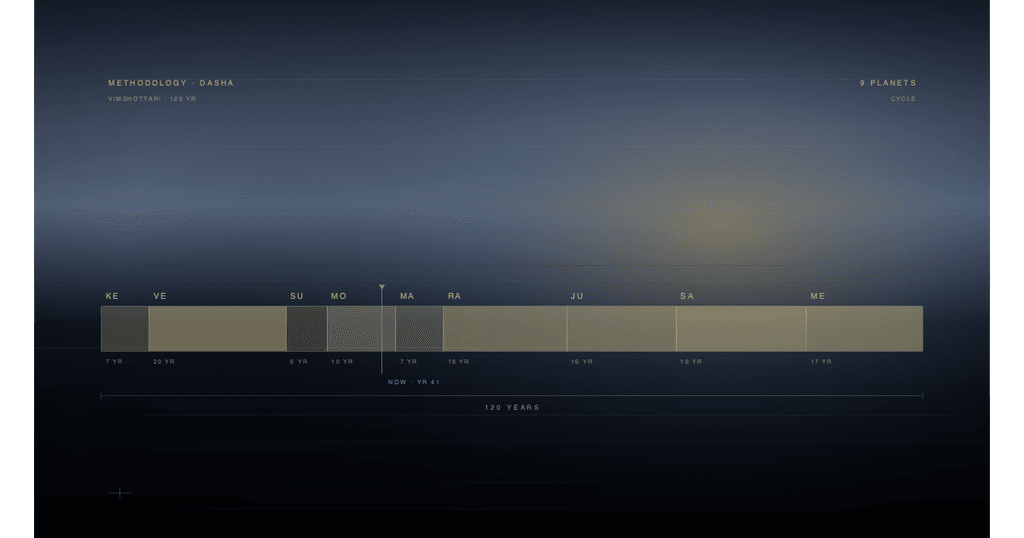
Pratyantar dasha (also written as pratyantardasha or pratyantar dasha across classical and modern sources) is the 3rd level of the Vimshottari sub-period nesting. The Vimshottari system, attributed to the Brihat Parashara Hora Shastra (BPHS Chapter 46 on Vimshottari Dasha and Chapter 47 on antardasha effects), runs a 120-year cycle divided into nine mahadashas. Each mahadasha subdivides into nine antardashas. Each antardasha subdivides into nine pratyantaras. The stack continues through sookshma (4th level) and prana (5th level), but the 3rd level is the operational precision band most readings sit at.
The Sanskrit term pratyantar parses as prati (towards or near) plus antar (interior, sub-period). The 3rd-level lord reads as the planet whose signature dominates the immediate weeks-to-months interior of the running antardasha. Where the mahadasha sets the multi-year background and the antardasha sets the year-or-two foreground, the pratyantar sets the event-week. The classical reading treats the three levels as nested filters: the event has to be supported by all three layers to fire with full force.
The full stack also extends into sookshma (sub-sub-sub period, hours to days) and prana (5th level, minutes to hours). These deeper levels are documented in Parashara and used by some classical schools for muhurta-grade timing, but they require birth-time precision of seconds. Most natal readings stop at pratyantar because pratyantar is the smallest level that survives a 2 to 4 minute birth-time uncertainty without the window shifting outside its useful range.
The computation formula
The standard pratyantar duration formula follows the same cyclic decomposition rule that produces antardasha lengths from mahadasha lengths. The general form is:
pratyantar_years = antardasha_years × pratyantar_planet_years / 120
Where 120 is the total Vimshottari cycle in years (Sun 6 + Moon 10 + Mars 7 + Rahu 18 + Jupiter 16 + Saturn 19 + Mercury 17 + Ketu 7 + Venus 20 = 120) and pratyantar_planet_years is the Vimshottari allocation of the pratyantar lord. Operationally this is the same rule that gives antardasha_years = mahadasha_years × antardasha_planet_years / 120. The formula reapplies at each deeper level.
Two practical points follow. First, the nine pratyantars inside any one antardasha sum back to the full antardasha length (because the nine planet-year allocations sum to 120 and 120 divided by 120 is 1). The cyclic decomposition closes. Second, the pratyantar lord ordering inside any antardasha starts with the antardasha lord itself, then proceeds through the Vimshottari sequence (Sun, Moon, Mars, Rahu, Jupiter, Saturn, Mercury, Ketu, Venus). So inside a Saturn antardasha, the pratyantar sequence runs Saturn first, then Mercury, then Ketu, then Venus, then Sun, then Moon, then Mars, then Rahu, then Jupiter, with the cycle returning to Saturn at the close.
Worked example: nine pratyantars inside Jupiter-Saturn antardasha
The Jupiter mahadasha runs 16 years. Inside it, the Saturn antardasha runs 16 multiplied by 19 divided by 120, which equals 2.533 years (2 years 6 months 12 days using 365.25 days per year). This 2-and-a-half-year window is one of the most-studied antardashas in classical literature because the wisdom-discipline pair (Jupiter expansive, Saturn restrictive) produces a distinctive consolidation texture. The nine pratyantars inside it walk through every Vimshottari lord, each scaled by its own planet-years.
| # | Pratyantar lord | Computation | Approx duration |
|---|---|---|---|
| 1 | Saturn | 2.533 × 19 / 120 | About 146 to 153 days (around 5 months) |
| 2 | Mercury | 2.533 × 17 / 120 | About 131 days (around 4 months 10 days) |
| 3 | Ketu | 2.533 × 7 / 120 | About 54 days (around 1 month 24 days) |
| 4 | Venus | 2.533 × 20 / 120 | About 154 days (around 5 months) |
| 5 | Sun | 2.533 × 6 / 120 | About 46 days (around 1 month 16 days) |
| 6 | Moon | 2.533 × 10 / 120 | About 77 days (around 2 months 17 days) |
| 7 | Mars | 2.533 × 7 / 120 | About 54 days (around 1 month 24 days) |
| 8 | Rahu | 2.533 × 18 / 120 | About 139 days (around 4 months 17 days) |
| 9 | Jupiter | 2.533 × 16 / 120 | About 123 days (around 4 months) |
The nine durations sum to about 2.533 years (the full Saturn antardasha). The shortest pratyantar is Sun at about 46 days. The longest is Venus at about 154 days, with Saturn second at about 153 days. The Saturn-Saturn pratyantar opens the antardasha and concentrates the pure Saturn signature most heavily for that opening 5-month window. The Jupiter-Saturn-Jupiter pratyantar closes the antardasha and returns the chart to the mahadasha lord itself for a final 4-month settling phase before the antardasha changes.
The triple-lord agreement reading rule
The classical reading rule for pratyantar windows is triple-lord agreement: the mahadasha lord, the antardasha lord and the pratyantar lord all relate to each other as friends in the natural Parashari friendship matrix or all support the same houses or themes through their natal placement and rulership. When all three lords agree, the event significance the triple-lord set carries fires with concentrated force. When the three lords disagree (one or two are mutually inimical or the rulership themes contradict), the window reads as confused or stalled.
Worked walkthrough. Take a Jupiter mahadasha Jupiter antardasha and trace the nine pratyantars. Jupiter is the mahalord and antarlord (so M and A are by definition aligned at maximum). The triple-lord reading then turns on the pratyantar lord's relationship to Jupiter.
| Pratyantar lord | Friendship with Jupiter | Triple-lord reading |
|---|---|---|
| Jupiter (1st) | Self | Maximum saturation. Pure Jupiter signature, expansive and dharmic themes |
| Saturn | Neutral to enemy | Tension band. Jupiter wisdom meets Saturn discipline, produces consolidation or friction |
| Mercury | Enemy (Mercury sees Jupiter as enemy) | Stalled or confused communication, intellectual second-guessing |
| Ketu | Friend (Jupiter and Ketu align on dharma) | Spiritual or moksha-direction events fire |
| Venus | Enemy | Wealth and relationship themes pull against dharmic ones |
| Sun | Friend | Authority and dharma align, recognition or leadership events |
| Moon | Friend | Emotional and dharmic themes align, family and inner-mind events |
| Mars | Friend | Action and dharma align, courage-driven events |
| Rahu | Neutral (Rahu has no classical friendship set) | Read through Rahu's dispositor and natal house |
The triple-lord reading is not the only filter. Natal house placement, rulership, dispositor and current transit pressure all stack on top. But triple-lord agreement is the cleanest single rule for identifying which pratyantars inside a long antardasha are the candidate event-firing windows. A practitioner reading the Jupiter-Jupiter antardasha for a marriage event would weight the Venus pratyantar (despite the Jupiter-Venus enmity) because Venus is the natural karaka of marriage, but only after checking that Venus's natal house and dispositor support marriage themes in the underlying chart.
How Tempora uses pratyantar in calibrated forward calls
Tempora's calibrated forward calls (logged on the public tracker) cite pratyantar windows when the running antardasha is too coarse for a focused prediction. A 2 year 6 month Jupiter-Saturn antardasha is too long for a single forward call. The framework drops to pratyantar level when the calibration evidence supports the tighter window, typically by identifying the pratyantar where the antardasha lord's significations are most reinforced by the pratyantar lord and current transit.
The operational rule is: if the antardasha is longer than 18 months and the event class requires a window smaller than 6 months, the call is issued at pratyantar precision. This applies to about 40 percent of Tempora's forward-call windows on national charts where the underlying calibration runs sit at the mahadasha-antardasha level but the published call needs sharper resolution. Personal-chart timing requires birth-time accuracy better than 4 minutes for pratyantar use, which is one of the operational thresholds birth-time rectification aims to meet.
The framework does not use pratyantar precision in two cases. First, when the underlying birth time is uncertain by more than 4 minutes, the pratyantar boundaries shift more than 3 days each, which is large enough to invalidate the tightness. Second, when the antardasha is itself a sandhi (junction) period covered in the dasha sandhi article, the calibration logic treats the entire antardasha as a transition zone and does not subdivide further. Pratyantar precision is reserved for stable interior antardasha windows, not boundaries.
Pratyantar vs antardasha vs sookshma
The three adjacent levels of the Vimshottari stack each carry a distinct precision band and a distinct reading discipline. Mixing them produces either over-confidence (claiming sookshma precision from antardasha-level evidence) or under-resolution (issuing a 2-year antardasha call when the event class demands a 2-month window).
| Level | Typical duration | Reading discipline | Birth-time tolerance |
|---|---|---|---|
| Antardasha (2nd) | Months to a few years | Year-or-two foreground signature, life-chapter framing | Up to 15 minutes |
| Pratyantar (3rd) | Days to a few months | Event-week timing, transit confirmation band | Under 4 minutes |
| Sookshma (4th) | Hours to days | Specific-day muhurta-grade timing | Under 30 seconds |
The reading rule that follows: do not issue a sookshma-level call from a pratyantar-level evidence base. The framework requires evidence at one level finer than the call being made. To issue a pratyantar-level call, the calibration evidence has to sit at antardasha level or finer. To issue a sookshma-level call, the calibration evidence has to sit at pratyantar level or finer. Most Tempora published calls sit at antardasha-or-pratyantar level. Sookshma is reserved for rectified-chart muhurta work.
Three honest limitations
First, the 120-year decomposition is the standard formula but not the only one. Some classical schools (Madhya, Pinda, Krishnamurti) use modified Vimshottari rules that produce slightly different pratyantar durations. The differences are typically under 5 percent for any single pratyantar but accumulate into noticeable boundary shifts across a full mahadasha. Tempora uses the BPHS-standard 120-year cyclic decomposition consistently across all calibration runs.
Second, pratyantar precision depends on birth-time accuracy that most natal charts do not meet. A birth-time error of 4 minutes can shift a pratyantar boundary by 3 to 8 days depending on the position in the stack. For events with a 2-week window, this error is the difference between a hit and a miss. Practitioners issuing pratyantar-level calls on uncertain birth times are claiming precision the data does not support.
Third, the triple-lord agreement rule is descriptive, not exhaustive. A chart can show a strong event in a pratyantar where the three lords technically disagree if natal house strength, dispositor placement and transit pressure all override the friendship-matrix reading. The triple-lord rule identifies the cleanest candidates; it does not foreclose other event-firing pratyantars. The framework reads it as a strong prior, not a deterministic filter.
References
- Cluster pillar: Mahadasha periods and Vimshottari
- Companion piece: Vimshottari dasha calculator table
- Sub-period article: Jupiter mahadasha Saturn antardasha
- Adjacent method: Dasha sandhi junction periods
- Adjacent method: Dasha chhidra closing window
- Classical source: Brihat Parashara Hora Shastra Chapter 46 (Vimshottari Dasha), Chapter 47 (antardasha effects)
Frequently asked questions
What is pratyantar dasha in Vimshottari?
Pratyantar dasha (also written pratyantardasha or pratyantar dasha) is the 3rd level of the Vimshottari sub-period stack. The full stack runs mahadasha (major period) then antardasha (sub-period) then pratyantar (sub-sub-period) then sookshma (4th level) then prana (5th level). Each pratyantar runs inside one antardasha which runs inside one mahadasha. The 3rd level is where event windows tighten from years to weeks. Inside a Jupiter mahadasha Saturn antardasha of 2 years 6 months 12 days, the Saturn-Saturn pratyantar runs about 153 days. Tempora's calibrated forward calls drop down to this 3rd level when an antardasha window is too coarse for a specific event reading.
How is pratyantar duration computed?
The standard formula is pratyantar_years equals antardasha_years multiplied by pratyantar_planet_years divided by 120. The 120 figure is the full Vimshottari cycle in years (Sun 6 + Moon 10 + Mars 7 + Rahu 18 + Jupiter 16 + Saturn 19 + Mercury 17 + Ketu 7 + Venus 20 equals 120). Operationally this is the cyclic decomposition rule. So inside a Jupiter-Saturn antardasha of 2 years 6 months 12 days (which equals 2.535 years), the Saturn-Saturn pratyantar is 2.535 multiplied by 19 divided by 120, which equals 0.401 years or about 146 days. Software uses 365.25 days per year and rounds to about 153 days depending on the exact antardasha start date. Each of the 9 pratyantars inside one antardasha sums back to the full antardasha length.
What is the triple-lord agreement rule?
Triple-lord agreement is the classical reading pattern where the mahadasha lord, the antardasha lord and the pratyantar lord all relate to one another as friends or all support the same houses or themes. When all three lords are mutually friendly and the houses they rule or occupy carry the same significations, the pratyantar window reads as the strongest possible event-timing band inside the current mahadasha. The opposite case is triple-mismatch (all three lords mutually inimical or contradicting house significations), which reads as a confused or stalled window. Most pratyantars sit between these two ends. Classical sources call the agreement case the convergence window for the event the triple-lord set signifies.
How does pratyantar differ from antardasha and sookshma?
Antardasha is the 2nd level (sub-period inside mahadasha) and runs from a few months to a few years. Pratyantar is the 3rd level (sub-sub-period inside antardasha) and runs from a few days to a few months. Sookshma is the 4th level (sub-sub-sub-period inside pratyantar) and runs from hours to a few days. Antardasha is too coarse for event-week precision. Sookshma is too fine for most practical readings because birth-time error of even 2 minutes shifts sookshma boundaries by hours. Pratyantar is the operational sweet spot: tight enough to land on event weeks, broad enough to survive small birth-time uncertainty. Tempora's calibrated forward calls cite pratyantar windows for event-class predictions and reserve sookshma for high-confidence rectified charts only.
What is the smallest practical pratyantar?
The smallest pratyantar inside the Vimshottari stack is the Sun-Sun pratyantar inside a Sun mahadasha Sun antardasha, which runs about 11 days (6 years multiplied by 6 divided by 120, equals 0.30 years, equals about 110 days for the full antardasha. Then 6 divided by 120 of that 110 days equals about 5.5 days). The longest pratyantar is the Venus-Venus pratyantar inside a Venus mahadasha Venus antardasha, which runs about 1 year 4 months. The variation across pratyantars is therefore roughly two orders of magnitude. Reading any pratyantar requires knowing its length first because a 153-day Saturn-Saturn pratyantar reads very differently from an 11-day Sun-Sun pratyantar even when the lord pair is the same nature.
Does Tempora use pratyantar precision in forward calls?
Yes. Tempora's calibrated forward calls (logged on the public tracker) cite pratyantar windows when the underlying antardasha is too long for a focused prediction. A Jupiter-Saturn antardasha of 2 years 6 months is too coarse for an event window of a few weeks. The framework drops to pratyantar level (specifying the pratyantar lord) when the calibration evidence supports the tighter window. Pratyantar windows are also used for transit confirmation: when transiting Saturn or Jupiter activates the same houses the pratyantar lord rules, the event probability concentrates inside the smaller window. The framework does not use pratyantar precision for personal-chart timing where birth time is uncertain by more than 4 minutes.
Read next
This article is a method explainer for pratyantar dasha (the 3rd-level Vimshottari sub-period) under the Brihat Parashara Hora Shastra tradition. Duration arithmetic uses the standard 120-year cyclic decomposition rule. Tempora's calibration runs on the Swiss Ephemeris with the True Pushya Paksha ayanamsa by PVRN Rao. The framework reads structural pressure on a chart through the nested sub-period stack; it does not predict specific events, actors or outcomes. Pratyantar readings are always relative to natal house strength, dispositor placement and current transit pressure. This research is published for informational and educational purposes only. No commercial, financial, medical, legal or professional decisions should be taken solely on the contents of this article. Internal audit log maintained.