Mars in the 10th House: Career Summit Through Action and Digbala
Mars in the 10th house is the classical strongest single career placement for action. The 10th is the midheaven of the chart (Karma Bhava in Sanskrit, the action house). Mars gains digbala (directional strength) here, meaning the warrior register operates at its peak regardless of sign. The combination produces career-summit signatures in military, police, surgery, sports, real estate, engineering and entrepreneurship and the career peak typically arrives during the 7-year Mars mahadasha. This article walks the placement through its classical signature, the digbala mechanism, the per-ascendant variation across the 12 lagnas, the Mars mahadasha activation rule and the limits of what the framework predicts.
The 10th house and Mars's action register
The 10th house (Karma Bhava the action house in Sanskrit) is the midheaven of the chart, the highest point of the zodiac above the horizon at birth and the strongest of the four kendras for action and public visibility. It carries career and profession, public standing and reputation, authority and institutional position, action that has consequences in the world (as distinct from the 1st's self-direction or the 3rd's personal effort), government work and the broader public-action register. The 10th has four classical karakas reflecting different facets of professional life: Sun (authority and command), Mercury (commerce and business), Jupiter (advisory and dharmic professions) and Saturn (institutional and durable career).
Mars is the karaka for direct action, courage, physical vitality, surgery, real estate, military and police professions, sports and entrepreneurial drive. The classical name Mangal translates as the auspicious or the bright; Kuja as son of earth. The mythology frames Mars as the commander of the planetary cabinet, the war-deity carrying disciplined force in service of dharmic ends. Mars rules Aries and Scorpio.
When Mars enters the 10th, the karaka of action occupies the action-house. The classical reading is that the placement is karaka-for-house-axis: the planet whose natural register most closely matches the house's significations is placed at the house itself. The combination produces the most direct possible signature for action-oriented public life. The chart owner builds career through doing, executes through force-of-will and reaches public visibility through visible action rather than through advisory work or institutional patience.
Digbala: why Mars in 10 reads strongest by direction
The classical Shadbala framework (the six-fold strength assessment in BPHS Chapter 27) includes digbala or directional strength as one of the six measures of planetary strength. Each planet gains digbala in one specific house of the chart based on the natural direction the planet represents in the classical four-direction scheme. The assignments are:
- Jupiter and Mercury. Digbala in the 1st house. The eastern horizon at sunrise. Wisdom and intellect peak at rising.
- Moon and Venus. Digbala in the 4th house. The northern lower-meridian. Emotion and comfort peak at the inner ground.
- Saturn. Digbala in the 7th house. The western horizon at sunset. Limitation and structure peak at the relational opposite.
- Mars and Sun. Digbala in the 10th house. The southern upper-meridian. Action and authority peak at the midheaven.
Mars in the 10th carries the maximum possible digbala value (60 virupas in the Shadbala calculation). The implication is that Mars at the midheaven operates at peak natural-direction strength regardless of sign dignity. A debilitated Mars in Cancer in the 10th still carries full digbala, even though the sign-dignity layer reduces overall effective strength. The classical reading is that digbala produces the consistent directional pressure (career-summit-through-action), while sign-dignity determines the texture (smooth versus friction-laden).
The Sun also carries digbala in the 10th. The combination of Mars-and-Sun together in the 10th of any chart is the classical strongest single dual-digbala configuration: two karakas of authority-and-action at peak directional strength in the action-house simultaneously. This combination is rare in practice (the Sun is rarely conjunct Mars), but the principle illustrates why Mars-Sun proximity in the 10th carries unusual structural weight.
Career routes: the classical action-axis professions
Mars-in-10th charts tend toward specific professional categories. The classical literature documents action-oriented public-life professions as the natural fit. Contemporary expressions extend the classical framework into modern professional categories with the same underlying signature.
- Military officer corps. The single most consistent classical reading. Combat-arm specialisations, command roles, special forces, naval and air services. The 7-year Mars mahadasha often coincides with command-rank promotion for natives in military careers.
- Police and security services. Civil police, paramilitary services, intelligence agencies with field-operational roles, private-security executive positions. The combination of public-standing (10th) and force-deployment (Mars) is direct.
- Surgery and surgical specialties. Surgical practice as the direct-action variant of medicine. Orthopaedic surgery, trauma surgery, vascular surgery and cardiac surgery suit the placement strongly. Internal medicine and contemplative-axis medical specialties suit it less.
- Sports careers. Athletic competition at professional levels. The 10th provides public-visibility; Mars provides physical-power. Boxing, wrestling, track-and-field, contact sports and individual competitive sports all align. Coaching and team-management careers also activate the placement.
- Real estate and construction. Real estate is one of the classical Mars-ruled domains (the 4th-house signification combined with Mars's natural register). Property development, construction-management and real-estate executive careers fit the placement directly.
- Engineering and technical-execution professions. Engineering as the application of force-and-structure to real-world execution. Civil engineering, mechanical engineering, defence engineering and the broader register of engineering-with-direct-output. Software engineering fits less directly except in performance-critical or systems domains.
- Entrepreneurship with execution-focus. The entrepreneur-as-builder rather than the entrepreneur-as-strategist. Mars-in-10th entrepreneurs tend to run businesses where the founder personally executes the operational work rather than primarily setting strategy. Manufacturing, logistics, services-with-execution-intensive operations all fit.
What Mars in 10th classically does not suit: pure-strategy advisory roles, soft-diplomacy professions, contemplative or research-only careers and any profession that requires sustained patience rather than direct action. The classical reading is that the placement can be made to work in these domains but the chart owner pays a higher cost for the misfit than in the natural-fit professions.
The Mars-Sun digbala stack and Ruchaka yoga
Two classical configurations involving Mars in the 10th deserve specific mention. The first is the dual-digbala stack where Mars and Sun are both in the 10th. This is structurally one of the strongest single chart configurations the system produces for authority-and-action lives. Common biographical signature: high command, leadership-by-direct-action and significant public-visibility in command roles. The classical caution applies: Mars-Sun conjunction risks combustion of Mars (within 17 degrees of the Sun), which reduces Mars's expressive capacity even as digbala remains intact.
The second is the classical Ruchaka yoga, one of the five Panch Mahapurusha yogas (the five great-person yogas) documented in BPHS Chapter 38. Ruchaka yoga forms when Mars is in its own sign (Aries or Scorpio) or in exaltation (Capricorn) and is placed in a kendra (1st, 4th, 7th or 10th) from the ascendant or the Moon. Mars in the 10th in Aries, Scorpio or Capricorn qualifies for Ruchaka yoga and produces one of the classical signature high-achievement charts: defining military or warrior-axis figures, leaders with direct-action signatures and the broader register of Mahapurusha-yoga lives.
Per-ascendant variation: how the 12 lagnas read Mars in 10th differently
Each ascendant places a different sign on the 10th and assigns Mars a different functional role. The natural significations remain constant. The functional significations shift substantially.
| Ascendant | 10th sign | Mars rules | Classical reading |
|---|---|---|---|
| Aries | Capricorn | 1st & 8th | Self-and-transformation lord exalted in 10th (Mars exalted in Capricorn). Ruchaka yoga active. Classical highest dignified placement: self-direction at career-summit. Major military or surgical biographical chart. |
| Taurus | Aquarius | 7th & 12th | Partnership-and-loss lord in 10th. Career through partnership or foreign-axis action. Strong for international military and foreign-trade-with-execution roles. |
| Gemini | Pisces | 6th & 11th | Service-and-gains lord in 10th. Upachaya-axis activation. Strong for victory-through-conflict careers and competitive professional life. |
| Cancer | Aries | 5th & 10th | Yoga-karaka (5th and 10th lord) in own sign Aries in 10th. Ruchaka yoga active. The classical highest single career configuration the system supports. Major leadership-by-action chart. |
| Leo | Taurus | 4th & 9th | Home-and-dharma lord in 10th. Mars's special 4th and 8th aspects activate 1st-house self and 5th-house creativity. Often produces yogakaraka-aspect-equivalent career signatures. |
| Virgo | Gemini | 3rd & 8th | Effort-and-transformation lord in 10th. Strong for engineering, technical-execution and competitive-effort careers. |
| Libra | Cancer | 2nd & 7th | Wealth-and-partnership lord debilitated in Cancer in 10th. Classical caution: maraka in karma. Friction with authority figures and wealth-through-conflict signatures. |
| Scorpio | Leo | 1st & 6th | Self-and-service lord in 10th. Mars in friend's fire-sign Leo. Strong for self-directed warrior-axis careers and competitive-action lives. |
| Sagittarius | Virgo | 5th & 12th | Education-and-loss lord in 10th. Often produces technical-credential-foreign careers and engineering-or-research-axis public roles. |
| Capricorn | Libra | 4th & 11th | Home-and-gains lord in 10th. Mars in enemy's air-sign Libra. Network-mediated property-axis careers with friction-component. |
| Aquarius | Scorpio | 3rd & 10th | Effort-and-career lord at own house in own sign Scorpio. Strong configuration: communication-and-effort lord at career-summit. Often produces high-execution professional lives. |
| Pisces | Sagittarius | 2nd & 9th | Wealth-and-dharma lord in 10th. Strong placement for dharmic-axis career with wealth-accumulation through visible public work. |
The classical strongest configurations are Cancer ascendant (yogakaraka Mars in own sign Aries in 10th, Ruchaka yoga) and Aries ascendant (Mars exalted in Capricorn in 10th, Ruchaka yoga). Both produce major leadership-and-action biographical charts when supported by the broader configuration. The classical caution is strongest for Libra ascendant (Mars debilitated and maraka in 10th).
When the 2026 to 2028 sky activates a natal Mars in the 10th
A natal Mars in the 10th, its house of directional strength, is activated when a slow transit crosses the sign of the 10th house or the degree of Mars. A Libra ascendant has the 10th in Cancer, so exalted Jupiter from 27 May 2026 and the 12 August 2026 eclipse move across the career axis where Mars sits. A Cancer ascendant has the 10th in Aries, which Saturn enters on 23 May 2027, retreats from on 4 November 2027 and holds again from 11 February 2028. An Aries ascendant has the 10th in Capricorn, where Rahu sits from 27 December 2026 to 15 July 2028. These transits date when the career register comes forward, and each is an activation window rather than a fixed promotion, since the natal Mars is the standing condition.
Mars also triggers its own summit house on its cycle. Transit Mars returns to any given sign about every two years, and its re-entry into the sign of your natal Mars forms a same-planet return, the classical trigger for the 10th-house achievement signature. The return provides the date, and the birth chart provides the condition it activates.
The Mars mahadasha career-summit window
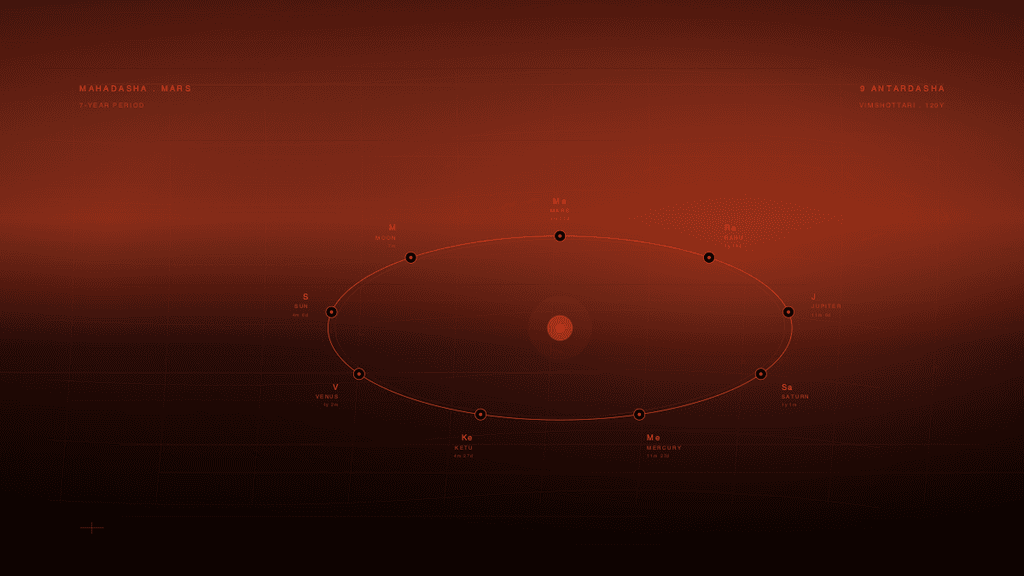
The 7-year Mars mahadasha is the classical career-summit window for Mars-in-10th natives. The mahadasha activates the placement at maximum alignment: the dasha lord (Mars) is also placed in the career house (10th). The classical reading is that this is one of the strongest possible single-placement-and-dasha alignments the Vimshottari system produces.
The most active sub-periods within Mars mahadasha for Mars-in-10th charts:
- Mars-Mars (first 4.5 months). Mahadasha-and-antardasha alignment activates the placement most directly. Defining career-summit decisions, command-rank promotions, surgical-practice-launches and entrepreneurial venture-launches concentrate.
- Mars-Sun (around year 3.5). Sun is the co-digbala planet at the 10th and the authority-axis karaka. Often produces the formal authority-recognition windows: promotions to senior leadership, public-honour events and the broader register of authority-conferral.
- Mars-Saturn (around year 5). Saturn provides structural-completion. The career-arc consolidation, institutional-position confirmation and the broader register of stable career-foundation-building.
- Mars-Jupiter (around year 1.3). Jupiter provides dharmic-axis support. When Jupiter aspects the natal 10th, this sub-period adds principle-and-recognition-axis events to the career-execution register.
The transit-confirmation layer adds Saturn transit over the natal 10th (career-consolidation), Jupiter transit over natal Mars (recognition-and-promotion), Sun transit over the natal 10th in the candidate windows. Three-layer convergence (mahadasha, antardasha, transit) produces the strongest single timing signal the framework supports.
A worked example: Cancer ascendant Mars in Aries 10th
Consider the strongest single Mars-in-10th configuration. Cancer ascendant. Mars in own sign Aries in the 10th house. Moon (the lagna lord) well-placed in own sign or in a kendra. Jupiter aspecting the 10th from the 6th or the 2nd.
The reading. Mars is yogakaraka for Cancer ascendant (rules the 5th trikona and the 10th kendra). At own house in own sign Aries, Mars carries maximum functional and natural strength. Ruchaka yoga is active (Mars in own sign in a kendra). The configuration reads as one of the chart's strongest single placements for command-rank career, surgical practice or major entrepreneurial venture. The lagna lord Moon supports public-life with people-attunement. Jupiter aspect from the 6th converts service-axis pressure into structural career-victory.
The Mars mahadasha activation. For this configuration, Mars mahadasha (7 years) often produces the defining career-summit of the chart owner's life. Command-rank military promotion, surgical practice establishment with significant patient-base, entrepreneurial venture-launch with execution-focus and major public-recognition events all concentrate. Cross-confirmation in the Navamsa (the D-9 chart) is the second-pass test: if natal Mars lands in a strong position in the D-9 (own sign Aries or Scorpio, exalted Capricorn or in a D-9 kendra), the placement carries soul-chart endorsement.
What this reading does not predict
The framework predicts structural disposition and the windows where the disposition activates most strongly. It does not predict specific job titles or organisation names. It does not predict specific promotion dates or specific recognition events. It does not predict whether the chart owner will accept any specific offer or decline any specific opportunity. The classical action-axis career-summit reading is a probabilistic structural framework, not a deterministic biographical script.
The classical caution on workplace-conflict is similarly directional. Mars-in-10th does not guarantee workplace friction. It predicts a structural disposition toward direct confrontation, which can be channelled constructively (as leadership-by-action) or destructively (as authority-conflict that damages reputation) depending on the chart owner's broader self-awareness and the modulation from Jupiter and other benefic aspects.
Calibration status
The article documents the classical Mars-in-10th reading as set out in BPHS Chapter 11 (the 10th house), the Shadbala digbala framework in BPHS Chapter 27, the Mahapurusha yoga framework in BPHS Chapter 38 and Phaladeepika Chapter 7. The Tempora calibrated signature library (Note 005) does not currently include Mars-in-10th-specific event signatures. Chart computation uses the Swiss Ephemeris with the True Pushya Paksha ayanamsa by PVRN Rao for sidereal positions. The classical readings (digbala, per-ascendant variation, dasha activation, Ruchaka yoga) are presented as the tradition's own framework rather than as Tempora calibrated output. Calibrating Mars-in-10th signatures against a labelled chart-corpus of verified military and surgical-career biographies is open work scheduled after the existing signature library is stable.
Frequently asked questions
What does Mars in the 10th house mean in Vedic astrology?
Mars in the 10th house is the classical strongest single career placement for action-oriented professions. The 10th house is the Karma Bhava (action house, Sanskrit), the midheaven of the chart and the most visible house for public standing. Mars at this position carries digbala (directional strength), meaning Mars gains additional strength simply by being placed in the 10th regardless of sign. The classical reading is career-summit-through-action: military, police, surgery, sports, real estate, engineering and entrepreneurship are the most natural career routes. Career peak typically arrives during the Mars mahadasha (7 years) for natives with this placement. Sources: BPHS Chapter 11, Phaladeepika Chapter 7.
What is digbala and why does Mars get it in the 10th house?
Digbala (Sanskrit: directional strength) is one of the six strengths in the classical Shadbala framework. Each planet gains digbala in one specific house of the chart based on the natural direction the planet represents. Jupiter and Mercury gain digbala in the 1st house (east). The Moon and Venus gain it in the 4th house (north). Saturn gains it in the 7th house (west). Mars and the Sun gain it in the 10th house (south, the midheaven). The 10th house represents action and visibility at its peak. Mars's natural register (force, courage, direct action) reaches full expression at the midheaven. The classical rule is that Mars in 10 acts at maximum strength regardless of sign dignity, though sign dignity still modulates the quality.
Is Mars in the 10th house good or bad for career?
Mars in the 10th is classically one of the best career placements for action-oriented professions. The reading is configuration-dependent in degree but consistently constructive in direction. Strongest configurations: Mars exalted in Capricorn in the 10th, Mars in own signs Aries or Scorpio in the 10th and yogakaraka Mars (Cancer or Leo ascendant) in the 10th. These produce defining career-summit charts. Even debilitated Mars in Cancer in the 10th retains digbala-strength though the warrior register operates with friction. The placement supports military officer corps, police-and-security careers, surgical practice, sports careers, real-estate development, engineering professions and entrepreneurial ventures involving direct execution. It does not suit professions requiring soft diplomacy or sustained patience.
How does the ascendant change Mars in 10th reading?
Each ascendant assigns Mars a different functional role. Cancer ascendant: Mars rules the 5th and 10th, making it yogakaraka, the strongest functional placement. Mars in own house in 10th here is the classical highest single career configuration the system produces. Leo ascendant: Mars rules the 4th and 9th, in 10th it brings 4th and 9th significations to career, often producing yogakaraka-aspect-equivalent configurations through Mars's special 4th and 8th aspects. Aries ascendant: Mars rules 1st and 8th, in 10th the self is the career. Capricorn ascendant: Mars exalted in Capricorn rises in the 10th, classical strongest dignified placement. The full table covers all 12 lagnas with the functional roles and likely career signatures.
When does the career peak for Mars in 10th house natives?
The 7-year Mars mahadasha is the classical career-summit window for Mars-in-10th natives. The mahadasha activates the career-axis placement at its most direct: the dasha lord (Mars) is also placed in the career house (10th), producing one of the strongest possible single-placement-and-dasha alignments. Within Mars mahadasha, the antardasha sub-periods of planets that aspect or connect to the 10th carry the most active windows: Mars-Mars (first 4.5 months), Mars-Sun (around year 3.5, Sun is co-digbala planet for the 10th), Mars-Saturn (around year 5, Saturn provides structural completion) and Mars-Jupiter when Jupiter aspects the 10th. The career peak also activates during Saturn transits over the natal 10th and during Jupiter transits over the natal Mars.
Does Mars in the 10th house cause arguments at work?
The classical caution applies. Mars carries the conflict register and the 10th carries public-standing. Mars in 10 can produce a combative professional temperament, direct confrontation with senior figures, episodes of workplace conflict and the broader register of friction-in-authority-relationships. Whether this reads as constructive (a leader who fights for the team, a surgeon who is direct under pressure) or destructive (a colleague who breaks relationships, a professional reputation damaged by anger) depends on Mars's dignity, aspect from benefics and the chart owner's broader self-awareness. The 10th-house Mars reading benefits from Jupiter aspect, which converts raw conflict into principled assertion. Without Jupiter modulation the conflict register operates more directly.
When is a natal Mars in the 10th house activated in 2026 to 2028?
A slow transit across the sign of the 10th house or the natal Mars degree activates the placement. A Libra ascendant holds the 10th in Cancer, reached by exalted Jupiter from 27 May 2026 and the 12 August 2026 eclipse. A Cancer ascendant holds it in Aries, entered by Saturn on 23 May 2027 with a retreat and a return by 11 February 2028. An Aries ascendant holds it in Capricorn, where Rahu sits from 27 December 2026 to 15 July 2028. Transit Mars also returns to any given sign about every two years, forming a same-planet return at the natal sign. The dates are activation windows, while the natal placement is the standing condition.
- 10th house (Karma Bhava) · full house article covering all five signification registers
- Mars mahadasha · the 7-year activation window for Mars placements
- Mars mahadasha career patterns · the career-arc signature during the 7-year period
- Mars in the 9th house · the previous house in sequence, the dharma trine
- Mars in the 11th house · the next house in sequence, the gains house
- The 12 houses cluster hub · all 12 individual houses plus classification groups
This article was prepared by Tempora Research as a planet-in-house reading article in the Houses cluster. The classical Mars-in-10th framework, digbala mechanism, per-ascendant variation table, Ruchaka yoga rule and Mars mahadasha activation rule are documented in Brihat Parashara Hora Shastra Chapters 11, 27 and 38 and Phaladeepika Chapter 7 and are presented as classical methodology rather than Tempora calibrated output. Chart computation uses the Swiss Ephemeris with the True Pushya Paksha ayanamsa. Methodology is documented in Tempora's research-publishing standards and reproducible against the public engine. Internal audit log maintained. This article does not constitute medical, financial, legal or professional advice. First published 2026-06-05 by Tempora Research.