Mars in the 9th House: Dharmic Action and Father-Line Conflict
Mars in the 9th house places the warrior in the fortune-and-dharma trine. The classical reading is action-oriented dharma: principle pursued through decisive force, philosophical conviction held with the energy of conflict, foreign-military and pilgrimage themes and a father-line marked by friction. This article walks the placement through its classical signature, the higher-education and credentialling register, the per-ascendant variation across the 12 lagnas, the Mars mahadasha timing layer and the reconciliation conditions where the framework reads differently.
The 9th house and Mars's action register
The 9th house (Bhagya Bhava the fortune house, Dharma Bhava the principles house in Sanskrit) is the strongest single trikona on the chart. It carries the father, fortune and grace that flows without proportional effort, the principles the chart owner lives by, higher learning beyond foundational education, the guru and teacher relationships, long-distance and pilgrimage travel and foreign religious or scholarly residence. The classical karaka is Jupiter (father, wisdom, dharma) with the Sun as secondary karaka for father specifically.
Mars carries the warrior register. The classical name Mangal translates as the auspicious or the bright; Kuja as son of earth. The classical mythology frames Mars as the commander of the planetary cabinet, the war-deity carrying disciplined force in service of dharmic ends. Mars rules Aries (the natural 1st house) and Scorpio (the natural 8th) and is the karaka for direct action, courage, physical vitality, surgery, real estate, military and police professions, sports and entrepreneurial drive.
When Mars enters the 9th, the warrior occupies the dharma house. The classical reading combines the two significations in a specific direction. The 9th asks what principle the chart owner lives by; Mars adds the question of how that principle gets enforced. Strong Mars in the 9th does not produce a passive holder of dharmic views. It produces a defender of those views through action: warrior-priest, dharma-litigator, principled-officer, philosopher who fights for the idea. The classical literature documents this combination as one of the constructive expressions of a malefic in a trikona.
The classical signature: decisive dharmic action
The single phrase that best captures Mars in 9th is decisive dharmic action. The 9th provides the why (the principle, the dharma, the long-arc purpose). Mars provides the how (force, directness, urgency, willingness to fight). The combination produces lives oriented toward action that has principle behind it, principles that get enforced rather than merely held and a temperament that reads injustice or principle-violation as something requiring response rather than reflection.
Practical expressions of the classical signature:
- Warrior-priest and dharma-officer. Roles that combine martial discipline with religious or principled authority. Military chaplains, dharma-council members, religious-order officers and the broader register of action-in-service-of-principle.
- Litigation and judicial work. Law as the formalisation of dharma enforced through action. Mars in 9th is one of the classical placements for prosecutors, litigators, judges with combative temperaments and any judicial role where principle gets defended through structured conflict.
- Foreign-military service. The 9th carries foreign-religious-or-scholarly residence. Mars carries the warrior register. The combination produces overseas military service, conflict-zone deployment, foreign-defence postings and the broader register of dharmic-warrior-abroad.
- Pilgrimage and far-journey action. Long-distance travel with purpose. Pilgrimage routes walked rather than bus-toured, expeditions with religious or scholarly aim and exploration-class travel that combines physical exertion with dharmic context.
- Higher-education credentialling under combat. The 9th carries higher learning. Mars adds competitive intensity. The combination produces high-achievement scholastic credentials earned through difficult examination cycles, defended through challenge rather than absorbed through transmission.
Father-line conflict: the classical caution
The 9th's father signification combined with Mars's conflict register produces the placement's most consistently flagged classical caution: friction in the father-relationship. The reading covers a range of possible expressions and is not deterministic. Soft expressions include philosophical disagreement, competitive father-child dynamics and arguments around life-direction. Stronger expressions include estrangement, defining episodes of separation and in malefic-aspected configurations major father-axis crises during the Mars mahadasha.
The variables that modulate the father-line reading:
- Mars dignity. Mars exalted in Capricorn in the 9th tends to read as constructive competitive father-line dynamics with respect-through-challenge. Mars debilitated in Cancer in the 9th intensifies the friction. Mars in own signs Aries or Scorpio in the 9th reads with stability close to the classical signature.
- Dispositor strength. The 9th-sign ruler's dignity governs the broader 9th reading and softens or intensifies Mars's effect. Strong dispositor (Jupiter well-placed for Sagittarius or Pisces on the 9th, Sun well-placed for Leo on the 9th) softens the conflict register.
- Aspect from benefics. Jupiter aspect on Mars in the 9th converts conflict into dharmic-debate dynamics. Venus aspect softens the harshness. Saturn aspect intensifies the structural friction.
- Sun position and dignity. The Sun is the secondary father-karaka. Sun in dignity (own sign Leo, exaltation Aries, in a kendra) supports father-axis even when Mars stresses it. Sun in dusthana (6, 8, 12) or debilitated in Libra compounds the friction.
The full reading sequence requires checking all four variables together. A chart with Mars exalted in Capricorn in the 9th with Saturn well-placed (Saturn rules Capricorn, so Saturn is the dispositor here) and the Sun in own sign Leo in another house reads very differently from a chart with Mars debilitated in Cancer in the 9th with Moon afflicted and Sun debilitated. Both are Mars-in-9th. The classical signature points in the same direction; the intensity and specific expression vary substantially.
Higher education and the credentialling axis
The 9th house carries higher learning beyond foundational education. Mars in the 9th puts the warrior register into the academic-credentialling axis with specific implications. The chart owner tends to pursue credentials through competitive challenge rather than through routine absorption. Examination-driven systems (medicine, law, engineering, civil service, military selection) suit the placement better than continuous-assessment systems. The high-pressure credential earned through combat suits Mars-in-9th better than the slow-accumulated credential earned through patience.
Specific manifestations in contemporary credentialling contexts: medical entrance examinations and surgical residency selection, law school entrance and bar examinations, civil service examinations including military selection processes, engineering entrance examinations with high cut-off marks and the broader register of credentials whose acquisition involves significant competitive effort. The Mars register makes these credential pathways more natural for the chart owner than they would be for placements with softer action signatures.
The combination with the 5th house (Vidya Bhava the education house in the foundational register) and the 4th house (foundational schooling) modulates the full education-axis reading. Strong 5th and 9th together with Mars in 9th read as a high-achievement scholastic life. Weak 5th with Mars in 9th may produce credentialling that comes only through difficult competitive routes rather than smooth academic absorption.
Per-ascendant variation: how the 12 lagnas read Mars in 9th differently
The classical reading shifts substantially by ascendant because each ascendant assigns Mars a different functional role. The natural significations of Mars (action, courage, warrior) remain constant. The functional significations (which houses Mars rules from a given ascendant) shift the meaning of the 9th-house placement.
| Ascendant | 9th sign | Mars rules | Classical reading |
|---|---|---|---|
| Aries | Sagittarius | 1st & 8th | Self-and-transformation lord in dharma. Action-warrior at home in fire-trikona. Strong configuration for military officers, surgeons-with-mission, transformative dharmic action. |
| Taurus | Capricorn | 7th & 12th | Partnership-and-loss lord in dharma. Mars exalted in Capricorn here is one of the strongest dignified placements. Foreign-spouse or foreign-loss-driven dharmic life. |
| Gemini | Aquarius | 6th & 11th | Service-and-gains lord in dharma. Upachaya-lord activates dharma. Strong placement for gains through principled work and victory through dharmic competition. |
| Cancer | Pisces | 5th & 10th | Yoga-karaka (5th and 10th lord) in 9th. Strongest single configuration after Leo. Buddhi-karma-dharma triangle activates. Strong dharmic public-life and creative-action recognition. |
| Leo | Aries | 4th & 9th | Yoga-karaka (4th and 9th lord) at own house in own sign. The strongest possible Mars-in-9th configuration. Father-axis activated as dharmic-action centre. Major military, judicial or dharmic-leadership chart. |
| Virgo | Taurus | 3rd & 8th | Effort-and-transformation lord in dharma. Earth-trikona placement. Strong for engineering, technical-credential lives with foreign-axis stints. |
| Libra | Gemini | 2nd & 7th | Wealth-and-partnership lord in dharma. Marakas in dharma carries classical caution but produces dharmic-wealth-axis when well-dispositorted. |
| Scorpio | Cancer | 1st & 6th | Self-and-service lord in dharma. Mars debilitated in Cancer here is the classical weakest dignified placement. Father-axis friction intensified. |
| Sagittarius | Leo | 5th & 12th | Education-and-loss lord in dharma. Mars in own friend's fire-sign Leo in fire-trikona. Strong placement for foreign higher education leading to dharmic career. |
| Capricorn | Virgo | 4th & 11th | Home-and-gains lord in dharma. Earth-axis dharmic action through property, network or family-axis. |
| Aquarius | Libra | 3rd & 10th | Effort-and-career lord in dharma. Strong configuration for principled-career-action: judicial work, military officer corps, dharmic-public-role professions. |
| Pisces | Scorpio | 2nd & 9th | Wealth-and-dharma lord at own house. Mars in own water-sign Scorpio in 9th. Dharmic-wealth combination with foreign-axis activation. |
The two strongest classical configurations are Leo ascendant (yoga-karaka at own house in own sign) and Cancer ascendant (yoga-karaka in dharma trine). Both produce major dharmic-public-life charts when supported by the broader configuration. The classical caution is strongest for Scorpio ascendant (Mars debilitated) and Libra ascendant (markaka lord in dharma) where the configuration introduces structural friction.
This placement in the transiting sky of 2026 to 2028
A natal Mars in the 9th is called forward when a slow transit crosses the sign of the 9th house or the degree Mars holds. A Scorpio ascendant has the 9th in Cancer, so exalted Jupiter from 27 May 2026 and the 12 August 2026 eclipse pass across the dharma-and-fortune axis carrying Mars. A Leo ascendant has the 9th in Aries, which Saturn enters on 23 May 2027, vacates on 4 November 2027 and re-enters on 11 February 2028. A Sagittarius ascendant has the 9th in Leo, tasted by Jupiter from 23 October 2026 and held from 19 June 2027, with Ketu present until 27 December 2026. Each of these dates an activation window rather than a settled event, with the natal Mars as the standing condition and the transit as its trigger.
Mars also returns to fire its own placement. Transit Mars comes back to any given sign about every two years, and its re-entry into the sign of your natal Mars forms a same-planet return, the classical activation of the 9th-house dharmic-action signature. The return dates the trigger, and the birth placement remains the condition.
The Mars mahadasha activation window
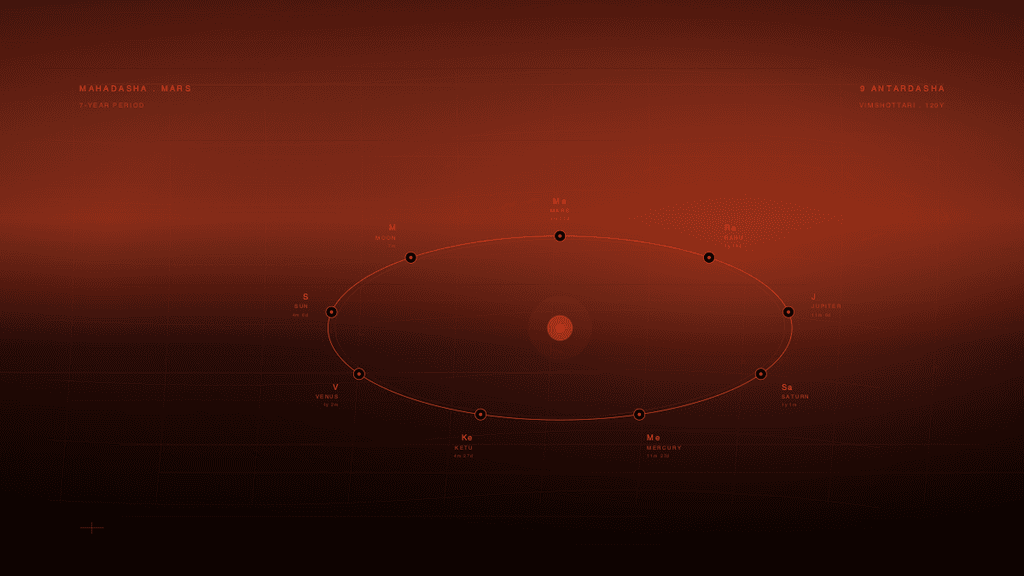
Mars in 9th events tend to concentrate during the 7-year Mars mahadasha. The full Mars mahadasha reading covers the broader activation pattern (military and surgical career-peaks, real-estate cycles, sport-and-competitive arcs); see Tempora's Mars mahadasha overview for the full framework. Within Mars mahadasha specifically for Mars-in-9th charts, the 9th-house signification register fires most strongly in the antardasha sub-periods of planets that aspect or connect to the 9th.
The most active sub-periods within Mars mahadasha for a Mars-in-9th chart:
- Mars-Mars (first 4.5 months). The mahadasha-and-antardasha alignment activates the placement at its most direct. Foreign-military deployments, defining father-axis episodes, dharmic-credential pursuits all concentrate.
- Mars-Jupiter (1 year ~3 months after start). Jupiter as natural 9th-karaka activates the dharmic register. Higher-education credentials, dharmic-cause engagements and philosophical conviction crystallisation tend to fall here.
- Mars-Sun (start ~year 3.5). Sun as secondary father-karaka activates the father-line. Defining father-axis events (positive or stressed depending on Sun dignity) tend to cluster.
- Mars-Saturn (start ~year 5). Saturn structural-pressure layer. Often produces the structural credential outcome (degree completion, professional licensure, military promotion) under sustained effort.
The transit-confirmation layer adds Jupiter and Saturn transits over natal Mars or over the natal 9th house. Three-layer convergence (mahadasha, antardasha, transit) produces the strongest single timing signal the system supports.
A worked example: Leo ascendant Mars in Aries 9th
Consider the strongest single Mars-in-9th configuration. Leo ascendant. Mars in own sign Aries in the 9th house. Sun (the lagna lord) in Leo or in another kendra. Jupiter aspecting the 9th from the 5th or the 1st.
The reading. Mars is yoga-karaka for Leo ascendant (rules the 4th and 9th, both kendra and trikona). At own house in own sign Aries, Mars carries maximum functional and natural strength. The configuration reads as one of the chart's strongest single placements for dharmic public life. Military career, judicial career, dharmic-leadership career and high-achievement scholastic credentialling are all directly supported.
The father-line reading. The classical caution applies but is substantially softened by Mars's own-sign dignity and by the strength of the Sun (which rules the lagna and is the father-karaka). The friction tends to read as competitive father-line dynamics with respect-through-challenge rather than as estrangement.
The Mars mahadasha activation. For this configuration, Mars mahadasha (7 years) often produces the defining career peak in dharmic-public-role profession. Military promotion to commanding-officer rank, judicial appointment to a senior bench, dharmic-leadership role acquisition all concentrate. Cross-confirmation in the Navamsa (the D-9 chart) is the second-pass test: if natal Mars lands in a strong position in the D-9 (own sign, exalted or in a kendra of the D-9 with the Navamsa lagna), the placement carries soul-chart endorsement and the reading is at its most reliable.
What this reading does not predict
The framework predicts structural disposition and the windows where the disposition activates. It does not predict specific father-axis dates or causes of any specific father-line event. It does not predict specific career titles or specific examination outcomes. It does not predict whether the chart owner will marry, when they will marry or whom they will marry. The 9th-house dharmic-credential and foreign-military registers are the placement's primary classical activations; everything else requires reading from other houses, other karakas and other dasha layers.
The classical caution on father-line conflict is a probabilistic structural reading, not a verdict on any specific relationship. Charts with Mars in 9th can and do produce harmonious father-relationships when the dispositor and Sun are strongly placed and the broader configuration supports it. The classical signature points in a direction; the specific outcome requires the full chart reading.
Calibration status
The article documents the classical Mars-in-9th reading as set out in BPHS Chapter 11 (the 9th house), the planetary-significations register of Phaladeepika Chapter 7 and the position-specific readings of Sarvartha Chintamani. The Tempora calibrated signature library (Note 005) does not currently include Mars-in-9th-specific event signatures. Chart computation uses the Swiss Ephemeris with the True Pushya Paksha ayanamsa by PVRN Rao for sidereal positions. The classical readings (per-ascendant variation, dasha activation rule, father-line caution) are presented as the tradition's own framework rather than as Tempora calibrated output. Calibrating Mars-in-9th signatures against a labelled chart-corpus of verified military-career and judicial-career biographies is open work scheduled after the existing signature library is stable.
Frequently asked questions
What does Mars in the 9th house mean in Vedic astrology?
Mars in the 9th house places the warrior in the fortune-and-dharma trine (Bhagya Bhava in Sanskrit). The classical reading is action-oriented dharma: principles pursued through decisive force, philosophical or religious convictions held with the energy of conflict. Practical manifestations include foreign-military service, pilgrimage and long-distance travel for cause, higher-education credentials earned through competitive effort, work in law and judicial-axis professions and a father-line marked by friction. The 9th is the strongest trikona on the chart and Mars in this trine activates the action-axis through dharmic themes. Sources: BPHS Chapter 11, Phaladeepika Chapter 7.
Why does Mars in the 9th house produce father-line conflict?
The 9th house is the primary significator for father in classical Parashari teaching. Mars is the karaka of conflict and direct force. When Mars occupies the father-house, the classical reading is friction in the father-relationship: arguments around principle, disagreement on life-direction, episodes of separation or estrangement and in malefic-aspected configurations, defining father-axis crises during Mars mahadasha. The reading is not deterministic. Strong dispositor (Jupiter or Sun well-placed) softens the conflict into competitive-but-respectful father-line dynamics. Weak dispositor or additional malefic aspect intensifies it. The classical caution applies particularly when Mars is debilitated in Cancer or in the 9th of a chart where the 9th-lord is afflicted.
Is Mars in the 9th house good for foreign-military or law careers?
Yes. Mars in the 9th is one of the strongest single placements for foreign-military service, law-and-judicial professions and any career that combines decisive force with principle. The 9th carries long-distance travel and foreign residence as dharmic activity; Mars carries the action register. The combination reads as warrior-on-foreign-soil or law-officer-defending-principle. Common career manifestations: military officer corps with overseas deployment, judicial service, prosecution and litigation, religious-axis law (canon law, sharia courts, dharma councils), foreign-aid and conflict-zone work, sports careers with international competition and any profession that travels far for cause.
How does the ascendant change the reading of Mars in 9th?
Each ascendant places a different sign on the 9th and assigns Mars a different functional role. Aries ascendant: Mars rules the 1st and 8th, in the 9th it links self-and-transformation to fortune-and-dharma, strong placement for warrior-priests and military leaders. Taurus ascendant: Mars rules 7th and 12th, in 9th it links partnership-and-loss to dharma, often foreign-spouse or foreign-loss-driven dharmic life. Cancer ascendant: Mars rules 5th and 10th, in 9th it forms a strong dharma-karma-buddhi triangle, one of the best placements for high public-dharmic achievement. Leo ascendant: Mars rules 4th and 9th, in 9th it is yogakaraka-at-own-house, the strongest single configuration for the placement. The full table covers all 12 lagnas.
Which dasha activates Mars in the 9th house events?
The 7-year Mars mahadasha is the primary activation window. Major life events in the 9th house register (foreign-military service, pilgrimage, higher-education credential, father-axis crisis, philosophical conviction crystallisation) tend to concentrate during the Mars mahadasha and within it during the antardasha of planets that aspect or connect to the 9th. The classical reading also activates during the mahadasha of the 9th lord, the antardasha of Mars within any larger mahadasha that connects to the 9th and during major transits of Saturn and Jupiter over the natal 9th house or over natal Mars. Three-layer activation (dasha plus transit plus antardasha) produces the most reliable timing signal.
Is Mars in the 9th house considered a malefic placement?
The classical reading is mixed. Mars is a natural malefic and the 9th is a trikona (the strongest trine on the chart). Malefic in trikona carries the classical caution: it can stress the trikona's significations or activate them through difficulty. But Mars's action register is constructive when the dharmic context channels it: warrior-priest, dharma-defender, principled-litigator are all strong Mars-in-9th expressions. The reading is configuration-dependent. Strong dispositor and benefic aspect produce the high-achievement dharmic-warrior chart. Weak dispositor or malefic aspect produces father-conflict and dharmic-axis turbulence. The single rule is that Mars in 9th is rarely passive: the dharmic axis activates through action one way or another.
When is a natal Mars in the 9th house activated in 2026 to 2028?
A slow transit across the sign of the 9th house or the natal Mars degree activates the placement. A Scorpio ascendant holds the 9th in Cancer, reached by exalted Jupiter from 27 May 2026 and the 12 August 2026 eclipse. A Leo ascendant holds it in Aries, entered by Saturn on 23 May 2027 with a retreat on 4 November 2027 and a return on 11 February 2028. A Sagittarius ascendant holds it in Leo, reached by Jupiter from 23 October 2026 and 19 June 2027 with Ketu until 27 December 2026. Transit Mars also returns to any given sign about every two years, forming a same-planet return at the natal sign. The dates are activation windows, while the natal placement is the standing condition.
- 9th house (Bhagya Bhava) · full house article covering all six signification registers
- Mars mahadasha · the 7-year activation window for Mars placements
- Mars in the 10th house · the next house in sequence, the digbala placement
- The 12 houses cluster hub · all 12 individual houses plus classification groups
- Mars-ruled nakshatras · Mrigashira, Chitra, Dhanishta and Mars's nakshatra-level signature
This article was prepared by Tempora Research as a planet-in-house reading article in the Houses cluster. The classical Mars-in-9th framework, per-ascendant variation table and Mars mahadasha activation rule are documented in Brihat Parashara Hora Shastra Chapter 11, Phaladeepika Chapter 7 and Sarvartha Chintamani and are presented as classical methodology rather than Tempora calibrated output. Chart computation uses the Swiss Ephemeris with the True Pushya Paksha ayanamsa. Methodology is documented in Tempora's research-publishing standards and reproducible against the public engine. Internal audit log maintained. This article does not constitute medical, financial, legal or professional advice. First published 2026-06-05 by Tempora Research.