Mars Mahadasha Mercury Antardasha: the sharp-debate combat window
The Mercury antardasha holds the fifth position in the seven-year Mars mahadasha and opens at the cycle's exact midpoint. It takes over from the Saturn antardasha, thirteen months of slow structural grind, and swaps that weight for Mercury's speed: negotiation, writing, trade and argument. The classical relationship is lopsided, since Mars counts Mercury an enemy while Mercury holds Mars as neutral, and the texts read that asymmetry as a period in which force keeps trying to settle questions that want analysis instead. The assigned texture is sharp-tongued and commercial, productive where the native lets the merchant lead and abrasive where the soldier insists on leading. A dignified natal Mercury turns the year toward contracts, publication and quick commercial wins; an afflicted one inclines it toward disputes, misfired words and deals reopened after signature.
Where the sub-period falls in the Vimshottari sequence
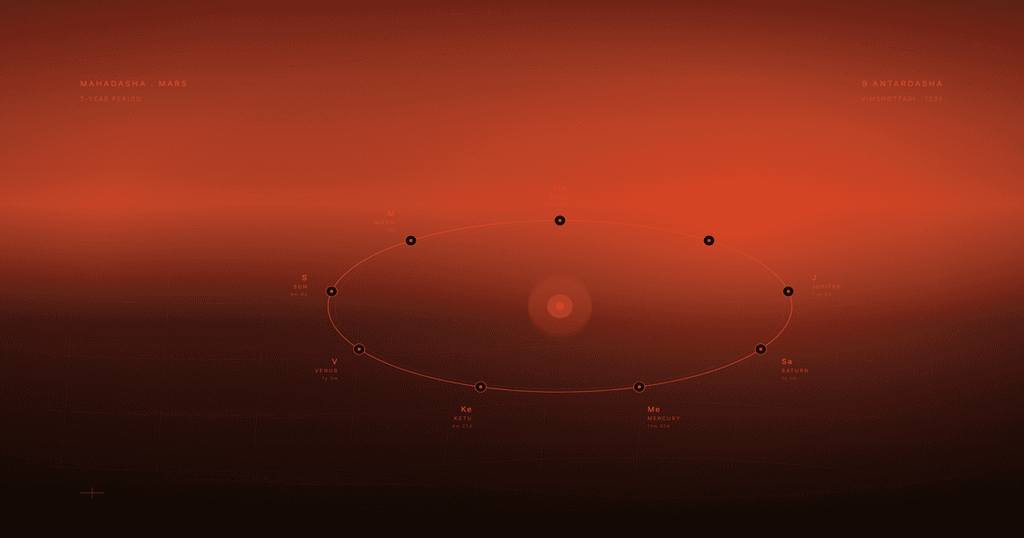
The 7-year Mars mahadasha divides into nine antardasha sub-periods in fixed Vimshottari order starting with Mars itself. The Mercury sub-period sits at position 5 of 9. Exact start and end dates for any chart can be computed from the natal Moon nakshatra-pada and the date of Mars mahadasha onset. The Tempora dasha engine produces this to the day.
The arithmetic of this period
Mercury holds 17 years of the 120-year Vimshottari cycle and Mars holds 7, so the Mercury antardasha inside the Mars mahadasha runs 7 × 17 / 120 = 0.99 years, which is 11 months and about 27 days, three days short of a full year. Four sub-periods precede it: Mars 4 months 27 days, Rahu 1 year 18 days, Jupiter 11 months 6 days and Saturn 1 year 1 month 9 days. Those four sum to 42 months exactly, half of the 84-month mahadasha, so the Mercury antardasha opens the second half of the cycle to the day and runs from three and a half years in to just short of four and a half.
The position shapes the reading. An antardasha that opens a mahadasha's second half inherits everything the first half established, which for Mars means momentum already spent on expansion and consolidation; Mercury's year then tends to go to negotiating, documenting and trading on what exists rather than launching from nothing. The same lord placed second in the sequence would be drafting plans instead of contracts. It also matters what comes next: the abrupt Ketu antardasha of 4 months 27 days follows immediately, so agreements left half-negotiated at the close of Mercury's year tend to be cut rather than completed. The complete sequence sits in the Mars mahadasha overview, and Mercury's own seventeen-year major period is treated in the Mercury mahadasha page.
BPHS and Phaladeepika on this period
Both source texts leave a record on this pairing, and BPHS gives the longer one. The BPHS antardasha chapters, Mars mahadasha section, promise pious company, reputation, diplomacy, conveyances, cattle and agricultural success when Mercury holds a kendra or trikona from the lagna, and ambitions fulfilled with authority near the ruler when it is exalted or well placed from the dasha lord. The same chapter turns dark for a debilitated or combust Mercury in the 6th, 8th or 12th, listing heart disease, imprisonment, loss of kin and destroyed wealth. It even cautions against Mercury sitting with the dasha lord itself, assigning foreign journeys, multiplied enemies and quarrels to that conjunction.
Where Mercury carries maraka lordship the text notes the possibility of serious illness and prescribes the Vishnu Sahasranama with charity as the remedial measure. Phaladeepika's sub-division chapter assigns enemy fear, cattle loss and harassment from the king, close kin to the adverse BPHS branch. The dasha engine takes these positions as raw classical inputs and resolves them against the natal chart before anything reaches a reading.
Friendship status and pairing reading
In the classical Parashari friendship matrix, Mars views Mercury as enemy. The enemy-pair classification means the 11 months 27 days sub-period classically delivers outcomes through friction between Mars's register (action, courage, brothers, surgery, property and the warrior register) and Mercury's register (intelligence, communication, commerce, writing and the youthful-skill register). Classical guidance suggests sustained-effort and patience over decisive-action during enemy-pair sub-periods. Events surface through the friction rather than around it.
The Mercury karaka overlay
Mercury is the karaka of intelligence, communication, commerce, writing and the youthful-skill register. Across the 11 months 27 days sub-period, this karaka set overlays on top of Mars's 7-year action, courage, brothers, surgery, property and the warrior register register. The combined reading is the central output of the sub-period.
How Mercury's natal dignity shapes the reading
Mercury's natal sign and house set the floor for the 11 months 27 days sub-period. Mercury at exaltation gives the strongest reading. Own-sign and mooltrikona placement gives clean expression. Debilitation introduces friction that the sub-period must work through. Combust and retrograde state, conjunctions with malefics or benefics and the dispositor's strength all further modulate the reading. See the Mercury mahadasha overview for the per-dignity breakdown.
Event classes typical to Mars-Mercury sub-period
The 11 months 27 days Mars mahadasha Mercury antardasha typically surfaces events across these specific domains:
- Friction between Mars-register and Mercury-register: enemy-pair sub-periods classically require careful navigation. Events surface through the friction rather than around it.
- Events in Mercury's natural karaka domain: intelligence, communication, commerce, writing and the youthful-skill register.
- Events specific to the natal house Mercury occupies in the chart.
- Events where the Mars-mahalord and Mercury-antarlord houses (both natal and ruled) interact (aspect, mutual reception or natal conjunction).
Transit confirmation protocol
The sub-period reading sets a structural pressure floor of 11 months 27 days. Specific event timing inside that window requires the pratyantara (sub-sub-period) overlay and a transit cross-check.
Two transit overlays do most of the work. The standard targets to track: transit Mars aspecting natal Mercury, transit Mercury through the natal 3rd or 9th house, transit Saturn aspecting natal Mercury during a writing or commercial-deal phase, transit Mercury retrograde windows that frequently coincide with editing or contract-revision phases. These transits intensify the Mars-Mercury dynamic within the broader sub-period and concentrate event timing on those windows.
The pratyantara (sub-sub-period) inside the antardasha gives finer timing. The Mars-Mercury-Mars pratyantara (about 3 months 17 days) and the Mars-Mercury-Mercury pratyantara (about 3 months 27 days) carry the most concentrated articulation signal within the 27-month sub-period. The Mars-Mercury-Saturn pratyantara (about 4 months 9 days) reads as the formalisation window where written work gets institutional recognition. Cross-checking the pratyantara against the transit overlay gives event timing to the week. Tempora's dasha engine produces this data to the day for any chart.
This period against the 2026 to 2028 sky
Neither Mars nor Mercury carries a dated station in the engine's 2026 to 2028 transit calendar, so this sub-period is located through the chart rather than through the news. Finding it takes two inputs: the natal Moon's nakshatra and pada, which fix where the 120-year cycle begins, and the onset date of the Mars mahadasha, from which the antardasha boundaries follow by the arithmetic above. The free computed reading on this page runs that calculation for a birth date, time and place and returns the exact start and end dates. Whether the period is running now or years away, the natal condition of Mercury remains the first thing to read it against.
What the framework does not predict
The Mars-Mercury reading is structural. It flags a 12-month window where the conditional probability of three named event classes lifts above chance, but it does not predict that any specific native will experience a specific event inside that window, nor the direction of any event that does fire.
A publication or commercial-expansion event during the sub-period can read as the turn that establishes the native's articulated voice or as a high-volume output phase whose individual pieces are forgotten; the broader chart determines durability. The framework times the pressure, not the result and timing finer than the antardasha band needs the pratyantara sequence and the transit overlay for the date in question.
How this connects to the broader Mars Mahadasha
The Mars-Mercury sub-period is the fifth antardasha inside the 7-year Mars Mahadasha. Reading the sub-period in isolation captures the 11 months 27 days; reading it inside the Mahadasha gives the broader arc that places the action meets articulation reading in its proper structural context.
The Tempora Mars Mahadasha method article covers the dispositor analysis, natal-house framework and the broader 6-year texture that this sub-period sits inside. The conditional probability framework holds across the full series: each antardasha is a flagged window for specific event classes whose probability is elevated relative to chance.
Frequently asked questions
How long is the Mars Mahadasha Mercury Antardasha and where does it fall in the Vimshottari sequence?
The Mars Mahadasha Mercury Antardasha runs 11 months 27 days. It is the fifth antardasha inside the 7-year Mars Mahadasha, opening after the Mars-Saturn antardasha (1 year 1 month 9 days). The full sequence inside the Mars Mahadasha runs Mars-Mars, Mars-Rahu, Mars-Jupiter, Mars-Saturn, Mars-Mercury, Mars-Ketu, Mars-Venus, Mars-Sun and Mars-Moon. Exact start and end dates can be computed from the natal Mars nakshatra-pada and the date of Mars Mahadasha onset.
What does Mercury signify in this sub-period and why does it read as action meets articulation?
Mercury is the karaka of speech, intellect, commerce, business, writing, analysis, communication, education, youthful expression. During the broader Mars Mahadasha's action and will reading, Mercury contributes the sharp-debate overlay. The sub-period sits at the fifth position in the antardasha sequence and reads as the Mars action and will register meeting Mercury's intellect, speech, commerce and analysis significations.
How does Mercury's natal dignity shape the Mars-Mercury sub-period reading?
Mercury's natal house, sign and aspectual state set the floor for the 12-month sub-period. Mercury exalted in Virgo, in own sign Gemini or Virgo or in angular houses (1st, 4th, 7th, 10th) softens the reading toward more auspicious outcomes. Mercury debilitated in Pisces introduces friction. Aspects from Saturn bring sustained structural pressure; aspects from Mars bring competitive or confrontational pressure.
What kinds of events historically correlate with the Mars-Mercury sub-period?
Three event classes correlate. Authorship and publication events: Books, long-form essays, formal teaching content, public-facing articulation milestones. The Mars-Mercury sub-period is the most concentrated authorship window in the entire 7-year Mars Mahadasha. The. Business and commercial growth events: Contract signings, partnership deals, business expansion through communication, client acquisition, product or service launches that depend on messaging. Founders, advisors and commercial professional. Education milestones: Degrees awarded, formal courses completed, learning programmes entered or finished, scholarly publications. The Mercury student function activates inside Mars authority function, often producing the s. The framework reads these as a structural-pressure window for the event class, not a deterministic predictor.
How does this sub-period connect to the broader Mars Mahadasha?
The Mars-Mercury sub-period is the fifth antardasha inside the 7-year Mars Mahadasha. It opens after the Mars-Saturn antardasha (1 year 1 month 9 days). The sub-period reading is best held in tandem with the broader Mars Mahadasha reading from the Tempora Mars Mahadasha method article, which covers the natal house and dispositor framework that sets the texture of the full 16 years.
What does the Tempora framework not predict about this sub-period?
The framework identifies a structural-pressure window of approximately 11 months 27 days. It does not predict whether a specific native will experience a specific event in that window. It does not predict outcome direction. It does not predict timing finer than the sub-period band without overlaying the pratyantara (sub-sub-period) and the transit overlay for the date in question. The readings carry conventional weight from classical literature; the framework treats them as structural-pressure flags to cross-check against transit data.
Why is the Mars-Mercury antardasha three days short of a year?
The Vimshottari constants give Mercury 17 of the 120 cycle years and Mars 7, so the antardasha is 7 multiplied by 17 divided by 120, which is 0.99 years or 11 months 27 days. A full year would need the product of the two lords' shares to reach 120, and 7 multiplied by 17 is 119. The shortfall is why the period reads on paper like a year yet closes slightly early against the calendar.
How do I find the exact dates of my Mars-Mercury antardasha?
Two inputs fix them: the natal Moon's nakshatra and pada at birth, which set where the Vimshottari cycle opens, and the onset date of your Mars mahadasha. From that onset, the Mercury antardasha begins after the first four sub-periods, exactly 42 months in, and runs 11 months 27 days. The computed reading on this page produces the dates to the day from a birth date, time and place.
What do the classical texts say about Mars-Mercury?
The BPHS antardasha chapters, Mars mahadasha section, assign reputation, diplomacy and agricultural success to a strong Mercury and heart disease, imprisonment and destroyed wealth to a weak or afflicted one, with a caution and prescribed remedy where Mercury holds maraka lordship. Phaladeepika's chapter on sub-divisions lists enemy fear, cattle loss and harassment from the king, matching the adverse branch. The engine takes these as classical inputs and resolves them against the natal chart.
Read next
- Mahadasha: the nine-period Vimshottari framework · the broader cluster this sub-period sits inside
- Mars Mahadasha Ketu Antardasha · the next sub-period in the Vimshottari sequence
- Venus Mahadasha Mercury Antardasha · the complementary sub-period in the prior Mahadasha
- Jupiter Mahadasha Mercury Antardasha · the same antardasha planet in a different Mahadasha
- Mahadasha and Vimshottari planetary periods · the full nine-period framework
- Calibrated lift: the discipline that turns Vedic astrology into research
This article represents conventional Vedic teaching and Tempora Research method documentation. It does not constitute financial, legal or professional advice. Internal audit log maintained.